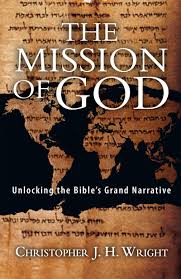
The Mission of God by Wright

book mission god

Christopher J. H. Wright is an author who never disappoints. Though he has written commentaries, theological works, and Bible studies, this book on the mission of God now available in paperback is likely his most influential. In fact, his specialty on the mission of God elevates all those other books that he has written, but this one is where he makes his grand case that the narrative of the Bible has mission as its overarching theme. You will likely agree when you take in what he has said.

This book succeeds on so many levels that you might debate where to put it on your shelves. There’s the obvious choice of your mission section, but then you may wonder if it should be among your Bible theology or even Bible survey sections. Finally, it could hold its head high among titles in your deeper theology section too. That is not to say the book is unfocused, but that its explanation of the broad sweep of the Bible gets the job done from all those various vantage points.

The book is divided into four parts: the Bible and mission, the God of mission, the people of mission, and the arena of mission. As you can see, that begins in championing mission as the proper hermeneutic, continues to see God’s hand in mission, followed by the final two parts looking at the Bible from beginning to end and seeing how it sticks without wavering to God on mission. At over 500 pages, it is never shallow nor possessing omissions while never bogging into minutia either.

I’ve always felt that Wright could hold his own with any scholar while outpacing most of them on spirituality. You will see that here. This book will be the top of its class on this subject for decades to come and no Bible student should be without it.

I received this book free from the publisher. I was not required to write a positive review. The opinions I have expressed are my own. I am disclosing this in accordance with the Federal Trade Commission’s 16 CFR, Part 255.
The Ten Commandments (I) by Patrick Miller


 book ten comm.jpg 

Perhaps you are familiar with volumes in the Interpretation Bible Commentary (IBC) series on various books of the Bible. Those volumes don’t dig too deep in exegesis but excel at providing theological implications within the text. Though that theology is much more liberal than my thinking, I’m often challenged to think of things that I would have otherwise overlooked. I’ve discovered that the Interpretation series has additional volumes on a variety of scriptural topics like this one on the 10 Commandments. What has surprised me when I picked up this volume by Patrick Miller is the depth of content that really unpacks these commandments while still pointing out the theology this series loves.

With every commandment studied Miller explains the commandment in depth, what it means, how it has been applied, the moral issues involved, and how it relates or is expanded to other Scripture. My only complaint is the occasional sentence that totally capitulates to modern progressive norms. The wise Bible student can get around those because this volume digs out too much needed information to miss.

This book impresses me. I can’t imagine ever studying the 10 Commandments as a whole or one of the individual ones without consulting this book in the future. I rank it higher than any IBC I have ever used. I’d even call it the ideal place to begin for study of the 10 Commandments.

I received this book free from the publisher. I was not required to write a positive review. The opinions I have expressed are my own. I am disclosing this in accordance with the Federal Trade Commission’s 16 CFR, Part 255.
1 & 2 Kings (NIVAC) by Konkel

book kings nivac.jpg

Professor August H. Konkel produced this commentary on 1&2 Kings in the New International Version Application Commentary (NIVAC) series. Its greatest strength lies in what the series itself aims at: application for our day. Without doubt, the scholarship that undergirds the work is solid, but the scholarly issues that he makes his focus might be less helpful than if he had, say, dove more deeply in the structure or broad themes of the book.

In fact, it is in the introduction that this becomes clear. Perhaps I overgeneralize, but he makes the theme of his introduction that of the Books of Kings being Deuteronomic history.  That emphasis almost exclusively thinks in terms of genre and composition. Even his review of the “prophetic character of Kings” is viewed from that rubric. I feel that there are clearly better options to serve as an overall guide for Kings. If you are of his mind, you will probably rank this volume as “great”.

Despite that caveat, I still can fully recommend this book for its commentary and application. Maybe I’m crazy, but somehow he reminded me of John Walton who has also written in this series. The book increases in value, too, when you consider how few volumes guide us in that last link of the chain called application.

For the record, what was slightly annoying in the introduction was in no way overwhelming in the commentary proper. I should stress again that the scholarship itself is well done. I see much evidence of careful study and thoughtful reflection. He is never trite or trivial, so you will get plenty of needed help for this often-neglected portion of Scripture.

While there are a few volumes in the NIVAC series that I enjoyed a little more, this commentary is a solid effort that I without hesitation recommend for your library.

I received this book free from the publisher. I was not required to write a positive review. The opinions I have expressed are my own. I am disclosing this in accordance with the Federal Trade Commission’s 16 CFR, Part 255.
Colossians & Philemon (BECNT) by G.K. Beale

book col phi bec

Veteran commentator G. K. Beale strikes gold in this commentary on Colossians and Philemon in the Baker Exegetical Commentary on the New Testament (BECNT) series. From the onset, Beale explains that he hopes to make a distinct contribution to Old Testament allusions in Colossians (Philemon has too few to really qualify). Strangely enough, though he handles those allusions with care and thoughtfulness, it is the exegesis itself that compels me to rate it highly. The well-reasoned conservative conclusions, the passion for Scripture, and the guidance offered throughout are what most stands out in this newly released commentary. He will tell you what other scholars have thought yet has a knack for interacting without endlessly droning on. At 500 pages it is not as bulky as some of the modern exegetical commentaries but it still delivers everything that you’re looking for regarding exegesis. Scholars will be quoting it in the future while pastors can use it practically for real help with the text.

His introduction to Colossians first addresses authorship. As you are probably aware, a certain segment of scholarship has been attempting to take Colossians away from Paul for many years. I loved how Beale fairly addresses the arguments for all non-Pauline positions while knocking the props out from under them with the skill that only a seasoned commentator could muster. To my mind, he could be a template for any of the Pauline epistles that are questioned or attributed to pseudonymity.  Next, he well explains the background both of the letter and its historical setting. He proves that he is, in fact, going to be dedicated to working out all the Old Testament allusions to be found in the letter. He mentions the relationship of Colossians to Ephesians and provides a detailed outline of the book. Perhaps the weakest aspect of this introduction is that of structure. Pretty much he just shares the divisions that some other prominent scholars propose.

The commentary itself is excellent. Again, there’s real help on every passage. Just in case you’re not as interested in his beloved Old Testament allusions as he is, he kindly provides those as additional notes at the end of every section.  I checked several passages that I had either studied a great deal or knew might be controversial and really appreciated his contributions.

Though I preferred his Colossians to his Philemon, he did offer some real help both in the short introduction and commentary on Philemon.

This commentary immediately becomes a Top-3 commentary for what’s available today on Colossians and Philemon.

I received this book free from the publisher. I was not required to write a positive review. The opinions I have expressed are my own. I am disclosing this in accordance with the Federal Trade Commission’s 16 CFR, Part 255.
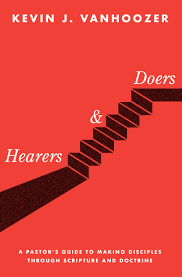
Hearers & Doers by Kevin Vanhoozer

book hear do.png

Kevin Vanhoozer is one of our sharpest theological minds today. He so often breaks into territory that no one else tackles. He may wrestle with a multitude of heavy theological works, but he is the guy to bring it to the rest of us. Since his latest subject here is that of making disciples, particularly from a pastor’s point of view, and since there’s a glut in the market on discipleship, he shows the league apart that he works in amongst a world of works that all say the same thing. Make room among all the dime-a-dozen discipleship titles on your shelves for this provocative volume to have a prominent place. This book is one for a pastor to lay as a foundation for our work. The subtitle accurately lets you know what you are getting yourself into: A pastor’s guide to making disciples through Scripture and doctrine.

After a clear introduction, Part One that is made up of four chapters explains why discipleship matters. He champions the importance of theology in making disciples. Chapter 2 is so profound that it could be pulled out of this book and presented as commentary on our age, at least involving fitness and body image which has taken on its own religious pretensions. I shared that chapter with some in my family as making clear things that I was ashamed I had never thought of. The next chapters explain the importance of taking disciples from hearing to doing and in building up the body of Christ.

Part Two in four more chapters digs into working out discipleship. Pastors should be challenged by his analogy of our being the eye doctor and general practitioner of the church. Next, he looks at the disciple as a member of the church, which is sadly so de-emphasized in our day. I found myself not fully agreeing with all he said in the chapter on the communion of saints, but there are some fair correctives there that may keep us from running off into the other ditch. The final chapter, wisely, looks at us as children of God who are disciples as “fitting image of Jesus Christ”.

You can often judge how much I find value in a book by how much I underline and notate throughout. My volume of this book is marked all over with usually something on every page. This book is for those who want to think, so pick it up and read slowly and you will be in for a treat.

I received this book free from the publisher. I was not required to write a positive review. The opinions I have expressed are my own. I am disclosing this in accordance with the Federal Trade Commission’s 16 CFR, Part 255.
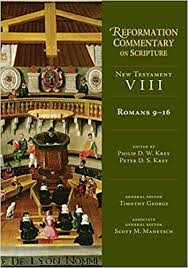
Romans 9-16 (RCS), edited by Philip and Peter Krey

book rcs rom 9.jpg

Romans 9 is one of the key chapters of Reformation thinking, so this volume covering chapters 9-16 is pivotal in the Reformation Commentary on Scripture (RCS) series. Since this volume has been released, an additional volume covering Romans 1-8 has also come out giving us an extraordinary resource in Reformation views on this key book of the New Testament. In this volume (9-16), two Lutheran professors, who happen to be brothers, Philip D. W. Krey and Peter D. S. Krey, culled all of Reformation commentaries to create this fine resource. These two were even raised by a Lutheran pastor, so they have lived in Reformation thinking their entire lives. They certainly have the credentials to assemble this volume of the best that Reformation commentators have to offer. To my mind, they have succeeded.

Their introduction to Romans 9-16 shows their understanding of the issues that were at the heart of Reformation thinking. In our day, many of us would label those views as Calvinist views, though they give the most kudos to Augustine and Luther. They do, however, quote Calvin in several places throughout the commentary itself. It’s clear these editors agree with those they quote in many cases. In that introduction, they will speak of predestination, double predestination, single predestination and offer an excursus on Erasmus and the freedom of the will as well as opposing views that they label as conditional predestination. Still, they get into other key issues that they label the call of the nations, the ministry of the word, and Christian ethics. All in all, it was well done.

The commentary itself is of the quality that I have so far found in every volume in this series that I have reviewed. There is likely an overabundance of primary material to sift through with corresponding choices to be made for what best represents Reformation thinking to share in this volume, but they appear to me to have done an excellent job. I feel one could easily get a full grasp of what the reformers thought about most passages in Romans 9-16 in this compilation. If you grab the one that’s now released on Romans 1-8, you will have a resource well worth having and consulting for this mountain peak of Scripture called Romans.

I received this book free from the publisher. I was not required to write a positive review. The opinions I have expressed are my own. I am disclosing this in accordance with the Federal Trade Commission’s 16 CFR, Part 255.
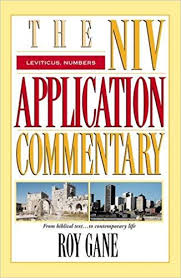
Leviticus, Numbers (NIVAC) by Roy Gane

book lev num nivac.jpg

This volume on Leviticus and Numbers by Roy Gane is easily one of the best in the NIVAC series. While the value of Leviticus in this book might surpass that of Numbers in my estimation, you will receive real help on both. The writing is so engaging, the passion so evident, and rather than apologize for the Bible Mr. Gane wisely counsels us to put our own modern culture on trial. On more than one occasion, he finds that we ultimately struggle with the same problems they once did. If the goal of the NIVAC series is to provide a scholarly explanation of the text and then take it on to modern application, then this volume has succeeded in spades. I can’t recall what is admonished in Leviticus ever having been more profitably related to our day than what you will find here.

I was thoroughly impressed with all that was nicely explained in the 13 pages of the introduction to Leviticus. The big picture, the relationship to the New Testament, and a careful case made for Leviticus being something more than legalism was made clear. There’s a brief pass at authorship (God, then mostly Moses) before an exceptional section on structure and themes. I’ve read many thick exegetical commentaries that were far less helpful on structure than what you find here. I felt the introduction to Numbers was not as well-done as that of Leviticus, but what you read there is all helpful.

The best value of all will be found in his explanation of the details of Leviticus. Without doubt, many struggle here. Again, it appears that the normal design of a NIVAC commentary (original meaning, bridging context, and contemporary significance) fit Mr. Gane like a glove. Some commentaries in this series will often either shortchange bridging context or contemporary significance, but I was pleasantly surprised to find something truly helpful in every one of those sections. The volume was more conservative than I expected while the engaging style exceeded any expectations I would’ve had for a volume on Leviticus! If you would like to see if I am reviewing accurately, find some obscure subject in Leviticus and go read what Mr. Gane has to say about it. If you will do that, you will agree with me.

I received this book free from the publisher. I was not required to write a positive review. The opinions I have expressed are my own. I am disclosing this in accordance with the Federal Trade Commission’s 16 CFR, Part 255.
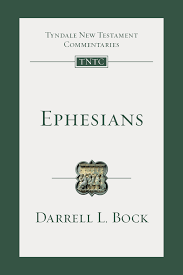
Ephesians (TNTC) by Bock

book eph tntc

This latest release in the Tyndale New Testament Commentary (TNTC) series has snagged yet another top-flight scholar. Darrell Bock tackles Ephesians here after his major works on Luke, Acts, and the historical Jesus. In case you weren’t aware, his two-volume commentary on Luke in the BECNT series is often rated as the best exegetical work we have on that book. Though he branches away from his normal work in this effort to grapple with a Pauline epistle, his credentials are clearly up to the mark. TNTC targets an audience below those major exegetical works though its scholarship is always top-notch. It seems to me that Mr. Bock understood the aims of the TNTC series and brought us an excellent work within those parameters.

After a select bibliography of a few pages, Bock jumps into his introduction. He begins with explaining the importance of Ephesians which many find to be a mountain peak within Pauline writings. He goes on to explain destinations of the letter with plenty of background on the city of Ephesus before he gets into several issues involving authorship. When he enters a more formal discussion of authorship and date, he explains vocabulary and style and theological issues within Ephesians. He doesn’t find enough evidence to deny Paul authorship.

After a brief outline, Bock enters the commentary section that makes up the bulk of the book. For each passage, he gives context, before entering into commentary itself for each verse. There’s also a paragraph or so on the theology of the passage. In my estimation, he makes the reader fully aware of the issues and what the passage is trying to say to us. For example, I thought he handled the Household Code with skill and grace. He stayed true to the text concluding a conservative position yet wrote in a way that would not be overly antagonistic to someone of a different persuasion. The quality of commentary remained throughout.

Pastors, teachers, and Bible students will appreciate the fine help this commentary provides. I recommend it.

I received this book free from the publisher. I was not required to write a positive review. The opinions I have expressed are my own. I am disclosing this in accordance with the Federal Trade Commission’s 16 CFR, Part 255.
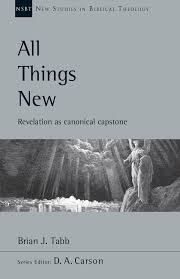
All Things New (NSBT) by Brian J. Tabb

book all th new.jpg

If you are like me, you know what to expect when you pick up the latest entry in the New Studies in Biblical Theology (NSBT): perceptive theology, careful scholarship, in-depth coverage that even exceeds many commentary introductions, and a work that goes beyond anything you already have on your shelves. That consistency is as steady as the unchanging gray covers that adorn every volume. On the one hand, some credit must go to D. A. Carson for his editorial work. On the other hand, somebody must have done their homework in choosing authors as well.

This latest release by Brian J. A Tabb looks at the book of Revelation “as canonical capstone”. As heady as that sounds, the author knew how to make a strong case for his thesis. As I read, I thought this author is great at digging. He brought out so many things that are easily missed and made so many connections between Scriptures that we rarely see. Mr. Tabb takes an “eclectic” approach to Revelation. In fact, he much reminds me of Gregory Beale. (He cited 19 of Beale’s works in his bibliography!) Still, it’s clear he did his own work and made his own conclusions. Further, as one who is a futurist rather than following his eclectic approach, I felt he was gracious throughout. Even better, the type of information he mined for us can be taken and shone back into Revelation no matter which approach to prophecy you take.

His introduction was outstanding and contained all kinds of wonderful information. I did much underlining there. From there he divides his book into four parts: the triune God, worship and witness, judgment, salvation and restoration, and the word of God. Part one contained, you guessed it, three chapters on the Sovereign on the throne, Jesus as the Lion and the Lamb, and the Spirit of prophecy. These were some of my favorite chapters in the book with particular success in the chapter on the Holy Spirit. Part two looked at followers of the Lamb and discussed things like a priestly kingdom and a new Israel while another chapter talked about the battle for universal worship. I felt that viewpoint was well worth digging into. Part three considered the wrath of the Lamb and made several insights on things like the seven seals, the seven trumpets, and the seven bowls of wrath, as well as a new Exodus. There was a chapter on Babylon the harlot and Jerusalem the bride as well as another on all things new. Part four only had one chapter on the Word of God but it was well done and followed by a conclusion for the book. There’s a lengthy bibliography for those wanting further study.

This book even contains some charts that summarize important information for the reader and that I was blessed by. This book is fully up to the high standards set by the NSBT series and I recommend it.

I received this book free from the publisher. I was not required to write a positive review. The opinions I have expressed are my own. I am disclosing this in accordance with the Federal Trade Commission’s 16 CFR, Part 255.

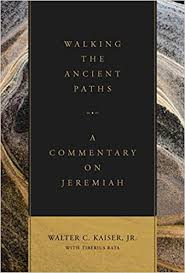
Walking the Ancient Paths: A Commentary on Jeremiah by Kaiser and Rata

book walk ancient.jpg

I’ve been using the works of Walter Kaiser for several years, so when I saw that he was coming out with a new work on Jeremiah I was instantly intrigued. Now that I’ve had a chance to get into this commentary, I can confess that it did live up to my high expectations. As something of a commentary junkie, I’ve had the privilege to review all types of commentaries all the way up to the massive tomes that cover every conceivable issue. As much as I enjoy using all of them, if I were forced to choose, this type of commentary prepared by Kaiser and his colleague Tiberius Rata is the most ideal for pastors. It has more depth than the TOTC series and is pretty close to the NAC in its scope. If you can imagine that style of commentary, then you will know how to gauge this work that is a model volume of its class. Further, in these days of prolific commentary production, I would argue that Jeremiah would be one of the books most in need of a new commentary of this type.

The introduction is not massive, but it gets to the heart of what most Bible students and pastors are looking for. There is background on Jeremiah and his times. There’s a brief mention of compositional issues because the scholarly world is so enamored with them. You will find conservative conclusions here. There is a discussion of Jeremiah’s relation to Deuteronomy as well as the text of Jeremiah. The section on theological emphases could probably have been expanded but was accurate as far as it went. The authors give us an extensive outline of Jeremiah along with a brief bibliography at the end of the introduction. (There’s a lengthy bibliography at the end of the book).

As for me, I enjoyed the commentary itself even more than the introduction. What you received in every passage was clear guidance on understanding the text. If scholarly side issues were mentioned, they never dominated the discussion. I don’t see how this book could not help someone wrestling with the challenging book of Jeremiah. Let’s label this book a necessity!

I received this book free from the publisher. I was not required to write a positive review. The opinions I have expressed are my own. I am disclosing this in accordance with the Federal Trade Commission’s 16 CFR, Part 255.