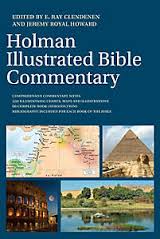
Holman Illustrated Bible Commentary

holman

As a pastor I think I have found the perfect resource to recommend to folks serious about studying the Bible–this new whole Bible commentary by Holman Reference, edited by E. Ray Clendenen and Jeremy Royal Howard. This volume is perfect for the person trying to read the Bible but struggling with certain passages. Even if you have been studying the Bible for years, you will still find this a real asset.

You have some measure of commentary on every verse. It may not give all the detail you would want on that verse (no one-volume commentary can), but you can at least grasp the general idea. There are fine maps as you see in other Holman resources as well interesting pictures. It really has a nice look.

While I do not know the names of all the contributing scholars here, I see many that are known to be outstanding scholars. Each book gets a short background, themes (message and purpose), how it fits in the Bible as a whole (Contribution to the Bible), and Structure. These are well done.

The only thing missing is an Introduction to the Bible as a whole or of each Testament, but no volume can have everything.

I highly recommend this commentary!

I received this book free from the publisher. I was not required to write a positive review. The opinions I have expressed are my own. I am disclosing this in accordance with the Federal Trade Commission’s 16 CFR, Part 255.

Two Great New Carta Titles

carta

Carta continues offering great titles to Bible students! Here are their latest two titles (distributed by Hendrickson):

Understanding Early Christianity: An Introductory Atlas by Franklin Littell

In 40 oversized pages you get an outstanding Introduction from the First to Fifth Centuries of Christianity. Setting Palestine in its proper context from just before Jesus, and discussing the influence of Judaism on early Christianity, the volume exposes us to the greater Greek influence of the times. From rising Hellenism to the evolving influence of Roman Rule, this work delves into the major influences of those times. Even the heresies that had such an effect are discussed.

Equally valuable are the profuse illustrations throughout coupled with fine Carta maps. This volume is excerpted from the large Carta’s Illustrated History of History and so provides a more economical way to study this critical time period.

This volume would be effective for many uses: Bible classes, homeschool, personal study, or a refresher for pastors. I recommend this volume.

Understanding Great People of the Bible: An Introductory Atlas to Biblical Biography by Paul H. Wright

This attractive, oversized-paged volume is a treat for the eyes. Mr. Wright brings much expertise to the table to make this volume valuable. Its unique approach of giving atlas information on Bible characters is helpful in that many study the Bible in character studies. Perhaps not every character is here, but those that are can have their study enriched.

Profusely illustrated in full color, this book is one you will enjoy. The greatest feature is that several of Carta’s very best maps are here. I personally find Carta’s maps the best we have today. Any one studying the Bible will be pleased to get this volume. I highly recommend it.

I received this book free from the publisher. I was not required to write a positive review. The opinions I have expressed are my own. I am disclosing this in accordance with the Federal Trade Commission’s 16 CFR, Part 255.
Paul And His Letters by John Polhill

paul

Are you looking for a book that digs into who Paul is and then naturally works its way to the 13 books conservative scholarship attributes to Paul’s hand? You will want to check out this accessible volume that is widely used by seminarians and pastors alike. Polhill is a highly respected Pauline scholar, having also produced a commentary on Acts, who is the perfect choice for this volume.

He first fleshes out Paul with penetrating insight. You get an idea of the key elements of Paul’s early history that molded him for the work God had for him. Roman citizen, Jew, and Pharisee, Paul was a complex person. His zeal was legendary, first for the bad and then the good. His meeting with Christ, which Polhill devotes a whole chapter, changed everything.

As the book develops, Polhill traces Paul through Acts and begins tying his letters to the narrative. Some reviewers, who feel that he offers too brief a commentary of these books, miss the point entirely. It is not a commentary at all, but a description of introductory and background issues from Paul’s life. The point is showing the essence of each letter, and what, humanly speaking, brought about the need of the letter. For its actual goal, the volume wonderfully succeeded. It occasionally traced rabbit trails of more eccentric scholarship, but usually sided on the conservative side.

This book will find its home next to F.F. Bruce and Conybeare and Howson on my shelves. Plus, it is the most recent of the three. I highly recommend it!

I received this book free from the publisher. I was not required to write a positive review. The opinions I have expressed are my own. I am disclosing this in accordance with the Federal Trade Commission’s 16 CFR, Part 255.

Dictionary Of Daily Life: Volume 2–A Review

dictDL

Here is volume 2 in the planned three-volume set (correction: now planned four-volume set) from Hendrickson that continues the promising start we found in volume one. This volume continues to live up to its stated aim of giving us insight into the daily life of Bible times with articles that cover what is often missed in other Bible dictionary or reference volumes. As one who owns several Bible Dictionary or Bible Encyclopedia sets, I found things covered well here that were little covered in larger volumes.

Written on a level that any Bible student could comprehend, this book is still backed by impeccable scholarship. Looking at every subject in the chronological order of OT, NT, the Near Eastern World, the Greco-Roman, the Jewish World, and the Christian World is especially ideal and enlightening.

Some of the most fascinating subjects in this volume include dentistry and teeth, divorce, dwellings, hair, and heating and lighting. In the article on divorce, for example, you will find information that may not match everything that you have heard. In the one on dentistry and teeth, you will simply be glad you did not live in Bible times!

There are even a handful of color pictures at the end. This practical resource will be a blessing to any Bible student or pastor, and I highly recommend it and eagerly anticipate the final volume.

I received this book free from the publisher. I was not required to write a positive review. The opinions I have expressed are my own. I am disclosing this in accordance with the Federal Trade Commission’s 16 CFR, Part 255.
Exploring Christian Theology–Now A Finished Set

ECT2

It’s great to see this fine, inexpensive three-volume set that serves as an excellent primer to theology be now complete. (Don’t be confused as I was with this being volume 2 as the set was released in a 3-1-2 order). This set has a chance to be really helpful as size, price, and accessibility are all in its favor. I realized a long time ago that very few people are going to read a full-blown systematic theology tome.

This volume covers Creation, the Fall, and salvation. That means the doctrines of man, sin, and salvation are all covered. As for might imagine in a series that tries to teach the spectrum within believing Christianity rather than one narrow viewpoint as in most such volumes, this one is forced to address controversial Calvinism issues. The writers did a good job walking that tightrope no matter which side of the Calvinist line you fall. Clear discussion that will enable you to think your own thoughts in context are provided.

The text includes really helpful charts and graphs. Historical context about what Christians have believed in the past is exceptionally well done and clear. It really added to the value of the book. Even in the salvation section it was fascinating to read the history of thought about predestination.

I would disagree with points along the way, but the book was a winner and any Bible student would be greatly enriched by reading it.

I wholeheartedly recommend both this volume and the entire three-volume set.

I received this book free from the publisher. I was not required to write a positive review. The opinions I have expressed are my own. I am disclosing this in accordance with the Federal Trade Commission’s 16 CFR, Part 255.
Volume 1

The Greatest Sermon Ever Preached by Tom Brennan

  
This volume by Independent Baptist pastor Tom Brennan tackles the Sermon on the Mount for Christians today. In thirty chapters Pastor Brennan seeks to help us apply this great sermons to our lives. He does not subscribe to the theory that this sermon is not for this dispensation, and so draws out many points.

Published by Xulon Press, this attractive volume is well written and easy to follow. His approach seemed to me to be devotional, just as you might expect a pastor to speak to his people. The intended audience is the person in the pew. He has read widely and was especially good at drawing in illustrations or quotes to bring out his points.

I might quibble with him over a few points, but he tackled even the more difficult passages in the Sermon on the Mount without dodging anything. He even dealt with the one on divorce. It appears to me that he worked really hard to put this book together.

In that we have fewer Independent Baptists writing today, you might enjoy giving this volume a try. 

I received this book free from the publisher. I was not required to write a positive review. The opinions I have expressed are my own. I am disclosing this in accordance with the Federal Trade Commission’s 16 CFR, Part 255.
Return To Me by Mark Boda

return

Here is a volume the New Studies In Biblical Theology (NSBT) series that tackles the theological hot-potato issue of repentance. Author Mark Boda strives to give us “a biblical theology of repentance” with this volume in the series edited by the well-known D.A. Carson.

The most valuable feature of this book is the in-depth tracing of repentance in every part of Scripture. He divides the Old Testament in the Jewish way as he feels that is more sensible for following repentance through the Bible. He has strong convictions about the Word of God, which I appreciate. He feels the typical approach of viewing the subject through the definitions of the words involved is insufficient. Following that theory, he traces more of the big picture of repentance. Repentance is more in some parts of the Bible than others, but he succeeds in finding what degree repentance is there. He is thorough.

It was surprising that the book is 80% Old Testament, but perhaps that is only because the New Testament talks much less of it. I found it easy to agree with many things he said. It seemed a little much to say repentance was a big theme of John when the word is only mentioned once. Still, you felt in the hands of a capable scholar as you read.

He references the theological battles involving repentance, but really does not address them. He seemed to want to lay the data out there so others could take it into the battle and think for themselves. I can not imagine anyone writing on this subject again without consulting this volume. For this volume set out to do, it succeeded all the way.

I received this book free from the publisher. I was not required to write a positive review. The opinions I have expressed are my own. I am disclosing this in accordance with the Federal Trade Commission’s 16 CFR, Part 255.

Perspectives On Israel And The Church: 4 Views by Brand

israel church                                                                                                                                                 Here is another fine volume in B & H Academic’s Perspectives series. This volume tackles viewpoints on Israel and the Church, which means a debate between dispensational and covenantal thought. This volume, edited by Chad Brand, discusses the four most prominent views though there is even more variety out there. You will read on the traditional covenantal view (Robert Reymond), the traditional dispensational view (Robert L. Thomas), the progressive dispensational view (Robert Saucy), and the progressive covenantal view (Tom Pratt Jr.). The editor Chad Brand assists on the progressive covenantal view as well.

All the authors are scholars and some have been well known in this subject for years. Each was fairly dogmatic, as you would expect in such a series. Only Mr. Reymond seemed to go too far in harshness. While I must disclose that I do not agree with his position, I even wonder if those who hold that position would think he had a good approach. He also used extreme examples like quoting John Hagee as if he were the best representative for dispensational thinking.

All of the other three wrote more respectively and gave much food for thought. It seems issues on election, the Millennium, and other topics intersected strongly with this subject, but the authors did a good job only referencing the points that made sense to the Israel/ Church issue.

This volume did not change my mind, but it did suggest points that I needed to think through. What more could you ask for in a series like this? I recommend it.

I received this book free from the publisher. I was not required to write a positive review. The opinions I have expressed are my own. I am disclosing this in accordance with the Federal Trade Commission’s 16 CFR, Part 255.
Do We Need The New Testament? By John Goldingay


We must applaud volumes that encourage us to see the Old Testament in all its splendor. Too many push it back to secondary status. Enter Old Testament scholar John Goldingay who makes his attempt to shake up our thinking on the subject. His aim is ” letting the Old Testament speak for itself.”

There are pluses and minuses in this volume for sure. The author writes well, knows the scholarly issues out there,  and can be quite thought provoking. His chapter on “The Costly Loss Of First Testament Spirituality”, for example, covered several trains on thought that I had never thought of, particularly on the Psalms and worship.

There were also chapters, like chapter four on Grand and a Middle Narratives, that I simply could not get on with. Perhaps that says more about me as a reviewer than him as a writer–I am not sure.

I imagine some will love this book and rate it highly, but for me it was marred by his suppositions that led him far afield. He has so little regard for the historicity of the Bible, thinks books like Jonah and Ruth must be fictional, and his claims of their abiding value are undermined by his view of dating.  His ideas of memory may be a trendy, new scholarly view, but it seems bizarre to me.

His last chapter fails completely in how it deals with Christology in the Old Testament, and I believe a majority of Christianity would think so. I will be curious to read future reviews. I will be curious, too, with his being such an influential scholar what will come of his discussion. He did at least succeed in making you feel he loved the Old Testament. You will have to check this one out and decide for yourself.

 I received this book free from the publisher. I was not required to write a positive review. The opinions I have expressed are my own. I am disclosing this in accordance with the Federal Trade Commission’s 16 CFR, Part 255.

Two New Titles From Carta Jerusalem

It is always exciting to see what new releases Carta Jerusalem has out. Here are two–one on a technical subject and another that makes for great history and touring.

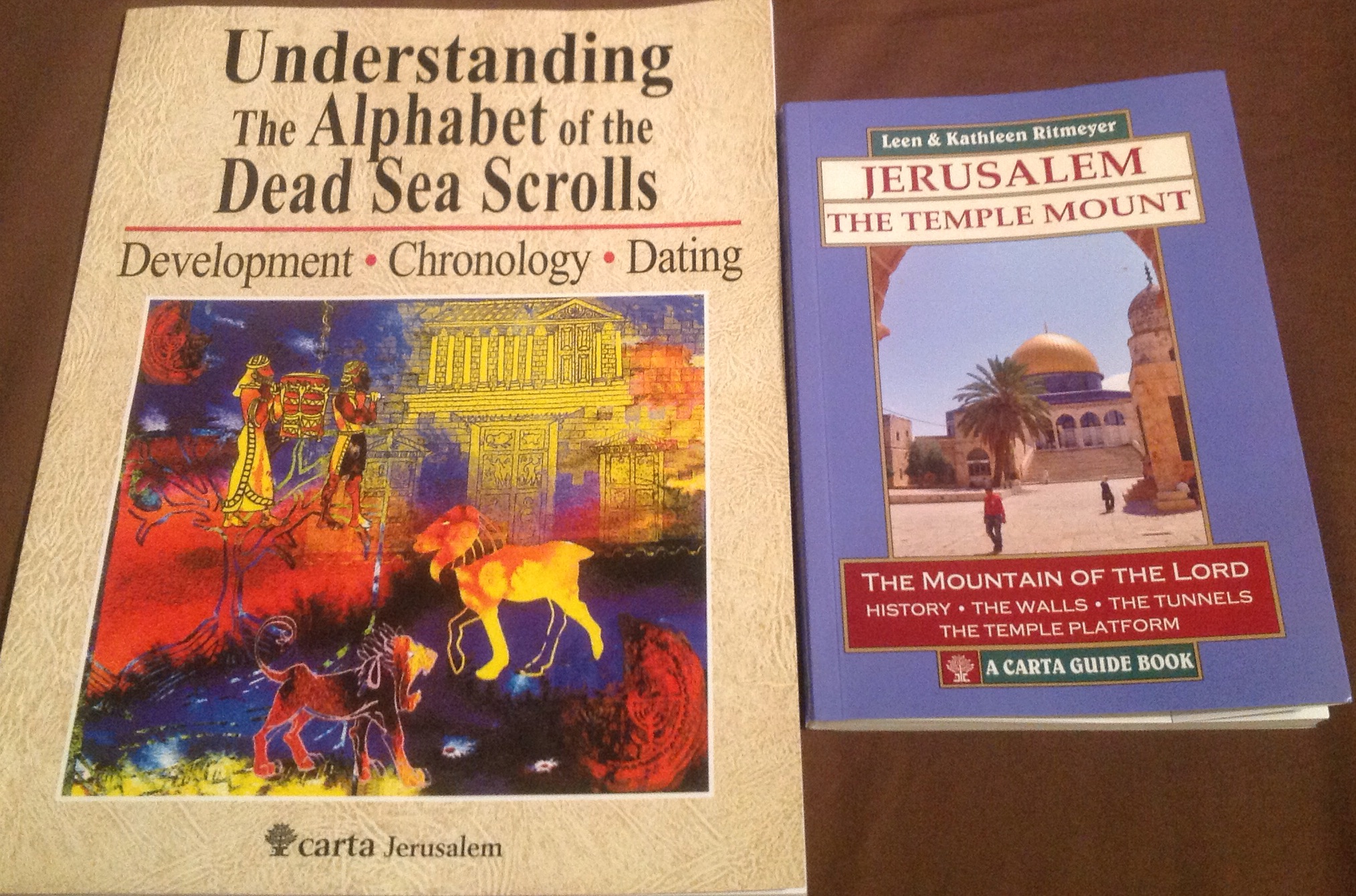
Understanding The Alphabet of the Dead Sea Scrolls by Ada Yardeni

Dr. Yardeni is one of the world’s leading authorities on Hebrew paleography, or the study of Hebrew handwriting. In this short, but profusely illustrated volume, she reviews the Dead Sea Scrolls to evaluate the development of the handwriting with an eye to dating. Though that is not my field, you can see a distinct evolution of the texts in the samples she provides.

If you are studying this subject, this title will be indispensable. She gives a page of hints that students will love at the end. This will likely be the definitive volume that will be all anyone would ever need.

Jerusalem: The Temple Mount by Leen and Kathleen Ritmeyer

In a word, this book is incredible. It is small enough (160 pages) and has a durable enough cover to be easy to carry on your next visit to Jerusalem. Even if you don’t make it to Jerusalem in the near future, this book can enlighten you as an armchair traveler. It holds its own as a small reference volume on your shelves as well.

The Ritmeyers are experts whose comments are trustworthy and well stated.(I am told they have other Carta titles that take this history farther).  Add to that superb photos and those awesome Carta maps and you have a winner.

The first chapter gives a succint history of the Temple Mount. Check out the illustration of Mt. Moriah before any building took place (page 13). With that map, later Temples are superimposed upon it that gives eye-opening perspective.  The history comes down to modern times and is captivating.

The other two chapters offer self-guided tours of outside the walls and upon the Temple Mount itself. I went to the Temple Mount a few years ago and loved it though I went along willy nilly; but I would so love to have had this book. It would have doubled what I got out of the visit. What better could I say about this volume? Don’t visit the Temple Mount without it!

I received this book free from the publisher. I was not required to write a positive review. The opinions I have expressed are my own. I am disclosing this in accordance with the Federal Trade Commission’s 16 CFR, Part 255.