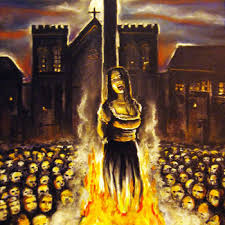
Is This Really The Time For A Witch Hunt? (IBTR #71)

witch hunt

There is nothing quite as unnerving as something coming back as a boomerang and smacking you up side the head. I fear that many may be having that experience already. It will only get worse. Every group that gets carried away with its demands of holding the party line to points of minutiae has such potential in changing times. This series has highlighted many such points among Independent Baptists, but I imagine these have not been dominating thinking as much as it did only a few days ago.

The change is shocking; its pace alarming. A mere two months ago I wrote an article in this series entitled “Where Will Independent Baptists Be In 10 and 25 Years?” I am no prophet, though I feel more sure about those predictions now than I did when I wrote that piece. It was almost surreal to reread what I myself had written–not because it was particularly brilliant, but because things tipped over so quickly. I did not see that coming!

Shootings, flag debates, racial wars, and especially, homosexual marriage legalization, and the general mood of the country–no, I did not see it coming in a few days, even if I thought it would over time.

Do you feel as so many Christians do that we are the subject of a witch hunt? It may sound dramatic, but have you had your visions of them coming for you?… Did you refuse to perform that gay wedding? Are you intolerant? How dare you discriminate against me! I feel marginalized by you! Something needs to be done about you!… Pessimists never had it so good. Fearmongers look like brilliant scholars. These are the days to make crackpot predictions because you may look like a genius tomorrow.

There is new material to work with every day. Today, for example, I read of a Baptist Church in New York City that is taking major flak for merely passing out VBS invitations. People in that community said it was discriminatory because of the church’s position on gay marriage. They also said it was offensive because the church workers were white and the community is predominately black. See where that could go? Or think about the Confederate flag debate. Every argument made against it could also be made against crosses–remember the KKK used to burn them in the yards of innocent Black folks. See what I mean?

Now let’s come back to the issues that have plagued the Independent Baptist world for several years and the subject of this series. Do you suppose some folks have felt the victim of a witch hunt for a long time? The very way we all feel now? You know, scanning Facebook pictures for pants, or trying to find your music playlist, or looking for information that you visited an unapproved church or listened to an unapproved preacher, or you were disloyal in some way to our exalted group. Many have told me that they almost live in hiding because they so fear the backlash from family or churches.

Can the recent days finally make us empathetic? Will changes in our country finally make us realize what some of us have done? Can we finally see how we have made some others feel? Think about our country and world today. I assure you that some other Independent Baptist with a different standard is not the enemy, nor is some differences in worship styles, etc., our big problem today. We do have some problems today…big ones ( we still have our hope too), but these decades-long issues in some of our churches are not it. Read the news today and answer me this: Is this really the time for a witch hunt?

Find all articles in the series here.
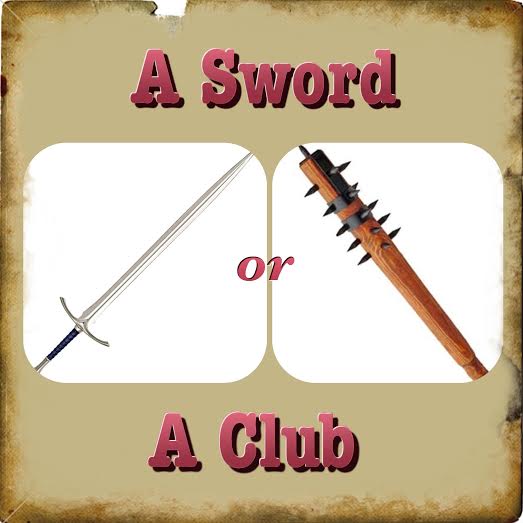
A Sword Or A Club? (IBTR #70)

sword club

Well, they are quite the different weapons. With skill, the sword can be used for precision cuts. But with a club, all you can do is bludgeon. With a club you can forget precision too as the questions are only what is broken and how much blood is on the floor.

As Christians we have a weapon and it is precise. Hebrews 4:12 says, “For the word of God is quick, and powerful and sharper than any two-edged sword, piercing even to the dividing asunder of soul and spirit, and of the joints and marrow, and is a discerner of the heart.” Now that is a weapon!

It is a powerful weapon—I can actually think of none stronger. It is two-edged for the height of precision. Its precision goes where none other can go. If its precision to cut perfectly the joints and marrow was not enough, it can slice between our souls and spirits. It turns out that its work exceeds cutting and actually discerns hearts. Its greatest feature it that it is “quick”, which means “alive”. Where other weapons excel in death, it distributes life. No wonder we are told that “…the weapons of our warfare are not carnal.”

So it is clear what the Sword of the Word of God is. But we have a problem. Some wielders of the sword confuse it for a club. They see it as a traditional weapon, which, of course, leads to death. This error raises its ugly head all through Christianity, and Independent Baptists have often followed suite. They are quite clumsy with a club, but who wouldn’t be if your club is actually a sword?

There are a variety of damaging moves with the club. Some take God’s Word that is meant to bring life and take those abused by sin and abuse them more. Where God’s Word brings guilt to see our sin only to later remove both the sin and the guilt with its Gospel message, some explain the sin and bring on the guilt only to leave you broken and bleeding from its blow. Some then run from the Word for relief when only the Word can bring relief because some silly Christian soldier thought his sword was a club.

All of this is not to say that God’s Word doesn’t convict or tell me what is wrong. It tells reality in a Holy God’s Universe. But when its precision cuts tell me what a rotten sinner I really am, the grace of God springing from the blood of Jesus Christ comes surging over me. Here is where club users go awry.

I read that the legalist wants you punished. Apparently, the delirium that comes from club swinging makes one forget that Christ took the punishment. We proceed from there. The legalist wants you to pay where Christ has already paid it all. Lest our discussion get off track, let’s remember that is as true years after I’m saved as it was the day I got saved.

If we get that messed up, we speed down the slippery slope. First thing you know, some club gladiator with a Bible in his hands tells some battered woman in the throes of physical abuse that she must stay and submit. Or next we’re told we can’t report a church member for molesting a child because we can’t our take brother to court. The Bible was referring to civil cases in that instance, but a club is not, as we said, an instrument of precision. None of that is “quick”, or life. It sounds like death to me. It may not be a bludgeoned skull, but it is a butchered heart and life.

It is time to lay down our clubs. We are not even trained or called to use them. But let’s take the Sword of the Word of God into our hands as it is the answer for us all.

Find all articles in the series here.

I Don’t Know A Thing About Revival

revival

I really don’t know anything about revival. Very few people could actually say that they have ever seen a real revival, but perhaps you are like me and sure would love to see one. I could say I have always been fascinated by it, and have read of it on several occasions. While I don’t know anything personally about a real breath from Heaven that sweeps through an area in a miraculous way, I would like to point out a few things that I have noticed from those who have experienced and written about it.

Let’s be sure on the front end that we are on the same page in what we mean by revival. I am not speaking of personal revival, or one of those special times in our Christian life. I am not talking about a time where evangelism was highly effective. I refer to a miraculous moving of the Spirit of God that must be traced to the mercy of God.

I think a study of revival from historical sources would bear out these things:

  • Revival is preceded by intense prayer.

Pick up any record of real revival and you will see a pattern of prayer. Usually it involves many praying, but not always. It is a time of serious prayer as opposed to the careless prayer you and I so often get caught up in. Months of praying, nights of prayer with forfeited sleep, intense praying—this is the prayer you find preceding a revival. While God gives revival, He is apparently willing to be asked for it.

  • Revival will first show up in confession of sin.

You will be amazed as you read of God’s people confessing their sins as being the tipping point for revival to break out. There are so many little hurts and hard feelings between us and these are quite obviously a great hindrance to revival. You might say a key to revival is removing hindrances. Apparently, the Lord finds us not too interested in revival as long is sin is unconfessed and grievances unfixed. Many remembrances of revival will point out that people’s sin became almost overwhelming in their minds, but led them to seek the Lord in a way they never had before.

  • Revival will come on the Lord’s terms.

Some who taught that a formula could be followed that would guarantee revival have been proven wrong. Charles Finney sometimes taught that, but his own life disproves it. His great revivals dried up while his formula kept right on going.

  • Revival does not fit our preconceived boundaries.

Of course not every claim of revival has been real, but revival has not stayed within the boundaries we would prefer it would either. Every denomination that held to the Gospel, had a strong Christology, loved the cross, and professed the Bible to be true has had great revivals in the past. Baptists, Presbyterians, Methodists, and on and on have been blessed with glorious revivals, but not one of those groups has really outdone the others in seeing great Revivals. Secondary issues have often even been laid aside in revivals. Not that each involved did not have strong feelings about those issues, but revival is not the time to battle them. Mode of baptism, Calvinistic debates, church government—I have never read of a revival where these things were strongly debated.

For example, Charles Finney and Jonathan Edwards were both instruments in God’s hands in revival. Strangely enough, both men have fans today who strongly criticize the other. Charles Finney was wrong about original sin, but he is more strongly criticized for originating altar calls, or invitations. Others today would strongly criticize the followers of Edwards for never using altar calls. Both sides have a problem—God blessed Finney and Edwards. There is no problem in our deciding which man was more theologically correct, but we are less than honest if we claim God did not use either one of them. Some books have been written, particularly against Finney, which skew the facts. There were abiding results following the revivals both were involved in. There were also anomalies in both revivals. Edwards did a great job in reporting those he knew of. Actually, every real revival seems to have some of those. Apparently, the Lord is not concerned with massaging our egos about the supposed superiority of the group we are in.

  • Revival is local.

For my whole life I am always hearing that we should pray for revival in America. If history is any judge, it will not start on a nationwide level if it comes. Likely our dreamy fascination that some great politician is going to come along and deliver us confuses our thinking. Revival starts somewhere, and at best, grows from there. We would be better served to beg God to send revival to our congregation, or our community, and see where He takes it from there.

Please join me in praying for revival!

Here are some book suggestions that I have read (most of them lately).

  1. Handbook Of Revivals by H.C. Fish

The chapters give history and teaching on revival from first-hand witnesses. The chapters are not of equal value, but the book is worthwhile.

  1. When The Fire Fell by George T.B. Davis

A little book with some great history of various revivals.

  1. By My Spirit by Jonathan Goforth

A gem! Confession really played a role in the revivals he was part of in China and Korea.

  1. Power From On High by John Greenfield

This little volume is a history of the great Moravian Revival of 1727. Gets sidetracked promoting the Moravians at times, but a good read still.

  1. Revivals of Religion by Charles Finney

A very popular title where if you ignore his thoughts that certain steps guarantee revival the rest of the book is quite helpful.

I plan to review others in the future. God bless!

The Hiding Place by Corrie ten Boom

What a joy to see Hendrickson Publishers select this title for their new Classic Biography series in lovely bindings. The series aims to reprint the greatest biographies and this title qualifies as, perhaps, the best of its kind. I am at a loss to tell you just how extraordinary The Hiding Place really is. Beyond the timeless story, the book is well written and designed for easy reading. Teenagers to the aged need this book.

To think of a simple, God-fearing family of watchmakers in the Netherlands and then watch this same family rise to the heights of faith and action when the Nazis overran their simple existence is a spiritual journey for every reader.

After the background of their lives is vividly set in an economy of words, the story of their work in the Underground to rescue persecuted Jews with all its twists is given. Had the story ended there it would have been a testament of love, sacrifice, and dedication.

But the story did not end there. They were arrested. The father died. The first prison seemed terrible until you read of the next one. This is when faith and a growing closeness to Christ really rose and becomes a challenge for every Christian reader.

The last prison was a city of horrors, but they found a way to trust the Lord and serve Him in an amazing way. The also saw the Lord do things that were truly miraculous in the midst of their incredible suffering. Getting the Word in each prison shows how the Lord reaches out to those who turn to Him. That Word sustained them just as the Lord promises it would.

They learned how to see the Lord’s hand and be thankful for it, all the way down to the fleas (read it, you will see). The sickly, broken Betsy faced death as the victor that in Christ she truly was.

This story is not merely moving biography, nor even inspiration. No, it is one of the greatest challenges of faith you will ever lay your hands on. Truly, one of the greatest Christian books of all time!

I received this book free from the publisher. I was not required to write a positive review. The opinions I have expressed are my own. I am disclosing this in accordance with the Federal Trade Commission’s 16 CFR, Part 255.

hiding place

Are You A Narcissist? (IBTR #67)

May I answer the question for you? Yes, you are and so am I. The real discussion is not whether we have narcissistic tendencies, but are we battling them. This is, of course, a human problem and not a denominational one. Though this series is aimed at those who are, or have been, part of the Independent Baptist world, this subject extends far beyond it. Those in it struggle here not because they are Independent Baptists, but because they are flesh and blood and join in the human condition. In that it is a challenge for us all, it affects every group of people including those in Christian circles. So that calls for a word here.

Narcissism as a term for our malady traces back to Narcissus in Greek Mythology. Its essence as a concept, though, goes back to Eden. Narcissus was a young handsome chap who caught a reflection of himself in a pond. He was so captivated by his own reflection that he fell in love with himself. This love affair grew until the captivated Narcissus fell in the pond and drowned. Whatever you think of Greek mythology, can you think of a better, or more accurate, story for being impressed and infatuated with yourself?

This excessively growing love that is narcissism has been described as “an unbounded admiration of self.” As bad as it has always been, it is clearly a growing issue of the Last Days: “For men shall be lovers of their own selves, covetous, boasters, proud, blasphemers, disobedient to parents, unthankful, unholy,” (II Timothy 3:2).

Being in a church setting, or a Christian home, or in a room all by yourself, is no guarantee to avoid narcissism. A preacher could look over his sermon notes and think…wow, this is awesome. A singer could come to believe that applause actually proved something. A pastor might start believing and openly proclaiming how great his ministry is…the best in town, or maybe the state. A volunteer might come to believe the church’s future is fully on his back.

Our teaching or preaching may become overloaded with stories where we are the hero. Beyond the little stories of things we have observed, our stories become ever more the tale of one rescuing the world, of one clearly standing above others. Just before we fall into the pond staring at our own reflection, our story grows more relevant as we speak than His story. 

It will show up in our daily lives as well. We might blog and think ours has more potential to change the world than others. (Ouch). Our Facebook or Twitter statuses grow beyond keeping up with each other to a need to status because those readers need to hear from us. It’s not the posting that is an issue, but the thought processes as we hit “send”.

The answer is in God’s Word. The reflection that you see in the mirror of its pages gives a more vivid and accurate image of us than do those ripples across the pond. If you look at it long enough you won’t fall in love with yourself, but with Christ Who is worthy of the deep love we narcissists usually give ourselves.

Perhaps, narcissism isn’t so surprising after all. I was reading the other day that we are made in the image of God and that God is worthy of praise. Somewhere inside of we who are in His image is a need for that praise. There is, however, two problems: 1) We are not the Almighty even if in His image, and 2) We are corrupted by sin and incredibly unworthy. We are marred and we view our lives as touched-up photos.

We must strive to keep the accurate, biblical view of ourselves ever before our eyes or we will never do any worthwhile ministry. We must stay in love with Christ, and fulfilled by Him, so that we need not believe such hopelessly ridiculous things about ourselves. The world could get along without us without missing one beat. On the other hand, it cannot do without Him.

So, I pray–Lord, help me keep the narcissist within at bay.

Find all articles in the series here.
narcissist

What I Learned And Received From My Mother

My mother, Patricia Reagan, is not the bragging type. She has always done helpful things for others. It seems my entire life she has always been responsible for taking people to town for shopping or doctor visits. Many of those folks were on my Daddy’s side of the family ( I have a lot of relatives that never learned to drive and others just got old).

I owe her a lot too. Every year older I get I realize more what a blessing I have had in my parents. I had a sheltered, carefree, and happy childhood thanks to them. Here are some of the things she gave me:

1. She told me about Christ.

From a very young age she told me about the Lord. She talked often of Him to me in our daily life. She had herself walked to church every Sunday as a child because her parents did not go. It was real to her. Not that she was perfect, but it was real to her. I firmly believe that moved my heart more than lectures that many parents give about a Christianity that has no impact on their lives.

When I became convicted about being saved she talked so carefully to me. She didn’t have enough confidence in herself and so sent me over to talk to my Grandfather who lived across the road. Then I came back and she and I went into her bedroom where I knelt beside her bed with only her with me and asked Jesus to be my Savior. That is, of course, the most previous memory of my life. She led me to Christ, which is the greatest thing any parent can do.

She also encouraged me to be a Bible reader. (I inherited a love of reading from her). She talked me into reading my Bible through on the one-year plan when I was thirteen. I made it to 1 Kings. That summer she was my VBS teacher and she was telling the class to be Bible readers. She also told them to not be like me and start and quit either. She was not one to ever publicly embarrass me, so this must have been incredibly important to her. I decided that day that if I lived to January I was going to start again ( I have no idea why I didn’t realize I could start then). I did read it through when 14 and have been a Bible reader since. In fact, I try other methods on occasion and always fall back on the one-year plan. You owe a lot to the one who teaches you to be a Bible reader.

2. She taught me about trusting the Lord.

When I was young she went through a period of panic attacks and depression in doubting her salvation. She talked openly of it but sheltered me from the harder parts of it. I remember her finding some good Christian materials. I remember Bible passages that she learned in her life that spoke to her problem. No one had ever trained this young lady (she is only 17 years older than me) about these spiritual truths. I saw her pray, I saw the Lord send help, and I saw her change into a happy Christian. Again, I saw that Christianity was not a game–it was real! Never once have I heard her brag on herself over this victory. She always just thanks the Lord for helping her.

She had to demonstrate this again when she battled breat cancer at 37, and ovarian cancer a few years later. She also lost three of her four siblings by the time they reached 45. She has had hard times. When I went through my own hard times at least I had had an example of trusting the Lord in a crisis.

3. She has loved and embraced my family.

It is a funny sight when we visit my parents now. There is usually one child in her lap and two snuggled up against her at all times. I imagine she is sore by the time we leave. As the kids get older I still see that they love to talk to her and tell her all about their lives and she is always ready for that conversation. I have always received unconditional love from my parents (they have never once failed me in this way) and they have passed it right on to the children.

So Happy Mother’s Day, Mama! I love you and thank you for all you have poured into my life.

Our Brand Of Idolatry (IBTR #65)

Any Christian should have an idea of what idolatry is. Idolatry is rendering to any other thing what is due only to God. Usually the actions run deep enough that the word “worship” comes to mind. Using the words of the Ten Commandments, it includes “bowing down” and “serving”. In the broader sense, I saw it defined as “immoderate attachment or devotion to something.” I believe idolatry is a battle for us all, and clearly for every group or denomination, and Independent Baptists struggle with their own flavor. Here are our prime ones, our brand of idolatry:

1. An Idol Of Independent Baptist Itself

Beyond folks who are Independent Baptists because they just feel it most closely aligns with the Scriptures, there are those who feel it holds an inherent superiority in and of itself. First, there are those who hold to what is known as a “Baptist Brider” position that believes that Baptists are the Bride of Christ and any other saved person is, at best, a friend of the Bride. We will sit at the table at the Marriage Supper of the Lamb while others stand at the side and watch. While Baptists have a longstanding and amazing legacy, this is without any Scriptural warrant and is ludicrous. The so-called “succession” can be no better be provided all the way back to Christ as a list than other groups who claim the same thing.

While I hope the “Brider” stuff is not too widespread, there are others who have come to believe that we have grown to be something so special that now only we have the truth. The rift between us and everyone else is now so large that they are the enemy. To be in some other group is a sign of either spiritual immaturity, or worse, backsliding. Many now make prominent their separation from everything not Independent Baptist and feel this so pleases the Lord. We size people up quickly not so much on what they believe about Christ, but whether are they Independent Baptists. That is to say, the question “Are you an Independent Baptist?” tells us more about a person than the question “What do you think of Christ?” See what got switched around? Is that not idolatry?

2. An Idol Of Standards

It appears to me that standards started out as simply deciding how one ought to live before the Lord. Everyone has to seek the Lord and answer those questions on many levels, but in some circles in the Independent Baptist world it has grown into a standardized list. No longer a thoughtful look at various issues to honor Christ, it is a package deal. Some subgroups have a slightly different package, but the package must be accepted as a whole. Any major transgression of any point is to break the whole package and bring the wrath of the whole group. The package is held up as what makes us right. Some over time confuse the adherence of the package of standards as the thing that makes God love them. Some vehemently deny that conclusion, but can’t explain why so many they have trained are so confused. In this situation, we look at ourselves and ask “Am I keeping my standards?” instead of “How is my personal relationship with Christ?” Is that not idolatry?

3. An Idol Of Associations

Another thing you see at times is some being obsessed with certain leaders in the Independent Baptist world. Make what you will of the leaders in those situations, I am more troubled by some who come so close to worship. Those leaders can do no wrong. Scandals must be hushed up. Slander of those against your leader is offered up without proof. This is not the same as friendship, or even appreciation. It is something much more.

Then there are the associations gathered around these persons (I do not mean if you happen to have gone to a school or church of one of these leaders and love and appreciate them that you are guilty of this, or that any particular leader is guilty!) There is a problem, however, if you yield a blind allegiance to such groups no matter what. If you are not willing to say that your favorite group, which is made up of fallible people, could be wrong, you have given an exalted status that should only be given to the Infallible Christ. If, on some matter, you say someone or some group is right when Christ says they are wrong, what have you done? This is not about turning into a critic, but having everyone stay firmly in the human category they are in. You even see younger guys working every angle to get higher up the totem pole of the group. Isn’t this one the most hideous transposings of worship? And is that not idolatry?

Find all articles in the series here.

idol_013

I’m Out! (IBTR #62)

imageI’m out! Well, I am and will later in this article explain where I am out. Those words reverberate loudly often, in the reverse, in the Independent Baptist world as well. That is worthy of discussion too.

Perhaps you have watched a show that fascinates my family called “Shark Tank”. It is not my favorite program, and usually I will read while they watch, but in my home you can’t help watching it some. If you haven’t seen it, it is a show where entrepreneurs needing money to propel their business forward come before five filthy rich business magnates and pitch their business to see if one or more of the five will give the money for a stake of the company. Those five have succeeded for a reason and can spot a bad business plan or product as quickly as a dog can a bone. There is even one shark in the center called Mr. Wonderful (never has the bar for wonderful been set so low) who often reenergizes the term “painfully honest”.

In accordance with the typical vicarious reality-TV experience of our generation, the camera will pan from the face of the entrepreneur to the shark. The tension is seeing if the shark will make a deal or say those dreaded words: “I’m out!” Though it seems personal, the viewer must not forget that those sharks surely have a right to invest where they choose. They seem in most cases to be fairly cordial afterwards to those they just dropped the bomb of “I’m out” on. Still, you can see the fear in the eyes of the entrepreneurs that the “I’m out” may come.

In the Independent Baptist world, and I imagine in a few other corners of Christianity, we have almost that same scenario, except worse. The words “I’m out” are altered to “You’re out.”  It is not I am going to pack up my toys (or money) and go home, but I am going to pack up your toys (or fellowship) and send you home. The former is unpleasant, but the latter is devastating.

We have had much communication with those on both sides of the “You’re out”. There are those who have heard it and are trying to recover from what has been an emotional crisis involving family or friends. If that doesn’t strike you as a big deal, it only proves you have not been through it. Someone I dearly love has had the “you’re out” hurled at them this very year.

Then there are those with that look of terror in their eyes who fear the words may come at any time. They wrestle with sticking to what they believe or selling their souls to avoid the “You’re out”.

O I almost forgot—you may be wondering what events precipitated the pronouncement of “You’re out”. Believe it or not, this complete or near-complete breaking of fellowship were over things like (in order of occurrence): dress standards, complete obedience to a certain clique’s position, unquestioned support of a questionable leader, and music standards. I will refrain from sarcasm here and just suggest you join many others of us in rolling your eyes.

I want to give a word to those who have heard the painful “You’re Out” since I know several readers of this blog fall in that category. Imagine being in a plane and the other riders decided you were not enough in agreement with them and opened the door and threw you out barely giving you time to strap on a parachute. There is the sheer terror of falling (at least that is how I visualize it as the last guy who will ever volunteer to jump out of a plane), the hurt of being treated so by those you expected more of, and the fear of the unknown and how exactly you handle the landing since you have never done this before. A little overwhelming, wouldn’t you agree?

But then imagine that as you drift down in your parachute in a torrent of emotion that you see the plane you were thrown out of slam into the side of a mountain. That would, of course, only make for even more strong emotions, but would not one of those new emotions be gratitude that you were no longer on the plane? Hurting one, what I am trying to say is that the plane you were thrown out of is going to crash.

Please don’t think I am saying: they hurt you and they will pay. That is God’s business and our thoughts must not go there. What I am saying is that a life where we must earn God’s love, where our soul liberty is brutalized, where the priesthood of the believer we possess is sabotaged, and the Lordship of Christ we must give to Jesus is high jacked– that life cannot succeed. That is not the Life that Jesus gave us. It is not really life at all. Be thankful you are no longer on the plane. Hurting or not, you are far better off.

O, before I go, I said I would explain where “I’m out”. I do not direct those words to any Independent Baptist people or institutions. Probably I can just wait for them to say “You’re out” to me and it will all sort itself out. Those who never say “You’re out” to me will find that I will remain friendly to the end. The Truth Revolution is not personal over characters in IFB for me, but personal about Christ Who I love. I love being a Baptist with its blood-stained heritage, but not what some Baptists have defrauded of that heritage.

So, I’m out to being sucked into bondage. I’m out over someone dictating to my conscience. I’m out to being forced to conform to feeble men’s demands. I’m out over forced or made up Bible (mis-) interpretations. I’m out to someone robbing me of the joy Christ so freely gives. I’m out to men’s opinion overtaking the Word of God. I’m out to voices that would drown out the Word of God. I’m out to having freedom and liberty in Christ taken from me. I have a wonderful Savior and I am free and I love it—so I’m out.

Find all articles in the series here.

It’s Not Who’s Right, But What’s Right (IBTR #60)

image


It’s not who’s right, but what’s right.” That was the statement I heard someone make that keeps ringing in my ears. How often have we seen the reverse–it’s not what’s right, but who’s right –lived out in front of us? It is a temptation to every group in Christianity, and Independent Baptists certainly have their struggles with it too.


When we live under the canopy of who’s right we are reduced to Christian politics. I can think of no two words more ill suited for each other than “Christian” and “politics”. It no longer is what Christ actually said that drives us, but which group is best at following what He said. That may appear a subtle distinction to you, but it is vast.


When I follow Christ by following which group or clique best follows him, I am no longer listening directly to Him. Now that is an incredible mistake to make. It is adding a middle man where none is needed. It is denying that Jesus Christ is the only mediator between God and man. It is exalting those to priests in your life who are not worthy of the role.  


Over time it makes us forgetful too. We forget we answer to Him. We forget to seek Him. We feel right with Him when we are right with them. We forget that if they are wrong, we will be too by default. Sadly, then we are in a place to not even realize it. 


That same gentleman also said, “It’s fraternity instead of orthodoxy.” We must realize that those two things are not the same. Orthodoxy is holding to Scriptures because God said it while fraternity is holding to something because either my buddies or my heroes said it. See the difference?


Orthodoxy is me following an infallible Book. Perhaps I will misinterpret it, but I do so from a pure source. Fraternity is me following fallible men who range from sincere to duplicitous. Again, see the difference?


This is not to say that some group may not be right–only that is not the point. That is not to say that I may not associate with a group that I feel most closely aligns with God’s Word–only that is not the deciding factor in what I do or believe. No, fraternity, for all its good features, must bow to orthodoxy. And we will answer at the end of the way not for who’s right, but most assuredly, for what’s right. May God help us to never forget it. 

Find all articles in the series here.



Make Sure You Leave Right (IBTR #57)

Make sure you leave right. Ever heard that one before? It can be said to church members, and especially to departing staff members. I’ve had many a letter describe a sordid tale over simply leaving. In fact, a reader even asked me to tackle this topic.

This is an awkward subject in the sense of who wouldn’t want to follow “make sure you you leave right” as a principle? In leaving one could, of course, be unchristian and bring damage to the cause of Christ. We should recommend this as a course of action to each other in the instances of life where we must leave.

Just because it is a good thing to do, and a good step to recommend, does not mean it cannot be used in some bad cases of abuse. It most often rears its ugly head when a pastor abusing his role like an oily hireling uses it as manipulative–PR moves, scapegoating, character assassination, or ego enhancement.

Oftentimes the church member or staff member will strive to leave in the best possible terms. Some things that could be said are graciously left unsaid. Care is taken to get into no gossipy situations. And especially, must respect is afforded the pastor.

Then sadly, that respect is not returned. Accusations are made. The pastor acts like the ends justifies the means even if that means destroying someone to protect his ministry. Sad when we forget it is God’s ministry.

In some cases it is only an assistant being called out to other work. This should be a cause of rejoicing like a Timothy going out from Paul, but instead the pastor is only concerned with the immediate impact on him. He acts like his ministry is the height of God’s work instead of seeing that God’s work often thrives by others being sent out.

We need a call back to pastors as shepherds. We give our lives for the sheep, not destroy the sheep we were called to love and care for. May God help us.

Find all articles in the series here.

IMG_2340