More Books On Revival

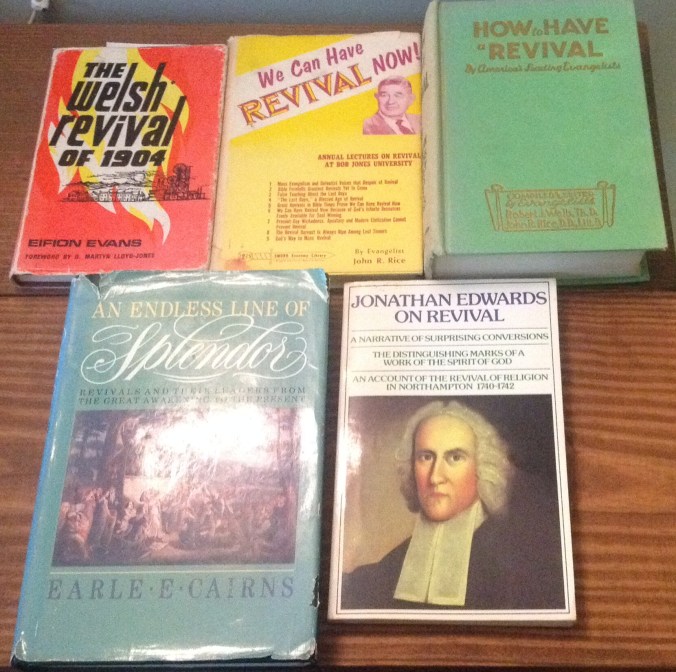
photoSince I have had revival on my mind for a year,  I have been reading newly discovered titles and looking anew at books read long ago. Here are some more books on the subject if you too have been thinking about it.

1. Jonathan Edwards On Revival

This volume published by Banner of Truth combines three of Edward’s smaller works–A Narrative of Surprising Conversions, The Distinguishing Marks of a Work of the Spirit of God. Two are historical accounts, the other a theological evaluation of the revivals Edwards personally witnessed. This book carries weight because  Edwards is such a respected scholar and theologian. He lives up to that respect by hiding nothing negative or excessive he saw in the revivals. Despite those anonomlies, he concludes God was mightily involved in the revivals he saw. It, then, is an encouragement to believe the Lord sends revival.

2. An Endless Line of Splendor by Earle E. Cairns

This book is simply historical, yet it gives a great overview of revivals from the Great Awakening to the 1980s. The thing that jumps off the page is that the Lord has sent revival as often as He has. While you might not agree with some things he includes, the book is excellent for what it is.

3. The Welsh Revival of 1904 by Eifion Evans

This volume is a mature look at revival in the context of the famous Welsh Revival in 1904. He faces the failings head on and yet a true picture of revival emerges. This book must be included in any in-depth look at revival.

4. We Can Have Revival Now! by John R. Rice

This is not as well known as other titles by this prolific Baptist author, but it is one of his best. While he can confuse revival with mass crusades or even soul winning, he still gives us a passionate plea for revival. He could perhaps go to far, and like Finney, make revival sound automatic if certain procedures are followed. Still, I leave that book reminded we are not past the days of possible revival. On that level, the book is a home run.

5. How To Have a Revival, compiled by John R. Rice and Robert Wells

This long out-of-print title is probably hard to find. The contributors are all successful evangelists from the 1920s-1940s.  Some of the chapters are out of date and unhelpful, so I only read the ones that I felt still applied. Those chapters were highly challenging and helpful. You will enjoy it, if you can find it.


For other titles previously recommended and some thoughts I had on revival, click here.

What Mohler Said About Reading

  
Here’s a fantastic article on reading by Albert Mohler (link below).  I really could not say it any better than he did. Notice how he describes how he encourages reading in several areas. Of course he reads Bible study materials (this is particularly true for pastors), but other categories are helpful for our reading diet. He specifically adds history and literature, which I agree is a great idea. 

He have several other good points on reading including marking up your books. That practice has been a help to me as well. 

I love reading. It is more than a hobby. It is an enrichment of life. It is a lens to make more sense out of life. It is a way to define you and make you a better person. Happy reading.

Albert Mohler’s Article

History Repeating Itself (IBTR #76)

history

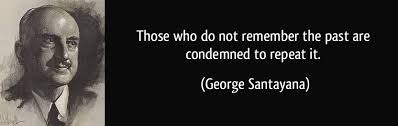
The old adage that those who don’t learn from history are doomed to repeat it shows up in ever unexpected places. Perhaps you are like me and lament the ugly bickering and outright attacks so prevalent in the Independent Baptist world today. I still find people expecting me to spew out current names in this series where I have decided to only write about issues because that is simply what is always done. What names I do want to mention here are Baptists who lived in the 1800s whom I have just discovered blazed a trail we regretfully have followed.

Reading a book to review as I often do, I stumbled upon the life of James Robinson Graves who had a pronounced influence in the early days of the Southern Baptist movement. I assure you his impact upon Independent Baptists today is equal to that upon Southern Baptists.

He is known for being the founder of Landmarkism. That teaching involves a belief in Baptist succession and a corresponding strong denominational identity. Though there are several points of his teaching that I would strongly disagree with, that is not the trail he blazed that I want to address except in one specific way.

It was his deciding what was Baptist and his relentless criticism of those who disagreed with him. Though he had a few short pastorates and did some evangelistic work, his career was defined by his publishing of Baptist periodicals where he strongly sought to sway Baptists to his way of thinking. While some good things have come out of Baptist periodicals, can you imagine the character assassinations and rank sin that has also been propagated by that method?

Perhaps his greatest contribution was championing the Baptist foundational thought of the autonomy of the local church and soul liberty that, though it sounded at times like a Jeffersonian republicanism or even a Jacksonian populism, still resonated truth springing from the priesthood of the believer. Strangely enough, his overboard attacks on those who disagreed with him was a direct denial of that soul liberty he at times articulated so well.

His battles consumed his ministry. He was engulfed in a battle with his pastor at the First Baptist Church of Nashville, who strongly disagreed with his Landmark teaching, and it turned rather ugly. Neither he nor the pastor looked very Christian by the time it was over. Finally, he was churched and left and started a church with a few others that he said was the true First Baptist (so much for church succession!). It is always surprising what we can throw out the window in an ugly battle and be so blinded to our own contradictions.

He sank into criticism. He tried to uphold truth with the unworthy tool of scorn. He attacked everybody who disagreed in any way. He attacked the Catholics. Then he attacked the Protestants as if they were no better. (Really?) Finally, and inevitably, he attacked other Baptists derisively calling them Pedobaptists. Catholics, Protestants, and other Baptists all equally corrupt because they did not agree with him on every point!

So, see what I mean? I won’t mention any current names, but Mr. Graves appears channeled in the breast of several others today. Just because we claim an issue is life and death and requires unquestioned acceptance does not make it so. I couldn’t help but notice how Mr. Graves proclaimed that he was being true to God’s Word without actually showing us. It certainly does not legitimize our pathetic unchristian behavior toward one another either.

Carry this historical tale to its end. History still loves to repeat itself. The Civil War came and his publishing business crashed. It could never get back to where it was before the war after hostilities ended. Ever notice how so many of these men or cliques crash before their ministries actually end? They seem to fragment, if not disintegrate completely. Check the periodicals, etc. of the 1970s, 80s, or 90s. See a difference? What do you suppose will happen in 10 or 15 years? Probably some new Independent Baptist will pick up the mantle of Graves while some others fade stage left.

Will we ever learn? If not, history stands ready to remind us.

Find all articles in the series here.

Is This Really The Time For A Witch Hunt? (IBTR #71)

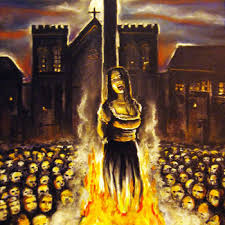
witch hunt

There is nothing quite as unnerving as something coming back as a boomerang and smacking you up side the head. I fear that many may be having that experience already. It will only get worse. Every group that gets carried away with its demands of holding the party line to points of minutiae has such potential in changing times. This series has highlighted many such points among Independent Baptists, but I imagine these have not been dominating thinking as much as it did only a few days ago.

The change is shocking; its pace alarming. A mere two months ago I wrote an article in this series entitled “Where Will Independent Baptists Be In 10 and 25 Years?” I am no prophet, though I feel more sure about those predictions now than I did when I wrote that piece. It was almost surreal to reread what I myself had written–not because it was particularly brilliant, but because things tipped over so quickly. I did not see that coming!

Shootings, flag debates, racial wars, and especially, homosexual marriage legalization, and the general mood of the country–no, I did not see it coming in a few days, even if I thought it would over time.

Do you feel as so many Christians do that we are the subject of a witch hunt? It may sound dramatic, but have you had your visions of them coming for you?… Did you refuse to perform that gay wedding? Are you intolerant? How dare you discriminate against me! I feel marginalized by you! Something needs to be done about you!… Pessimists never had it so good. Fearmongers look like brilliant scholars. These are the days to make crackpot predictions because you may look like a genius tomorrow.

There is new material to work with every day. Today, for example, I read of a Baptist Church in New York City that is taking major flak for merely passing out VBS invitations. People in that community said it was discriminatory because of the church’s position on gay marriage. They also said it was offensive because the church workers were white and the community is predominately black. See where that could go? Or think about the Confederate flag debate. Every argument made against it could also be made against crosses–remember the KKK used to burn them in the yards of innocent Black folks. See what I mean?

Now let’s come back to the issues that have plagued the Independent Baptist world for several years and the subject of this series. Do you suppose some folks have felt the victim of a witch hunt for a long time? The very way we all feel now? You know, scanning Facebook pictures for pants, or trying to find your music playlist, or looking for information that you visited an unapproved church or listened to an unapproved preacher, or you were disloyal in some way to our exalted group. Many have told me that they almost live in hiding because they so fear the backlash from family or churches.

Can the recent days finally make us empathetic? Will changes in our country finally make us realize what some of us have done? Can we finally see how we have made some others feel? Think about our country and world today. I assure you that some other Independent Baptist with a different standard is not the enemy, nor is some differences in worship styles, etc., our big problem today. We do have some problems today…big ones ( we still have our hope too), but these decades-long issues in some of our churches are not it. Read the news today and answer me this: Is this really the time for a witch hunt?

Find all articles in the series here.

A Truth We Baptists Should Never Forget (IBTR #68)

Sometimes in a series like this we discuss denominational pride, or in our case, believing that Independent Baptists are the only ones who are serving the Lord in an effective way. In recent articles we mentioned the extreme Baptist Brider position and its more common counterpart, the belief that we must separate from any who are not Independent Baptists. As you would imagine, once you start down that road the next step becomes separating from Independent Baptist who are not Independent Baptist enough.

I am on record as an Independent Baptist who finds that wrong, an example of misguided thinking and unbridled pride. Instead of exposing that as pride in this article, however, I would like to offer a fact that should be faced in any discussion on this subject. Maybe I should put it as a question.

How do you explain the mighty things God has done in other Christian groups? Further, how do you explain the incredible faith, love of Christ, and wonderful service of individuals in other Christian groups?

How do you explain Hudson Taylor, or George Mueller, or Jonathan Edwards, or George Whitefield, or John Wesley? These Christians were men of faith, but not Baptists. Human? Yes, but they are some of the choicest servants of Christ ever and only a twisting of the facts could state otherwise.

I began thinking of these questions as I was reading and reviewing The Korean Pentecost this week. It is the story of Presbyterians, some men I had never heard of, who took the Gospel to Korea. In 1865 Robert Taylor took passage on a boat up into Korea to take Bibles and be one of the first missionaries there. After being able to give out Bibles at a few stops, rumors took fire that this boat crew came to rob the Koreans. Long story short, when the boat grounded and was set on fire by the Koreans, the crew took its only chance and charged the shore with weapons. They all died. It wasn’t until missionaries returned years later that it was discovered what happened. They were told the story and how all the crew were killed. They recounted, though, that one man came ashore without weapons but arms filled with Bibles where he handed out all he could before he died.

The other extraordinary thing about that story was that the missionaries discovered many pockets of believers where that man handed out the Bibles. Who could deny that God’s hand was incredibly upon that man who gave his life for his Savior? As that Presbyterian work continued through the years, an incredible revival came, which was followed by persecution where many other bold believers gave their lives for Christ.

So back to our question. If God’s hand is only upon we Independent Baptists, how can this and the many stories like it be explained? God has blessed the work of Baptists. He has blessed the work of others. The Lord has sent revival to Baptists. He has sent revival to others. Baptists have given their lives for Christ. So have others. We have an incredible heritage, but so do others.

We can, of course, disagree on a few points in our efforts to be true to Scripture as best we understand it. In the case of those Presbyterians, we would differ from them on Baptism, church polity, and a few other things, but that in no way proves our superiority over them. Again, that tracing of God’s hand in both groups makes that an opinion that cannot be logically held.

So we must humble ourselves and drop a belief that cannot possibly be true. This is a truth we Baptists should never forget.

Find all articles in the series here.

J.-Hudson-Taylor

Where Will Independent Baptists Be In 10 Years and 25 Years? (IBTR #66)

future

It is a scary exercise to contemplate the future. There is so much we do not know, so many variables we cannot accurately evaluate. Still, trends around us might suggest a general direction that might allow us in the broadest terms to make some good guesses. “A” does often lead to “B” in a world where God’s principle of sowing and reaping will never pass away.

What does this have to do with anything in a series about issues we face in the Independent Baptist world? In comes into play when we ask…where will we be in 10 years?…where will we be in 25 years? To answer these questions and make sensible predictions will involve considering two areas: 1) the natural progression of issues in this series, and 2) trends in our country that affect every Christian group.

Natural Progression Of Truth Revolution Issues

1. The Pants Issue will fade away. It will retreat greatly in 10 years and fade almost completely in 25 years. It has been divisive, split a few families and churches along the way, but it simply will not last. Hundreds drop it yearly and others are trying to get up their nerve. The logic behind this prediction comes from those constantly shrinking numbers, from the inability to frame either a biblical argument for its necessity or an intelligent explanation for how pants and immodesty (a clear Biblical idea) are synonymous, and track records of other such standards as strongly upheld in other generations. For example, 30 years ago TV was as forbidden in as many Independent Baptist homes as pants are today. Where is the TV issue today? Almost every one of those homes have a TV today.

2. The Music Issue will change but it will not go away. I do not believe what is argued today will be the same in either 10 or 25 years. The logic there is that there has always been a music debate and likely always will be. Music, in some respects, is a matter of taste. There will always be a temptation to confuse that with its being not worldly. It will always be hard to pin down. The Fanny Crosbys of the world can be radical in one generation to some groups and too conservative in another. I can’t see what would change it.

3. Alliances among several Independent Baptists groups will shift. History dictates this prediction. Every 10 or 25 years the most vocal groups cycle a few times. Yesterdays close friend is preached against at today’s conference. This lamentable fact likely is a natural result of a hyper separatist outlook all too common in some circles. Couple that with the sin tendencies we all fight and it is inevitable.

4. Standards may change, but legalism will thrive. Legalism has always thrived and will till Jesus comes. The temptation to self-righteousness and a need to earn God’s favor will never end until Satan is chained. Religion arises from the dark core of who we are as sinners. Even those who love holiness and hate legalism are haunted at some deep level by these Gospel-hating, grace-denying thoughts. The best we can do is get it right on a personal level.

5. Our greatest challenges will arise from without. For some time our challenges have come from within (hence this blog series). I can’t pin down if it will be real soon, 10 years, or 25 years, but we won’t need articles like this series for long. That leads to…

Trends in our country that affect every Christian group

I may sound overly pessimistic here (I sincerely hope someone can show me this article in 25 years and tell me I was an idiot!), but recent news and changes that are being made in our country do not bode well for Christianity, at least as we have known it and handled it. A persecuted church may thrive in ways we have been seen before, but it will surely change what we are used to.

1. Bus Ministry will die. I am in no way criticising what has been a blessing in many ways. My only negative would be those who only use it as an attendance and baptism numbers game, but it has brought many under the sound of the Gospel. Beyond the growing antagonism toward the outreach in some communities, and the ever-expanding possibilities of lawsuits and accusations, the openness of our government to criminalize Christian work doesn’t bode well for bus ministry.

2. Church-run Christian schools will fall by the wayside. They are already closing in alarming numbers as the financial side is now close to impossible. The likelihood of a national approval of homosexual marriage and the corresponding ability of the IRS to revoke tax-exempt status for an anti-homosexual marriage stand will surely be the greatest challenge for us. When we lose that exemption, a 30% tax rate may kick in. Schools will evaporate in a moment in that environment. Our Bible Colleges will be strained as well.

3. Decreased giving will strain all churches and ministries. We have long faced Christian apathy and disobedience, but the loss of a deduction for charitable donation will erode giving even more. Couple that with paying taxes on what we do get and that will be financial crisis. I am in no way saying the Lord cannot provide, but that how we do things will change to what is done in other parts of the world today. With this potentiality, even taking on long-term debt or large building projects are tenuous at best.

4. Other changes will follow. It is hard to predict what other dominos that may fall. It may require the churches going underground. Our invitation-to-church approach will likely give way to one-on-one work only

Perhaps this is enough legitimate prediction. My faith in God has not wavered. I still believe He can take care or me and you. Still, I know changes to all I have known will be a challenge for me. Maybe it would be time to pray and prepare our hearts for the handwriting on the wall. And for sure it is time to live for what is really important. If it won’t be important in an underground-church environment, it likely isn’t too important now.

(You know I don’t really like this article myself, but I am compelled to write it. God bless you all!)

Find all articles in the series here.
Old Fashioned Church? (IBTR #64)

A battle rages on today that will last until Jesus comes–the battle between traditional church and something newer or contemporary. I fall in a more conservative line than many, yet do not get as worked up about some of the newer stuff as some do. In the Independent Baptist world the battle is even more intense than in other circles. There is not, to my mind, some simple answer that is beyond dispute. In either case the argument will go better if there is no one in the room from the other side.

Still, there is an unusual phenomenon in these days. Some advertise themselves as being one of the few that still do “old fashioned church”. Again, if someone says they are traditional or conservative, those terms at least make sense. We have some idea what that means and it seems at least fair advertising.

While there is not one uniform model of the churches that call themselves old-fashioned, some of them carry a few similar traits. We should, too, specify that calling ourselves old fashioned when we feel the whole world is running ahead of us is a fair and common usage of the word. To use it, though, as many do now should have a more accurate time element to it–it should be at least a little ancient.

In my unscientific observation, I have noticed many of these churches will have conservative music, though it may have some get-up-and-go to it. Others may prefer a great deal of shouting. Others a very specific order of service. I have nothing negative to say about any of it. Phrases like “have it your way” come to mind; or as they said where I grew up, “More power to you.”

The funny thing is how did those specific things become the standard bearer of being old fashioned? Right or wrong, how far back can you really trace them? If you carried one of these old fashioned services back just 100 years, how do you think it would have been perceived? Or how about going on back to the frontier in colonial days? Do you think you would have been thought some sort of modern usurper of the godly way of doing church? I think you likely would have. I think we have no evidence that our “old fashioned ways” look anything like what a service led by the Apostle Paul would have.

A lively, yet very conservative, piano piece would not have been accepted in the not-so-recent past. I have read of the scandal the first organ playing brought to church services in the Middle Ages. 

It is a fair discussion to try to figure out what is appropriate for our churches, or more importantly, what would please Christ. Whether we all arrive at the same answer, we should all seek the Lord till we think we are where He would want us to be. On the other hand, I don’t see how we are going to make much progress on the discussion between ourselves until we learn to choose our words more carefully. I am not sure “old fashioned” as often used is very accurate.

Find all articles in the series here.


Misconceptions About The Truth Revolution (IBTR #63)

Being misunderstood is a risk with any passionate writing. Misconceptions will almost always arise when dealing with painful problems. The status quo will always have its champions. To do good on any level will always strike someone as evil. Such is life.

In this Truth Revolution, from the day I penned the first article, I went in with both eyes open. Perhaps you think me ill advised, but I was not naive. I knew. I always knew what losses might follow the gains I sought. I counted the cost, understood the calculated risk, and wrote the series anyway. I used the picture of Revolutionary War soldiers in the original article for a reason. Forgive the illusions of grandeur, but I saw myself writing like the Founding Fathers did. They paid and so could I. (On the other hand, I never saw myself as that big aimagevoice–hopefully just one small voice in a growing number of voices.)

I offer no apology. I have no regrets for what I have written. I am sure it could have been better in ways, but I will stand by it, such as it is.

Still, misconceptions by good people can happen, just as logical criticisms can be offered up. I would like to address a few.

1. You Give Fodder To All Who Attack A Pastor.

While I have written extensively about pastors or leaders abusing people, that in no way denies that people can sin grievously against a pastor. I am a pastor and have had that experience before myself. Every situation must be looked at honestly, carefully, and Scripturally. Still, we must realize that the extra authority of leadership also demands greater cost, even putting up with more. Our accountability must, then, be higher. We can do more damage from a position of authority than those who do not have it and that must be taken into account.

2. You are hurting Independent Baptists.

I remain convinced that those of us who address our problems instead of acting as if they do not exist do Independent Baptists the most good.  My goal is not to destroy but to salvage. Still, my first prerogative is to be true to Scripture and Christ. His Name is more important to me than the name Independent Baptist. As it turns out, there is no shame besmirching His Name while there is in too many of the groups in Christianity including our own.

3. You are encouraging those leaving the Independent Baptist world.

I am aware some are leaving. There have even been a few isolated cases, I am told, where someone hands a printout of one of these articles to a pastor while walking out the door. That was not my original purpose, but even if it is done in a case where the church member is wrong that no more makes this series look bad than someone quoting the Bible out of context makes the Bible look bad! We must remember, too, that people leave. We must let them leave without harassment. It is only cults that do that! Letting them leave in peace is normal and allows them to more easily come back if they ever choose.

4. You are harming the good pastors.

One of the really good guys said, “how are if ever going to get out from under this if we keep discussing it.” It can only hurt us, though, if we are guilty of it–that is the beauty of “independent.” When we pastors are faced with criticism, we have a process to go through. First, we must examine ourselves to see if it is true, and if it is, we should fix it. If it is not, we must let it go realizing that we are partaking in the sufferings of our often-critiqued Savior. The truth is, we should just do right and lies won’t stick except with folks who have issues anyway. Let’s treat our flock with such love that any discussion of abuses could have no effect on our people because they know better about us. Lies can never alter truth anyway.

5. Do you even think you are accomplishing anything worthwhile?

I am not in a position to know the lasting effects of this series. It probably will be completely forgotten in ten years. I get letters from people who say it has helped, but that is, I know, anecdotal evidence at best. Maybe it helps a few; is that worth it?

I will just leave that to the Lord.

Find all articles in the series here.

So Who Is Your Lord And Master? (IBTR #61)

image


Who really calls the shots in your life? Who is the one you truly answer to? I must address an ugly problem. You see it inside churches. You see it inside circles of pastors. This one has crept into some corner of every part of Christianity, I want to share what I have seen among some in the Independent Baptist world. What am I speaking of? Having someone as Lord and Master of your life who is not named Jesus Christ!

Let’s start with pastors and others in ministry. Most of them would vociferously proclaim that Christ is their Lord and Master, but there is creepy evidence that it is not so. What would be the clearest proof? If some well known person, a known leader, can call you up, tell you something, and it will necessarily bring some change in your course of action, that person is slipping into the role of your master. (I am not especially picking on these leaders because if you are crazy enough to always do what another says you are putting an insurmountable temptation before them–who could resist?)

So there be no misunderstanding, let’s readily admit that it can be a good thing to listen to others. Respect for someone may fairly require a more vigorous due diligence in weighing the issue, but that is all. The question becomes can we, at the end of the day, say “no” and therefore not violate our consciences before Him Who is truly the Master? Often it does not work out this way.

While this is clearly a breach in our Christianity, that is not to say it is easily overcome. The pressure is real, perhaps even relentless. There is the larger group you are part of. If that leader writes you off, you may be done–at least in the circle you are most likely to be accepted in. That is terrifying. If you can muster the courage to withstand that loss, then there are your friends, or maybe even your family, that you could be in very real danger of losing. This is more than many can bear to face. Sad to say, this may not be your imagination running away from you, but a real foreboding of coming events.

Still, for all that agony, we have no right to give away to others Christ’s deserved Lordship. How do we rationalize it? It seems to me that we count the cost but with faltering arithmetic. There is a cost both ways, but we fail in seeing which is truly greater. My suspicion, too, is that we know the Lord will love us if we fail Him, but we figure these others might not. May God grant us a little fortitude

Now let’s turn our attention to the rank and file. Actually it is the same problem with only the slightest variation on a theme. The actors switched. Above it was pastors before well-known leaders and the corresponding peer group, and now it church members before pastors. Everything else is pretty much the same. Pressure. Fear. And finally, failure.

The only apparent difference is that the church member stands in closer proximity to the pastor and might not have the same luxury of sneakiness as the case where the leaders and peer group are miles away.

You would think that pastors would remember how that pressure feels to them and be more gentle with their flocks. Usually, the reverse is true. They must, I suppose, decide that if I am going to be closely watched and have the bit ever held tightly in my mouth, then you people will too. They must, sadly, come to believe that is how the game is played.

But that is not how the game is played. In fact, we are not playing a game. The plan of salvation our Savior wrought is anything but a game. He was ever so serious when He said we were bought with a price. The real pain we feel in pressure and loss of prestige, friends, or even family, is little compared to the pain He gladly suffered for us. We need no further arguments for what we ought to do. We know. It is, only, time to answer the question sincerely: So who is your Lord and Master?

Find all articles in the series here.


So You Must Be In Full-Time Ministry? (IBTR #59)

Have you ever been in a meeting where the strong impression is given that any life other than being in full-time ministry is a failed one? Have you not particularly felt that call on your life but been pressured, or even guilted, that if you were where you should be you would go into ministry? I am not sure what level this happens in other areas of Christianity, but it is widespread in the Independent Baptist world.

This is a problem, a problem with many implications. I say that even though I love being in the ministry and think it is an awesome life. I also love seeing young men go into the ministry and fear we may eventually face a crisis where there will not be enough in ministry to meet all the need.

Still, to say that one must be in full-time ministry to please the Lord is wrong on many levels. It degrades those you who are called to other noble lives. It overlooks that we need Christians in every honest field. It misrepresents Scripture as well. Think of some great Bible characters who were preachers.

The most collateral damage with this problem materializes in misspent lives. It could be as minor as a young person being forced into Bible college. That is a minor thing as Bible college could do you some good even if you did something else. Then, though, there are those highly-charged services where the aforementioned pressure is put on and many respond to “the call.” Then some fine young will not want to be the one who doesn’t love the Lord and in an emotional moment he will go forward and say he is called.

This will go wrong in some way as “the call” is real but must come from the Lord and not emotions. That young man may graduate and then either fail completely, not because he is bad or undedicated, but because he is uncalled. Or he may never land in a pastorate and feel like a failure when he is only uncalled. Some of these guys make wonderful Christian layman and thrive in some career that they thought was only to pay the bills. They may do pulpit supply, or be a deacon or song leader and do fine. Why? Because it was where they were called. I hate to see young men who finally stumbled into their real calling still feel like a failure on some level. It simply isn’t true.

The lesson for us is that we should encourage those who faithfully serve the Lord even if they once thought it was to be in ministry. We should also quit putting undue pressure on our young people. Our counsel should be that they find God’s will, no matter what it is, and give it their best. It is far better to pray for God to call more men than to push young men into a call they did not receive. This would spare a lot of pain on many levels.

Find all articles in the series here.

IMG_2370