Coolidge by Amity Shales (Presidential Bio Series)

coolidge

Here is an awesome book bringing to life a man I have wanted to know ever since I heard he was a role model of Ronald Reagan. Shales was a good biographer who stepped out of the way and let us know Cal.

In her deft hands, the simply telling the story helped us see that Coolidge was a good man. He was ever motivated by principle and was, perhaps, the least politician who ever sat in the office.

He was a hard worker, and especially tireless in going after budget cuts. The country and the economy thrived in his time in office.

Shales shows us his full orbed personality. He likely was a little harsh at times. His moniker of “Silent Cal” was no exaggeration. He was a little jealous of his beautiful wife too, but he clearly adored her. Shales related one strange episode where his wife and a secret service agent got lost hiking. He exploded and the agent was transferred. It did seem he was at least a nominal Christian.

He seemed to be the perfect President for his times and you wonder if he would have done quite as well at other times. He handled the Boston Police Union strike in such a way that perhaps he could have well handled a major foreign policy crisis, but we will never know as he was spared that in his term.

I did get the feeling that he would have better handled the Depression than Hoover, as he fully realized the market was overvalued in his day.

I came to really like this man and came to love this biography along the way too. This is a real winner.

Read all in the presidential series here.

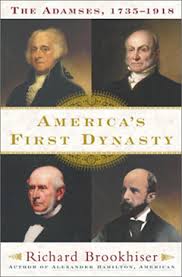
America’s First Dynasty: The Adamses by Brookhiser (Presidential Bio Series)

adams

This volume is like presidential biography plus. You get President John Adams as well President John Quincy Adams. It doesn’t stop there as you will trace the family to its dissolution too. Living up to its title “America’s First Dynasty”, Richard Brookhiser gives us another of his fast-paced, brief biographies that are a joy to read.

Brookhiser writes well on John Adams, though I found him to be less sympathetic than David McCullough. The political and historical side were adequately presented, but his niche is clearly familial. This family with two Presidents certainly had a cadre of failures too.

John Quincy Adams was shown as the striking, successful character he was. It is interesting that John Adams had only one good son (John Q) and John Quincy in turn had only one too. It seemed to me that Brookhiser missed what made for the success in these cases: time from a father. This was clearly missing in the others who failed.

The rest of the book is almost depressing. Each generation lost sons (often to alcohol) who went really bad. The last Adams was Henry and his story was one of despairing of life. He had no children and the dynasty ended, though as you read, you will see it actually ended before.

This is a fine book and the succeeding generations do not, at least for me, take away any admiration for our two President Adams.

Find other titles in Presidential series here.

The Scariest Book I Ever Read And What It Taught Me!

third reich

It was beyond belief. The story of Nazi Germany and its maniac leader, Adolf Hitler, is more than history; it is a parable of what can happen. It is the ultimate lens through which to view current events. It is the worst case scenario of the proverbial history repeating itself. The Rise and Fall of the Third Reich will grip you in unexpected ways.

Strangely enough, it was not the war itself, or even the bloody terror before and during it, that was most horrifying in this episode of history. No, it was that an Adolph Hitler could rise from where he did, have such complete control over a people, and go on to get away with all he did with the masses following like deranged sheep.

Hitler was nothing. He had no track record of anything other than finding ways to bluff or manipulate his way to power. This proponent of the superior German race was actually an Austrian. This great warmonger had only been an undistinguished corporal in WWI. He failed at all he did and kept going forward as if he had greatly succeeded. (It kind of reminds you of other leaders who were only community organizers). He came out of no where and seized power by effective propaganda and shrewd political moves. During his whole career he habitually told lies and so effectively that you wondered if he grew to believe them himself.

He was consistent in some things. He never wavered on who was subhuman–Jews first and foremost, then Poles and Russians. (Like some see the inferiority of Christians today). He always believed the state was supreme and people dispensable to uphold the state. Of course, it took a while to realize that he was the state! Any amount of blood was legitimate to shed in propelling the state and its aims forward. (For him I suppose it took a village to raise a child).

Nothing he said was too ludicrous for the masses to swallow. There was a sizable number of Christians in pre-WWII Germany, but they made no outcry. Somehow he convinced them that what he said fit Christianity, at least until it was too late to do anything about it. He rewrote history (the circumstances of the end of WWI) until he convinced people who had actually lived through it! (American history is not matching what I remember when it is told today either).

He incredibly manipulated other countries. His first two major conquests of territory were bloodless. He simply made baboons out of other European leaders. He never kept his word in any deal he made and yet spoke as if he had the greatest moral authority when it was time to discuss the next one.

He mastered the art of controlling the conversation. He developed methods to stop the mouths of those who disagreed. (Christians, do you feel our mouths being silenced?) He realized that getting the minds and hearts of the younger people was essential and so started the Hitler Youth. (Do you feel like we just woke up and found a generation that finds things like gay marriage perfectly acceptable?)

As I read I kept trying to tell myself that in America we have more background in freedom and would never get sucked in to this extent. We have many who could not be forced into silence. Yet this tale shows just how far things can go. It is a horrifying portrait of people closing their eyes along with the exceeding depravity of men.

Actual Book Review

An actual masterpiece! No novel could ever hold your attention to a greater degree. William Shirer was the perfect man to write this book. As a reporter who reported from Germany until the war and again after in the Nuremberg trials, he saw many things firsthand including appearances by Hitler and his associates. In addition to that familiarity, he did extensive and effective research. Finally, he brings the skills of a gifted writer. It is a page turner.

The two criticisms that are most often leveled against this book take nothing from it. Some say he was taken in by Hitler’s charms before the war and denies it in the book, but I read several humble admissions that he believed Hitler when he should not have. He also writes of homosexuality as a perversion in a few references. That was his belief and the prevalent belief of those times, and for a few of us still today. I appreciate a volume without the baggage of political correctness.

I believe this book will never be superseded. It is simply that good.

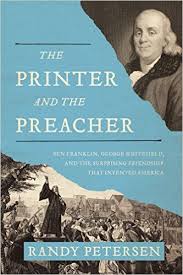
The Printer And The Preacher by Randy Petersen

printer preacher

Here is the merging of two categories of reading that, if you are like me, you enjoy–Christian biography and Colonial America. You get in this volume two prominent characters in those categories–George Whitefield and Ben Franklin. It is a pleasing, somewhat stretched, and breezy read.

His premise that the friendship of these two men “invented” America failed, but the book did not. These two men made distinct contributions to what became America, and they even had some sort of friendship, but the friendship itself had nothing to with anything in forging of our nation. In fact, the friendship was much ado about nothing as he failed to uncover just how deep the friendship was. I suspect it was not that deep and we will never know for sure beyond that.

Why I will still recommend the book is that these two men with their different lives did have such an impact. The similarities and differences in the two men are fascinating and how people took to them is something Petersen did capture. He succeeded in bringing Franklin alive more than he did Whitefield in my opinion. Part of the reason, I imagine, is that he too followed the oft-discredited study of Harry Stout.

Still, with the above caveats in mind, it remains enjoyable reading.

I received this book free from the publisher. I was not required to write a positive review. The opinions I have expressed are my own. I am disclosing this in accordance with the Federal Trade Commission’s 16 CFR, Part 255.

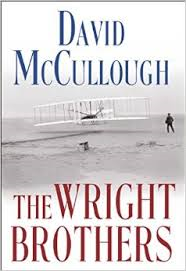
The Wright Brothers by David McCullough

He’s still got it. David McCullough, a favorite for many of us, weaves another powerful tale. I’ll confess in my looking forward to his next book that I was disappointed when I saw the press clippings for it some months ago. I wanted another John Adams or 1776. I don’t feel that way after actually reading the book. In the hands of this master writer, we learn both how important and interesting were Wilbur and Orville and how revolutionary flying was when they brought it about. I don’t believe anything in my lifetime has equaled taking to the skies in the early 1900s.

Wilbur and Orville were unique. Never showing any interest in getting married, never afraid to go their own way no matter what anyone else thought, and never deviating from the raising of their preacher father, they do not fit the common mold. Dismiss out of hand any comments that the characterizations here are one-dimensional. The Wright brothers simply do not fit the modern mold especially. Mr. McCullough obviously felt no need to manufacture some speculations that tantalize our generation. He just gave us the Wright brothers as they were. I enjoyed getting to know them and have nothing but respect for them. The saw the prize out ahead of them and never rested till they had it.

The setbacks, the hardships (Kitty Hawk was not pleasant then), the secrecy when fame was dangling in front of them, the danger, the crashes, the occasional family drama but unwavering devotion–the story never sags. The competition with others trying to get the title of first to truly fly was always part or the story. The initial reluctance of the U.S. to show interest while France was ready to embrace them is interestingly portrayed. You admired the brilliance of these amateur mechanics as you read and are amazed at the mathematical and scientific ground they covered in their relentless research.

This volume can proudly take its place on the hollowed bookshelf of Mr. McCullough’s writings. Another piece of our history is now preserved with distinction.

I received this book free from the publisher. I was not required to write a positive review. The opinions I have expressed are my own. I am disclosing this in accordance with the Federal Trade Commission’s 16 CFR, Part 255.

wright brothers

Reading Non-Fiction

image


I wonder if any of you are like me: you read so much in a few areas that you fail to read in other great areas. I read so much on Bible study, theology, and ministry that I miss other helpful things. For the preacher particularly, it is this kind of broader reading that will imbibe realness throbbing with life into our preaching.

That is not to say we should just read anything of the millions of books printed. Pablum is all around us! But there are wonderfully enriching books too. Great literature, non-fiction writing including biography and history can all made distinct contributions to our lives. 

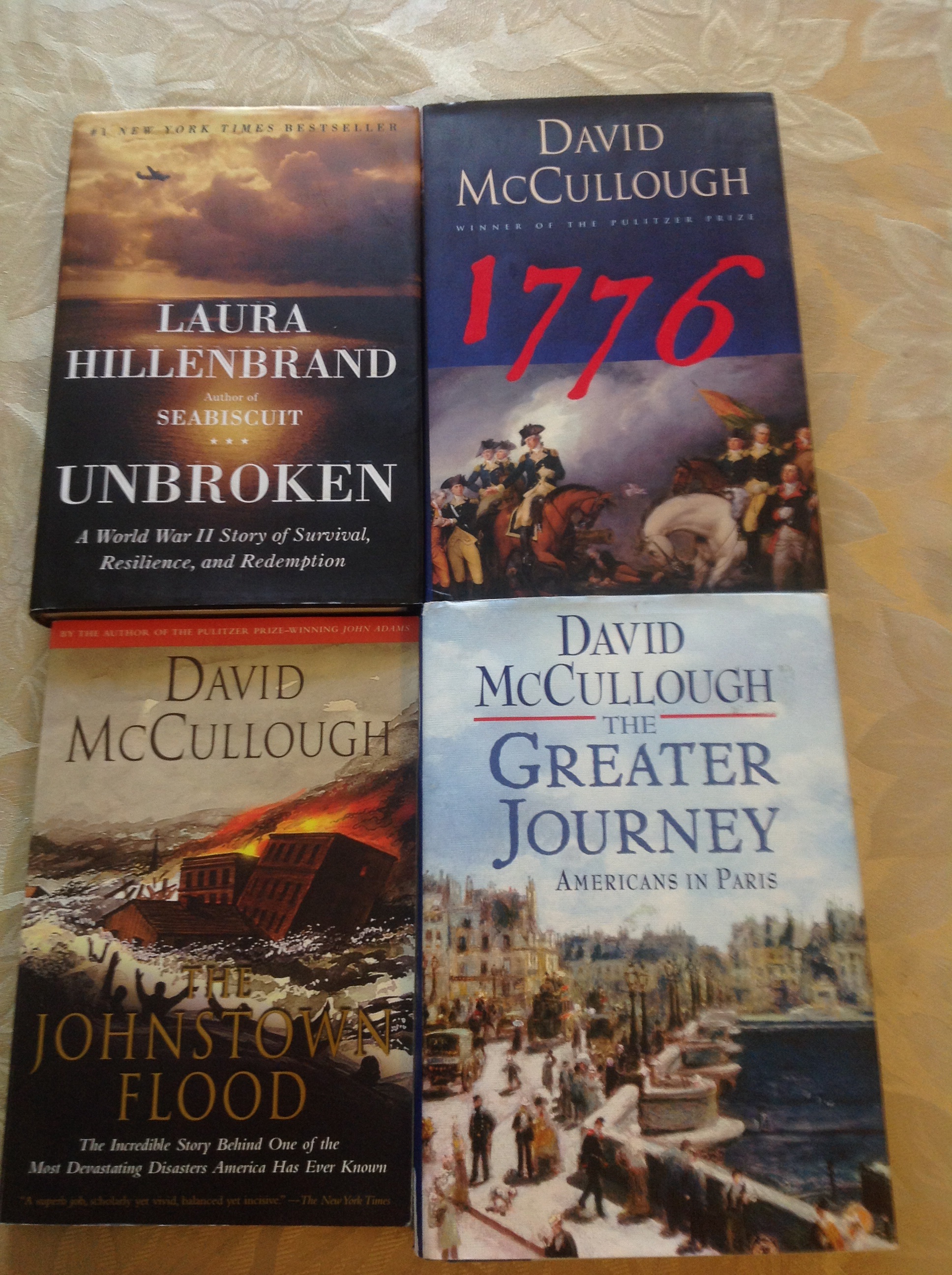
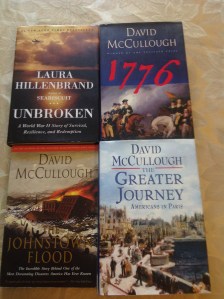
I want to focus on non-fiction in this post. Here are four outstanding titles that will stick with you for a long time. You may notice that three of the four are by the same author—David McCullough. When you find an author that really connects with you, you should feel free to go to that well again and again.

As a prelude to this post I went to my Goodreads account and looked at several of my friend’s reviews there and noticed that many, and especially the preachers, had some of these kinds of titles listed.

I may add other reviews of this sort later and so I will kind of make this post the hub for reviews or discussion on non-fiction titles (though I plan a separate one for Presidential Biography).

I would love to hear recommendations from others since many of you may have read more than me in this category and I personally need to expand. Just send me a message or use the comments section of this blog.

  1. Unbroken by Laura Hillenbrand

What a story! A friend, Mike Montgomery, recommended this title to me. As he described the book, I noticed he could recall more facts than one could usually muster from a book previously read. I thought then that book must have been special to have gripped him so. I later read it and it was all of that and more.

It is the story of Louis Zamperini. A rough-and-tumble youth finally guided by a loving brother to run track, he rose all the way to the Olympics and even met a pre-WWII Hitler. Later called into service in the WWII Pacific Theater, he was shot down and spent a harrowing 47 days in shark-infested waters on a raft with little food. This part of the story alone would have made an awesome book, but then he was captured by the Japanese.

His suffering at the hands of the Bird, warden of the prisoner camp, are beyond description. Ms. Hillenbrand did a great job in telling the story, so much so that you continually wanted to get your hands on the Bird as you read. There are so many interesting things, so much determination, but you can read and find out yourself.

He got saved after the war and his quest to go and forgive his tormentors is a challenge to all Christians. Ms. Hillenbrand is not a Christian writer, but did little to obscure this telling fact. The recent film made of this book is fairly good in following the book, but stops short of what really explains his life. As is proverbially the case, the book was better than the film.

  1. The Johnstown Flood by David McCullough

The first book written by the Pulitzer Prize author that is as gripping as any he wrote. Forgive the triteness of saying this was better than fiction, but it was. Drama, intensity, tension—this volume had it all. Since it was history, you knew as you read that the dam would break and agonized over the choices made by some. Then the description of the flood itself was as exceptional writing as I have ever seen. They call his writing style the “documentary method.” Whatever it is, it will stay in your memory a long time. A masterpiece!

  1. 1776 by David McCullough

In an interesting book idea, McCullough takes our history of one year (1776), but the one year that we teetered to the point that it could have easily gone either way. George Washington rises to the top as the man, who despite modern critics, is every bit the hero some of us think he is. Defeat and failure do not crush where they so easily could have. The Battle of Brooklyn, the escape that should not have worked, the Christmas surprise, all changed our formally disappointing prospects. More than a Washington biography, other generals, like Greene and Knox, prove their mettle. Here is a real page turner!

  1. The Greater Journey by McCullough

This volume has not garnered the praise that some of his others have, but that is only because the subject was not quite as thrilling. The writing itself is still of the highest standards. It seems to me that in his John Adams biography he became fascinated with the French influence of our earlier history. That influence is as dramatic as he came to believe and explains more about American history than most imagine. It connects the dots of the country we came to be. Perhaps it does not end on a dramatic high, but it is a pleasurable read.

Happy Reading!
Dead Wake by Erik Larson

The last crossing of the Lusitania gets a vivid, dramatic telling in this superb volume. This was my first go with Mr. Larson, but I found his writing matched the superlative blurbs I’ve seen for his other books. My knowledge was limited on the Lusitania, so learning and exciting reading met together here.


The book never drags and is filled with tension throughout as you know what is coming. We meet several of the passengers, see the dynamics of personality of Captain Turner, and back office workings of the Cunard ship company. You get to know them to the point that their fate during the actual sinking is high drama. The scene of the dead wake itself, the torpedoe coming across the water and being seen by many, is well done too.


 We learn of Room 40 and what the Admiralty, including Churchill, knew about the U-boats. They could not tip their hand and risk losing the Germans knowing about the codes that they had broken. Then, from German records of the captain of U-20, we watch the story unfold from their perspective. We learn too of complications because of war that added to the horror of the event that could have possibly been avoided. 


In a few paragraphs here and there President Wilson’s story is brought into the story. You will be convinced his budding romance had a great effect on what he did during these critical events.


Though this volume can hold its own with a great novel, I truly believe it passes the test of being well researched as well. Though Mr. Larson made some good conclusions, he seemed to strive make you and I able to make our own. The book succeeded on every level (except the attractive book needed pictures) and I highly recommend it as 5-star plus!

I received this book free from the publisher. I was not required to write a positive review. The opinions I have expressed are my own. I am disclosing this in accordance with the Federal Trade Commission’s 16 CFR, Part 255.    


No Greater Valor–A Thrilling Read

Looking for an exciting historical read that at least acknowledges that the Lord works in the affairs of men? You will love the fast-moving story given by Jerome Corsi on the Siege of Bastogne. The action vivid, the characters real, this story comes alive in its 300 pages.

It is not, in my opinion, a Christian book. It is respectful of Christianity, though it even makes no theological distinctions between, for example, Protestant Christians and Catholics. The heroes from both (particularly chaplains) are presented glowingly, just as they should be, though the differences that will always divide are never mentioned.

What makes this volume be published by a Christian publisher (Nelson) is its recognition that God made the greatest move and the heroes of the battle are the first to admit it. Most importantly the weather, followed by fortuitous developments that were clearly beyond just good planning, and finally some smaller unexplainable events, worked together to show God’s favor.

Much is made of the prayer that Patton pushed out among the men, who clearly embraced it, and that thankfulness to God that followed the results.

The story of the incredible soldiers involved was well told too. Eisenhower listened to all sides and made the big decision. He was moved by the sometimes reckless Patton, whose unorthodox ways were made for this battle. Patton, a living paradox who was obsessed with God’s favor and prayer and yet cursed often and worked reincarnation into his Christianity, was the man of massive ego who yet pulled off the most amazing pivot northward of an army on record. General McAuliffe, the understated commander in besieged Bastogne, was a model of courageous leadership. There seemed to amazing courage, and as the title suggests, no greater valor, in every group involved.

I think you will enjoy this book. I recommend it.

I received this book free from the publisher. I was not required to write a positive review. The opinions I have expressed are my own. I am disclosing this in accordance with the Federal Trade Commission’s 16 CFR, Part 255.

E

IMG_2318