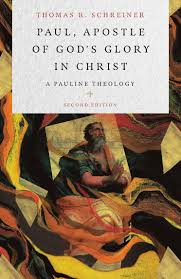
Paul, Apostle of God’s Glory in Christ (2nd Ed.) by Thomas Schreiner

book paul

To label a book “important” or “influential” is probably too often done, but it would be hard to deny that this book has held that reputation for 20 years. Now, Thomas Schreiner takes the time to update his work in this second edition. When we are discussing Paul’s theology, no one book holds the field. In fact, I can’t think of a scholarly subject that has more pages written about it, particularly over the last 30 years or so. In that light, holding an important place in that crowd is quite an accomplishment.

Another reason that some of us might like this book is that several of the other most popular books on the subject are not nearly as conservative or orthodox. Many are mesmerized by the so-called “New Perspective on Paul”. To be clear, this book is not just a book against that perspective, but it will sufficiently address it for a thinking person and put it out to pasture as it belongs. Another feature to help you ascertain its value, is that it follows more of a reformed position in many cases and, perhaps, is most influenced by John Piper whom he mentions in the preface. If you like me are not as reformed as him, as many are not, you will still find incredible value in this book.

He says he does not want to make the book so boring as to interact with every scholar out there. While he may be selective, he is effective. I think it’s fair to say that he does not dodge any relevant issue in Paul’s theology.

Permit me to oversimplify his approach. He takes the position that Paul’s is championing God’s glory in Christ. In other words, Paul is the writer in scripture who most addresses the doctrine of salvation. In that light, he takes what Paul teaches us on a round-robin circuit of systematic theology. Again, he really doesn’t hide from any issue whether it is controversial or not. Some things he addresses are missed by others as well. Don’t miss his chapter on suffering. Still, he holds as the organizing principle that Paul is upholding God’s glory in Christ.

The value of this book is not it’s final conclusions, but it’s help for you to reach yours. In that way, let’s keep those labels of “important” and “influential”.

I received this book free from the publisher. I was not required to write a positive review. The opinions I have expressed are my own. I am disclosing this in accordance with the Federal Trade Commission’s 16 CFR, Part 255.
The Holy Spirit by Gregg Allison and Andreas Kostenberger

book h sp

This inaugural volume in a series entitled “Theology for the People of God” is so ideal that it makes one excited for the whole series. At the same time, this book sets the bar high for those who will write the following titles. Scholars Gregg Allison and Andreas Kostenberger, prolific scholars to be sure, took the time to produce a book we need. As you can guess, the work has a conservative and baptistic bent, but is fair in all the issues and one that everyone should use.

This work is divided into two parts: biblical theology on the Holy Spirit working its way chronologically through scripture followed by systematic theology that digs deep into the doctrine itself and places it in the context of all doctrinal thinking. I found the second half more interesting, but that is not to disparage the first half. It was more a matter of taste and enjoyment of subject. To be sure, it is critically important to explore how doctrines are developed throughout scripture.

The second half on systematic theology began with an outstanding look at the Holy Spirit as part of the Trinity. The chapter on the deity and personhood of the Holy Spirit was just as exceptional. In all, four chapters explore the Holy Spirit both as an Individual and Collective Member of the Trinity. From there, the Holy Spirit’s role in Creation and Providence, the role in scripture, relation to angelic beings, relation to human beings, relation to Jesus Christ, the role in salvation, relation to the church, and the future. As you can see, nothing was left out in systematic theology and all the content presented was level headed, interesting, and enlightening.

As with any work that touches on systematic theology, of course, you will disagree on some points. I did, but none of the major points. My only criticism of the work, and it is a slight one, is I felt that the development of being filled with the Spirit, or being full of the Spirit, and distinguishing it from the baptism of the Spirit, perhaps, fell a little short.

This is an outstanding book that every Bible student and pastor ought to have. I have at least 20 pages in this book especially notated for something I want to remember. For me, that’s a sign of a great book. I say, bring on the rest of those volumes in this series soon!

I received this book free from the publisher. I was not required to write a positive review. The opinions I have expressed are my own. I am disclosing this in accordance with the Federal Trade Commission’s 16 CFR, Part 255.
1, 2, and 3 John (Revised) [WBC] by Stephen Smalley

book 1 2 3 jn wbc

This commentary was originally published in 1983 and was overdue for updating. It appears that revision took place in 2008 and yet we have another new edition coming out at this time with a superior binding. Years ago the WBC series printed nice hardbacks with dust jackets and a few years ago changed to a more case-bound style with some of the earlier reprinted volumes having what would best could be called a shabby cover that simply would not last. I’m happy to see this binding that appears will hold up much better.

At this point, most Bible students are familiar with the WBC format. You either love it or you hate it and it falls on the more scholarly end of the spectrum. It is known, additionally, for its depth of exegesis. That is clearly true in this volume. The most scholarly comments that might not be interesting to pastors or students is in a note section. A section on form, structure, and setting has some interesting help, but the actual commentary is the best section in the book. There is some Greek, but the English is nearby and with just a little effort any serious student can use this book.

The introduction has real depth, though I can’t really follow his description of the Johannine Community. That was something of a fad for a few years and he probably explains it as well as anyone if you would like to understand it. Nevertheless, he digs in on many issues making this an important contribution.

This commentary falls more on the critical side of the scale. For example, this publisher, Zondervan, has a book in its ZECNT series that is much more conservative. On the other hand, Smalley has more evangelical beliefs than many of his fellow critical counterparts. This commentary is by no means the most critical commentary in this series. I would go so far to say that this would be the commentary I would recommend if you preferred conservative commentaries and yet wanted to have one quality more critical commentary just to cover your bases. Smalley reads well even if your own sensibilities run another direction.

I received this book free from the publisher. I was not required to write a positive review. The opinions I have expressed are my own. I am disclosing this in accordance with the Federal Trade Commission’s 16 CFR, Part 255.
The Letters of John (Pillar)[Second Ed.] by Colin Kruse

book ept john pil

Without a doubt, Colin Kruse’s work on the Letters of John in the Pillar (PNTC) series has been one of the most highly regarded since it was first published 20 years ago. In fact, the whole Pillar series maintains a sterling reputation. In the intervening years, a few series have contributed serious rivals like the BECNT, and just recently the EEC, to Kruse’s work. In any event, it was a wise decision to allow this volume to be updated for a second edition. I judge it a success that will likely extend its usage another 20 years.

From what I can tell this edition is more of a tweaking or a finessing than a serious rewriting. It seems the author has not swayed in his approach to these letters, but does take the opportunity to interact with more recent scholarship. The commentaries listed in his bibliography include almost as many titles released since his original volume as before.

The introduction is solid and arrives at consistently conservative conclusions. His description of the Johannine community makes much more sense than some of the bizarre descriptions in more radical works. He doesn’t just state that John is the author of these letters, but lays out an excellent case surveying both internal and external evidence. His section on structure is overly brief, but most scholars have issues figuring out the structure of these letters anyway. I have read previous criticism of the brevity of his discussion of 2 & 3 John, and it does not appear to be too much longer. I do think, however, it will satisfy most students. His theological approach is fully in line with what users of this series expect. I don’t agree with every conclusion he makes, but see this volume as important and an asset to any student’s library.

This volume is more directed at pastors and serious students, but is scholarly perceptive while not getting stuck in the morass of more scholarly esoteric subjects. If I were going to get two or three important modern commentaries on these letters, I would for sure choose this book as one of them!

I received this book free from the publisher. I was not required to write a positive review. The opinions I have expressed are my own. I am disclosing this in accordance with the Federal Trade Commission’s 16 CFR, Part 255.
1 and 2 Samuel (TOTC) by V. Philips Long

book samuel

Can you imagine the task that you would have before you if you were charged to write a commentary on a portion of scripture the length of both books of Samuel and stick to the typical parameters of the Tyndale Old Testament Commentary (TOTC) series? To make it worse, you would have to allow within those constraints that your task was to delve into some of the most beloved stories of scripture. Did V. Phillips Long get the job done? Yes. How did he do it? Pithiness.

The trick would be to make every sentence count. There would be no room for fluff and every paragraph would have to carry quite a load. All of that you will find here. To make it even better, theological accuracy is not sacrificed and getting out such a myriad of details.

You will see the author’s pithiness in the introduction. To be honest, I found it ideal. Unlike many introductions, it sticks to the type of information that will actually do a Bible student much good. I noticed an honesty as well. For example, Long was willing to admit that there is no clear structure to the books of Samuel other than telling the story as it happened. The Lord, of course, develops the appropriate theology in the text. But this story is a history, a history that the Lord carried out in the persons of Samuel, Saul, and David. These stories need no help in being thrilling, only that we not miss the point of those stories.

I read some passages in this commentary that I thought are some of the more challenging to commentate on. Again the value of saying more with less was clear. I found myself nodding in agreement with the theological implications of the text brought out as well. The things in the story that needed explaining were well explained. The goal to illuminate more than the obvious was accomplished.

This is a fine commentary. Bible student, Sunday school teacher, or pastor we’ll find this a treat. That it is more economical than most helpful commentaries cements its value. You will enjoy this one.

I received this book free from the publisher. I was not required to write a positive review. The opinions I have expressed are my own. I am disclosing this in accordance with the Federal Trade Commission’s 16 CFR, Part 255.
Romans (KEL) by John Harvey

book romans

I’ll be honest. When I first thumbed through this book, I wasn’t impressed at all. It looked too brief for an exegetical commentary. Then I started digging into it and I became more and more impressed. First, we need not forget that some commentaries are written for pastors or serious Bible students rather than scholars. That is the case here. Come to think of it, there isn’t exactly a shortage of those voluminous exegetical works on Romans! Second, there’s much to be said for writing succinctly with clarity. That is clearly present in this work. At times he says as many meaningful things in a paragraph that some of those larger commentaries would need 10 pages to say.

The Introduction was actually enjoyable to read. He made historical background actually interesting to read. When he delved into deeper, more scholarly issues, he gave a number of particularly helpful charts to synthesize his presentation. I give him kudos for all of them.

The commentary was a solid work. There were a few instances where Romans has become controversial that he did not say as much as many other writers. He usually outlined the various viewpoints, but didn’t seem to want to bog down in making that what his work was known for. He never lost his focus on pastors and Bible students. In some ways, the commentary reminded me of one of the better NAC volumes. In any event, this is a commentary worth having.

I received this book free from the publisher. I was not required to write a positive review. The opinions I have expressed are my own. I am disclosing this in accordance with the Federal Trade Commission’s 16 CFR, Part 255.
Joshua, Judges, Ruth (RCS), edited by N. Scott Amos

book jj rurh

This latest volume of the Reformation Commentary on Scripture equals its predecessors in laying bear the contributions of the Reformation Era to the respective area of scripture. Somehow, at least in my opinion, this volume was a little more fun. Perhaps it is because the books of Joshua, Judges, and Ruth are at once unique and even controversial. What you will soon see is that passages that invite all sorts of wrestling among students had the same grappling with a text in the days of the Reformation. Particularly, some of those wild stories in the latter part of the Book of Judges prove for interpreters to run circles in trying to form an interpretation. From what I can see, we have not improved upon their commentating despite our decades of exegetical work.

Mr. Amos did a good job in the Introduction in describing his research. You will likely find answers to questions you will later have, like say, why are there fewer Anabaptist citations in this work compared to other RCS volumes. It’s simple if Mr. Amos is accurate. Very few Anabaptist authors tackled these books of the Bible. He lays out clearly what the Reformation had to offer in these three books from each strand of Reformation thinking.

The layout of this volume is identical to the others and Mr. Amos seems right at home in that setup. There are always many decisions to be made in what to put in and what to leave out, but I found many interesting contributions in what we find here. I enjoyed how he pointed out that whatever comments different Reformation personalities had about who wrote each of these books, that they had an overwhelming sense that the Holy Spirit was the ultimate author. I’m glad he didn’t scold these giants of biblical interpretation with modern gibberish.

This is a fine series that makes a distinct contribution and I find this one of the best books it has given us so far.

I received this book free from the publisher. I was not required to write a positive review. The opinions I have expressed are my own. I am disclosing this in accordance with the Federal Trade Commission’s 16 CFR, Part 255.

Including the Stranger (NSBT) by David Firth

book in str

This book has two things in his favor. It’s another of these unique entries in the New Studies in Biblical Theology (NSBT) series, edited by D. A. Carson, that are theologically astute and make a distinct contribution to both scholarship and biblical studies.The other plus is that renowned scholar David Firth contributes this volume in his area of expertise, the Former Prophets which include Joshua, Judges, Samuel, and Kings. In fact, Firth has already delivered an outstanding commentary on the books of Samuel. His deft hand shows throughout this volume.

His premise is that a unifying theme of these Former Prophets Is the treatment of strangers or foreigners. It is a theory that he very well may convince you on because (It made sense to me). Even if it isn’t the overarching theme of these books, it is at least in play in a key way.

To my mind even if you don’t agree with his premise, you have something of a fine introduction to each of these historical books of the Old Testament. In fact, I could not imagine studying these books without consulting this work going forward. To me, it almost does what Barry Webb’s “Five Festal Garments” does for the Five Scrolls. Count this another winner in an outstanding series.

I received this book free from the publisher. I was not required to write a positive review. The opinions I have expressed are my own. I am disclosing this in accordance with the Federal Trade Commission’s 16 CFR, Part 255.
Two New Resources To Study Theology!

book ch th

This book that describes Christian theology is a real treat. I say that knowing full well that there are a plethora of such works ranging from overviews of theology all the way to massive, full systematic theologies. To me, it will find an audience among those who need something with real depth yet aren’t quite ready to spend the time that one of those 10-pound systematic theologies requires.

Most everyone has to wrestle with what order to study the great doctrines of theology and the one used here is as good as any. They come in this order: knowing God, God’s Revelation, God the Trinity, God’s attributes and works, humanity and sin, Jesus, Jesus’s saving work, salvation, the Holy Spirit, the Church, the future, and the Christian life.

I felt the beauty of this book is in its understandability. It takes subjects that may be opaque for many and makes them clear. Making the difficult plain is always the factor that ultimately decides the value of a work of this type. It is good theologically, biblically with many scriptures brought to bear, and historically. Knowing what church history says about these subjects is not as important as what is said biblically, but it is important. This work gives these viewpoints in proper proportion. There are also a list of key terms and resources for further study in every chapter. Those key terms will lead you to their other resource released at this time as well called “A Concise Dictionary of Theological Terms.”

There’s probably no work of this type where any reader will agree with every point made, but that is not the issue anyway. What is needed is being introduced to the subject, why it is important, and ultimately what is at stake. This work checks all the appropriate boxes and would be a worthy addition to any student’s library.

I received this book free from the publisher. I was not required to write a positive review. The opinions I have expressed are my own. I am disclosing this in accordance with the Federal Trade Commission’s 16 CFR, Part 255.
book con dict

Released as a companion volume to the fine work entitled “Christian Theology: The Biblical Story of Our Faith”, this work puts a lot of important information at one’s fingertips. In a day when most people will merely Google these terms, a book like this is really needed. You are aware, I hope, that Google doesn’t always give you the right answer or even a good answer. That can be most detrimental with theological subjects. Further, this work explains the term in only a paragraph or two. Fortunately, that brevity does not sacrifice clarity and understanding. Google can’t match that! I recommend this book and its companion volume to any Bible student or pastor. It’s a perfect place to begin for a deeper study of important theological concepts of scripture.

I received this book free from the publisher. I was not required to write a positive review. The opinions I have expressed are my own. I am disclosing this in accordance with the Federal Trade Commission’s 16 CFR, Part 255.

The Book of the Twelve by Michael Shepherd (Kregel Exegetical Commentary)

book mp kec

This commentary will serve as a handy help to pastors and Bible students. Since there is only a little over 500 pages of actual commentary covering all 12 of the Minor Prophets, it is obvious that Mr. Shepherd has not attempted to produce the typical prolix commentary of our day. What he has provided, however, is direct help on grasping both the meaning and overarching theme of these prophets. His stated niche,that to my mind he has accomplished, is presenting these 12 prophets as a unified composition. In other words, instead of 12 random prophecies that so lacked cohesiveness that they were not even fully integrated within themselves, he paints a portrait of the Lord designing them as so unified that they should never be completely thought of by themselves. You can’t deny that that is a refreshing approach after years of commentators trying to decide if each passage within each of these prophecies is even legitimate!

It will be extra important to read the introduction to this work as he makes his case for the cohesiveness and unity of these prophecies. I personally thought this introduction read well and made a lot of sense.

The commentary proper lacks the thoroughness of some other works, but what he shares is good all around. Perhaps it shows the forest better than the trees, but that is no problem. There are plenty of other commentaries to analyze those trees!

I received this book free from the publisher. I was not required to write a positive review. The opinions I have expressed are my own. I am disclosing this in accordance with the Federal Trade Commission’s 16 CFR, Part 255.