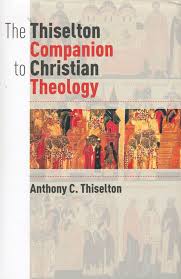
The Thiselton Companion to Christian Theology

book thiselton

What is called a theological companion turns out to be an astute theological dictionary from a seasoned theologian. The scope of this fine volume is so massive that it is hard to believe that one writer gave us the entire volume. Most dictionaries are compiled by a host of scholars who can even contradict themselves across entries, but here we have a unified approach to all things theological.

The book begins with a timeline of theologians to help you place the many theologians that will receive a biographic entry in the volume. That is a great help in seeing who was contemporary with each other. Next, there is a list of entries which is much easier than flipping through the large volume itself. Still, the majority of the book is a-to-z entries.

In addition to influential theologians, he gives almost every theological word imaginable whether common like “justification”, or biblical like “abba”, or of a modern scholarly bend like “open theism”, or even esoteric like “womanism.” Exhaustive is a fair description.

The articles are of various lengths following a logical approach to their complexity and importance. You might occasionally disagree with his choice, or find something missing like the “New Perspective on Paul”, but it is broad enough to cover most everything you might need in such a volume. You might even disagree on a theological conclusion, but you will never find him careless, naive, or harshly dogmatic. His lifetime in theology is apparent.

Quite simply, I must rate this a winner and consider it a jewel to have on your shelves.

I received this book free from the publisher. I was not required to write a positive review. The opinions I have expressed are my own. I am disclosing this in accordance with the Federal Trade Commission’s 16 CFR, Part 255.

The Enduring Authority of the Christian Scriptures–An Important New Book

book authority

Likely the most important book of its kind for this generation, this massive volume covers the doctrine of Scripture from every conceivable vantage point. Edited by the redoubtable D. A. Carson, this book maintains a consistently high level of scholarship. Though I did not read every page (I wanted to provide somewhat of a timely review),  I read much and was impressed throughout.

The volume begins with a spectacular introductory essay by Carson that was fascinating. He at once laid bare the lines of debate and an outline of the history. Starting a trend that carried through the book, he named names. He was never ugly, but he put people with positions and then evaluated positions in this successful romp through the issues.

Next comes nine chapters on historical topics. There might be more information than you feel the need to know, but in any future historical questions you will likely find your answers here.

The heart of the book was chapters 11-24 on biblical and theological topics. These articles were excellent even if certain parts were somewhat esoteric. Still, the great subjects were fully addressed. The next section on philosophical and epistemological topics carried the theological discussion forward. The section on comparative religion topics was much less interesting to me, but that is likely a matter of taste. The book ends with Daniel Doriani encouraging us to think holistically and then some FAQ by Carson.

This book is a major publishing event. Pastors will find some that is helpful clarification, but some that is needless complication. We must remember, though, that the book is dedicated to scholarly concerns in addition to what is helpful to us. There were statements that I could not agree with in these pages, but this book is a presentation of the conservative position. To that end, it was just what was needed in our complicated days.

I received this book free from the publisher. I was not required to write a positive review. The opinions I have expressed are my own. I am disclosing this in accordance with the Federal Trade Commission’s 16 CFR, Part 255.
Knowing God by Packer–A Timeless Classic

book knowing god

Using the idea of knowing God, Packer has struck the perfect balance between theology and Christian living. That has worked well because doctrine in its purest form intersects best at the point of real life. Add to that timely material a simple yet profound writing style, and you have the substance of a masterpiece. It can be cliché to throw around words like “classic”, but if you read this book, you will discover that it is true.

Here IVP gives us the classic in a deluxe edition worthy of its value and a new study guide. Both will serve to extend the value of a book that has lost nothing in the passage of time. It’s found on almost every list of greatest Christian books that I have ever seen. I read it slowly and found it impacting.

Of course you may find a sentence or a paragraph that you disagree with, as I did, but you will be challenged and feel you “know” God a little better as you read. I first thought that I would tell about my favorite chapter(s) in this review, but I underlined too much in every chapter to narrow them to favorites.

I would recommend that every Christian interact at some point with this extraordinary volume.

I received this book free from the publisher. I was not required to write a positive review. The opinions I have expressed are my own. I am disclosing this in accordance with the Federal Trade Commission’s 16 CFR, Part 255.
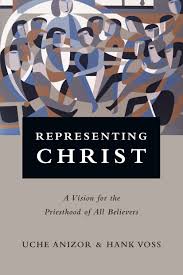
Representing Christ by Anizor and Voss

christ

Anizor and Voss write here on a doctrine, the priesthood of the believer, that is precious to some of us, yet under duress in many places. Whole segments of Christendom deny its existence. This book shows that is both a biblical idea and an idea believed by several across the centuries.

This book is at its best discussing what the Scriptural basis of the doctrine of the priesthood of the believer is. Chapter 2 entitled “A Royal Priesthood” lays out well the case for clear teaching on this doctrine. I had never considered Adam as a priest, but Israel was clearly “a kingdom of priests.” Even more important is when the authors draw out the New Testament teaching on the subject. To me, it is undeniable as they well show.

The balance of the book looks at the subject in more of a church history vein. Luther might not deserve quite as much credit as they give him, but he does play into the history. They also explain what all priesthood really means in our lives, which is the reason for the subtitle “a vision for the priesthood of the believer.”

They take care to write to those who might be in a group that has priests today and deny that all Christians are priests. Some of that explanation might not be necessary to one not in one of those groups.

They write well and make a good contribution to this important dialog. This is a fine theological volume to have.

I received this book free from the publisher. I was not required to write a positive review. The opinions I have expressed are my own. I am disclosing this in accordance with the Federal Trade Commission’s 16 CFR, Part 255.
New Dictionary of Theology, Second Edition (IVP)

dictionary

IVP continues to uphold its well-earned reputation in quality reference works with this revised work. It is essentially a new work in that so many articles were enlarged. The material covered also differs from the first edition because another volume, IVP’s New Dictionary of Biblical Theology had already pulled out that material. This volume focuses exclusively on historical and systematic theology in its massive 1000 pages.

The list of contributors is impressive. The scholarship is of the highest quality and none of the articles I read seemed to be done in haste. You might make the mistake of forgetting a subject would actually be categorized as biblical theology and search in vain, but if you are looking for historical or systematic theology subjects you likely won’t fail to find an entry here. At least I couldn’t.

Besides the great entries on all the theological concepts, I really enjoyed the biographical entries on the great theologians. They even had an entry for Charles Spurgeon! They purposely included articles on global theology and theological trends of our day.

The book is attractive and a joy to peruse. It will serve as an outstanding reference for many years. I loved it!

I received this book free from the publisher. I was not required to write a positive review. The opinions I have expressed are my own. I am disclosing this in accordance with the Federal Trade Commission’s 16 CFR, Part 255.
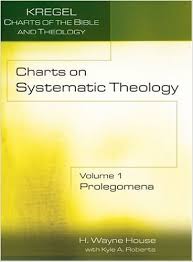
Charts On Systematic Theology, Volume 1 by House and Roberts

charts

This volume of charts is part of the Kregel Charts of the Bible and Theology series. Though it covers Prolegomena, or introductory issues, this material is not for the beginning Christian like several books of charts are. Written by H. Wayne House with Kyle A. Roberts, it aims at an audience that has wrestled some with systematic theology.

It begins with helping readers see the difference between objective and subjective theologies. As is done throughout the book, it uses the explanations of the most famous corresponding theologian. That will range from the rather orthodox to the rather unorthodox theologians and theological positions.

At times, like in sharing different perspectives on possibility, the different position positions have a few that seem really close. Some charts, like the one comparing systematic, biblical, historical, and philosophical theologies, rose above the others in value. Still, they are all worthwhile.

I believe the greatest value in this book will be for those doing a deeper study on theology. From that perspective, complex things are well compiled and condensed without sacrificing understanding. It would likely be a boon to one teaching or needing a refresher in systematic theology.

I received this book free from the publisher. I was not required to write a positive review. The opinions I have expressed are my own. I am disclosing this in accordance with the Federal Trade Commission’s 16 CFR, Part 255.
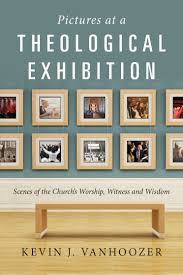
Pictures At A Theological Exhibition by Vanhoozer

exh

Kevin Vanhoozer is an excellent writer. He has a knack for making very complex concepts understandable. He has written many fine essays and sermons and this book collects several of them. What makes the book worthwhile is how well these essays work together to say something to us.

You probably picked up on his using Mussorgsky’s Pictures In An Exhibition. He effectively explains the parallel for what he is doing with Mussorgsky. It made good sense. He also looks at how we have lost our imagination (he explains its good meaning) and how we must work to get it back. He describes his book as “scenes of the church’s worship, witness, and wisdom.”

Like me, some of these essays will speak to you more than others, but they are all well thought out. Not a one of them seemed hasty to me. I loved how he picked up on a concept he came across called the “McDonaldization” of our society. How that exposed our day! He gave some great thoughts about Scripture that gave much to chew on.

There is so much more here. I loved how he could could even tackle a narrow subject like he did in “Enhancement in the Cathedral: Power, Knowledge, and Smart Pills.” Don’t miss that one.

If like theology, you will enjoy this volume.

I received this book free from the publisher. I was not required to write a positive review. The opinions I have expressed are my own. I am disclosing this in accordance with the Federal Trade Commission’s 16 CFR, Part 255.
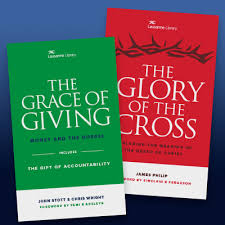
Two New Titles From Hendrickson

cross giving

Hendrickson has picked up two fine titles from the Lausanne Library.

The Grace of Giving by John Stott and Chris Wright

This short volume is actually two books in one: The Grace of Giving by John Stott written in 2004 and The Gift of Accountability by Chris Wright written in 2013. An easy, but provocative read, these two titles combine well.

Stott deduces ten principles for Christian giving from an exposition of II Corinthians 8 & 9–the kind of exposition where he always found his writing material. The beauty of it is how flawlessly his conclusions sprang from the text. It’s hard to believe that something so condensed could be so powerful, yet that is clearly the case here. Preachers might find it a seed plot for preaching on giving too.

Wright, a colleague and something of a keeper of the flame for the late Stott, did not duplicate Stott but looked at the same passage and found clear principles for accountability. It was a helpful addition to Stott and was particularly potent for our reckless generation.

Small enough for a wider distribution, this volume is a winner.

The Glory Of The Cross by James Philip

Subtitled ” Exploring the Meaning of the Death of Christ”, this volume in a manageable 60 pages well overviews its subject. Its size might make it a particular blessing for those who panic in the presence of larger theological tomes.

Still, don’t label it lightweight as it works to make a theological impact, and succeeds without surrendering accessibility. Tracing Christ from the Last Supper, to the Garden of Gethsemane, and on to the Cross, this book stays in His final 24 hours. No wonder Philip ends with Hallelujah! What a Saviour! before he gives a reminder of Jesus’ Return and the need to share the story of the death of Christ.

Small enough for a wider distribution, this book that could be read quickly might best be read slowly. I recommend it.

I received this book free from the publisher. I was not required to write a positive review. The opinions I have expressed are my own. I am disclosing this in accordance with the Federal Trade Commission’s 16 CFR, Part 255.
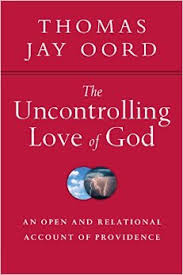
The Uncontrolling Love of God by Thomas Jay Oord

oord

This book tackles a subject that everyone thinks about at times–how to think about God in a world of profound hate and senseless tragedy. While the author, Mr. Oord, takes us beyond the hard feelings of questioning faith to the theology that can tries to answer the question, he even goes to science and philosophy along with the Bible. Without any fluff at all he takes us on a journey that demands we decide what we believe about the providence of God.

Mr. Oord brought out a potpourri of emotions in me as I read. At times I would feel I was reading a simple believer in Christ while at other points I would think how could he believe such nonsense.  In one place he would hold that Scripture is a trustworthy guide and at another he would speak of evolution as a settled fact. Here he would want to honor the Lord and His Word and there he would speak of science and philosophy as near equals to the Bible. 

His analysis of all the issues and what has been believed was simply superb. His writing was as good as acedemic titles get. His simple, little chart on page 83 crystallized the range of thought on providence. His description of every method was fair and probing. He was a careful thinker who would have no part in reducing the discussion to merely a Calvinistic/Armenian debate. 

When he finally turned to his own explanation that he called “an open and relational account of providence”,  I simply could not go along with him. Though he offered profound points, I could not put them all together as he did. He figured that God’s love was the controlling factor in all God did until providence could be deemed as the Uncontrolling Love of God.

To my mind he missed a major point. The Lord is better described as equally the God of love and the God of holiness/justice. I believe one could arrive at a better theology of providence with that focus.

Despite disagreeing with his ultimate premise, and some lesser ones on what God could do or miracles, why do I give this volume a pretty good rating anyway? He spurred my thinking until I had to decide what I believed. I will always count such a book good and helpful. I am truly glad I read this book and have it on my shelves to refer to in the future.

I received this book free from the publisher. I was not required to write a positive review. The opinions I have expressed are my own. I am disclosing this in accordance with the Federal Trade Commission’s 16 CFR, Part 255.

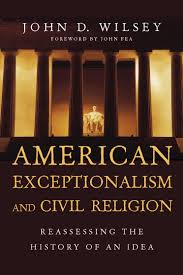
American Exceptionalism and Civil Religion by Wilsey

american ex

Have you ever read about a subject that you have known for a long time that you needed to have deeply thought about, but had not? That is the experience I have had in this unique volume. I am a Christian and consider myself first and foremost a follower of Jesus Christ. At the same time, I am one of those old-fashioned patriotic types who can get a lump in my throat in a whole variety of patriotic settings. Mr. Wilsey forced me to reconcile some things where I had never done so before.

He clearly had a Bible first and patriotism second attitude of which I agree. I even saw the traces of that same patriotic background in his life. I could show you several sentences and paragraphs in this volume, and even some historical assessments where I could not agree, but he gave me the tools to evaluate this issue. My final conclusions were not far from his when I finished.

He distinguishes throughout the book a helpful “open exceptionalism” and a “closed exceptionalism” that conflicts with Christianity. His categories may not always divide as neatly as they do in his mind, but his point is well made.

I intend to use what I learned in this volume going forward. It’s scholarly and helpful throughout.  I know of no other book quite like it and I highly recommend it.

I received this book free from the publisher. I was not required to write a positive review. The opinions I have expressed are my own. I am disclosing this in accordance with the Federal Trade Commission’s 16 CFR, Part 255.