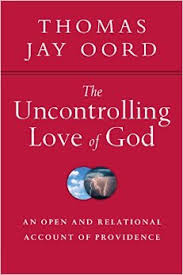
The Uncontrolling Love of God by Thomas Jay Oord

oord

This book tackles a subject that everyone thinks about at times–how to think about God in a world of profound hate and senseless tragedy. While the author, Mr. Oord, takes us beyond the hard feelings of questioning faith to the theology that can tries to answer the question, he even goes to science and philosophy along with the Bible. Without any fluff at all he takes us on a journey that demands we decide what we believe about the providence of God.

Mr. Oord brought out a potpourri of emotions in me as I read. At times I would feel I was reading a simple believer in Christ while at other points I would think how could he believe such nonsense.  In one place he would hold that Scripture is a trustworthy guide and at another he would speak of evolution as a settled fact. Here he would want to honor the Lord and His Word and there he would speak of science and philosophy as near equals to the Bible. 

His analysis of all the issues and what has been believed was simply superb. His writing was as good as acedemic titles get. His simple, little chart on page 83 crystallized the range of thought on providence. His description of every method was fair and probing. He was a careful thinker who would have no part in reducing the discussion to merely a Calvinistic/Armenian debate. 

When he finally turned to his own explanation that he called “an open and relational account of providence”,  I simply could not go along with him. Though he offered profound points, I could not put them all together as he did. He figured that God’s love was the controlling factor in all God did until providence could be deemed as the Uncontrolling Love of God.

To my mind he missed a major point. The Lord is better described as equally the God of love and the God of holiness/justice. I believe one could arrive at a better theology of providence with that focus.

Despite disagreeing with his ultimate premise, and some lesser ones on what God could do or miracles, why do I give this volume a pretty good rating anyway? He spurred my thinking until I had to decide what I believed. I will always count such a book good and helpful. I am truly glad I read this book and have it on my shelves to refer to in the future.

I received this book free from the publisher. I was not required to write a positive review. The opinions I have expressed are my own. I am disclosing this in accordance with the Federal Trade Commission’s 16 CFR, Part 255.
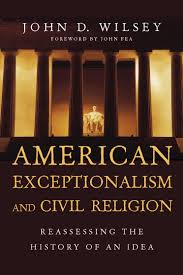
American Exceptionalism and Civil Religion by Wilsey

american ex

Have you ever read about a subject that you have known for a long time that you needed to have deeply thought about, but had not? That is the experience I have had in this unique volume. I am a Christian and consider myself first and foremost a follower of Jesus Christ. At the same time, I am one of those old-fashioned patriotic types who can get a lump in my throat in a whole variety of patriotic settings. Mr. Wilsey forced me to reconcile some things where I had never done so before.

He clearly had a Bible first and patriotism second attitude of which I agree. I even saw the traces of that same patriotic background in his life. I could show you several sentences and paragraphs in this volume, and even some historical assessments where I could not agree, but he gave me the tools to evaluate this issue. My final conclusions were not far from his when I finished.

He distinguishes throughout the book a helpful “open exceptionalism” and a “closed exceptionalism” that conflicts with Christianity. His categories may not always divide as neatly as they do in his mind, but his point is well made.

I intend to use what I learned in this volume going forward. It’s scholarly and helpful throughout.  I know of no other book quite like it and I highly recommend it.

I received this book free from the publisher. I was not required to write a positive review. The opinions I have expressed are my own. I am disclosing this in accordance with the Federal Trade Commission’s 16 CFR, Part 255.
The Faithful Creator by Ron HighfieldHighlights

faithful

This volume tackles the tough questions, as the subtitle “Affirming Creation And Providence In An Age Of Anxiety” suggests. It is scholarly (I would guess graduate level), yet highly readable even if this is not your specialty. Dr. Highfield gives evidence of deeply thinking on everything involving these issues.

The book is in three parts: Creation, Providence, and the Problem of Evil. By the time you finish you will see that the problem of evil is where your beliefs on creation and providence are tested. I was genuinely impressed with the author’s presentation, logic, and fairness. Though he was a strong Bible believer and conservative in theology, he did not write to support one theological persuasion as much as addressing the hardest questions we Christians will ever hear or think.

Highlights include his explanation of the glory of God (pg. 111), his interaction with evolutionary biology (pg. 159), his description of reading the OT christologically (pg. 206), his phenomenal discussion of foreknowledge (pg. 226 ff), and his majestic handling of the problem of evil.

This volume will get the most prominent place on my shelves for this subject. I highly recommend it!

I received this book free from the publisher. I was not required to write a positive review. The opinions I have expressed are my own. I am disclosing this in accordance with the Federal Trade Commission’s 16 CFR, Part 255.
Exploring Christian Theology–Now A Finished Set

ECT2

It’s great to see this fine, inexpensive three-volume set that serves as an excellent primer to theology be now complete. (Don’t be confused as I was with this being volume 2 as the set was released in a 3-1-2 order). This set has a chance to be really helpful as size, price, and accessibility are all in its favor. I realized a long time ago that very few people are going to read a full-blown systematic theology tome.

This volume covers Creation, the Fall, and salvation. That means the doctrines of man, sin, and salvation are all covered. As for might imagine in a series that tries to teach the spectrum within believing Christianity rather than one narrow viewpoint as in most such volumes, this one is forced to address controversial Calvinism issues. The writers did a good job walking that tightrope no matter which side of the Calvinist line you fall. Clear discussion that will enable you to think your own thoughts in context are provided.

The text includes really helpful charts and graphs. Historical context about what Christians have believed in the past is exceptionally well done and clear. It really added to the value of the book. Even in the salvation section it was fascinating to read the history of thought about predestination.

I would disagree with points along the way, but the book was a winner and any Bible student would be greatly enriched by reading it.

I wholeheartedly recommend both this volume and the entire three-volume set.

I received this book free from the publisher. I was not required to write a positive review. The opinions I have expressed are my own. I am disclosing this in accordance with the Federal Trade Commission’s 16 CFR, Part 255.
Volume 1

Seeing God In The Dark by J. I. Packer

image


“Unraveling the Mysteries of Holy Living” says the subtitle of this theologically penetrating volume by Packer and published by Hendrickson Publishers. While that might be misleading to some degree since he is a writer who would command a large audience if he wrote a new volume on that subject, this is actually a collection of articles all across Mr. Packer’s career. Don’t let that scare you away.  While on the surface that sounds dull, in this case it succeeds.

First, someone has chosen well in assembling this collection. While it would not be necessary to read the chapters in order in a collection of this sort, there even seems to be good logic in that ordering. They speak to our generation without surrendering faithfulness to Scripture. That is not to say, that there are not a few chapters where I strongly disagree with him. He sees predestination as strongly as any popular writer today. Still, he is incredibly gracious and gets one really thinking.

In some strange way he reminds me of C. S. Lewis and Lloyd-Jones in writing style, even if the three would disagree at points. It is all the metadiscourse in their writings. If you and I wrote so much about our writing as we wrote, it would destroy us. In some way they do it and hold your attention firmly in their grips.

My favorite chapters were the ones on revival and Christian living. The very last chapter was one of the best, so be sure to go all the way to the end. Another interesting feature was the way he addressed those with charismatic beliefs. I never saw anyone so gracious while disagreeing with them. I think he went even farther than I could in finding their good traits.

For what this volume sets out to give, it delivers!

I received this book free from the publisher. I was not required to write a positive review. The opinions I have expressed are my own. I am disclosing this in accordance with the Federal Trade Commission’s 16 CFR, Part 255.


New Testament Theology by I. Howard Marshall

This massive volume by highly-respected scholar I. Howard Marshall leaves few stones unturned in a scholarly presentation on New Testament Theology. New Testament theologies are usually written as either tracing theological themes across the entire NT or discussing theology book by book. This IVP published volume approaches theology by the latter method. I prefer the first method, but we surely need both approaches.

The strengths of this volume are that with distinct acumen Mr. Marshall tells us what modern scholarship thinks and always weighs in with his own thoughts. It almost seems encyclopedic in that way. His writing is clear and you leave knowing what the consensus of modern scholarship is.

The weaknesses include an exaltation of modern scholarship at the expense of previous generations. He puts modern scholars, apparently, as the final authority of biblical thought. Perhaps you would think me biased, but I do not agree with that thinking. So that can make for a mixed bag at times. Of course modern scholarship is an extraordinary asset to us, but some of the excesses–the certainty of the existence of “Q” or other conclusions by scholars repeated so often till some accept as fact though no concrete proof exists. Of course I have many volumes that speak of “Q” on my shelves, but this book makes so many conclusions on a certainty of what came from where that the section on the Synoptics seemed flawed to me. Other similar conclusions were made. At times I read more like a collection of NT book introductions than a theology too.

Despite the weaknesses, there are insights in many places. This volume will not hold the primary place among the theologies on my shelf, but it will be consulted. If your goal is learning modern scholarly thought, give this volume 5 stars. If it is a well rounded, spiritual you seek, give it 3 stars. So let’s average the scores and say 4 stars. Fair enough?

I received this book free from the publisher. I was not required to write a positive review. The opinions I have expressed are my own. I am disclosing this in accordance with the Federal Trade Commission’s 16 CFR, Part 255.
2015/01/img_2317.png

A Theology For The Church, Revised Edition

A Theology Of The Church, Revised Edition, edited by Daniel Akin and published by B & H Publishers, is a fine volume that no Baptist pastor can afford to be without. Sadly, I missed the original edition, but am glad to possess this revised edition.

This book is not so consumed with Baptist thought that it can’t on its own two feet as a quality systematic theology–it stands well. What it adds is that extra few pages in each section on how Baptists in particular have wrestled with that doctrine. I find that invaluable and something that can be found no where else.

Each chapter is written by a different Baptist theologian, and as is the common problem of such a setup, there isn’t always complete consensus. Still, that is no difficulty because the editor must have strictly enforced the notion of being kind and fair to other viewpoints, particularly other common viewpoints. There is variety in Baptist thought and this succeeds at being helpful to all. In fact, I believe even one not a Baptist would love this volume.

I must call out for special recognition the chapter by Kenneth Keathley on the Doctrine of Salvation. Since you may have guessed the possible bias, I will admit that I agree with his conclusions. Still, he so deftly defines issues and the points of debate. He confesses weaknesses in every viewpoint, including his own. He was charitable to all and I believe no matter your viewpoint you should read this chapter.

I did not read every page in reviewing this book, but took care to read enough to get a feel for what it taught. The chapter on Human Nature was another favorite. The chapter on Eschatology was less of what I expected ( he seemed to assume we started with a basic position and understood the main ones), but still gave wonderful material needed to grasp this issue in our day. Albert Mohler’s charge to the volume’s most likely users–pastors–was spot on too.

This volume is a new favorite for me.

I received this book free from the publisher. I was not required to write a positive review. The opinions I have expressed are my own. I am disclosing this in accordance with the Federal Trade Commission’s 16 CFR, Part 255.

2015/01/img_2281.png

Books On The Study Of Ecclesiology (Doctrine of the Church)

9415130_origHere’s a doctrine with a wide variety of viewpoints. For that reason, you will probably find fewer books that you agree with than in the study of other doctrines. Even among independent Baptists (like me) there is an incredible amount of debate. The debate, in my opinion, is hardly worth fighting over.

When did the church begin? What is the Church? Is it only local? Or is there a Universal Church that is the Body of Christ? Then as you spread out among Christian people, there is the issue of church government. How do we do baptism? The Lord’s Supper? Are denominations acceptable or should every local church be autonomous?

It often starts more fights than it answers questions, but there are places to read to decide what you believe.

Best place to start:

In this case I recommend beginning with the Systematic Theologies out there.

1. Systematic Theology Volume Four: Church/Last Things by Norm Geisler

He writes well and as a teacher of many years he is understandable. He fairly presents differing viewpoints and that is especially important on this subject. I love his 4 volume set.

2. Systematic Theology by Wayne Grudem 

He supports a form of church government I wouldn’t follow, but he presents it well and you will understand where they come from. I love to read him after Geisler.

3. Christian Theology by Millard Erickson

Presents in a way different from the above two and well worth having. I am glad to have it.

There are others like Charles Ryrie worth consulting too.

Baptism/Lord’s Supper

1.The Meaning And Use Of Baptizein by T. J. Conant

The nuts and bolts of why we immerse.

2. Baptism: Its Mode And Subjects by Alexander Carson

An influential classic.

3. Understanding Four Views On Baptism, edited by Armstrong and Engle

These Four Views books are awesome to really understand a concept.

4. Understanding Four Views On The Lord’s Supper

Another winner!

Local Church

There are some helpful material out there. I recently reviewed Believe and Belong by Clarence Sexton. Peter Masters has written some helpful pamphlets and books like Do We Have A Policy For Church Membership and Growth? We need more here.

Baptist Church

1. Principles and Practices For Baptist Churches by Edward Hiscox

The first place to look.

2. The Church: Its Polity and Ordinances by Hezekiah Harvey.

A good secondary source.

3. Baptist Church Manuel by J. M. Pendleton

I’ve seen some Baptist churches that made it a higher authority than the Bible! Still,  it lets you see what has been believed.

Happy studying!

Humble Orthodoxy by Joshua Harris

humble orthodoxyWhich one do we need: orthodoxy or humility? Both says Joshua Harris! In fact, we don’t have the luxury to choose one at the expense of the other. Or as the subtitle of this volume published by Multnomah says, we should be “holding the truth high without putting people down.” So what does that leave as the goal? What he calls humble orthodoxy.

This is actually a reworking of the last chapter of his Dug Down DeepIf I were  forced to choose I would prefer that volume to this one as I really enjoyed reading it. Still, this book has something to say and I need to hear it.

Our tendency to be a Pharisee, our latent idolization of self,  our propensity to be so impressed with who we are and what we know, he exposes with care. He says, “The message of Christian orthodoxy isn’t that I’m right and someone else is wrong. It’s that I am wrong and yet God is filled with grace.” Ouch!

He demonstrates how at our core we are about God being on our side. That is a world of difference than wanting to be on God’s side. If it is about God being on my side, then I will argue and fight till my last breath. Sadly, at that point our lives are no longer about God and His glory. We live for what he calls “the tiny kingdom of self.” In that setting, of course, “Knowledge puffeth up.”

We have the wrong focus to make correct theology, as critically important as it is, the goal. Our Lord is the goal. Any other goal is inferior and little more than misspent effort. If correct theology is the goal I can so easily look down on others who I know has less theology than me. I know I have fallen in that trap before and am glad I had Mr. Harris to take me to task for it.

He attacks “arrogant orthodoxy” as actually falling short on the orthodoxy scale rather than the other way around. He sees true theology as telling me that repentance must start with me. Well, he has us there!

He sees a interlocking link between orthodoxy and humility. More orthodoxy leads to more humility and more humility leads to more orthodoxy. When our pride grows, what, then, does that tell us about our orthodoxy? That is a painful, yet particularly helpful, insight.

As much as I want to have my theology right, there is enough remaining sin in me to keep me humble, he says. You can speak for yourself, but that really describes me. A critical spirit, though a spirit quite at home in our age, is pure nonsense in a sinner like me. I must defend my faith without reducing myself to a critical spirit that denies on many levels the very faith I defend.

He also says: “Friend, the truth is not about us. It’s not self-determined. It’s not an accessory. It is about God.” That will help us not develop a Christian subculture with all the weirdo that can accompany it. He also says: ” In eternity we’ll see the silliness of self-righteousness and quarreling over the nonessentials.” That sums it nicely for a book well worth your time to read.

I received this book free from the publisher. I was not required to write a positive review. The opinions I have expressed are my own. I am disclosing this in accordance with the Federal Trade Commission’s 16 CFR, Part 255 .

Books On The Study Of Eschatology (The Doctrine of Last Things)

eschatologyIt’s not hard to get folks to study the doctrine of eschatology. What other Bible subjects are so many whole conferences discussing? What is amazing, too, is the outlandish number of books written on the subject. A blog post far too long to write would be “Worthless Books On Prophecy.” Very few subjects have so many volumes go from the bestseller list to the discount bin so quickly either.

This is one place that one must admit his or her bias right up front. I follow the pretribulational premillennialism point of view. That is not to say that there isn’t many wonderful believers who have differing viewpoints while dearly loving my Savior just as I do. Still, my studies of God’s Word has led me to a position.

One thing is clear: Jesus is coming again! This is the non-negotiable point of prophecy. We can debate some points, but we shall see Him face to face. No amount of ridiculous date-setting or bizarre speculations will change that fact! Let’s make sure we see this as a life-changing doctrine, not a mere academic exercise for esoteric knowledge.

Here are some of the books I find to be the most helpful:

1. Things To Come by J. Dwight Pentecost

A widely used bestseller! Most every premillennialist has a copy. This volume is often used as a textbook and many pastors I know make it their first choice. A clearly laid-out volume that can help anyone understand the premillennial position.

2. Dispensationalism by Charles Ryrie

Whether your dispensationalism would go as far as his or not, this volume is indispensable to grasp this point of view. He is fair to opposing viewpoints and is the best representative of classic dispensationalism.

3. Progressive Dispensationalism by Darrell Bock

There has been a change in the dispensational world by some and this volume is a great reference to understand it. I agree with some of this thinking found here. Read this to be up-to-date.

4. The Coming Kingdom of Christ by John R. Rice

A sentimental volume to me as I read it years ago as a young Christian. He is one of the best at highlighting the imminent return of Christ. Much original and helpful material is presented in this volume.

5. What Does The Future Hold? by C. Marvin Pate

I read this recently as a refresher before I taught a class on prophecy. It is the perfect overview volume no matter your perspective. He is careful in his explanations. His own eclectic view means he is in no one’s camp, but he really helps you understand the various viewpoints. I highly recommend this volume.

Other volumes to consider:

You might find The Nations, Israel, and the Church in Prophecy by John Walvoord helpful as well as his The Rapture Question, his The Blessed Hope and the Tribulation, and his The Millennial Kingdom (yes he wrote widely on the subject). The Meaning of the Millennium: Four Views edited by Robert Clouse is good for comparing views.

Jesus Is Coming by W.E.B. was a great challenge to me as a young Christian. It had a great influence on many later volumes. The Basis of the Premillennial Faith by Ryrie is ideal for the younger Christian as is First The Rapture by J. F. Strombeck.

To round out your library you will want the 3-volume set The Theocratic Kingdom by George Peters (look for the Kregel edition). I’m glad to have Biblical Eschatology by Ironside and Ottman in a beautiful Klock & Klock edition.

Don’t forget to consult your favorite systematic theology volume. I used several and especially enjoyed Norm Geisler’s Systematic Theology as it was very well done. I’m not even getting into the many commentaries on Revelation as that is a discussion for another day.

Perhaps there are some volumes you would have expected I include here and while they are on my shelves, I don’t recommend volumes that pretend to see what can’t be seen, that tends to focus on signs rather than the Savior, or that  tends toward ultra-dispensationalism.

Some are afraid of the study of prophecy, but a Christian shouldn’t feel that way. I like to say that if you are a believer prophecy is taking us somewhere and it is somewhere good–the presence of Jesus Christ!

Related Posts:

Books on the Study of Bibliology

Books on How to Study the Bible