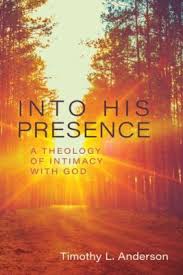
Into His Presence: A Theology of Intimacy With God by Tim Anderson

book into pres

I’ve thought for some time that I needed some help on the theology of intimacy with God that was more depth and less fluff. There are so many who claim to be the golden ticket that it is refreshing to find someone who would prefer to dig out what the Scriptures truly say. When you think about it, there are not that many books that help us at this more theological level. There’s probably an experiential book on intimacy with God released every month but that usually doesn’t translate into us knowing anything more about it. Tim Anderson has clearly felt the same way and has made a grand attempt to step into the void. I’m not sure that this book fully settles the question, but it’s the best one I’ve gotten so far to get the discussion started.

Don’t skip his introduction as he makes it about what he’s trying to accomplish and the wide array of thinking that has to be sifted through to make sense of the subject of intimacy with God. The first half of the book comprising four chapters most scratched my itch. His defining intimacy with God forces us to think concretely about all the nebulous thoughts swirling around. Chapter 2 addresses the subject regarding philosophy and theology with some of that theology being the most helpful to me. Chapter 3 on linking the Fall of Man with intimacy with God was one of the best in the book and did clear up some real questions for me. The chapter on God as our Father tied in some important information as well and made sense of the role of fathers in our lives that is often written about today.

The chapter on interpreting biblical images of marriage and Christ perhaps got a little off track and in some cases, I felt split the hair too finely. Some of the pages on hermeneutics and how to interpret the Song of Solomon might have been better in another book too. There were additional chapters that addressed intimacy with the Holy Spirit and how suffering might be involved. A final chapter on songs of intimacy did not materially add to my understanding because I did not know every song discussed. I can see how that would have been a helpful exercise in his class, but I thought it was, perhaps, less effective in the book. Though he was cautious not to go the How-To route, a real theological discussion for how to apply the more pertinent things his book told us might have been in order.

Though I still say we need more, this book is an outstanding start. I appreciate what was shared here and the work that went into it. It’s nice to know that he read so across the spectrum to make sure he got a thorough idea of what’s believed in Christianity. It added something nice to when he discussed the theological directives of Scripture itself. I’ve scribbled several helpful notes from this fine book. Now I just need to figure out myself how to put it all in practice.

I received this book free from the publisher. I was not required to write a positive review. The opinions I have expressed are my own. I am disclosing this in accordance with the Federal Trade Commission’s 16 CFR, Part 255.
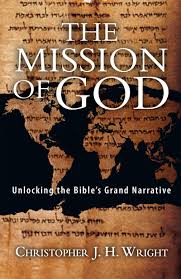
The Mission of God by Wright

book mission god

Christopher J. H. Wright is an author who never disappoints. Though he has written commentaries, theological works, and Bible studies, this book on the mission of God now available in paperback is likely his most influential. In fact, his specialty on the mission of God elevates all those other books that he has written, but this one is where he makes his grand case that the narrative of the Bible has mission as its overarching theme. You will likely agree when you take in what he has said.

This book succeeds on so many levels that you might debate where to put it on your shelves. There’s the obvious choice of your mission section, but then you may wonder if it should be among your Bible theology or even Bible survey sections. Finally, it could hold its head high among titles in your deeper theology section too. That is not to say the book is unfocused, but that its explanation of the broad sweep of the Bible gets the job done from all those various vantage points.

The book is divided into four parts: the Bible and mission, the God of mission, the people of mission, and the arena of mission. As you can see, that begins in championing mission as the proper hermeneutic, continues to see God’s hand in mission, followed by the final two parts looking at the Bible from beginning to end and seeing how it sticks without wavering to God on mission. At over 500 pages, it is never shallow nor possessing omissions while never bogging into minutia either.

I’ve always felt that Wright could hold his own with any scholar while outpacing most of them on spirituality. You will see that here. This book will be the top of its class on this subject for decades to come and no Bible student should be without it.

I received this book free from the publisher. I was not required to write a positive review. The opinions I have expressed are my own. I am disclosing this in accordance with the Federal Trade Commission’s 16 CFR, Part 255.
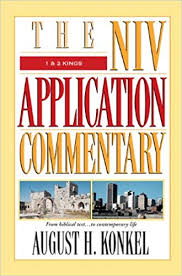
The Ten Commandments (I) by Patrick Miller


 book ten comm.jpg 

Perhaps you are familiar with volumes in the Interpretation Bible Commentary (IBC) series on various books of the Bible. Those volumes don’t dig too deep in exegesis but excel at providing theological implications within the text. Though that theology is much more liberal than my thinking, I’m often challenged to think of things that I would have otherwise overlooked. I’ve discovered that the Interpretation series has additional volumes on a variety of scriptural topics like this one on the 10 Commandments. What has surprised me when I picked up this volume by Patrick Miller is the depth of content that really unpacks these commandments while still pointing out the theology this series loves.

With every commandment studied Miller explains the commandment in depth, what it means, how it has been applied, the moral issues involved, and how it relates or is expanded to other Scripture. My only complaint is the occasional sentence that totally capitulates to modern progressive norms. The wise Bible student can get around those because this volume digs out too much needed information to miss.

This book impresses me. I can’t imagine ever studying the 10 Commandments as a whole or one of the individual ones without consulting this book in the future. I rank it higher than any IBC I have ever used. I’d even call it the ideal place to begin for study of the 10 Commandments.

I received this book free from the publisher. I was not required to write a positive review. The opinions I have expressed are my own. I am disclosing this in accordance with the Federal Trade Commission’s 16 CFR, Part 255.
1 & 2 Kings (NIVAC) by Konkel

book kings nivac.jpg

Professor August H. Konkel produced this commentary on 1&2 Kings in the New International Version Application Commentary (NIVAC) series. Its greatest strength lies in what the series itself aims at: application for our day. Without doubt, the scholarship that undergirds the work is solid, but the scholarly issues that he makes his focus might be less helpful than if he had, say, dove more deeply in the structure or broad themes of the book.

In fact, it is in the introduction that this becomes clear. Perhaps I overgeneralize, but he makes the theme of his introduction that of the Books of Kings being Deuteronomic history.  That emphasis almost exclusively thinks in terms of genre and composition. Even his review of the “prophetic character of Kings” is viewed from that rubric. I feel that there are clearly better options to serve as an overall guide for Kings. If you are of his mind, you will probably rank this volume as “great”.

Despite that caveat, I still can fully recommend this book for its commentary and application. Maybe I’m crazy, but somehow he reminded me of John Walton who has also written in this series. The book increases in value, too, when you consider how few volumes guide us in that last link of the chain called application.

For the record, what was slightly annoying in the introduction was in no way overwhelming in the commentary proper. I should stress again that the scholarship itself is well done. I see much evidence of careful study and thoughtful reflection. He is never trite or trivial, so you will get plenty of needed help for this often-neglected portion of Scripture.

While there are a few volumes in the NIVAC series that I enjoyed a little more, this commentary is a solid effort that I without hesitation recommend for your library.

I received this book free from the publisher. I was not required to write a positive review. The opinions I have expressed are my own. I am disclosing this in accordance with the Federal Trade Commission’s 16 CFR, Part 255.
Colossians & Philemon (BECNT) by G.K. Beale

book col phi bec

Veteran commentator G. K. Beale strikes gold in this commentary on Colossians and Philemon in the Baker Exegetical Commentary on the New Testament (BECNT) series. From the onset, Beale explains that he hopes to make a distinct contribution to Old Testament allusions in Colossians (Philemon has too few to really qualify). Strangely enough, though he handles those allusions with care and thoughtfulness, it is the exegesis itself that compels me to rate it highly. The well-reasoned conservative conclusions, the passion for Scripture, and the guidance offered throughout are what most stands out in this newly released commentary. He will tell you what other scholars have thought yet has a knack for interacting without endlessly droning on. At 500 pages it is not as bulky as some of the modern exegetical commentaries but it still delivers everything that you’re looking for regarding exegesis. Scholars will be quoting it in the future while pastors can use it practically for real help with the text.

His introduction to Colossians first addresses authorship. As you are probably aware, a certain segment of scholarship has been attempting to take Colossians away from Paul for many years. I loved how Beale fairly addresses the arguments for all non-Pauline positions while knocking the props out from under them with the skill that only a seasoned commentator could muster. To my mind, he could be a template for any of the Pauline epistles that are questioned or attributed to pseudonymity.  Next, he well explains the background both of the letter and its historical setting. He proves that he is, in fact, going to be dedicated to working out all the Old Testament allusions to be found in the letter. He mentions the relationship of Colossians to Ephesians and provides a detailed outline of the book. Perhaps the weakest aspect of this introduction is that of structure. Pretty much he just shares the divisions that some other prominent scholars propose.

The commentary itself is excellent. Again, there’s real help on every passage. Just in case you’re not as interested in his beloved Old Testament allusions as he is, he kindly provides those as additional notes at the end of every section.  I checked several passages that I had either studied a great deal or knew might be controversial and really appreciated his contributions.

Though I preferred his Colossians to his Philemon, he did offer some real help both in the short introduction and commentary on Philemon.

This commentary immediately becomes a Top-3 commentary for what’s available today on Colossians and Philemon.

I received this book free from the publisher. I was not required to write a positive review. The opinions I have expressed are my own. I am disclosing this in accordance with the Federal Trade Commission’s 16 CFR, Part 255.
Hearers & Doers by Kevin Vanhoozer

book hear do.png

Kevin Vanhoozer is one of our sharpest theological minds today. He so often breaks into territory that no one else tackles. He may wrestle with a multitude of heavy theological works, but he is the guy to bring it to the rest of us. Since his latest subject here is that of making disciples, particularly from a pastor’s point of view, and since there’s a glut in the market on discipleship, he shows the league apart that he works in amongst a world of works that all say the same thing. Make room among all the dime-a-dozen discipleship titles on your shelves for this provocative volume to have a prominent place. This book is one for a pastor to lay as a foundation for our work. The subtitle accurately lets you know what you are getting yourself into: A pastor’s guide to making disciples through Scripture and doctrine.

After a clear introduction, Part One that is made up of four chapters explains why discipleship matters. He champions the importance of theology in making disciples. Chapter 2 is so profound that it could be pulled out of this book and presented as commentary on our age, at least involving fitness and body image which has taken on its own religious pretensions. I shared that chapter with some in my family as making clear things that I was ashamed I had never thought of. The next chapters explain the importance of taking disciples from hearing to doing and in building up the body of Christ.

Part Two in four more chapters digs into working out discipleship. Pastors should be challenged by his analogy of our being the eye doctor and general practitioner of the church. Next, he looks at the disciple as a member of the church, which is sadly so de-emphasized in our day. I found myself not fully agreeing with all he said in the chapter on the communion of saints, but there are some fair correctives there that may keep us from running off into the other ditch. The final chapter, wisely, looks at us as children of God who are disciples as “fitting image of Jesus Christ”.

You can often judge how much I find value in a book by how much I underline and notate throughout. My volume of this book is marked all over with usually something on every page. This book is for those who want to think, so pick it up and read slowly and you will be in for a treat.

I received this book free from the publisher. I was not required to write a positive review. The opinions I have expressed are my own. I am disclosing this in accordance with the Federal Trade Commission’s 16 CFR, Part 255.
Romans 9-16 (RCS), edited by Philip and Peter Krey

book rcs rom 9.jpg

Romans 9 is one of the key chapters of Reformation thinking, so this volume covering chapters 9-16 is pivotal in the Reformation Commentary on Scripture (RCS) series. Since this volume has been released, an additional volume covering Romans 1-8 has also come out giving us an extraordinary resource in Reformation views on this key book of the New Testament. In this volume (9-16), two Lutheran professors, who happen to be brothers, Philip D. W. Krey and Peter D. S. Krey, culled all of Reformation commentaries to create this fine resource. These two were even raised by a Lutheran pastor, so they have lived in Reformation thinking their entire lives. They certainly have the credentials to assemble this volume of the best that Reformation commentators have to offer. To my mind, they have succeeded.

Their introduction to Romans 9-16 shows their understanding of the issues that were at the heart of Reformation thinking. In our day, many of us would label those views as Calvinist views, though they give the most kudos to Augustine and Luther. They do, however, quote Calvin in several places throughout the commentary itself. It’s clear these editors agree with those they quote in many cases. In that introduction, they will speak of predestination, double predestination, single predestination and offer an excursus on Erasmus and the freedom of the will as well as opposing views that they label as conditional predestination. Still, they get into other key issues that they label the call of the nations, the ministry of the word, and Christian ethics. All in all, it was well done.

The commentary itself is of the quality that I have so far found in every volume in this series that I have reviewed. There is likely an overabundance of primary material to sift through with corresponding choices to be made for what best represents Reformation thinking to share in this volume, but they appear to me to have done an excellent job. I feel one could easily get a full grasp of what the reformers thought about most passages in Romans 9-16 in this compilation. If you grab the one that’s now released on Romans 1-8, you will have a resource well worth having and consulting for this mountain peak of Scripture called Romans.

I received this book free from the publisher. I was not required to write a positive review. The opinions I have expressed are my own. I am disclosing this in accordance with the Federal Trade Commission’s 16 CFR, Part 255.
Franklin Pierce by Michael Holt (Presidential Bio. Series)

Book pierce

I must confess that I knew almost nothing about Franklin Pierce before I read this biography written by Michael F. Holt in The American Presidents Series. This book was pitched perfectly. Its length and depth were ideal for this less significant president. As you may be aware, he is in a stretch of Presidents who often fight over being our worst one. This book told me all the broad details of his life that I needed to know and surprisingly succeeded in its few pages to dig into what made Pierce tick. Some volumes in this series are a complete dud, but I’m happy to have found this volume to be my choice for a biography of Pres. Pierce. To my mind, his presidency could fairly be called a failure while Pierce himself would’ve been far more interesting to meet than, say, John Tyler or James Buchanan. Though he was far too caught up into politics to have ever been a visionary, he does come across as sincere.

Franklin Pierce did succeed in his home state of New Hampshire in various offices. He rose through the ranks at an incredible rate and became the political power of his state. He had a near obsession with the Democratic Party that the author well exposes. The more I read about presidents in this era the more I’ve come to believe that they had little chance to succeed. We often think of the country dividing along sectional lines between the North and the South, but there was an equal division between Democrats and a succession of Whigs/Know-Nothings/Republicans. If you survey the election results from these years, you will see that they did not divide along the Mason-Dixon line. Much like our day, some states leaned more toward one party or the other with an occasional flipping. New Hampshire was the most democratic state in the Northeast and Pierce did everything he could to keep it that way. It was, however, true that some of Franklin Pierce’s decisions help solidify our country finally dividing between the North and the South.

What is inexplicable about Pierce was his dedication to the South. To be honest, since he was from the north, it makes no sense to me at all. You might find a few clues in him forging some strong friendships with Southerners and that his interest in the success of the Democratic Party was far more important to him that how the issue of slavery turned out. Historians will always label Pierce as being on the wrong side of that issue. I don’t think he was proslavery, but he was going to protect his friends and acquaintances that stood with him in earlier political battles. Another mistake that he made was not accepting the new direction of the North even in how they viewed Lincoln who followed him. He openly criticized Lincoln at times and also tried to support Jefferson Davis during his trial for treason after the Civil War. Again, it seemed to be nothing other than he would be true to his old friends. That kind of thinking will probably keep your friendships strong, but it may destroy your historical standing.

As with several other presidents, it’s hard to pin down where Pierce was regarding Christianity. The author paints Pierce as the poster child of an 1800s party animal in his youth. While that may have been true, he married a very religious woman. She was no social bug either. Still, he seemed to adore her. He curtailed his drinking and stuck by her through several health crises. There are not a lot of other facts to go on, but the author relates casually that one time Pierce detested working on the Sabbath while he was president. When his wife died shortly after his presidency ended, he started drinking some again. The author insinuates that he married his second wife for money, but they appear to have had a good relationship too though he spent more time alone during those years. He still had his demons and alcoholism finally destroyed his health and ended his life. Though the author never said, I can’t help but wonder if the obvious failings of his presidency though he genuinely meant to do what he thought best led him to discouragement. All in all, he was probably a far better person that he was a president.


For others in this series, look here.

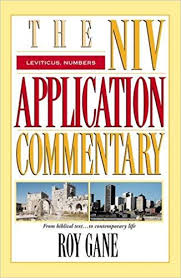
Leviticus, Numbers (NIVAC) by Roy Gane

book lev num nivac.jpg

This volume on Leviticus and Numbers by Roy Gane is easily one of the best in the NIVAC series. While the value of Leviticus in this book might surpass that of Numbers in my estimation, you will receive real help on both. The writing is so engaging, the passion so evident, and rather than apologize for the Bible Mr. Gane wisely counsels us to put our own modern culture on trial. On more than one occasion, he finds that we ultimately struggle with the same problems they once did. If the goal of the NIVAC series is to provide a scholarly explanation of the text and then take it on to modern application, then this volume has succeeded in spades. I can’t recall what is admonished in Leviticus ever having been more profitably related to our day than what you will find here.

I was thoroughly impressed with all that was nicely explained in the 13 pages of the introduction to Leviticus. The big picture, the relationship to the New Testament, and a careful case made for Leviticus being something more than legalism was made clear. There’s a brief pass at authorship (God, then mostly Moses) before an exceptional section on structure and themes. I’ve read many thick exegetical commentaries that were far less helpful on structure than what you find here. I felt the introduction to Numbers was not as well-done as that of Leviticus, but what you read there is all helpful.

The best value of all will be found in his explanation of the details of Leviticus. Without doubt, many struggle here. Again, it appears that the normal design of a NIVAC commentary (original meaning, bridging context, and contemporary significance) fit Mr. Gane like a glove. Some commentaries in this series will often either shortchange bridging context or contemporary significance, but I was pleasantly surprised to find something truly helpful in every one of those sections. The volume was more conservative than I expected while the engaging style exceeded any expectations I would’ve had for a volume on Leviticus! If you would like to see if I am reviewing accurately, find some obscure subject in Leviticus and go read what Mr. Gane has to say about it. If you will do that, you will agree with me.

I received this book free from the publisher. I was not required to write a positive review. The opinions I have expressed are my own. I am disclosing this in accordance with the Federal Trade Commission’s 16 CFR, Part 255.

American History–A New 2-volume set by Thomas Kidd

book amer hist

Are you like me and have become disgusted with most books today that attempt to teach American history? Do you suppose that most young Americans who are wrapping up their educational years really have no idea of the incredible history of our country? There are some excellent titles floating around on specific incidents in American history, but those that could be used as a textbook are often either lacking or skewed beyond recognition. That’s why I am happy to see this two-volume set come out by Thomas S. Kidd. He has written several historical biographies including those of Christians who have impacted our history. To my mind, he was the perfect person to step up and produce this set.

The balance with which he writes is refreshing for history. He’s never afraid of Christianity, nor does he ever obscure it in our history. On the other hand, he doesn’t make it Christian where it’s not, though he often does describe how Christians have viewed particular historical incidences. For my money, that approach is ideal.

You can always quibble the amount of coverage one event gets compared to another in a book of this type, but he did as well as anyone could do. The visual quality of the work is excellent as well. The pictures are well chosen, attractive, and yet not so prevalent as to give us a skimpy text. Perhaps my only criticism is that this title might have been better presented in a hardback. Rarely do I mention in a review the choice between hardback or paperback, but for some reason, this looks like it should have been a hardback. Still, the covers for each volume in the set are gorgeous.

This set would easily be my choice to recommend for an American history textbook today. I should add, too, that homeschooling parents would do themselves a favor to check out this title for their high school students. Because of where we are today, I believe that if many high school and college students used this set it would be a boon to our society. It’s what we’ve needed for a long time.

I received this book free from the publisher. I was not required to write a positive review. The opinions I have expressed are my own. I am disclosing this in accordance with the Federal Trade Commission’s 16 CFR, Part 255.