Haggai and Malachi (NICOT) by Jacobs

book hag mal

This latest entry in the highly- regarded New International Commentary on the Old Testament (NICOT) by Mignon Jacobs covers Haggai and Malachi. It replaces the serviceable volume by Pieter Verhoef that’s been much used for 30 years. In the last few decades this series has transitioned to academic issues from its earlier emphasis of assisting pastors, though scholarly pastors will still love it. If you appreciate the last few entries in this series, you will find this new title in that same vein and fully of their caliber.

After a substantial bibliography, the Introduction of Haggai begins with the historical background. We learn of the times of the prophet, his identity, and the date of his activity in the book. The next section tackles historical context by explaining what the author calls “chronological indicators” followed by the sociopolitical context and the conceptual framework. Next, there’s a brief discussion of the text followed by a section on inter-textual indicators. That revolves around Haggai’s comparison with Ezra, Chronicles, Jeremiah, Isaiah, and Leviticus. There’s also a short section on structure (It could have been longer). The Introduction ends with a brief overview of the message that includes a few theological values.

The book of Malachi has an Introduction with the same design as that used by Haggai and explained above. There’s a few more charts and tables in this one to help the reader. The outline provided in the section on structure was also much more detailed than that of Haggai. I thought the theological discussion of the ideal versus the real was illuminating.

The verse by verse commentary of both sections is helpful. Scholarly issues are well defined and inter-textual discussions are well done. I’m glad to have this book on my shelves. It’s a real asset!

I received this book free from the publisher. I was not required to write a positive review. The opinions I have expressed are my own. I am disclosing this in accordance with the Federal Trade Commission’s 16 CFR, Part 255.

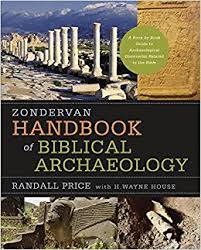
Zondervan Handbook of Biblical Archaeology

book arc h

This Zondervan Handbook of Biblical Archaeology is a real gem. Not only is it attractive, but it assists in the very area that many Bible students struggle: archaeology. Randall Price has both taught and participated in archaeological excavations, and is the perfect candidate to produce this book. H. Wayne House, a prolific biblical writer, assists.

Whatever you do, don’t skip the introduction to biblical archaeology provided in this volume. It defines terms, helps you see were biblical archaeology is today, explains the major difference between minimalists and maximalists, explains the limitations of archaeology, its value, and its methodology. There’s a good description of what archaeology contributes to biblical studies too. That’s followed by a fascinating explanation of an archaeological site. It really brings archaeology to life. The introduction ends with an overview of archaeological periods.

The book is divided into three main sections, you have archaeology in the Old Testament, archaeology and the intertestamental period, and archaeology in the New Testament. This enables the reader to approach the Bible chronologically and apply archaeology to it.

You will love all the vivid, color photos, the helpful charts and diagrams, and the text itself. As a bonus, each of the main sections has a detailed chart of archaeological discoveries from that time. There are several helpful color maps at the end, as well as a thorough glossary.

I was pleasantly surprised by this book and highly recommended!

I received this book free from the publisher. I was not required to write a positive review. The opinions I have expressed are my own. I am disclosing this in accordance with the Federal Trade Commission’s 16 CFR, Part 255.
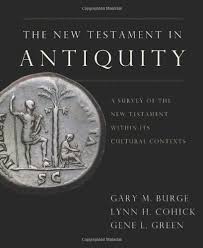
The New Testament in Antiquity by Burge, Cohick, and Green

book nt antiq

This book is a fine new entry on the market for New Testament introduction. This attractive, well-illustrated volume by Gary M. Burge, Lynn H. Cohick, and Gene L. Green is an up-to-date survey of the New Testament. Its special emphasis is to provide that introduction within the cultural contexts, whether Jewish, Hellenistic, or Roman cultures. That viewpoint helps bring the New Testament to life. The book is designed as a textbook, and the publisher provides both instructor and student resources for it, but any Bible student could learn much from it.

Chapter 1 begins with a broad look at the issues involved in studying the New Testament. The reader is reminded of the importance of context, geography, history, and as said before, culture. Chapter 2 discusses the historical setting of the New Testament. It begins by explaining the post-exilic times, continues through the Hellenistic period, and ends by explaining the Roman era. (Notice the chart on page 38, which is one of the most creative I’ve ever seen explaining the family of Herod). Chapter 3 narrows its focus to Israel and the time of Jesus. Chapter 4 expands the discussion to the Mediterranean world of the Apostle Paul. Chapter 5 discusses sources for the Gospels – I find that chapter off target, but it’s exactly what you’ll find in most modern New Testament introductions.

Chapters 6 – 11 cover the life of Christ and the four Gospels. It’s helpful to view the Gospels collectively as a life of Jesus and then examine the uniqueness of each gospel. Chapter 12 overviews the book of Acts while chapter 13 gives an overview of the Apostle Paul. Chapters 14 through 26 survey the rest of the books of the New Testament. A concluding chapter discusses the preservation and communication of the New Testament.

The maps and pictures are well chosen, beautiful, and quite enlightening. Some of the illustrations and reconstructions were especially eye-catching. The design of this survey is ideal. It is at once to the point and of sufficient depth to be a real asset to readers. I imagine this book will be the text of choice for New Testament survey classes for the next several years. Pastors and Bible students will find it worthwhile to check out as well. I recommend it.

I received this book free from the publisher. I was not required to write a positive review. The opinions I have expressed are my own. I am disclosing this in accordance with the Federal Trade Commission’s 16 CFR, Part 255.
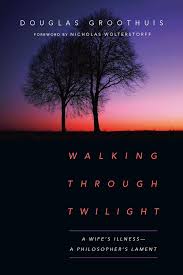
Walking Through Twilight by Douglas Groothuis

book teilight

This book grabs you. You pick it up, anticipate what you will find, and then get surprised. Though being real, or “raw” as they say, is all the rage these days, after you read this book you may decide, as I did, that you’ve hardly ever read something that’s “raw”. So much of the rawness of our day is merely façades more painstakingly crafted, but here the author detonates dynamite under his façades. He is a philosopher, an academic, an accomplished speaker, the man that is supposed to have it all figured out, but in the waves of bewilderment that crashed upon his soul as his wife descended into the twilight of dementia he found out he did not. What he could figure out when he forced himself to examine this bizarre, unexpected place is worth contemplating. It reminded me of my dark places, which were not as dark as his, and taught me what to examine the next time.

This effort is not along the same lines as the other titles Mr. Groothuis has produced, other than his quality writing skills. For example, I was greatly instructed by his “Philosophy in Seven Sentences”. He was able to marshal philosophy and especially the Bible for his struggles. He did it without an ounce of superficiality. He wasn’t able to tie everything up in neat little packages either. The profound part was that the more crushed he became the more sufficient his Savior became. I was moved.

Usually, when I review a book I overview the contents, but I think that would be a mistake in this case. Just experience it. Approach every chapter with a clean slate. You won’t regret it!

I received this book free from the publisher. I was not required to write a positive review. The opinions I have expressed are my own. I am disclosing this in accordance with the Federal Trade Commission’s 16 CFR, Part 255.

A History of Israel (Revised Edition) by Kaiser and Wegner

book hist israel

We have here a massive revision of a much-beloved history of Israel textbook. Don’t allow the word “textbook” to cause you to think this book is only designed for college students. It’s an extraordinary resource for any Bible student or pastor. The amount of information is incredible. Walter C. Kaiser, Jr. is known for his helpful conservative scholarship and has been a trusted name for many for years. You might say this volume has been made fresh with the addition of Paul Wegner as a co-author.  The addition of many color pictures and maps from the B&H Publishing collection helps immensely as well. It’s large 7” X 10” size allows the font and picture/map dimensions to add to its enjoyment. The only downside is the fact that it’s in paperback and that its type of printing removes some of the sharpness of the illustrations. My hope is that this volume will meet with such success that the publisher might consider an attractive hardback with slick pages. That is, though, the only shortcoming of this book that I found.

As much as I enjoyed the bells and whistles of this volume, it’s the well written conservative viewpoint that makes it stand out. I’ve seen most of the other histories of Israel in print by academic publishers today, and this volume far exceeds them all. The others may have some commendable features but always come with a pile of caveats because of their consistently twisted chronology and skeptical nature. This volume contains all the academic and biblical information on the history of Israel that a sincere Bible believer could desire.

After three introductory chapters that describe the scholarly mess that academia has made of the history of Israel, the book has nine major parts with 30 more chapters that take us from Israel’s beginning to the Intertestamental period. You might quibble over some date or conclusion, but you will greatly appreciate the bedrock assumption behind every conclusion drawn from the evidence found that the Old Testament is a trustworthy source and the basis of our study. I especially appreciated the archaeological proof of Israel and the Old Testament, which is substantial, that is presented in this volume.

Without a doubt, this volume will take pride of place in my library on the subject of the history of Israel. I highly recommend it!

I received this book free from the publisher. I was not required to write a positive review. The opinions I have expressed are my own. I am disclosing this in accordance with the Federal Trade Commission’s 16 CFR, Part 255.
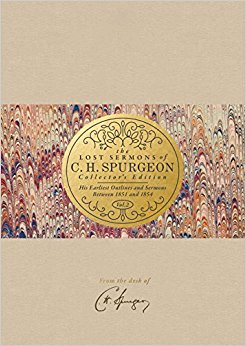
The Lost Sermons of Spurgeon: Vol. 2 [Collector’s Edition]

book spurgeon 2 coll

It’s thrilling to see this second volume roll out in this exciting series of the lost sermons of Charles Spurgeon from the earliest days of his ministry (1851-1854). I fell in love with the first volume, and this one continues all the interesting features and beauty of the first. I noticed the sermons are little more developed here than those in volume 1 as well.

This Collector’s Edition contains the same content as the regular volume as you will see when comparing each Table of Contents, but is still worthwhile to check out. I suspect many Spurgeon fans will prefer it. ( I do!)  It has the look and feel of those heirloom volumes that existed in Spurgeon’s day and have lasted until ours. It comes in a slipcover box and is a cloth over boards volume with leather spine binding. In addition, there’s genuine gold foil on the spine as well as gilded page edges. I’m a book lover and own many, but this collector’s edition is easily the best I’ve seen published these days. Don’t miss the incredible pictures either that have been added in unnumbered pages at this end of this book–they aren’t found in the other edition.

The forward and editor’s preface are the same as in Volume 1, but the introduction is specific to the sermons in Volume 2. Editor Christian George continues his painstaking research to uncover an incredible amount of detailed information on the sermons. As we saw in Volume 1, he shows that Charles Spurgeon did little borrowing in the early days of his ministry from preachers like John Bunyan, Charles Simeon, and Thomas Manton. To my ear, they still came out sounding like Spurgeon himself. As is always the case when he preaches, they are full of the gospel.

Spurgeon had such an eye for texts. In fact, when I look through this work the idea would often strike me that I should preach on some of these texts someday. (I promise I won’t steal Spurgeon’s sermons!) It’s no understatement to say he was a master preacher.

This volume includes #78-134 of his sermons, including the famous sermon entitled “The Curse and the Blessing” that he preached from Proverbs 3:33 when the horrific accident at the Surrey Garden Music Hall in London happened where seven were killed and others were injured in a stampede. Be sure to read the footnote that describes how Spurgeon was so affected by that tragedy that the mere mention of the text would precipitate a reaction from him. For that matter, all the footnotes in this book are incredible. I can’t fathom the number of hours involved to assemble all this information.

This set will be a treasure when completed. Either set is superb, but the Collector’s Edition is extraordinary. I imagine many are collecting them one at a time as they are released and joyously anticipating the next release. If you have an appreciation for the greatest preaching from history, you can’t overlook Spurgeon or this set. I commend the publisher for undertaking the task of producing this treasure for us. We are all indebted to them. I give this book the highest possible recommendation!

I received this book free from the publisher. I was not required to write a positive review. The opinions I have expressed are my own. I am disclosing this in accordance with the Federal Trade Commission’s 16 CFR, Part 255.
Philippians (EEC) by Keown–2 In-depth volumes on Philippians


book phil eec

In this latest release in hardback of the Evangelical Exegetical Commentary (EEC) series, Mark Keown hits a home run. As one who owns all the modern, major exegetical commentaries on Philippians, I can say unequivocally that these two volumes on Philippians are the most thorough we have today. As a bonus, its stance is warmly conservative. As I understand it, as is the case with all volumes in the series, this two-volume set was first released as one volume in digital form. Readers like me who will defiantly only use a book that can be held in our hands must be grateful to Lexham Press for providing these two attractive volumes for us.

Volume 1 covers Philippians 1:1-2:18 and with indices runs over 550 pages. See what I mean about thorough! This volume contains the Introduction to the Book of Philippians and runs to 92 pages alone. I appreciate that the author’s love of Philippians becomes apparent on page 1. To me, that’s essential to a good commentary. Keown quickly establishes his acceptance of Paul as the author. After discussing the role of Timothy in this letter, he dives into Paul in Rome and thoroughly describes the scene there. Next, he explains the integrity of Philippians. He picks apart the multiple–letter hypothesis and sees Philippians as a unified whole. After carefully examining the evidence, he’s comfortable with a conservative dating.

After he works his way through the data in Philippians, he reviews the recipients of the letter and gives us background on the town of Philippi itself. From there, he delves into the Philippian church and draws a careful picture of its makeup. That church’s need transitions him into some of the themes that we find in Philippians. He concludes that section with finding the “cruciform” life in the letter. The next section tackles the genre of Philippians. He finds it hard to fit in the straitjacket of one narrow description. After describing the use of the Old Testament in Philippians, he explains thematic and structural analysis of the book. Though brief, it is very good and clear. After an outline, he provides a lengthy bibliography.

In every passage he gives an introduction for the passage itself, followed by the portion of outline in play, translation, textual notes, and all followed by detailed commentary. This is where the commentary is impressive. Though it might be lengthier than many will want for Philippians, there’s no doubt that it addresses every exegetical issue imaginable. In other words, it’s not going to miss something that you think ought to be discussed. What makes it superior to many other major commentaries of great length is that its bulk is not made up of esoteric, somewhat off-topic discussion. No, he gives us mostly exegesis.

I predict that this commentary will prove to be widely used in the years ahead. I highly recommend it.

I received this book free from the publisher. I was not required to write a positive review. The opinions I have expressed are my own. I am disclosing this in accordance with the Federal Trade Commission’s 16 CFR, Part 255.
Volume 2 covers Philippians 2:19-4:23 in the Evangelical Exegetical Commentary (EEC) series, and continues the thoroughness found in the first volume. With indices, it runs to almost 570 pages. Just like the first volume on Philippians, its claim to fame is detailed exegesis. Other major tomes addressing Philippians on the exegetical level often run on side paths that many Bible students think go nowhere. I so appreciate that this volume is always wrestling with the text.

As a case in point, check out the commentary on Philippians 4:13. In six pages of commentary, every word is thoroughly investigated. Options are weighed and conclusions are explained. Hard questions are not dodged either. After all the exegetical work, he explains the major interpretive issues. How wide is the application of this famous verse? He doesn’t just spout off an answer, and though he warns against taking in too wide a direction, he explains why we can take it farther than the narrowest interpretation with good reason. It’s in places like that we discover the commentator’s skill found in this volume.

In every passage he gives an introduction for the passage itself, followed by the portion of outline in play, translation, textual notes, and all followed by detailed commentary. This is where the commentary is impressive. Though it might be lengthier than many will want for Philippians, there’s no doubt that it addresses every exegetical issue imaginable. In other words, it’s not going to miss something that you think ought to be discussed. What makes it superior to many other major commentaries of great length is that its bulk is not made up of esoteric, somewhat off-topic discussion. No, he gives us mostly exegesis.

I predict that this commentary will prove to be widely used in the years ahead. I highly recommend it.

I received this book free from the publisher. I was not required to write a positive review. The opinions I have expressed are my own. I am disclosing this in accordance with the Federal Trade Commission’s 16 CFR, Part 255.
 

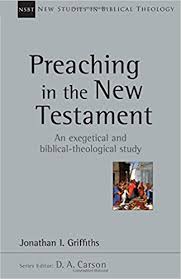
Preaching in the New Testament (NSBT) by Jonathan Griffiths

book preaching NSBT

This recent release in the New Studies in Biblical Theology (NSBT) series, written by Jonathan I. Griffiths and edited by D. A. Carson, is a winner! It matches the depth of the series that is respected all around while having something to say about preaching that will be meaningful to every preacher. While I have read and enjoyed many volumes on the subject of preaching in the New Testament, this one is different and lives up to its subtitle in that it goes hard after being an exegetical and biblical-theological study. In other words, it’s less a motivational approach and more of a declaration of what the New Testament specifically says about preaching. By the end of the volume, you will have no doubt that the task of the preacher, or “authoritative public proclamation”, is the design of the Lord revealed in the New Testament.

After a brief Introduction explaining the purpose of this book, the author tackles in Part 1 what he calls foundational matters. He will explain in three chapters the basis of the Word of God in biblical theology as well as the key Greek words for “preaching” in the New Testament. That chapter on those keywords is fascinating (don’t miss the fine charts) and really proves the authors premise by its end. This section is followed by an excursus on who the preachers are in Philippians chapter 1.

Part 2 covering chapters 4 through 9 exegetes six key passages where preaching is discussed in the New Testament. 2 Timothy 3-4, Romans 10, 1 Corinthians, 2 Corinthians 2-6, 1 Thessalonians 1-2, and Hebrews are all superbly covered. In some cases, the focus is on a few chapters while others trace words for “preaching” throughout an entire New Testament book. The author succeeds in both of these approaches, and again, in my opinion, proves the place of preaching in the New Testament beyond doubt.

Chapter 10 shares a summary and conclusions. He gives a summary of exegetical findings, followed by his biblical–theological conclusions. I found it easy to agree with every one of his conclusions made here after reading this book. In a day when preaching is held in less repute than former days, this book is just what we need. I’m glad it’s been written and glad to recommend it.

I received this book free from the publisher. I was not required to write a positive review. The opinions I have expressed are my own. I am disclosing this in accordance with the Federal Trade Commission’s 16 CFR, Part 255.

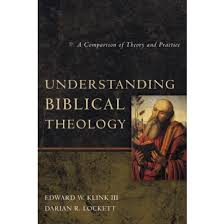
Understanding Biblical Theology by Klink and Lockett

book und B theo

Edward Klink and Darian Lockett join forces to guide us in defining the term “biblical theology”. In doing so, they will divide the scholarly world into five major schools of thought on the subject. In addition, they will compare theory and practice as well as the origin of it being the church or the academy. Both authors have already published major works. In particular, I greatly admire Klink’s recent commentary on the Gospel of John in ZECNT. I see him as a theological and scholarly writer to keep an eye on in the future.

The introductory chapter surveys what the authors call the spectrum of biblical theology. Though I read widely, I was a little surprised to see what I thought was a commonly accepted term so exactly defined and widely debated. Along the way, they will further try to separate the concept of biblical theology from systematic theology. As will become important as you read the rest of the text, in this introductory chapter they define the issues involved that divide scholars. How the Old Testament connects to the New Testament, whether we should look for historical diversity or theological unity, the impact of the scope and sources of biblical theology, what the actual subject matter of biblical theology is, and finally, whether biblical theology should be defined by the church or the academy. Make sure you linger over the small chart on page 22 that shows a logical way to view the five schools of thought. Spoiler alert: there’s an outstanding summary chart at the end of the book that will make it possible for you to review and make sure you followed the line of thought given in this book.

The design of the book is simple. There’s a chapter of defining the particular school of thought followed by a chapter that fully examines one of its major proponents. In a nutshell, you have biblical theology as historical description with James Barr, as history of redemption with D. A. Carson, as worldview-story with N. T. Wright, as canonical approach with Brevard Childs, and as theological construction with Francis Watson. Please don’t ask me where I land even after reading this book, though I find myself vacillating between the first two schools of thought. Strangely, each point of view had some aspects worth considering, even if some of them had more serious drawbacks.

Some might find this subject a hair too finally split, but I can’t imagine a resource that could more capably define the parameters of this subject. Believe it or not, the authors were so faithful to their task of explaining why this issue is hard and how it’s been viewed that they never championed one viewpoint over the others. This is THE book on the subject.

I received this book free from the publisher. I was not required to write a positive review. The opinions I have expressed are my own. I am disclosing this in accordance with the Federal Trade Commission’s 16 CFR, Part 255.

The Spurgeon Journal–The Perfect Gift!

book sp journ

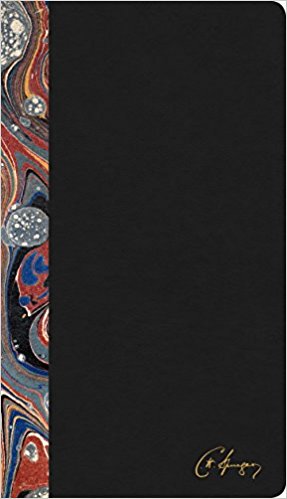
You’ve surely heard of one of the publishing feats of recent years in the publication of the lost sermons of Charles Spurgeon. Available in both a hardback and deluxe collector’s edition, this set when complete will be a treasure for Spurgeon fans or those who love preaching in general. Many are building their set one volume at a time as they are released. B & H Publishers has also created this exquisite ruled journal in a matching style to the set. Journaling is the rage these days, and I’ve hardly seen one that looks nicer than this one. It’s a leather-bound beauty!

This 5” x 8.25” Journal grabs your attention at first sight. You will notice Spurgeon’s signature embossed on the lower right-hand of the cover. When you open the book, you’ll see a place to put your name with another faint rendition of Spurgeon’s signature below. The next page gives a blurb about the 12 volumes of the Lost Sermons set. That’s followed by an open table of contents where you can approach the 140 sermons in the order you prefer. What’s labeled as page 1 has a place for you to put the date in the top right-hand corner with the ruled lines for your reflections filling the rest of the page. Some pages have profound quotes by Spurgeon at the bottom, with the following page giving the title and sermon number of the Spurgeon sermon that the quote was pulled from.

This journal on acid-free paper is the perfect size and feel. If you like journals, you will love this one. My guess is that any pastor would find it the perfect gift. In my view, no corners were cut in producing a journal worthy of the monumental set of the lost sermons of Spurgeon.

I received this journal free from the publisher. I was not required to write a positive review. The opinions I have expressed are my own. I am disclosing this in accordance with the Federal Trade Commission’s 16 CFR, Part 255.