Altar Ego by Craig Groeschel — Book Review

altar egoIt’s a purposeful play on words. We already possess an ego, and most of us in Jekyll-and-Hyde fashion have something of an alter ego. Mr. Groeschel proclaims that we Christians need an altar ego transformed by Christ.

He begins by discussing how we focus on our reputation. In most cases, that is not who we really are, nor who the Lord wants us to be. We have worked so hard at maintaining what he calls our “false self.” This, he says, must be sacrificed to our new identity in Christ. He explains this in 4 chapters.

This is helpful in that the Lord knows we aren’t what we project, and deep down, we know it too. It makes for a public and a private life. This is not what we were made for. As he says repeatedly, “You are not yet who you are supposed to be.” Galatians 2:20 backs up his premise that Christ lives in me and that is the real me now. Let’s live in that light!

He explains that we we may have to shed labels that have attached themselves to us in the life we have lived. He speaks of being labeled “tightwad” and easy it is to fall back into old ways with the excuse “that is just who I am.” I suppose the labels we put on ourselves are the most damaging. Christ, we must always remember, changes everything.

At times I thought he was going to run to the power-of-positive-thinking mantra, but he pulled it back to our being overcomers in Christ. His discussion of how we are God’s ambassadors was a challenging perspective.

Part 2 on “Sacrificing Cultural Relativity for Eternal Values”, also done in 4 chapters, really calls for us to have more character in terms of patience, integrity, honor, and gratitude. This section doesn’t really deal with Christ transforming us as much as moral teaching and enticements to be more of the person we should be.

Part 3 encourages us to be bold in behavior, prayers, words (really good), and obedience. This succeeds in some measure in tying together the other 2 parts.

The book is an easy read that you can digest quickly. Some might think he tells too many stories that make him look like a really great Christian, but that would be a matter of taste. Still, this book could be a help to people.

I received this book free from the publisher. I was not required to write a positive review. The opinions I have expressed are my own. I am disclosing this in accordance with the Federal Trade Commission’s 16 CFR, Part 255.

Success Or Victory — Which Do You Want?

success or victoryAre you shooting for success or victory in your life? Do you actually know the difference? And if you really do, do you live for the noble one of the two? A book I read and recently reviewed got me thinking about this in my life. It really intersects with some other things the Lord has been pointing out to me.

Perhaps you have lined up with the world around you and think in terms of success. I know it has infected my thinking at times. Success is impressive. It woos the praise of those around us. It titillates our own emotions. But it bores Heaven.

Success is about achievement, not results. Particularly when the results are impossible to quantify, we fall back on those old standbys of the pats on the back. It’s like favoring the medal over strategic gain on the battlefield. Strategic gains do not, I might remind you, always take the shape of a superior number in some category.

Take the ministry as a prime example.  How do you decide if your ministry has meaning? The world tells you that it’s measured in success. That is, success defined by my number of choice: attendance, baptisms, visitors, budget, building projects. The key number for success is, of course, my best number at the moment. I’ll talk that up because I want you to think I am successful. I’ll never mention my bad numbers–I’m not stupid enough to mention those. Then you would know I’m unsuccessful, and my life would be meaningless. (Yes, that is just as ridiculous as it sounds and it is still how we feel).

Do you suppose the Lord really measures us in such a fashion? If I could improve any of those numbers, would the Lord love me more? A little thought and we know the answer to that question! The flip side must be answered by the same logic–will He love me less when some of my numbers decrease and I become proportionally more unsuccessful? Again, you know the answer, but this has still been the case of extreme discouragement for so many of us.

 The book I mentioned spoke of the cross. That’s a good reference point, wouldn’t you agree?  Jesus had success for a while. The crowds were impressive, even if a bit superficial and unruly. Impressive enough, in fact, that the religious establishment got so concerned about His numbers in regards to theirs that they decided to kill Him. Success, you know, has a dark side. As His ministry rolled along the crowds disappeared. By the cross, even the Twelve couldn’t be found! By our standards, that is anything but success. But was it victory?

I say it was the greatest of all victories that rose from the ashes of all that apparent failure. Such is the benchmark of success–it doesn’t know the difference between victory and defeat. Again, it might think the losing general of the battle, as long as his chest was decorated with rows of medals, quite the hero.

It plays out in our lives. We strive for success and care little for victory in the Christian life. As if the Lord cared more about what we do than who we are! Surely, you know better than that. And yet like me, at times, I bet you forget.

Remember that success fades while victory ever remains. Remember who topped the statistics 50 years ago? 200 years ago? I didn’t think so. Do you remember who invested in your life in a meaningful way? I thought so!

Living for success is a roller-coaster ride that most of us are ill-equipped to survive. There are so many factors beyond my control. People in the midst of success don’t want to mention the fact of how many things favorably fell their way, yet it is true. Noah had a lot of things stacked against him, and success eluded him. As the Ark door closed, and among the animals he could only count his own family after 120 years of preaching, I’d say he didn’t think of success. On the other hand, did he have victory? I’d say he thought so as he stepped out that same Ark door to a world reborn with life.

Success is complicated. Despite all my efforts, it may never come. Victory is simple. It is as easy as throwing my life into His life. If I live for Him and in fellowship with Him, I have victory. It will be as strenuous a life as working for success, but it will be so much more satisfying. And so much more attainable. Lord, help me not waste my life seeking success when victory is right in front of me in You!

A Book Every One In Ministry Needs To Run And Buy!

mondays with my old pastorYou think I’m exaggerating when I tell you to run and buy Jose Luis Navajo’s Mondays With My Old Pastor, but I assure you I have never more thoughtfully made such a statement. My friend, Ryan Hayden, gave me the book telling me it had such an impact on him. I looked forward to reading it, but never dreamed it would so move me. It is certainly one of the top 2 or 3 ministry books I now possess.

Don’t let its laid-back format fool you. It wraps you up in a story to deliver its gold, but it is more than a story as it touches all the places we need as Christ’s servants. Particularly if the strain of that service weighs on you.

It apparently has a few things working against it on the surface, yet those things vanish with every turn of the page. First, it is written by an unknown Spanish- speaking pastor. The translation is so good, however, that you never think of it. Plus it can help abolish the ridiculous thinking that the Lord can’t use others in another culture on the same level as us. Second, you may not know this pastor, but you will want to walk his steps and feel every throb of his heart. Third, the old pastor he learns from is unknown too. But you will have the most incredible vision of what an entry into Heaven this old man must have had. He could join Paul and Spurgeon and make quite a team. He was of their ilk.

In the book Mr. Navajo is sinking under the weight of ministry and decides to look up his old pastor for counsel. As the book goes along we learn the old pastor is dying, but he is energized to share with this protege of his. He goes every Monday for a meeting with the old pastor and the pastor speaks from accumulated wisdom, extraordinary stories, and power from a dynamic walk with God. The chapters are the discussion on each Monday.

Every chapter is a field of diamonds scattered all over the ground. If you can’t be helped by this book, take off your work boots and leave the gospel field–there’s no help left for you. But if you want to see–I mean really see–read with your senses fully engaged. You will find yourself craving the fellowship of your Lord! You will want to stay in the field, with your head now on straight and your heart running at full capacity.

The book boils down to 15 key principles. The list is amazing as is the journey to get to them. There are so many lessons, so many corrections and reproofs, and so much hope. I’m not going to mention even one of the principles in this review as I wouldn’t want to rob you of the journey. There are a thousand greats quotes in the book as well, but I will let you do your own digging too.

Thank you Mr. Navajo for taking us on your journey by writing it down for us. Thank you old pastor for your sage counsel–we will never forget it!

RELATED POSTS:

Leading on Empty

Dangerous Calling

Thou Shalt Not

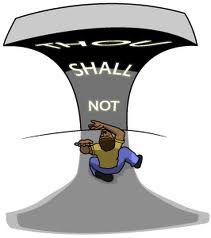
thou shalt notYou can’t deny that the Bible has a few of those “Thou Shalt Nots” in it. There’s a few “Thou Shalts” as well for that matter. We have a tendency to reduce Christianity to what we should do, and more often, to what we should not do. Is that really the essence of Christianity? Is it a fair representation to say that Christianity has as its main feature that it tells you what to do.

Well, it does mention, in passing, what we should do. Is that the theme?  Have I arrived as a Christian when I know the “cans” and “cannots”, and particularly, if I get to the place where I think I have proof that I live them?

As my Christian life goes along, I’m learning a few things. I don’t handle these things as well as I once imagined I did. I guess when the Lord Jesus told us that when we hate we really murder, or when we lust we actually commit adultery, I wasn’t listening carefully enough. In other words, I still struggle with the “Thou Shalt Nots”. Come to think of it, I guess that shows just how desperately I needed/need Jesus Christ. Actually, that is a little closer to the theme of the Bible, isn’t it?

That raises an even more bizarre question. Why do some people insist on adding to the “Thou Shalt Nots”? How can they do this to me? Couldn’t they wait until I mastered all the ones the Bible actually mentioned before they encumbered me with more? I think someone is out to get me!

Speaking of bizarre questions, I can go one better still for these folks. Wonder why the Lord forgot to put all the necessary “Thou Shalt Nots” in His Word? It wasn’t like we didn’t have any of them already, or that we had so conquered them that they were boring or irrelevant. We have never lacked volunteers, from Christ’s day until today, to fill this void.

You almost wonder if some people just want me to fail. The pointless part of their efforts is how wonderfully I was failing before they got involved! Are they trying to prove I am a sinner? Talk about a day late and a dollar short—that was already proven a long time ago.

Are they afraid I am going to think too highly of myself? (Kind of like they are or they wouldn’t be so presumptuous to add to God’s “Thou Shalt Nots”—oops, I better save that topic for another day). Again, this is the proverbial beating of a dead horse. The more deeply I look into my black heart, the less able I am to see anything worthy. I really could fall apart over it until I look long and hard at the One Who saved me. That’s the only relief I have ever found.

So add to the “Thou Shalt Nots” if you must. I’m probably not going to pay any attention to you. The ones the Lord left us have already been effective enough to drive me into the arms of Christ—the place I needed to be all along.

The Connecting Church 2.0 by Randy Frazee

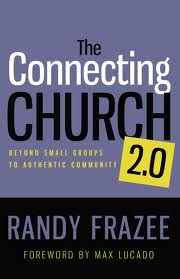
connecting church 2.0Are people really connecting at our churches? Or are they lonely and unfulfilled? Nationwide attendance numbers tell us something is wrong. Here’s a book that makes sense of what is really going on in our society today. There’s real help here too to go with his persuasive analysis in terms of what needs to happen in our churches to stem the raging tide.

Mr. Frazee has had over 10 years to work out his ideas since the first edition of this  book was released (hence the 2.0). He is only more convinced. We are missing the unity of the early church. Who could disagree with that statement? We lack the community that characterized them. He is also particularly candid in the methods of modern churches, even what I would find fault with–I didn’t expect that!

American culture has been high-jacked by individualism. In other words, individual rights trump community, even the Christian community called the local church. Small groups became the rage a few years ago because someone figured this fact out. Individualism has even, says Mr. Frazee, robbed small groups of their real value because we are groups of individuals. The group knows we will hit the road if anything is said, so they say little. Community, then, fails at what it was designed to do.

What’s the answer? He says we must shift thinking back to a real understanding of community. There’s a common purpose there that we can all rally around and serve the Lord. After he explains just how lonely and isolated we really are. the balance of the book tells us how to implement in our churches.

He speaks so much of a neighborhood approach, called a starfish model, that quite frankly is far beyond our comfort zone. Can it work? Read and decide for yourself. My thoughts–we can glean some real ideas from him without becoming a congregation of multiple house churches. I could never follow him fully, but did he ever give me much to think about. For that, I thank you Mr. Frazee. As a pastor, after reading your book, I feel obligated for Christ’s sake and the multitudes of the unconnected to work at community again.

I received this book free from the publisher. I was not required to write a positive review. The opinions I have expressed are my own. I am disclosing this in accordance with the Federal Trade Commission’s 16 CFR, Part 255.
RELATED POST:

Does It Take A Village To Raise A Child?

Does It Take A Village To Raise A Child?

village to raise a childWell, does it? Surely you remember the hullabaloo that Hillary Clinton raised when she told us that “It takes a village to raise a child ” in the 1990s? Christians rightfully protested because we knew that she meant only that government had preference over parents in decisions regarding the lives of children. That is absurd in the extreme.

On the other hand, think of that village again. Do any of us really raise our children alone? Would we really want to? We predominantly raise them, but not exclusively. On further examination, that was the Lord’s plan all along. A book I’m reading (and will review very soon) really got me thinking.

The Lord always intended that we live in community with each other. Adam was unfulfilled alone and needed community. That has always been the plan really. Jesus lived that way when He showed us what life on Earth was supposed to look like. To top it off, the Lord gave us the local church. Wouldn’t you call that a community lifestyle? Read Acts 4 again if you just can’t remember.

There was a time when community was key to our lives in America. It wasn’t too long ago (if you must know, I’m 42) that I was a boy growing up in Happy Hollow down in the Smoky Mountains and knew every single one of the hundred or so people living in that little community. I couldn’t have done anything too bad because any one of them would have called my parents and told them.  I suspect  that is actually a very good thing. I wouldn’t have wanted to be embarrassed in front of all of them! Sadly, in most communities that is not what it once was.

The question is, do we still have that sense of community in our churches? That surely is one of the reasons the Lord designed it the way He did. It should be true that all there are on my side and want to see me raise my children for the Lord. They probably will have my back and let me know if my children get out of hand. It should work that way.

I realize that you may know of a few super-critical church members that ever wait to lambaste your children. Just remember that they are wrong and that doesn’t make the design wrong. Plus you may know some who you could never explain that, perhaps, something about their children needs to be brought to their attention. They are the type who as we were standing around glowing embers would be offended by you suggesting that their child burning the church to the ground was not exactly a good deed! Still, a community designed around the unity we have in Christ is what it is meant to be.

If parenting weren’t hard enough, many forgo this wonderful help. The issue really goes far beyond parenting. You and I need community too. We need encouragement and accountability. We have built into us this need of others. Were this not true, we Christians would be even more pathetic than we are at reaching the world for Christ.

We need the village to share our journeys, to lift each other up, to carry each other when we are weak, and to take away the nagging loneliness that is all around us. Be yourself, but embrace the village–most especially that community called the local church.

Are You Stuck In The Old Testament?

Many of us do it. We live an Old Testament existence in a world of New Testament promises. I guess Law will always appeal to our flesh more than Grace. So we go along mistaking the physical lesson of the Old Testament for the spiritual truth of the New Testament.

Recently, there it was in my Bible reading. In Joshua 5 there was a lesson I found thrilling. Here were the Children of Israel freshly arrived in the Promised Land, and after the drama of the Jordan crossing, the Lord’s first order of business was the practice of circumcision. They had carried it out years before in Egypt, but over the years of wandering they had neglected it.

Well, we are supposed to look at OT stories with NT light, right? The circumcision that the Lord is really after is circumcision of heart. So many times we neglect it and it is urgent that we put it in practice again. Just think of the pain of carrying out that call to circumcision! I understand that “sharp knives” of Joshua’s day were flint stones. I don’t want to be too graphic, but I would dread it! Any surgery with stones instead of modern day knives would terrify me.  So, I suppose even at the cost of discomfort we must do the work the Lord seeks in our hearts. In verse 9 we were even told that “This day have I rolled away the reproach of Egypt from off you.” He never said it until the events of this chapter. This we need and in verses 13-15 the Lord came. Pretty exciting stuff, huh?

These lessons get by us too easily. We’d rather pull out the stones of flint than do real heart surgery. We’ll inflict the pain of body and leave our souls at ease.

We become consumed with the object lessons. We prefer the tangible, outward things over the spiritual, inward things. Since this lacks spiritual power, we turn on each other and watch for the pool of blood and listen for the screams.  We are always ready to point out everyone’s failure as if circumcision could tell us all of our hearts. Our conclusions miss the point and hurt others, as well as ourselves. Need I remind you that Jesus has come through in the interim between Joshua and us?

Perhaps we find the pain exhilarating. Perhaps we enjoy it more if we see others suffering with us. I don’t know. We inspect the circumcision, so to speak, while the Lord says you are seeing the object itself as the lesson and missing the point. But we can see the circumcision and we can prove we did it. We can never prove what is in our hearts. We settle for what we can impress others with while being indifferent to what might please the Lord. We live the Old Testament as if the Lord had no greater revelation in the New Testament to share. Pretty ridiculous, wouldn’t you agree?

If I saw the point I’d pray for my heart and yours. I’d listen carefully as the Lord spoke to me and encourage you to do the same. But I’d leave the stones of flint to your own consideration and ask you to keep them away from me. Live the Old Testament if you please and I’ll keep my mouth shut. As for me, though, I’m rather fond of the New Testament.

Leading On Empty–Personal Observations and a Book Review

old gas pumpAre you out of gas? Is your tank dry? Yet the road ahead of you goes out beyond the farthest horizon? While this could happen to anyone, what about if you are in the ministry? You are slowing down while the need in God’s work is ever growing. I am now convinced that this is a common problem, perhaps inevitable for those of us who want to give our all.

I’ve read, I’ve studied, and for a season of last year, I felt it! My love of the ministry never wavered. I never stopped loving preaching passionately, yet I felt a weariness. I didn’t quite understand it. I never stopped, but the engine wasn’t running as well. My gentle Lord worked in a variety of ways to help me. He is faithful! 

Among those things He used was this book, Leading On Empty by Wayne Cordeiro. It was during a conversation with a friend  where we were each throwing out book titles that we had read or heard about, that he mentioned this book. Strangely, I didn’t even think I needed the book at the time but was intrigued when he said he had heard of some prominent pastors who were rescued to some degree by this book.

Frankly, I’m not ashamed to speak of this in my life. If far better men than me have faced it, why shouldn’t I? Life has taught me, anyway, that I am far from the strongest person. I see more clearly than ever that I am just going along, held in His hands, and living on His grace. Because of that grace, we need not live on and on with an empty tank.

So I can review this book on more than a theoretical level. Sometimes a book is worth three times more at a certain season of your life than at any other. It might not be your need at this time. On the other hand, it might be soon. I recommend every pastor, and really any leader, have this book on the shelf. For perspective,  I read over half of this book at a tough time for me, and then read the other half later when things were so much better for me. I can recommend it from both angles.

Mr. Cordeiro, a pastor of a thriving, large church, hit bottom. He simply had nothing left to give. He tells his story –warts and all. But as you read, you know he writes with a distinct measure of authority.  He shows how at times Elijah, Moses, Jeremiah, and David lived this too. “Burnout”, being overwhelmed, or out of gas–call it what you will, but it is a real danger, particularly for pastors. As easy as pastoring looks to many, the weight of souls is a load like no other.

He shows statistics for how widely pervasive this issue really is among pastors. He explains the concept of strength being perfected in weakness. He shows how the long-term stress of this leads to depression. He shows how people like Spurgeon suffered here. He sounds the alarm of early warning signs.

His biggest suggestion is solitary refinement– stopping, listening, being quiet. He suggests we divide our lives into what only we can do versus what others can do. We often work where others could while neglecting that 5% that only we can do. My personal life, my family, my Bible time–here are things that only I can do.

His chapter on “Finding the Still Waters” is on target. He also wants us to remove the stigma that is so often put on rest. Our resources of physical strength are obviously limited so we must carefully develop a strategy. Rest, he says, is not a sin, but a responsibility. We see the principle in the weekly Sabbath and in the land resting every 7 years in ancient Israel.

He focuses on being in our Bible and shares this acronym to get more:

SOAP

S = Scripture

O= Observation

A = Application (Never stop without it)

P = Prayer

He pushes taking a sabbatical. That is a little beyond most of us financially, and he finally confesses it. Still, work refreshment into your life. His idea of a Personal Retreat Day is worthwhile too. The last few chapters focus on these kinds of practical things.

This book can make a difference.

leading_on_empty

Desiring God–A Book Review For The Christian Who Seeks Joy

desiring godCan we make sense of satisfaction or real joy? It’s one life’s most common questions. Answers for most people are rather less common. I’m interested in knowing, aren’t you? Here’s a book to show us the way.

The subtitle of “Meditations of a Christian Hedonist” tells you what a unique writing John Piper presents to us in this revised edition published by Multnomah. It’s interesting that he has to answer for his writings 25 years later when life had opportunity to test his theories. I found it a real challenge to my Christian life. He goes against so much conventional wisdom, but really discusses the subject with a Bible ever in his hands.

Don’t let the term “Christian Hedonist” turn you off. He certainly isn’t suggesting that you throw your life away in a pointless pursuit of worldly pleasures. Quite the opposite, he simply believes that life’s greatest joy comes from seeking joy in God. He further proves that this is exactly what the Lord enjoys from us. As he says, “This is a serious book about being happy in God.” We all want to be happy and this truly is the only way. This works beautifully in that: “We get the mercy; He gets the glory. We get the happiness in Him; He gets the honor from us.”

He tweaks the famous confession to “The chief end of man is to glorify God by enjoying Him forever.”  I think he makes a powerful case that the Bible actually teaches this very thing. His chapter on the “The Happiness of God” is hard to refute. Apparently, in the last 25 years several have tried.

Mr. Piper weaves his premise through many of the most important aspects of the Christianity. Happiness in God is all through the warp and woof of our Christian experience in conversion, worship, love, and prayer. It gets especially interesting and life-altering when he speaks on things like money, missions, and suffering. Our modern-day Christianity comes out of those chapters bloodied but perhaps that is fair as this same modern Christianity has slaughtered our happiness on many occasions!

You simply must read this book. There’s not much Calvinism to work around if you are more of a whosoever-will man like I am. I read each chapter so much more slowly than usual. There was so much to think about, so much heart-searching demanded, but I assure you that you will be glad you took the time to read it. I can see myself referring to it again and again in the years ahead.

I received this book free from the publisher. I was not required to write a positive review. The opinions I have expressed are my own. I am disclosing this in accordance with the Federal Trade Commission’s 16 CFR, Part 255.
Good Mood, Bad Mood–Answers On The Subject Of Depression

moodFinally a book that settles the matter of what a Christian should think about depression. I’ve always had trouble arriving at a firm conviction as there is so much conflicting information making the rounds. Charles Hodges is both a doctor and a Christian and has carefully researched the subject in this volume published by Shepherd Press.

Don’t panic. Whatever he has to say, he says compassionately. He never has a “just-get-right-with-God” attitude! Still, he demands that the subject be looked at both from the point of verifiable medical fact and the Bible. What could be more fair?

He discusses what we have probably all noticed–an amazing number of people now have a diagnosis of having depression. He explains how a so-called “chemical imbalance” in the brain is a theory that has never been proven at any level. He further explains that diseases that have legitimate diagnosis capabilities have a clear pathology (structural and functional cellular changes) that you can see. In depression, or a chemical imbalance, there is no such pathology.

There are, however, several ailments that have mood changes as a symptom and he suggests you check these out if you think you are depressed. (He lists them in an appendix). If this is not the case, then likely you are sad. He beautifully shows how our Creator made sadness as an emotion in us to deal with life and drive us to God. Though we may not respond properly, it can help us. Unfortunately, “depression” as a medical diagnosis can be a label that short circuits the process our Creator designed. We quit seeking–we stop at our label instead of the arms of our God.

He tackles the issue of so many not only having this diagnosis, but being prescribed anti-depressants as well. Beyond having their own side effects and dangers, these medicines have little success according to studies. Placebos (sugar pills) and no medicine at all have better results in patients!

He takes Bible characters like Hannah and shows how they would have gotten a “depression” diagnosis. Their real problem was normal sadness and in being driven to God they got real relief. He really puts the Bible to good uses in later chapters!

The last few chapters tackle Bipolar Disorder. It used to be called Manic Depression. He proves it is a rare but real disorder. There are now a wave of people getting a diagnosis of Bipolar Disorder. This is because they came up with Bipolar Disorder II that has a weak criteria that really can’t be verified and now we are giving away a false label and hurting people in the process.

He writes in a way that we can all understand. If you want to know what I think on the subject of depression now, just read this book. As individuals who will have sadness, worse moods and feel depressed, this book is a real help. Were it fall to us to help someone we think acts depressed this book is an indispensable guide. I give it the highest recommendation.

I received this book free from the publisher. I was not required to write a positive review. The opinions I have expressed are my own. I am disclosing this in accordance with the Federal Trade Commission’s 16 CFR, Part 255.

Addendum

I had a fine Christian lady write me and pointed out a few things to me so I want to clarify and share what I told her.

Here’s a few things the book said that I didn’t say clearly enough:
1. He says 90% of people labeled depressed are only sad, which means 10% do have  real medical issues.
2. He says some do feel better with anti-depressants (but some get better with placebos and some with nothing).
3. He says to talk to the doctor before you change your medicine (I SHOULD HAVE TOO).
4. He never writes in a way that treats depression as something to be ashamed of and I agree. It is something to deal with and try to figure out.
This kind lady also recommends that we remember that this is just one Christian doctor and we should read others. She recommends Donald P. Hall- “Breaking Through Depression: A Medical and Spiritual Approach to Emotional Wholeness” and Tim LaHaye’s “How to Win Over Depression”. It is good to read widely!
I made it sound like this book has the final say on the subject and that is a little strong!
I suggest we use this information to encourage and not discourage! Suicide and other such things mean we should be cautious in what we say.I still think this is a great book!