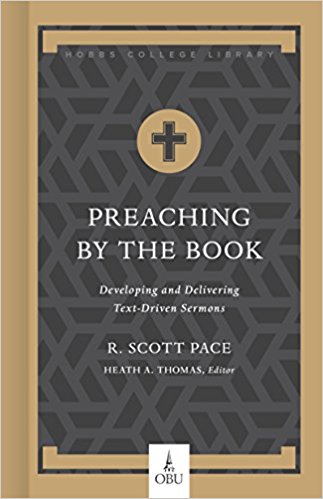
Preaching by the Book: Developing and Delivering Text-Driven Sermons (Hobbs College Library)

book preah pace

Here in the second installment of the Hobbs College Library series aimed at those in the ministry we have help with developing and delivering text-driven sermons. It’s another small, attractive hardback of quite-manageable length that is well done. It gives a grand overview that covers preaching from picking the text to giving the invitation.

As I read, it struck me that this book would especially appeal to two groups: 1) those starting out in the ministry, and 2) bi-vocational pastors. Still, even as one who has been a pastor for several years, I would catch myself thinking as I read– I need to remind myself to quit being sloppy here!

The book begins with a great chapter on inspiration for preaching and what preaching really is, as well as why textual preaching is so valuable. The next chapter shows a process of sermon development that begins with prayer and the first work of study. Part II includes chapters 3 and 4 on the framework that includes how to study and draw out what’s needed for the sermon from the text. Part III gives four chapters on what he calls the finishing touches. These touches include the importance of a good introduction to draw people in, the effective use of illustrations to captivate attention, and the crucial aspect of giving a good invitation. There’s a short, challenging conclusion to conclude the book.

If this book is an indication of what’s to come in this series, we have a tool to look forward to. This book is helpful, encouraging in the places where it’s most needed, and should be a boon for preaching to those who read it.

I received this book free from the publisher. I was not required to write a positive review. The opinions I have expressed are my own. I am disclosing this in accordance with the Federal Trade Commission’s 16 CFR, Part 255.
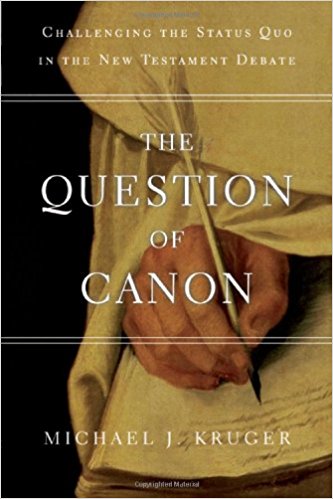
The Question of Canon by Kruger

book canon

This book on the canon of the New Testament comes at a different angle than most I’ve seen. In my view, it’s a breath of fresh air and displays a wonderful viewpoint. He goes beyond the usual question of which book should be included in the canon to the more fundamental one: why is there a canon of the New Testament in the first place? Along the way, he exposes where the scholarly world has gone awry in this discussion. Where I felt that those scholars were predisposed against the Bible, Mr. Kruger was content to look at the Bible, what was logical, and weigh scholarly opinion against it. I may have disagreed with him on a small point or two, but this book was a grand success!

In the introduction, he lists five tenets that are prevalent in a wide array of scholarship. These five assumptions lead to conclusions that put the canon of the New Testament in jeopardy. The five chapters of this book tear these five assumptions to pieces. Since the canon of the New Testament is under relentless attack in our day, it’s great to see how lacking these assumptions are on a variety of levels. Someone should send Bart Ehrman this book for a Christmas present!

Call this book a needed corrective. Call it a helpful apologetic. But most of all, call it a book that you need to read.

I received this book free from the publisher. I was not required to write a positive review. The opinions I have expressed are my own. I am disclosing this in accordance with the Federal Trade Commission’s 16 CFR, Part 255.
A Great Commentary Series For S.S. Teachers and Bible Students!

book evc

Have you heard that Moody Publishers is in the process of re-releasing their much-beloved Everyman’s Bible Commentary series? I’m a pastor who has a warm spot in my heart for this series. As a younger Christian, and in my earlier days of teaching a Sunday school class, I built my collection of the entire set. They were a real help to me. Every volume in the set is clear, concise, yet really gets at the heart of what the passage is talking about. Further, every volume is conservative, free of scholarly jargon, and glowing with warmth.

It’s my understanding that this re-release of the series will include both paperbacks with redesigned, attractive covers and Kindle editions. The first wave of these new additions will include Daniel by John Whitcomb, Acts by Charles C. Ryrie, Romans by Alan Johnson, and Revelation by Charles C. Ryrie. All these titles are winners by the way!

Either Sunday school teachers or those attempting serious Bible study on their own will find these volumes a treasure trove. If you are in either of those categories, this pastor recommends that you don’t hesitate to secure your copies of these fine books that will greatly aid your study of God’s Word! You won’t regret it!

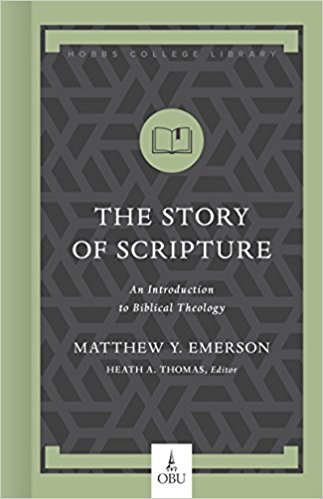
The Story of Scripture: An Introduction to Biblical Theology (Hobbs College Library)

book story.jpg

This book is the first of 21 volumes in the promising Hobbs College Library series published by B&H Publishing. Matthew Emerson provides what could be called either a broad overview of the Bible or an introduction to biblical theology. That’s a perfect place to begin any series aimed at those in ministry. We need the big picture before we dive into the details. I see this volume as the scholarly presentation of what many old-time preachers called “the Scarlet Thread that runs through the Bible”.

Chapter 1 explains what biblical theology is. It gives an overview of the difficulty that some have found in defining it. He even explains the Dallas School, the Chicago School, and the Philadelphia School, which represents the main viewpoints. The point for us is learning how a passage fits into the grand narrative of Scripture. He also argues for the Bible’s theological unity.

Chapters 2, 3, and 4 tell the story of the Bible in a way that honors that unity and develops biblical theology. Chapter 2 devotes itself to an explanation of Creation, the Fall, and redemption as seen in the foundational Book of Genesis. Chapter 3 traces redemption from Exodus through the end of the Old Testament in beautiful fashion. Chapter 3 carries the story to its completion in the New Testament.

Chapter 5 entitled “Exploring Biblical Terrains” looks at the primary themes of the story that covers the entire Bible. The author sees those themes as covenant and kingdom, with the additional themes of creation and wisdom, God’s servant, mission, and salvation through faith. The final chapter gives practical applications for using biblical theology in our preaching and teaching.

The book is less than 100 pages, easy-to-read, attractive, and filled with scholarly footnotes for those who seek additional study. If this first volume is any indication, I believe this series will be particularly successful.

I received this book free from the publisher. I was not required to write a positive review. The opinions I have expressed are my own. I am disclosing this in accordance with the Federal Trade Commission’s 16 CFR, Part 255.
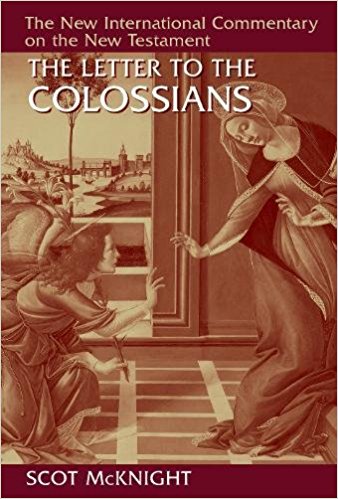
Colossians (NICNT) by McKnight

book nic col

Scot McKnight produced this fine new commentary on Colossians in the well-respected New International Commentary on the New Testament (NICNT) series. This volume replaces the work of F. F. Bruce and complements McKnight’s recently released volume on Philemon in the same series. Additionally, I find this commentary superior to the author’s commentary on James in the NICNT. Experience must help when it comes to commentary writing.

After a substantial bibliography, McKnight gives us an Introduction with vigor and punch. His writing style captivates even in those places that many commentaries slow down to a crawl. Some commentaries, too, bog down in scholarly interaction. He was unusually successful in weaving in other scholar’s opinions while formulating his own. I did not agree with every conclusion he made but found it easy to follow his arguments. I don’t know about you, but that’s what I want from a commentary.

He begins the Introduction with a broad-ranging discussion of the apostle Paul and the situation of the Colossians. He concludes that Paul communicates “as an apostle and missionary and pastor, hence, as a missional, pastoral theologian”. His discussion of authorship interacted with the New Perspective on Paul and provided some great independent thinking. I don’t agree with his final conclusion but found the whole discussion enlightening. He also discusses the authority of Paul, Christology, ecclesiology, eschatology, themes absent in Colossians, and relationships with Ephesians and Philemon. He re-creates the opponents and setting of Colossae with clarity. He arrives at a date for Colossians by pinpointing the imprisonment of Paul and thoroughly discusses all the possible options. He has a large section on Paul’s theology of Colossians with scholarly awareness for our benefit. The final section is on the structure of the book and recapitulates several famous scholars before he provides his own outline of the letter.

The commentary itself is excellent it’s everything you’ve come to expect in this series and manages to give help both to scholars and pastors (though I strongly disagree with him on the Household Code). This commentary takes its worthy place in this long-standing series and I highly recommend it!

I received this book free from the publisher. I was not required to write a positive review. The opinions I have expressed are my own. I am disclosing this in accordance with the Federal Trade Commission’s 16 CFR, Part 255.
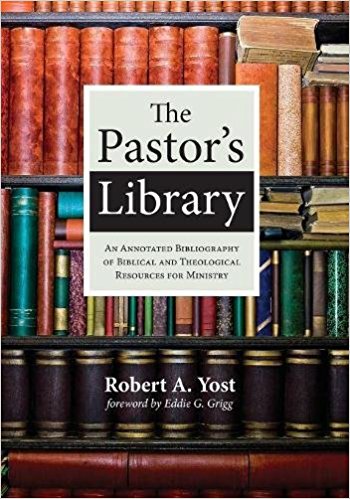
The Pastor’s Library by Yost

book pas.jpg

Here’s a fine book for pastors to help with building a biblical and theological library. There are a few books on the market that give book reviews and recommendations, but this one stands out by recommending both old and new titles as well as both theological volumes and commentaries. Most other works review commentaries only and operate on the theory that new is always the best. While we would always want some of the newest exegetical works available, we must not overlook the treasures of the past. He tells us in the preface that The Minister’s Library by Cyril Barber was his inspiration. When I think about books that came after Spurgeon and went through 1985, Barber is my go-to reviewer. I’ve often thought that we needed a modern-day Barber-type volume. That’s exactly what Mr. Yost has done and done well. There may be several books on the market, but the author has truly found his niche. Pastors will be pleased.

Though Mr. Yost favors conservative books, he is fair in recommending some of the more well done critical works.  He has a simple system where a book that is recommended to be obtained, a recognized classic in the field, a work of liberal scholarship, and a work that is very technical but of scholarly value are all marked in the book. I love how he has included several classic volumes. He has even recommended many of the wonderful Klock & Klock volumes that should never be forgotten. I’d say my only fault with this book is his near obsession with a hatred of transliterations – I’m confident it isn’t that life-and-death an issue.

He gives recommendations for Old Testament introductions, theologies, Hebrew language works, and a nicely wide-ranging list of commentaries. After doing the same for the New Testament, he jumps into a section on systematic theology, church history, and theological topics. There’s a final section on practical theology that covers all sorts of topics.

I was amazed at how often I agreed with his recommendations. It’s really a balanced, helpful list. I’d be happy to see it in the hands of a brand-new pastor and would recommend it to any of them without hesitation. Since no one has every book printed, some of us that’s been building a library for decades can still find much help and enjoyment in this book. In fact, I’d recommend this book be purchased along with John Evans’ work on biblical commentaries where he covers even more commentaries but none of these other subjects. I’m a great fan of a library with a balance between old and new works and give this book of recommendations five big stars!

I received this book free from the publisher. I was not required to write a positive review. The opinions I have expressed are my own. I am disclosing this in accordance with the Federal Trade Commission’s 16 CFR, Part 255. 
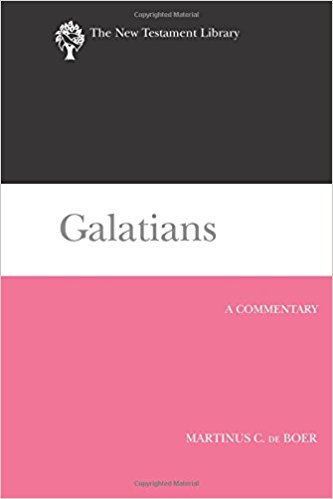
Galatians (NTL) by De Bour

book gal NTL.jpg

Martinus C. de Boer has written a captivating commentary on Galatians that is one of the very best in the New Testament Library (NTL) series. There’s a lot I appreciated in this volume. Often, I look to this series to find the critical position of the scholarly world, and though the author falls in that camp, he surprised me on several occasions. To his mind, the Book of Galatians is all about the Gospel. You’ve got to love that!

His Introduction is brief, but that’s only because he prefers to deal with most issues as you come to them in the text. After providing a lengthy bibliography, he began his Introduction by discussing his own approach that he will be taking in the book. At first, I didn’t know what to think when he said, “the aim of this commentary, then, is to understand and to expound Paul’s theology as it unfolds in this letter, and as the Galatians will probably understand it when they receive it”. As it turns out, the commentary doesn’t prove to be as novel as that sounds.

As is more typical in introductory materials, he explains the addressees of the Book of Galatians, which is the churches of that area. Though that section is brief, we learn that he holds to the North Galatia View. Next, he discusses the date of the book. He looks at the six references to events or time in the letter itself and formulates a conservative conclusion about the date (51 A.D.). He has a nice section on structure. He overviews the most common breakdown before he works his way to his own outline that breaks down the book into six sections. He provides an overview of the book using that outline. Strangely enough, he never mentions in the Introduction what he explicitly proclaims in the commentary itself – the primary theme of Galatians is “the gospel of Christ”.

The value of this book is really in the commentary section. He has the gift of clarity and where necessary breaks down his arguments into numbered lists. It’s easy to follow his line of thought whether you agree with it or not. He draws good parallels and connects lots of dots. Even if I can agree with whatever conclusion he makes, he understands how commentary ought to be put together. There are several fine short excursuses throughout. This one is worth checking out!

I received this book free from the publisher. I was not required to write a positive review. The opinions I have expressed are my own. I am disclosing this in accordance with the Federal Trade Commission’s 16 CFR, Part 255. 
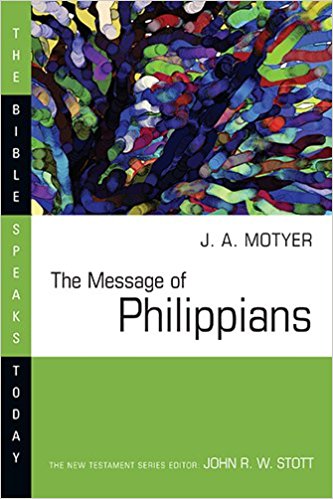
2 Great Motyer Commentaries!

Here are two wonderful commentaries by Motyer:

  1. The Message of Philippians

book bst p

This commentary by the late J. A. Motyer in the Bible Speaks Today (BST) series is a reminder of what a commentary should be. Though he describes lots of trees, he never fails to present the forest. I even got the feeling as I read this book, and it’s a feeling too often missing in many commentaries, that the author here believed God wrote the book. He seemed in awe of Philippians. Christ was magnified throughout.

In the Introduction, the author did not run straight to the theme of joy as most do. In fact, he opened with: “Philippians is a joyful letter, but its undercurrent is a sober realization that time is running out.” It made sense to me! He described the setbacks Paul was facing here in his second missionary journey. He further gave a good view of Philippi as Paul’s first European church. He well highlighted unity, the coming day of the Lord, and the Person of the Lord Jesus Christ as the three keys to understanding the book. More than referencing other scholars, he referenced other scriptures. That probably tells you more than anything what kind of commentary this is, but I believe we all need some of this type.

The commentary itself was outstanding. I will always pull out Motyer even if there’s only time to glance at a few volumes. He may have been an Old Testament expert, but reading here you would assume the New Testament was his field.

There’s a chance this volume may be replaced as the BST series updates volumes from time to time. Since this author has passed away, I want to encourage the publisher to slide this volume over and print it as a classic. It’s a warm volume, so I give it the warmest recommendation.

I received this book free from the publisher. I was not required to write a positive review. The opinions I have expressed are my own. I am disclosing this in accordance with the Federal Trade Commission’s 16 CFR, Part 255.
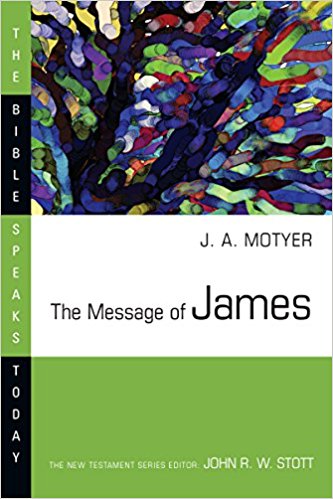
2. The Message of James

book bst j.jpg

Here’s another of the great commentaries by the late J. A. Motyer in the Bible Speaks Today (BST) series. In my view, it’s as top-notch as the one on Philippians. The author had written a smaller book several years ago on James but rewrote it in its entirety to produce this commentary. It’s not as scholarly or exegetical as many commentaries, but he captures James’s message better than most.

The Introduction is quite perceptive. Though he doesn’t talk about structure per se, he gives some great insights on how the book is designed. He sees the themes of conflict, holiness or a Christian lifestyle, the recovery of the local church, concern to meet the needs of others, and our tongue. He shreds a few of the strange scholarly trends that somehow has reached ascendancy and brings us back to basic conservative conclusions. It’s good stuff!

The commentary is outstanding at getting to the heart of what James is talking about. It would be a mistake to not add this inexpensive commentary to your collection.

I received this book free from the publisher. I was not required to write a positive review. The opinions I have expressed are my own. I am disclosing this in accordance with the Federal Trade Commission’s 16 CFR, Part 255.

Ruth (Interpretation) by Sakenfeld

book ruth i

This slim volume is part of the Interpretation Bible Commentary series. It’s one of the best books available to lay out the critical position (your other option is the OTL from the same publisher). Of the two, this one probably has more theology and insights to glean for the preacher. The author writes clearly, accessibly, and with enough verve to hold the reader’s attention well.

The Introduction begins by stating that Ruth is the favorite of many Bible readers and that it could be viewed as “an island of tranquility”. The first main section discusses date and purpose. Though I can’t accept all her conclusions, she reviews well the scholarly debate over the date. She also well explains the belief that the point of Ruth is to reinforce David’s right to the throne. She goes on to state her belief that the use of David is only “the storyteller’s means of legitimizing an inclusive attitude towards foreigners, perhaps especially toward foreign women”. I personally doubt that’s the theme of the Book of Ruth, but it was interesting. She also confesses that tradition has long held Samuel to be the author of this book and doesn’t counteract it other than stating her fascination with the possibility of a female author. She’s indecisive on what exactly the levirate marriage’s role is. She well describes the canonical context. The best part by far of the Introduction is her description of theological themes. She sees the themes as the peaceable community, examples of loyal living, and the place of God in the story.

The commentary itself makes for interesting reading. Yes, there are critical conclusions at many junctures, but also many perceptive theological points. I felt I got exactly what I was looking for in this commentary, and for those looking for the same, I highly recommend this book.

I received this book free from the publisher. I was not required to write a positive review. The opinions I have expressed are my own. I am disclosing this in accordance with the Federal Trade Commission’s 16 CFR, Part 255.

In Defense of the Bible–A Great Book!

book def bib

This is a needed book! Its subtitle explains its approach: “a comprehensive apologetic for the authority of Scripture”. Edited by Steven B. Cowan and Terry L. Wilder, this book gathers a fine collection of articles by competent writers. I was especially impressed that though these writers were scholars, they truly succeeded in writing in a way that was accessible to a wide array of readers.

You will find this book to be expertly designed. After a brief introduction, Part One discusses philosophical and methodological challenges in four chapters. That covers things like special revelation, the veracity of the Bible, what higher criticism says and how it’s wrong, as well as our ability to understand the Bible. Part Two explains textual and historical challenges in seven chapters. In this section, you will learn how that neither the Old nor the New Testament are hopelessly corrupted. You will also be made aware of the reliability of each Testament and how to view apparent contradictions in the Bible.

Part Three, which was my favorite, looked at ethical, scientific, and theological challenges in six chapters. It covers subjects that often bewilder Christians when the world attacks. What about the Bible’s apparent condoning of genocide? There’s a profound chapter answering the question–does the Bible condone slavery and sexism? There’s another chapter on the Bible’s conflict with science, and though I did not agree with all of it, it did give some help in understanding the subject. Considering the charges that our Bible is missing several books, the chapter on Canon was especially enlightening. All in all, every chapter was a winner.

My library contains just about every major work on the authority and inspiration of the Bible. I have all the old standbys and love them, but if I had to choose to recommend just one volume to someone wanting to really dig into this subject, I would choose this book. The main reason that it’s so valuable is that it takes a high view of Scripture just as the best books have in the past while focusing on the most turbulent issues that our non-Christian culture hurls at the Bible today. It’s fair to say this book succeeds in both defending the Bible and in offering an apologetic for our day. Every pastor could benefit from this book, but I recommended it to anyone feeling overwhelmed by the criticisms widely broadcast against the Bible in our day. This is an awesome resource!

I received this book free from the publisher. I was not required to write a positive review. The opinions I have expressed are my own. I am disclosing this in accordance with the Federal Trade Commission’s 16 CFR, Part 255.