The Truth About Being Always Positive

a smile

We’re told to always be positive. We’re to take it so far that we should never say anything negative. Some not only say it’s the right thing to do, but also the Christian thing to do. But we must ask: is that true?

If your options are: 1) be joyful and look for the positive, or 2) be grumpy and find the bad in every good, then your choice is clear. No one likes the person who sees the dark cloud beyond every rainbow, or the person who finds pain in every pleasure, or the person compelled to never suffer alone yet who seems to always suffers much. Still, does that mean nothing negative should ever be thought or said? Is there a better point of balance on this subject?

An article entitled “The Harm of Swarm” by Christine Rosen got me thinking. She was writing about “smarm.” That word (either as a noun or a verb) has to do with “behaving in an ingratiating way in order to gain favor.” Swarm was never a familiar word to me as in my childhood we preferred the phrase “laying it on thick.” Still, we’ve all seen it. Likely, some salesperson we’ve met along the way first comes to mind.

In our day it extends far beyond sales. Some websites have said only positive things can be shared, and even some review sites now only accept positive reviews. Social media naturally lends itself to this approach too. I’m glad my wife only shares on Facebook some nice thing I’ve done instead of those days she is convinced I’m a moron who needs to take a long walk off a short plank. Of course, no good could ever come from hurting those we love and live in close proximity to and a positive Facebook presence makes complete sense.

You might be surprised at the research the article I referenced shared about people reading their Facebook news feed. Studies have shown that many people are discouraged or even depressed by reading their mostly positive Facebook news feed ( they may even “hide” the few negative friends on their list). Why does that flow of positive not have a positive emotional impact on many people?

Because it’s not real! (I believe you could enjoy Facebook if you kept your head on straight here). You see all those perfect pictures and posts, those lovely couple posts, or those awesome children pictures, and you compare that to your own imperfect life and somehow you feel worse.

That article goes on to show how it corrupts us politically and filters through society, but I was thinking of how it affects our Christian lives.

We are fragile people for sure. Too much negativity aimed straight at us will soon put us over the edge. I know that I won’t find you helpful or caring no matter your intentions if you bombard me with all that’s wrong with me. I assume I’m not too unique in that regard. On the other hand, even the Bible suggests that their are times for “the wounds of a friend.” Thoughtful prayer, careful word choices, and checked motives are essential to pull this off for good. Many of us well understand the balance in this instance.

The danger of allowing yourself only to live in a world of positive spin, however, is that you more and more leave reality. Then those efforts to rid yourself of unpleasant fear backfires because there is nothing quite as scary as the unknown. It’s just in this case that it’s an unknown of your own creation.

For example, we have had much horrible news in regards to the morals of our land recently and any thinking Christian knows what that means before the Lord. Some even limit what they allow themselves to hear about it because the prospect of persecution or God’s judgment is just too horrifying to contemplate. But is that the best way to manage the fear?

Think of these two options and decide which is really best: 1) Don’t read articles or watch stories of these latest cultural disasters at all to avoid thinking about it–it’s bad, you know, so I don’t want to think about it, or 2) gather information of what happened including the long-term spiritual ramifications and then from the perspective of reality (not excessive pessimism but true present realities) seek out the positive realities–God still reigns and Christianity often thrives in horrid times– and form a spiritual plan for yourself and your loved ones. Is this question not the ultimate no-brainer for a Christian?

This is not to deny that there might be an occasional day that I don’t need to think about the bad news. Maybe I just need to listen to birds sing and watch the children play for a day or two to bring the necessary balance back to my heart and mind. That approach, though, does not have me hiding in non-reality to fix a fear that will only grow in an environment of an unreal world. Truth is always your best choice.

Again, we are not talking about the negative person who spins events until there’s a goblin behind every bush and a conspiracy in every news item. We are talking about an honest look. We are talking about being real. You not only need to be a real person, but you need to face a real world. Perhaps our timing isn’t great in our country as we are clearly at that unpleasant moment of our history that is a jolt downward.

Still, this honest look will not hurt me. It will prepare me. The cost of carelessness with my Lord just got much greater. With that knowledge I can find the comfort that His grace is always the superior of the darkest times. And that is far better comfort than the cult of always being positive.
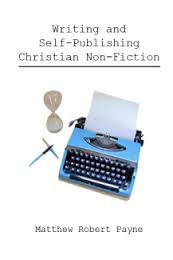


Help For Writers by Payne

book payne

This book is for those beginning  to write a first Christian non-fiction title. It gives hints particularly for self-publishing. The author has published several titles at this point and shares what he has learned.

The greatest value of this book is encouragement. He encourages through the trials of writing and even the disappointments that may arise after your book is published. He focuses on the true goal of writing Christian non-fiction–helping people. He counsels that we think of those we have helped rather than the number of copies sold.

He gives other practical advise as well. Things like making sure the book is edited well, praying for God’s help, using choice personal stories, how to get inspiration, and much more is covered here.

This book is a help to writers for sure.

I received this book free from the publisher. I was not required to write a positive review. The opinions I have expressed are my own. I am disclosing this in accordance with the Federal Trade Commission’s 16 CFR, Part 255.

The Fourth of July and the Church

Fourth July

A subject that I had not giving a lot of thought to is the appropriateness of celebrating America’s Independence in a worship service of the local church. Perhaps it is so common I had never had occasion to consider it, but a thoughtful article by Thomas Kidd on The Gospel Coalition (article here) gave me pause to consider it.

He carefully traced the history of the churches of Early America having a celebration on the Fourth of July unless it fell on Sunday, but not in the regular worship services until later years. Kidd felt it blurred some important lines and made suggestions on how to handle the situation. You can read the article yourself to form your own opinions.

After some thought, I believe the issue is what it actually means to you. Do you love America right or wrong? By love I mean that she retains superiority no matter what? Is God indebted to our nation? Do you love your God far more than your nation? When conflict arises, who is to blame–the Lord or the good old USA?

When I spoke of America to our congregation and when sang the patriotic hymns, I specifically meant:

1. I love the country the Lord allowed me to be born in.

I suspect people from other countries would feel the same way about their homeland. I’m not claiming superiority, just that the land of your nativity naturally will always be a warm spot in your heart– a spot that a Christian will be thankful for.

2. I love the Christian heritage of my country.

I love it so much that I praise my God for it and the blessings that we still derive from it to this day. We were once a truly Christian nation and the precious possession of freedom sprang directly from it. As we lose these freedoms and run from our Godly heritage, I, of course, lament the losses, but I praise the Lord even more. I feel like the hearts of our congregation was united on that point. I have to believe the Lord would be pleased that our thanksgiving on that matter would be directed back to Him.

On the other hand, our love of country and patriotism does not blind our eyes to its sins. To balance our perspective, we further believe:

1I hate the sin that is destroying my country.

Without hesitation, we proclaim where our country is fighting God and heading to judgment. When an issue comes up, we never cover it for our nation. The Lord is right and our nation is wrong. Period.

2. I feel compelled to pray for my country.

God is just and our country has no free pass on its wickedness. That means we prayed for our country–Lord forgive our sins, Lord turn our nation back, Lord send revival. As I prayed, I believe the people had the appropriate attitude of heart. At other points of the service, I noticed men leading in prayer returning to that same theme.

We are blessed too that our patriotic hymns turn us back to the Lord acknowledging His help and mercy in our lives. I see no conflict in singing those songs to the glory of my God.

We had a patriotic element in our service, but the last song we sang was wholly about worshiping the Lord. Our sermon was totally about yielding to God in our personal lives because He and His Word are the ultimate authority.

All in all, I am in favor of an appropriate patriotic element in our July 4th services as long as everything is in its place–our Lord is supreme and our nation is not. God bless America!


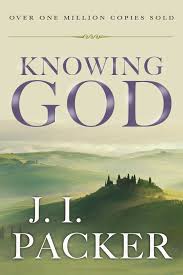
Knowing God by Packer–A Timeless Classic

book knowing god

Using the idea of knowing God, Packer has struck the perfect balance between theology and Christian living. That has worked well because doctrine in its purest form intersects best at the point of real life. Add to that timely material a simple yet profound writing style, and you have the substance of a masterpiece. It can be cliché to throw around words like “classic”, but if you read this book, you will discover that it is true.

Here IVP gives us the classic in a deluxe edition worthy of its value and a new study guide. Both will serve to extend the value of a book that has lost nothing in the passage of time. It’s found on almost every list of greatest Christian books that I have ever seen. I read it slowly and found it impacting.

Of course you may find a sentence or a paragraph that you disagree with, as I did, but you will be challenged and feel you “know” God a little better as you read. I first thought that I would tell about my favorite chapter(s) in this review, but I underlined too much in every chapter to narrow them to favorites.

I would recommend that every Christian interact at some point with this extraordinary volume.

I received this book free from the publisher. I was not required to write a positive review. The opinions I have expressed are my own. I am disclosing this in accordance with the Federal Trade Commission’s 16 CFR, Part 255.

A Matter of Life and Death by Bill Goldsborough

daeth life

Written primarily for Fundamental Baptists, this volume seeks to address a glaring misunderstanding among many. The subtitle “thoughts for thinking fundamentalists” makes me think that Bill Goldsborough would like to move more fundamentalists over to the “thinking” category.

In chapter one we are told that “identity is determined by birth, not by behavior,” and from that basis he seeks to get us thinking. That basis for identity should give peace and an entirely different approach to the Christian life than the one so many are living. Many Christians have something far short of peace and strive for what could never be earned, though it is freely given. It’s a tragedy he hopes to Scripturally help us get past.

He focuses much on old man verses new man and what he believes the Bible teaches on that subject. He also explains carefully what it means to “reckon” Christ in your life. That can be quite revolutionary for a believer.

He marshals an incredible amount of Scripture to make his case, and unlike some works I’ve seen, those references actually discuss his subject. It also kind of had the feel of old Keswick writings as you go through this book.

He writes with an encouraging and helpful spirit. You might disagree on the interpretation of a particular passage he references, but you will appreciate the warmth of this book. If we see our relationship with Christ more along the lines he describes, we will definitely be blessed.


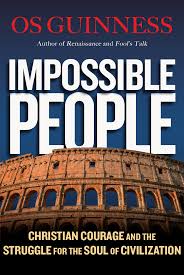
Impossible People by Os Guinness

book

This book is the one precisely needed today. It speaks to what thinking Christians are dwelling on. His title won’t make any sense until you read his reference to Peter Damian, but the book will strike the right cord on many levels. The problems are as bad as we imagined, yet the answer is not despair, but courage.

He will explain how Western culture is in its death throws. He really doesn’t explain a way to save it as we are too far down the line for that, but Western culture or not, Christians have an obligation just as they did in the hedonistic days of the Roman Empire.

He writes about how Christians are failing dramatically these days. He compares the very thing some of us have been telling others–how did German Christians get duped into accepting Nazism. Sounds so familiar, doesn’t it?

Os Guinness never fails to challenge me and this title is no exception. This book,  particularly, is needed whether that sounds trite or not. There is so much more here that I don’t even know what to say other than I underlined line after line as I read. This is a winner and I give it the highest recommendation.

I received this book free from the publisher. I was not required to write a positive review. The opinions I have expressed are my own. I am disclosing this in accordance with the Federal Trade Commission’s 16 CFR, Part 255.

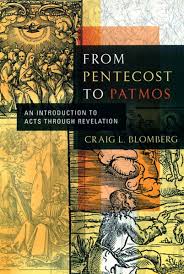
From Pentecost To Patmos by Craig Blomberg

Blomberg 2

Craig Blomberg followed up his highly successful volume on the Gospels with this title that covers the rest of the New Testament. While it might not be as good as his earlier volume as the Gospels are clearly his specialty, this Introduction is still one I found to be quite an asset.

He presents his material in the typical style taking one NT book at a time. The length of his chapters varies in a fashion corresponding to the length and importance of the NT book discussed. He used good judgment and covered what should be there for us. In fact, pastors and Bible students will love it despite some occasional sidewalks into critical study that some of us put little stock into.

He gave some of his most helpful information when he discussed the structure of the book. I also felt the overview commentary on each book was quite effective in one getting his or her bearings straight. There were more maps than in his earlier volume and some of the charts provided were eye opening for the study of the NT books.

I highly recommend this as a worthy study tool!

I received this book free from the publisher. I was not required to write a positive review. The opinions I have expressed are my own. I am disclosing this in accordance with the Federal Trade Commission’s 16 CFR, Part 255.

Related Post:

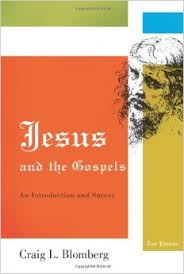
Jesus and the Gospels (2nd ed.)

Jesus and the Gospels (2nd ed.) by Craig Blomberg

blomberg

When it comes to New Testament Introduction, the Gospels are so critically important that they are definitely worth a whole volume to themselves. Blomberg has supplied that need as well as any. I read the first edition years ago and was particularly enriched by it. The second edition here is not an extensive revision, though that is a good thing as there are many things too helpful to be changed. The extra material is mostly scholarly developments over the decade between editions.

Part One is outstanding on the historical background including political, religious, and socioeconomic information. He related what you need to step back into that day. Part Two had two chapters on historical and literary critical methods. That was the weakest section to me as there are many elements of that I simply can’t agree with. Still, it was a thorough explanation for what has gone on in the scholarly world involving the Gospels.

Part Three gives a chapter each to specific Introduction for each Gospel. That was likely the section of greatest value for this book. His section on the life of Christ also integrates the individual Gospels approach to it. The final part on historical trustworthiness and theology round out the fine volume.

The book has won awards in the past and this reviewer finds them to be well deserved.

I received this book free from the publisher. I was not required to write a positive review. The opinions I have expressed are my own. I am disclosing this in accordance with the Federal Trade Commission’s 16 CFR, Part 255.

Related Post:

From Pentecost to Patmos


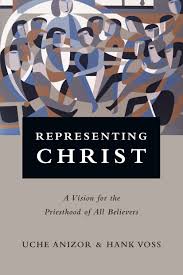
Representing Christ by Anizor and Voss

christ

Anizor and Voss write here on a doctrine, the priesthood of the believer, that is precious to some of us, yet under duress in many places. Whole segments of Christendom deny its existence. This book shows that is both a biblical idea and an idea believed by several across the centuries.

This book is at its best discussing what the Scriptural basis of the doctrine of the priesthood of the believer is. Chapter 2 entitled “A Royal Priesthood” lays out well the case for clear teaching on this doctrine. I had never considered Adam as a priest, but Israel was clearly “a kingdom of priests.” Even more important is when the authors draw out the New Testament teaching on the subject. To me, it is undeniable as they well show.

The balance of the book looks at the subject in more of a church history vein. Luther might not deserve quite as much credit as they give him, but he does play into the history. They also explain what all priesthood really means in our lives, which is the reason for the subtitle “a vision for the priesthood of the believer.”

They take care to write to those who might be in a group that has priests today and deny that all Christians are priests. Some of that explanation might not be necessary to one not in one of those groups.

They write well and make a good contribution to this important dialog. This is a fine theological volume to have.

I received this book free from the publisher. I was not required to write a positive review. The opinions I have expressed are my own. I am disclosing this in accordance with the Federal Trade Commission’s 16 CFR, Part 255.

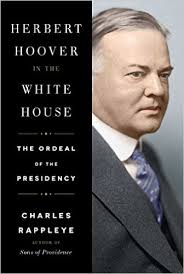
Herbert Hoover in the White House by Rappleye (Presidential Bio Series)

book

Hoover, so often vilified and ranked as one of the worst presidents, just begs for a good biography. You just know there’s more to the story than we have heard. Charles Rappleye gives us a biography of Hoover’s turbulent presidency and only enough of his life before and after to contrast it with his one term in office. He went into office with tremendous respect and admiration and left it with little love lost.

Rappleye did not write as a fan of his subject, but with keen research he did strive to present a balanced picture. Besides, perhaps, going too far in some of his psychological analysis of Hoover, Rappleye brought Hoover to life in this book.

Hoover was a hard worker, had a peculiar personality that was really not a good match for the presidency, and was somewhat petty. At the same time, he had core principles, determination, and great brains. He was also a most unfortunate victim. The Depression was in no way caused by him and was ready to explode before he even took office. There were international factors out of his control too. Really, everything lined up against him and likely no politican could have stopped it. His popular successor was much better at calming the people, but did not stop the Depression either throughout the 1930s.

I left this biography feeling sorry for Hoover and thinking that many of the things he stood for would have been better than what transpired after him. He just lacked a real connection with the American people.

This well-written biography fills in many of the questions you may have. It is a solid contribution.

I received this book free from the publisher. I was not required to write a positive review. The opinions I have expressed are my own. I am disclosing this in accordance with the Federal Trade Commission’s 16 CFR, Part 255.