From The Pen of Pastor Paul by Daniel Hyde

paul

This new volume gives help for studying I & II Thessalonians. The style is sermonic rather than a regular commentary style. Whether reading for study purposes, or just for devotional reasons, you will likely enjoy it.

The approach may vary from one text to another, and it may not cover all that could be said, but what is said is of value. You do sense a pastor at work and that the approach was first to address his own congregation. You also pick up on his closely following the thinking of his denomination–the Reformed Church.

The book’s greatest feature is Hyde’s ability to trace Pastor Paul in the two letters. It strikes me that he may he on to something that I will want to think about in my own future studies of Thessalonians. Those sermons that highlighted the ministry were the most penetrating in this volume.

There is some repetition from one sermon to another as might happen in a preaching series, but this is a solid volume to pick up for your studies.

I received this book free from the publisher. I was not required to write a positive review. The opinions I have expressed are my own. I am disclosing this in accordance with the Federal Trade Commission’s 16 CFR, Part 255.

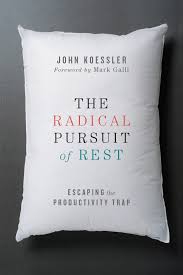
The Radical Pursuit of Rest by John Koessler

rest
This book blessed my soul. It said so much that needs to be said, yet we never hear. Along the way you get a good understanding of what the Bible tells us about rest. This book is not “get apart and rest”, or even “stop and smell the roses along the way”. No, though those type books are popular in our exhausting age, this book goes much deeper in the concept of rest. We don’t rest because we don’t even know what it is. John Koessler gives us exactly what we need to get our thinking straight.

He explains how our thinking is skewed these days and affects us as Christians and especially those in ministry. We fall into what he describes as “the productivity trap”. It has come to us from the business world. We now assume busier is better. We always want to exceed what we have done before. He says,”The church is driven by bottom line just as much as a company whose lifeblood is sales revenue.” We even to fail to see that worship is a wonderful thing and critically important, though we might feel we aren’t actually doing anything.

We get reduced to selling our brand–our particular church. We change our worship to consumerism. He says, “Visitors are treated like consumers and the church’s members are employees whose main job is to promote the brand. They do not worship; they produce. ” How incredibly perceptive is what he shares.

He used the Sabbath and Christ’s saying “I will give you rest”to explain the idea of rest. Rest is trusting God. He says, “Rest is a practice because the ‘work’ of rest is rooted in the finished work of God.”

There is so much more here. This book is exceedingly valuable. I wish all of us would read it and take it to heart.  

I received this book free from the publisher. I was not required to write a positive review. The opinions I have expressed are my own. I am disclosing this in accordance with the Federal Trade Commission’s 16 CFR, Part 255.

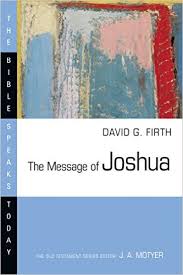
The Message of Joshua (BST) by Firth

joshua

It’s finally complete! Now every book of the Bible is represented in the BST series. It’s strange that Joshua would be the last to get coverage in the series, but it is an outstanding volume in any event. David Firth, the contributor of this volume, has shown in recent years his mettle as a commentator on the historical books of the Old Testament. His superb quality is upheld here.

The Introduction is unique, and yet a joy. The typical elements of an Introduction, which are of varying worth to readers, were skipped to focus on what he felt was the biggest issue in studying Joshua–the violence in Joshua. Since that violence is often parlayed into an attack on God, and a reason to completely discount Joshua, his approach has merit.

His conclusions are interesting. He argues that the violence is not as widespread as it sounded, and that the line was not as racial as imagined. Rahab and others seem to prove his point. Even his explanation that the land is owned by Jehovah as the overriding justification is helpful. This novel approach to Introduction is, in my judgement, a success.

The commentary proper exhibits those qualities you love when studying a text. Great insights and good theology abound. For example, read all he explains on the story of Rahab and see what I mean. He addresses the violence all through the text as well.

This is a fine commentary and I highly recommend it.

I received this book free from the publisher. I was not required to write a positive review. The opinions I have expressed are my own. I am disclosing this in accordance with the Federal Trade Commission’s 16 CFR, Part 255.

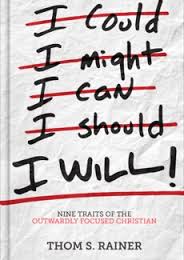
I Will by Thom Rainer

iwill

Here’s a needed book for pastors and church members alike. Pastors need to know what church members are really thinking these days. At the same time, church members would do well to recognize how the culture has affected us all and turned us into church consumers who only view church in terms of what benefits it can give. Lost in the shuffle is service, which clearly is a bedrock of Christianity.

Rainer is the perfect author for this subject. He’s been studying churches and pastors for years. He challenges us to break out of the straitjacket of an inward focus. It is, as he writes here, a matter of the will.

As we have shifted to a preference-driven mentality, he diagnoses our real problem: the focus of our worship is not on God. He encourages us to say “I will” to corporate worship. He also encourages us to grow together with others rather than in isolation. His chapters on serving and going would likely revitalize any church whose members put it in practice. He wonderfully discussed the oft avoided subject of giving too.

The final three chapters on determining not to be a church dropout, avoiding the traps of churchianity, and deciding to make a difference are a challenge to every individual Christian. As a pastor, I wish  church members everywhere would read it.

I received this book free from the publisher. I was not required to write a positive review. The opinions I have expressed are my own. I am disclosing this in accordance with the Federal Trade Commission’s 16 CFR, Part 255 .

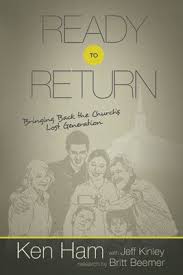
Ready To Return by Ken Ham

return

Ken Ham returns to a subject that he has written on before–our losing the younger generation from the faith. As you would expect from this famous creationist, he sees the denial of the historicity of the Genesis account as part of it. Still, he and co-author Jeff Kinley, assisted by researcher Britt Beemer, probe deeper to all aspects of moral relativism and an insufficient view of God’s Word that have brought on this problem.

The research is at once fascinating and heartbreaking. His assessments of why we are where we are seem spot on. When he shares that children being raised in Sunday School are leaving churches and the faith at a higher rate than those who weren’t, we get the greatest shock of all. His explanation that how we teach Bible “stories” is adding to the problem gets one thinking.

The book is excellent, the analysis keen. The only downside is there is a bit of repetition at times. Still, he looked at issues from several vantage points. Public school was shown to statistically predict a bad turnout for children. He well showed differences in only borrowing someone else’s faith. The chart on page 99 showing “renters” versus “owners” well illustrated the problem.

Chapter 9 was the best as he gave a plan that used the Bible as the basis for our raising our kids with results different than these dismal statistics he shared. His analysis of current trends nationally shared in appendixes was helpful. This book is a fine resource!

I received this book free from the publisher. I was not required to write a positive review. The opinions I have expressed are my own. I am disclosing this in accordance with the Federal Trade Commission’s 16 CFR, Part 255 .

More Books On Revival

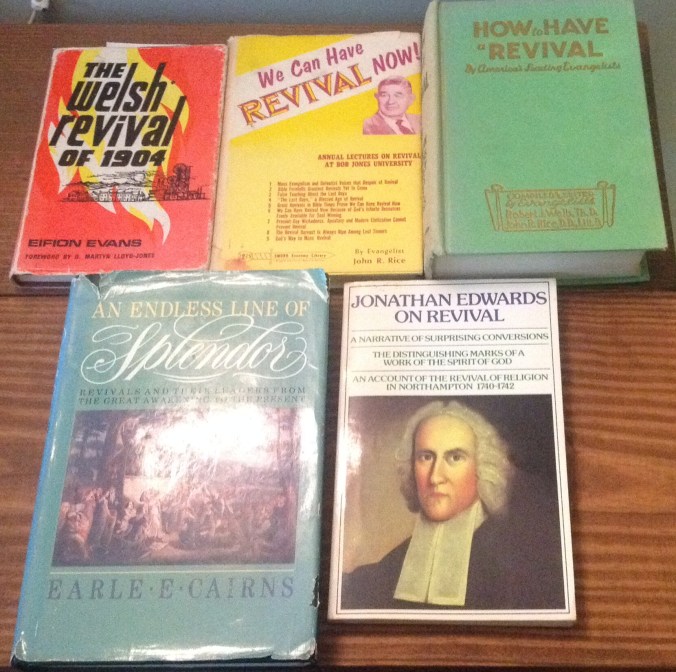
photoSince I have had revival on my mind for a year,  I have been reading newly discovered titles and looking anew at books read long ago. Here are some more books on the subject if you too have been thinking about it.

1. Jonathan Edwards On Revival

This volume published by Banner of Truth combines three of Edward’s smaller works–A Narrative of Surprising Conversions, The Distinguishing Marks of a Work of the Spirit of God. Two are historical accounts, the other a theological evaluation of the revivals Edwards personally witnessed. This book carries weight because  Edwards is such a respected scholar and theologian. He lives up to that respect by hiding nothing negative or excessive he saw in the revivals. Despite those anonomlies, he concludes God was mightily involved in the revivals he saw. It, then, is an encouragement to believe the Lord sends revival.

2. An Endless Line of Splendor by Earle E. Cairns

This book is simply historical, yet it gives a great overview of revivals from the Great Awakening to the 1980s. The thing that jumps off the page is that the Lord has sent revival as often as He has. While you might not agree with some things he includes, the book is excellent for what it is.

3. The Welsh Revival of 1904 by Eifion Evans

This volume is a mature look at revival in the context of the famous Welsh Revival in 1904. He faces the failings head on and yet a true picture of revival emerges. This book must be included in any in-depth look at revival.

4. We Can Have Revival Now! by John R. Rice

This is not as well known as other titles by this prolific Baptist author, but it is one of his best. While he can confuse revival with mass crusades or even soul winning, he still gives us a passionate plea for revival. He could perhaps go to far, and like Finney, make revival sound automatic if certain procedures are followed. Still, I leave that book reminded we are not past the days of possible revival. On that level, the book is a home run.

5. How To Have a Revival, compiled by John R. Rice and Robert Wells

This long out-of-print title is probably hard to find. The contributors are all successful evangelists from the 1920s-1940s.  Some of the chapters are out of date and unhelpful, so I only read the ones that I felt still applied. Those chapters were highly challenging and helpful. You will enjoy it, if you can find it.


For other titles previously recommended and some thoughts I had on revival, click here.
The Message of Esther (BST) by Firth

esther

The Bible Speaks Today series by IVP continues its high standard of excellence in this fine volume on Esther by David G. Firth. Firth is emerging as a preeminent commentator on the historical books of the OT. He writes with quality, consistency, and a conservative outlook that pastors or teachers will love and scholars will respect.

The Introduction is short, but succinct in getting you going on studying Esther. He explains the options out there on genre for the Book of Esther and he concludes it is “an historical work”. His assessment of purpose makes much sense. He devotes the largest portion of the Introduction to the main characters of the book. That was an effective approach that i enjoyed.

The commentary itself was outstanding. He kept the flow, saw the forest along with the necessary trees, and gave many valuable insights along the way. I highly recommend this volume.

I received this book free from the publisher. I was not required to write a positive review. The opinions I have expressed are my own. I am disclosing this in accordance with the Federal Trade Commission’s 16 CFR, Part 255.

Christian Mission In The Modern World by Stott and Wright

stott

This Stott classic has been ably updated and expanded by Christopher J. H. Wright. In fact, this volume is double the size of the old edition as Wright follows each Stott chapter with one of his own. Not only were Stott and Wright colleagues and friends, but Stott was something of a mentor to Wright. They share many specialities including the subject of this book. Stott is known as the master expositor, and Wright follows him in that way too with several fine, medium-length commentaries if his own. 

Stott does not give us another how-to-do-missions books, but looks deeply as what missions even is, what it entails, and what qualifies as God’s idea of missions. He wrestles with what part social work has in missions, but balances with a critique of the picture of a traditional missionary. There is exceptional exposition in places–like on page 60ff where he unwraps the meaning of evangelism (“euangelizomai”). I loved how he explained it is never defined in terms of results.

This book also clears up a false accusation against Stott that I remember hearing. He was charged with capitulating to pluralism. That is most certainly not the case. See page 178 where Wright clarifies that Stott believed that salvation was exclusively in Christ. What Stott said that some twisted is that who can say about people who respond to God with the light they were given. That does not mean, say, they can respond to Mohammad and get to a God. His discussion makes sense to me.

This is top flight title on Christian Mission and I recommend it. 

I received this book free from the publisher. I was not required to write a positive review. The opinions I have expressed are my own. I am disclosing this in accordance with the Federal Trade Commission’s 16 CFR, Part 255.

Holman Illustrated Bible Dictionary

dictionaryt

In-depth, conservative, attractive, scholarly, accessible–this is the best single-volume Bible Dictionary we have today. Revised and expanded from its popular previous edition, it covers just about anything you could think of researching.

You get the typical person, place, and thing common to Bible Dictionaries. Then you theological ideas and introductions to books of the Bible. There are helpful charts in places. For example, the chart beginning on page 1359 “Millennial Perspectives on Revelation” covers 5 pages and includes an incredible amount of helpful information.

The book is appealing to the eye as well. Choice pictures are found on almost every page. The maps are high quality and very helpful. You might read an entry and want more, but this the greatest amount of information that you can get in one volume. It comes in at around 1700 pages and you would have to go to an expensive, multi-volume Bible Encyclopedia to get more.

This dictionary is perfect for pastors, Sunday School teachers, or any serious Bible student. I give it the highest recommendation!

I received this book free from the publisher. I was not required to write a positive review. The opinions I have expressed are my own. I am disclosing this in accordance with the Federal Trade Commission’s 16 CFR, Part 255.

Following The Christmas Story In The Bible

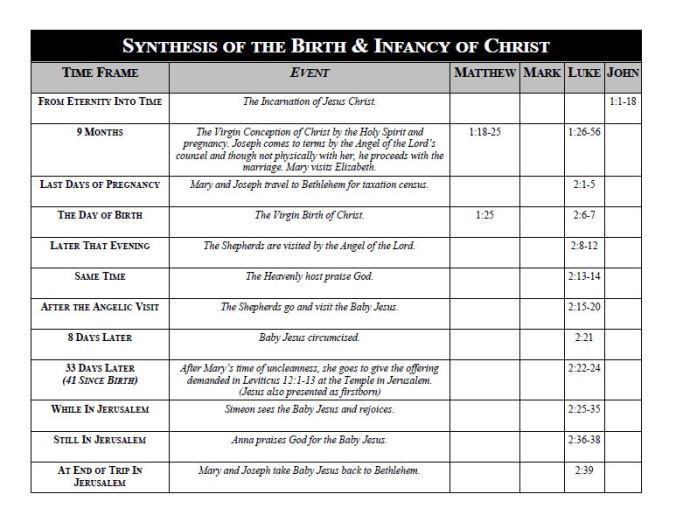
Synthesis of the Birth and Infancy of Christ (Click here for a PDF of the chart below. Feel free to print out for personal study.)

chripic1

chripic2

Sometimes following the Christmas story of the birth of Jesus Christ gets confusing for Bible readers. What time frame was involved? What happened on the night of Christ’s birth and what happened later? Did the Wise Men come the night of His birth? Etc.

The Bible speads the story out mostly between the Gospels of Luke and Matthew. Because of the critical nature of His Virgin Conception and Virgin Birth, the Bible tells that story in detail. Once Christ is taken by Joseph and Mary to Egypt, the details dry up. In fact, besides the detail of His leaving Egypt and returning to Galilee where He would grow up, nothing besides a trip to Jerusalem as a twelve-year old is mentioned until He begins His Public Ministry at age thirty. Apparently, we needed to see that like Israel He must go into Egypt and then return as she did. The similarities will end there as He will succeed in every point that she failed.

The chart here is designed to help you read the story in chronological order and keep your bearings. It is wonderful to see our heroic Savior in His incredible Incarnation. What great things it led to for you and me.

Happy Bible study and Merry Christmas!