This latest entry in the Reformation Commentary on Scripture (RCS) may not be as overtly helpful as some in the series as a commentary of this pattern probably doesn’t lend itself to the design of Proverbs, Ecclesiastes and the Song of Solomon. What it lacks in general effectiveness, though, it more than makes up for in sheer fascination. These three, and especially the Song, have veered from the approach of the Reformation era. For my money, it has not changed for the better, so maybe the potential value of this volume should be that of reorientation.
The Introduction is well done and perhaps admits to the changes I alluded to above. Mr. Fink, does not, perhaps, want to go back as far in approaching the Song as me, but he doesn’t obscure the differences. You will want to check this out. Even in Proverbs and Ecclesiastes the Reformers simply found more treasure than we do today.
In these three books, the selective nature of the materials marshaled here could hardly be more fatal to gaining the big picture. You’ll likely be perturbed that the passage you want to address isn’t here in depth, but honestly how could anyone have done better?
Use this one more as a guide of how to do it rather than straight commentary and you will have uncovered its cache.
I received this book free from the publisher. I was not required to write a positive review. The opinions I have expressed are my own. I am disclosing this in accordance with the Federal Trade Commission’s 16 CFR, Part 255.
There are two elements to consider in evaluating this commentary. First, there is the novel, almost experimental approach of using as his Hebrew source text the old Greek text of Jeremiah! Yes, I said Greek. Second, there is the commentary skill exhibited as he works through the text. To my mind, he scores far better on the second one than the first.
For the life of me, I can’t see why that Greek text as his basis was a good idea. Yes, I read his reasoning, but I’m still unconvinced. Perhaps the scholarly world will eventually canonize him as a bold pioneer, but I don’t think still I’d be convinced. Perhaps, too, since he mentioned the plethora of commentaries on Jeremiah today, he felt he needed an angle to join the fray. I would have thought, but what do I know, that delivering a commentary in a major commentary series on one of the largest books in the Bible would have been enough. If I’m studying anything based on the Masoretic text, as most would be doing, won’t this commentary leave me high and dry where they differ? Will this be along the lines of Coca-Cola bringing out New Coke, which of course if you’re younger than me you probably never heard of?
If I’ve been sounding super-critical, let me balance it. Mr. Shepherd is a quality scholar. His writing is fine, his research thorough, his conclusions clear headed and the help he gives quantifiable. His earlier commentary on the Minor Prophets in this same series was top notch. It would not be fair to write him or this commentary off for one questionable idea even if it unfortunately pervades the whole work. To be even more fair, what he did is not one iota as bad as those who take the Masoretic text and chop it to pieces, as if you couldn’t believe a word of it. Finally, perhaps anticipating the criticism, he mentions what the MT says often throughout the commentary.
Every commentary has its strength and this one is the exegesis despite the incessant discussion of the Greek text. The exegesis is better than, say, the theology, but it’s not barren of theology and often makes good Scriptural connections.
I’ll give this 4 stars, but you can add one more if you happened to be looking for a commentary on the Greek text of Jeremiah. If that were the case for you , I doubt this one could be beat.
I received this book free from the publisher. I was not required to write a positive review. The opinions I have expressed are my own. I am disclosing this in accordance with the Federal Trade Commission’s 16 CFR, Part 255.
When I first beheld this book, the first surprise was how slender it was. I mean Ephesians is one of the most prominent NT letters of all. Perhaps the quick turnaround from when Pillar’s previous Ephesians volume was retired contributed to it. Still, I knew Constantine Campbell’s expertise on union with Christ and union’s prominence in Ephesians suggested the volume would have to possess distinct advantages. The size turned out to be not a factor really and the expected proficiency was present as well.
The Introduction was sufficient, thoughtful, and well reasoned even if it too was shorter than some similar volumes. Authorship, background, and date lined up with conservative conclusions. Themes, beginning with, you guessed it, union with Christ, was the best section of the Introduction. Structure was given something of a short shrift, but overall the Introduction satisfied.
The commentary impressed me. I found the flow of logic that he laid out for arriving at his conclusions was truly enlightening. All the main passages including the thorny Household Code were well handled. I felt I was getting real help in every case.
I know it’s a bit overused in commentary reviews these days, but the word for this one is judicious.
I received this book free from the publisher. I was not required to write a positive review. The opinions I have expressed are my own. I am disclosing this in accordance with the Federal Trade Commission’s 16 CFR, Part 255.
It’s the breadth of this volume that immediately grabs you. As you continue perusing, the scope and then the depth impresses. There’s 1160 double-columned pages on, just think, Paul and his letters. I know Pauline studies take on a life of their own in scholarly circles, but that’s still amazing. Those modern tangents are of course covered, but the classic subjects are as well. Such massive productions are more a thing of the past for whatever reason, but this work can stand up to any of them.
The updating of this volume is so extensive that it’s almost a brand new work. It’s predecessor was well received, but it is here superseded, though the older work is still worth having as either a comparison of 20 years of developments or an alternate angle.
There’s nothing I could think of that is missed, nor did I find anything superficially handled or glossed over. You might not, as I, always agree with conclusions offered, but the elements that we might debate are usually clearly given.
What’s my favorite feature out of the many positive attributes I found in this volume? It’s the extensive coverage of each letter of Paul that really amounts to an Introduction of each—like maybe what you’d find in a really good commentary. That coupled with all the extensive background material and you’ve got a winner here. There’s good theology too here where the absence of can at times sink other such works. Additionally, even if you don’t find some of the more esoteric subjects riveting, you’ll at least have a place to remind yourself what they are should the need arise.
Easily, this book is the best of its kind.
I received this book free from the publisher. I was not required to write a positive review. The opinions I have expressed are my own. I am disclosing this in accordance with the Federal Trade Commission’s 16 CFR, Part 255.
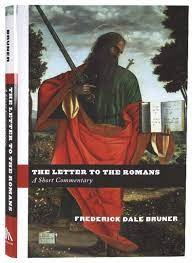
Having enjoyed Bruner on Matthew and John, I was excited to see his work here on Romans. Strangely enough, before I tell you how much I enjoyed this book, let me you what’s wrong with it.
It’s much shorter than his other commentaries, hence the “a Short Commentary”. He quotes other authors more extensively, yes on every page. Sometimes he only skims what has been deeply debated arguments. No Introduction is given. There’s no way this volume could serve as your main commentary on Romans. Maybe that sounds like a lot.
Still, I loved it. Read the preface for the beautiful outlook he has for Romans following his deeper work on Matthew and John. He quotes a lot but they are good ones. He drops theological nuggets all around. Once Spurgeon recommended a title as a spice to add at the end of meal preparation. That’s what you have here. This is some paprika to dash on after you’ve studied the major tomes. Your dish will taste better for sure.
I received this book free from the publisher. I was not required to write a positive review. The opinions I have expressed are my own. I am disclosing this in accordance with the Federal Trade Commission’s 16 CFR, Part 255.
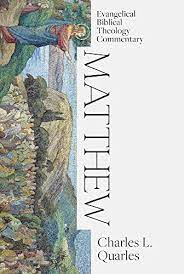
Having written extensively on Matthew’s Gospel in the past, Charles Quarles here delivers the latest entry in the EBTC series. It strikes me as being of the same value as most of the previous entries in the series and it seems to strike the balance the EBTC series calls for as well.
Somewhat surprising is the 100 page Introduction before you even get to the commentary proper. The first 45 pages cover basic introductory issues like author, date, provenance and destination, language, genre and purpose, and structure. The author’s vast learning is on display here, the conclusions conservative, and the coverage adequate.
Even better is the rest of the Introduction that embraces theological themes as this series promises. At first, I thought it was odd that these discussions began focusing exclusively on Christological titles. As I continued I had to confess that they are critical to unlocking Matthew. I especially loved later the discussion on the Kingdom of Heaven for its perceptiveness and restraint. New Covenant, New Creation, and New Israel continued fleshing out what Matthew was up to. By the end, I was sold on his approach.
The commentary proper was also a success. 650 pages for Matthew means the commentary is mid-length by today’s standards. For many, though, that’s going to be just right. This one will be especially enjoyed by pastors and anyone who is interested in careful study. The deep learning is there while the parade of it is subdued. For many, this would be all they would want or need on Matthew.
I received this book free from the publisher. I was not required to write a positive review. The opinions I have expressed are my own. I am disclosing this in accordance with the Federal Trade Commission’s 16 CFR, Part 255.
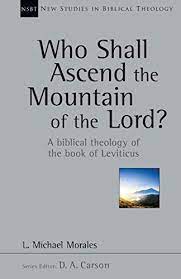
I. Love. This. Book. I could string together enough positive adjectives to describe it to fully wrap three Christmas trees. Instead of exhausting the thesaurus, however, let me tell you why I love this book with descriptive nouns—essence, landscape, theme, theology, insight, wisdom, and treasures.
Morales knows how to step back and take in the horizon, so much so that after reading this book I have a much better grasp of not only Leviticus but the whole Pentateuch. For that matter, the whole OT and even the whole Bible are clearer. I know you think I’m getting carried away, but give it a try. The details are many, but they are not wasted. God is really after a sanctuary where we meet Him.
I’m not going to review the contents as I often do because I think you’ll enjoy the experience I had—just diving in with no idea of what to expect and just enjoying discovery after discovery.
As I read this book I fell more in love with Leviticus. Leviticus! You know, the place where Bible reading plans come to die!
The NSBT was developed into a mighty forest and this one is a Redwood. I could only wish that all 66 books of the Bible had such a one to honor it as this one does Leviticus.
I received this book free from the publisher. I was not required to write a positive review. The opinions I have expressed are my own. I am disclosing this in accordance with the Federal Trade Commission’s 16 CFR, Part 255.
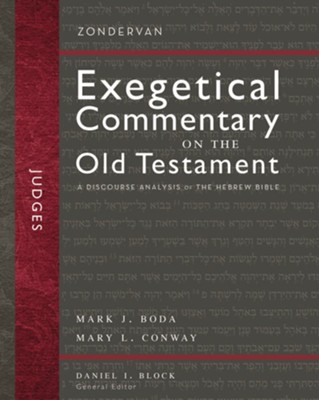
The ZECOT has certainly found its own niche with its discourse analysis orientation and in the process has become a commentary series you simply must not miss. Here the wooly Book of Judges gets its turn and it seems to me the discourse analysis approach especially gives a rich payload in this book that many don’t know what to make of. Boda, whose commentary on Zechariah impressed me a few years back, and Conway have done good work here. The two are colleagues at McMaster Divinity College and proved to be seamless collaborators as well.
After a bibliography and translation, there’s a successful 50 page introduction that slows down where it should while zipping along where it should as well. When discussing Judges and its historical context, the authors see a dichotomy between the history itself and that of the original readers as they see Judges being written later on. Obviously, much of that is speculative. The intent of the writer taken from clues from the text is the rose among the thorns of this section. That next section leads them to an in-depth look at clause function as originated by Roy Heller. The detail is complex, but the conclusions are easy to follow and quite interesting.
My favorite section of the Introduction, entitled Judges and its literary shape, is eye opening. The earlier detailed work is marshaled into an outstanding explanation of the structure. That means, of course, the unique goal of this series is fully realized here. You’ll understand Judges fair better because of it too.
The theology section was a little brief but perhaps some would blame Judges for that.
The commentary proper with the good foundation laid in the Introduction is ideal. One of the strengths of the ZECOT is its layout and its advantages are evident here. People love Daniel Block’s work on Judges and rightly so, but you’d do yourself a favor to get this one too.
I received this book free from the publisher. I was not required to write a positive review. The opinions I have expressed are my own. I am disclosing this in accordance with the Federal Trade Commission’s 16 CFR, Part 255.
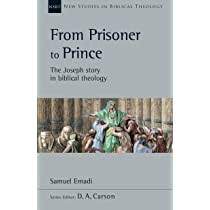
The NSBT never disappoints and it usually delivers that which is not really available some other convenient place. Such is this book on Joseph. The author states upfront that this book isn’t a commentary on Genesis 37-50, though I would submit it would enlighten where those commentaries might let you down.
He is trying to lay out the biblical theology of this portion of Scripture as well as tracing out how Joseph was used throughout the rest of the Bible. To be sure, the heart of the discussion is the question of its typology—is that a real thing or not. For people like me the answer is an obvious yes, but it’s still helpful to hear that championed.
The farther into this book you delve into this book its greatest strength quickly emerges—bringing the structure of Genesis to life. The design of Genesis and how the beloved story of Joseph fits into it is nothing short of exciting. Perhaps this is as it should be because biblical theology when successfully executed will deliver exactly the kind of eye opening insights Emadi delivers. There’s hardly any theological works I enjoy more than those that succeed where this one did.
Amazingly, he brings to life all of Genesis with this work on Joseph. He also shows how typology should be responsibly done and the tasty fruit it yields. This is a good one!
I received this book free from the publisher. I was not required to write a positive review. The opinions I have expressed are my own. I am disclosing this in accordance with the Federal Trade Commission’s 16 CFR, Part 255.
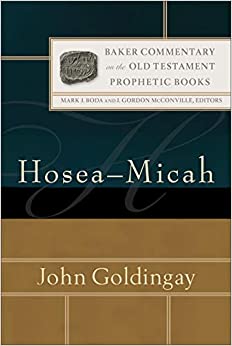
Goldingay is a prolific writer of commentaries to say the least. Sometimes you wonder if he has some captive researchers locked up in his basement. As Baker expands its major commentaries in the OT, we find that he will soon have in print a commentary for them in the Pentateuch, History, Wisdom, and Prophetic sections. At what point is he just showing out?
More seriously, I really like this commentary. In over a decade of book reviewing, I’ve found myself not particularly liking some of his earlier ones that I reviewed and then really liking his more recent contributions like Jeremiah and Lamentations. Maybe he changed. His comments don’t strike me as subversive as before to be sure. Maybe I changed. I had to make myself admit the possibility.
So for this review I want to focus on specifically why this volume and his other recent ones ( I hadn’t seen his Genesis or Joshua yet) are so effective. When you pick up this volume, read the Author’s Preface that mostly describes the process of how he wrote this commentary. I wish all commentaries told this information up front. Later it hit me. He didn’t just collate a mass of scholarly details (a fair description of many modern works), but he had something to say himself. He is one of the leading OT scholars today, so isn’t that as it should be? I can look up what everyone else says myself. I like to hear what the author has to say. The footnotes will back up this assertion.
Further, he has settled into a comfortable, mature, capable writing style that belies his scholarly prowess mingled with effective communication that belies his years of teaching. He writes as one who wants to get his message across and has honed the skills necessary to do it. In his paragraphs both what he has learned and what you have just learned rise to the top.
His next great strength is in OT background. Again, offering to us from his decades of work that we don’t have. Only when his assertion arises from critical assumptions alone does he miss. He often transports the reader to Bible times. He harnesses a mass of details and makes it a palatable morsel to swallow. He is closer to average on theology and structure, but he excels in bringing to bear the broad sweep of OT times while sitting you down in a particular text. That is really how he stands out in the pack and that really helps in these lesser-known Minor Prophets.
This book is not as long as some on just one of these prophets from Hosea to Micah, but I bet it will do you as much good. I still must spar with him in places. “Wind” instead of “spirit” in Joel 2. Ok, whatever. The historicity of Jonah? I knew that was coming. At least he said it was still authoritative. The whole theological message of Obadiah is that “God will take redress”. That’s it? Really? I could list more examples, but there are far more places where he taught me something. Even where he failed to convince me, he often made me think. I can overlook a few places where I rolled my eyes to get all that good stuff. And of course you, the reader of this review, might have rolled your eyes at me instead at these disputed points.
I like this volume so much that I wonder if I should go back and look up and review a few of his that I missed along the way like, say, the Psalms. In any event, you can’t miss with this one.
I received this book free from the publisher. I was not required to write a positive review. The opinions I have expressed are my own. I am disclosing this in accordance with the Federal Trade Commission’s 16 CFR, Part 255.