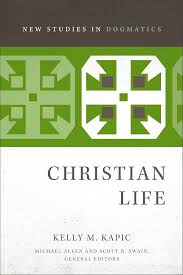
Kelly Kapic is one of the best theological writers of our day. He gears his writings a bit toward scholars, but don’t let that stop you. Accept the challenge of this book and you won’t be sorry. The title of the series (“New Studies in Dogmatics”) might scare off some readers, but don’t allow that to camouflage a great read. Yes, scholars will likely eat it up as a book that shows an artisan at work in their trade, but I say pastors and thoughtful Bible students ought to claim this one as their own.
The only part that might appeal more to scholars than the rest of us is how he loves to delve into some historical personage or creed to illustrate his point. That is only an issue because sometimes that takes more explanation than the point at large he is making. I doubt he can help it. He seems like a walking encyclopedia; a passionate one to be sure, but it is amazing the scope at which he views his subject.
His clearly stated thesis is that “Christian life is a response to the love of God”. Not only does that make sense, especially as he develops it, but it also gave him free reign to write across most of the systematic theology corpus as he desired. That could easily degenerate in a muddled mess that said little, but in his skilled hands it became something really special. In fact, the first chapter on why we need a theology of Christian life shows his clear vision of the argument of this book. For the record, I was bought in part way through that first chapter.
Part Two with its three chapters fills in “the love of God” part of his thesis. He approaches it as love, grace and fellowship. Those three are often thrown about with a perverse shallowness. Not here. It seems that the depths of the heinousness of sin that he so astutely explains is the key to bringing those three out in all their resplendent glory. Here they sparkle.
Next, he has a section that he called an “interlude” on the Law-Gospel distinction. His Reformed orientation comes out strongest here and this section is likely to be the most controversial. In fact, even some Reformed thinkers might quibble with him.
From there, he develops the “response to” part of his thesis. This last section covers Messiah, ego and ecclesia to great effect. That our Messiah is the key is painted with the right significance. The chapter on ego was profoundly done. I thought he brought in current thinking on ego and held it up to Scripture and came up with clear thinking in the process. The two chapters on ecclesia surprised me. I was sure that he was going to champion a certain strain of liturgy, but actually he explained that every worship style is a liturgy. It was convincing to me.
I nominate this book as the theological title of the year. It is that good.
I received this book free from the publisher. I was not required to write a positive review. The opinions I have expressed are my own. I am disclosing this in accordance with the Federal Trade Commission’s 16 CFR, Part 255.

