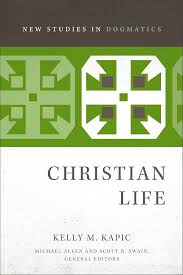
Christian Life (New Studies in Dogmatics) by Kelly Kapic

 Kelly Kapic is one of the best theological writers of our day. He gears his writings a bit toward scholars, but don’t let that stop you. Accept the challenge of this book and you won’t be sorry. The title of the series (“New Studies in Dogmatics”) might scare off some readers, but don’t allow that to camouflage a great read. Yes, scholars will likely eat it up as a book that shows an artisan at work in their trade, but I say pastors and thoughtful Bible students ought to claim this one as their own.

The only part that might appeal more to scholars than the rest of us is how he loves to delve into some historical personage or creed to illustrate his point. That is only an issue because sometimes that takes more explanation than the point at large he is making. I doubt he can help it. He seems like a walking encyclopedia; a passionate one to be sure, but it is amazing the scope at which he views his subject.

His clearly stated thesis is that “Christian life is a response to the love of God”. Not only does that make sense, especially as he develops it, but it also gave him free reign to write across most of the systematic theology corpus as he desired. That could easily degenerate in a muddled mess that said little, but in his skilled hands it became something really special. In fact, the first chapter on why we need a theology of Christian life shows his clear vision of the argument of this book. For the record, I was bought in part way through that first chapter.

Part Two with its three chapters fills in “the love of God” part of his thesis. He approaches it as love, grace and fellowship. Those three are often thrown about with a perverse shallowness. Not here. It seems that the depths of the heinousness of sin that he so astutely explains is the key to bringing those three out in all their resplendent glory. Here they sparkle.

Next, he has a section that he called an “interlude” on the Law-Gospel distinction. His Reformed orientation comes out strongest here and this section is likely to be the most controversial. In fact, even some Reformed thinkers might quibble with him.

From there, he develops the “response to” part of his thesis. This last section covers Messiah, ego and ecclesia to great effect. That our Messiah is the key is painted with the right significance. The chapter on ego was profoundly done. I thought he brought in current thinking on ego and held it up to Scripture and came up with clear thinking in the process. The two chapters on ecclesia surprised me. I was sure that he was going to champion a certain strain of liturgy, but actually he explained that every worship style is a liturgy. It was convincing to me.

I nominate this book as the theological title of the year. It is that good.

I received this book free from the publisher. I was not required to write a positive review. The opinions I have expressed are my own. I am disclosing this in accordance with the Federal Trade Commission’s 16 CFR, Part 255.
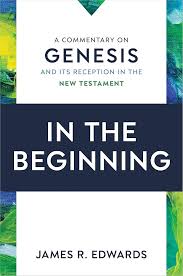
In the Beginning: A Commentary on Genesis and Its Reception in the NT by James Edwards

Many new commentaries purport to be something different. You begin reading and they may be good or bad but they are not different. And then I started reading this one. At first, I was reading the Introduction and thinking there was a problem. I was asking myself what is guiding this author in what he is choosing to put in this Introduction. Finally, I realized that this commentary really is different. That is its intention and it is pulling it off. Reception history really is different than the usual commentary fare.

Still, as I said, I don’t know how he chose what went in his Introduction. But what goes in an Introduction on reception history? For all the commentaries I’ve reviewed, I don’t have a clue. I guess when you’re forging a new trail you get to make your own path. In any event, it was interesting. The usual subject of structure was well handled. He cast a suspicious eye toward the Documentary Hypothesis, which is always appreciated, though he could have been more lethal. His dating of Genesis fell flat for me, but that’s not really influential to this type of commentary. There was, though, all these zesty tidbits along the way that I appreciated. Finally, the Introduction digressed into texts of Genesis. It took me a minute to realize that was laying a foundation for this reception history.

In the commentary proper what was so helpful was that if you laid this commentary by the others you have, there would be no duplication. It was all interesting too. I would never choose this commentary as my main source for exegesis, but if I were doing a deep study, this could add so much.

This commentator would fall on the conservative side of the fence—I mean he’s written for the Pillar New Testament commentary series—but I was amazed at the plethora of more critical scholars that he always cites. Possibly, that was because they sometimes offer some of that really high-flying theology. And though I know there is not a consistent number of New Testament references to every passage in Genesis, I did sometimes feel that he just wrote about whatever he wanted to write about. My expectations meant nothing either. I just guessed that John chapter one would have been extensively discussed during the commentary of Genesis chapters one and two, but that was not the case. Still, I must rate the work a smashing success because whatever he chose to say was highly captivating.

This book does not garner a high rating because of its consistency, but rather because it was so lively compared to several other commentaries. Let’s mark this down as one that I really enjoyed despite itself. 

I received this book free from the publisher. I was not required to write a positive review. The opinions I have expressed are my own. I am disclosing this in accordance with the Federal Trade Commission’s 16 CFR, Part 255.
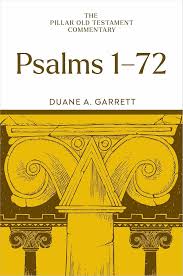
Psalms (POTC) by Duane Garrett

Here’s the inaugural volume in the Pillar Old Testament Commentary series. You just know this series is going to be good. The Pillar NT that has been around for some time is unusually consistent for a series. It’s probably the editor you have to thank for that. So it was with high expectations that I picked up this volume and opened it. It delivered!

I’ve read Duane Garrett quite a few years and found him pretty solid. I must say, though, this is the best I’ve ever seen from him. Maybe it’s just me, but it’s the best by a wide margin. His reasoning was so mature and well thought out. I don’t want to be trite in a review, but it really was impressive.

My only complaint is that I wish these commentaries could be released complete rather than have years between them. It’s common these days, but it’s disappointing if you really like a volume. Maybe it’s the constraints facing all publishers (Eerdmans is one of the best), so we’d better be understanding I guess.

This commentary is such a compliment to many other commentaries that I have on the psalms. I’m a bit of a sucker for discussions about structure. It’s not that I think these structures unlock the secret meaning of a book, but that they just kind of reinforce it and show a divine hand at work. Still, Garrett argued so persuasively that we can get a bit out of hand. In fact, in so many cases, he was reeling people like me back in. I’m sure we needed it. At least we needed the balance. In many cases, he would explain all that we really know for sure. And it could be at times less than we would like to think we know. I could see myself picking up this volume and reading it right after I read, say, James Hamilton. Both have so much to give, but reading them both could keep you in the right lane I’m sure.

Other features I loved included reminding us that there is a personal and devotional function to the psalms. He is correct that we can get carried away thinking it’s always for formal temple worship. He was calm and sensible in his discussions of superscripts too. One of the best sections in the introduction is on recurrent theological motifs in the Psalter. That section is nothing short of fascinating and so insightful in studying this portion of scripture. The short section on patterns of repetition were also eye-opening for me.

The commentary proper was outstanding. I read over several of the psalms and thought he provided distinct help for us.

This is a grand commentary, and I can’t wait until the other volume is released and finishes his work on the psalms. 

I received this book free from the publisher. I was not required to write a positive review. The opinions I have expressed are my own. I am disclosing this in accordance with the Federal Trade Commission’s 16 CFR, Part 255

The Mission of God (2nd Ed.) by Christopher J. H. Wright

What I thought about the first edition still holds true. Christopher J. H. Wright is an author who never disappoints. Though he has written commentaries, theological works, and Bible studies, this book on the mission of God now available in paperback is likely his most influential. In fact, his specialty on the mission of God elevates all those other books that he has written, but this one is where he makes his grand case that the narrative of the Bible has mission as its overarching theme. You will likely agree when you take in what he has said.

This book succeeds on so many levels that you might debate where to put it on your shelves. There’s the obvious choice of your mission section, but then you may wonder if it should be among your Bible theology or even Bible survey sections. Finally, it could hold its head high among titles in your deeper theology section too. That is not to say the book is unfocused, but that its explanation of the broad sweep of the Bible gets the job done from all those various vantage points.

The book is divided into four parts: the Bible and mission, the God of mission, the people of mission, and the arena of mission. As you can see, that begins in championing mission as the proper hermeneutic, continues to see God’s hand in mission, followed by the final two parts looking at the Bible from beginning to end and seeing how it sticks without wavering to God on mission. At over 560 pages, it is never shallow nor possessing omissions while never bogging into minutia either.

I’ve always felt that Wright could hold his own with any scholar while outpacing most of them on spirituality. You will see that here. This book will be the top of its class on this subject for decades to come and no Bible student should be without it.

What do we have in the 60 extra pages of this edition? Well, it’s not his overall thinking on the subject for sure. It seems he took seriously what some reviewers and colleagues criticized in the first edition. In many cases, the clarifications strengthen the original work. Perhaps the criticisms both of his “holistic” view of mission and on the “linear” nature of his work are overblown, rendering his response something along the line of shooing a fly. Isn’t that broad view the essence of good biblical theology? I say that as one who doesn’t even hold to supersessionism myself. You don’t have to hold to every detail Wright gives to find the book superlative.

You can’t think of the mission of God without this book. There are several points I disagree with, yet I must rate this book as particularly important.

I received this book free from the publisher. I was not required to write a positive review. The opinions I have expressed are my own. I am disclosing this in accordance with the Federal Trade Commission’s 16 CFR, Part 255.
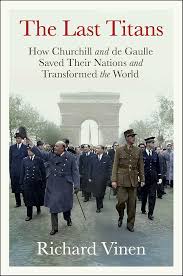
The Last Titans by Richard Vinen

Developing the subtitle “How Churchill and de Gaulle Saved Their Nations and Transformed the World” makes for fascinating reading. I’ve not really read a joint biography myself, but I’ve heard of a few good ones and decided to take the plunge here. To be sure, I really enjoyed it–both the subject and the format. The length (330 pages) was a plus as well. I’ve got some favorite large tomes, but this book made for a nice changeup for me. It didn’t take a massive commitment of time, yet I felt I gained real insight into these two men both individually and in relation to each other. If you’re like me, you never seem to get enough of that time period.

Perhaps I can speak from two perspectives; the one where you know a lot about the subject and one where you don’t. Churchill has long intrigued me. On the other hand, I hardly knew anything about de Gaulle beyond his being French. On both counts Vinen held my attention. I gained a few reinforcements and clarifications on Churchill while feeling I came to know de Gaulle. More specifically, though I admire Churchill, that he really had a hubris element to himself that defines so much of who he was is clear. In the raw, it’s both ugly and childish. It’s the childish side that became more clear to me in this work. de Gaulle had maturity in spades, and though he had certain characteristics that fall on the humility side of the ledger, his essential belief that he was destined to lead France could be seem as illusion of grandeur; unless, of course, you remember it all fell together as he anticipated it would. He could be quite conniving to gains the heights he felt were his as well.

Churchill at least has the epic days of 1940 to hold up. I’m not clear on what great thing de Gaulle ever did to merit his position. The failure in both men’s stories before their ultimate fame staggers the mind. How did this happen? I don’t know the answer, but I enjoyed watching it unfold in the pages of this book.

For most of the book, the author’s political beliefs were not overt. Only occasionally did they seep through. Though I am to the right of the author, he was disciplined enough not to read current politics into it to enough bother me. The reader’s perspective, then, will not greatly alter your enjoyment of the work. Only at the very end did he lose that focus, but by then the value of the book was already in hand. One other minor quibble is that at times I wondered if he even liked either man. At least this isn’t hagiography!

Here is one to enjoy. You will have a lot to think over at its end.

I received this book free from the publisher. I was not required to write a positive review. The opinions I have expressed are my own. I am disclosing this in accordance with the Federal Trade Commission’s 16 CFR, Part 255