Middle Knowledge by John Laing

book mid know.jpg

John Laing makes a strong case for the concept of middle knowledge as an explanation of the providence of God. In doing so he upholds both human freedom and divine sovereignty. No doubt he writes in a highly divisive category among theologians and will probably get some pushback, but in my view has done well in writing a detailed, scholarly examination with careful biblical and logical accuracy.

Though he uses a lot of down-to-earth examples, this work will still be tough for newcomers to the debate. The logical analysis has not an ounce of fluff and so I suspect this work will be more appreciated by those with some theological background.

In a lengthy introduction he discusses what the doctrine of providence is, he examines the various models of providence, and he addresses the assumptions that are in play in arriving at a position. This information is extremely helpful in grasping the theological landscape. In chapter 1 he defines the doctrine of middle knowledge. He introduces the specialized vocabulary involved and shows several examples.

Chapter 2 is on the grounding objection, which he feels is the most important element in explaining middle knowledge. In chapter 3 he reviews the circularity objection before getting into the more debated chapter 4 on divine foreknowledge and free will. By chapter 5, he enters the most explosive battleground when he addresses predestination and salvation in regard to these theories.

Chapter 6 addresses the problem of evil and how it impacts each of these viewpoints. There’s a chapter on inerrancy and inspiration and its effect on this debate as well as one on science and theology. Since middle knowledge comes from Molinism, he addresses the biblical evidence for it in chapter 9. Chapters 10 is a conclusion upholding middle knowledge.

I can see myself referring to this book in the future any time the subject of providence in these debated areas comes up. I imagine the reader’s viewpoint may impact the rating of this work by reviewers more than the work itself. Again, it may be a little too strong for students due to the subject, but that’s not to say it’s written too opaquely. It’s the subject that’s tough. For me, it will likely be my go-to book on this lively subject.

I received this book free from the publisher. I was not required to write a positive review. The opinions I have expressed are my own. I am disclosing this in accordance with the Federal Trade Commission’s 16 CFR, Part 255.
Lamentations by Berlin (OTL)

book lam otl

Mark this volume by Adele Berlin down as one of my favorites in the Old Testament Library (OTL) series. In fact, it has some helpful information that I’m not used to seeing in this series. There’s still the critical viewpoint, yet that criticism is not as orienting in the work itself and is far more open to conservative theories than I would’ve expected.

The Introduction begins by describing some of the unique elements of the book before it dives into an explanation of the poetry of Lamentations. Berlin makes it clear that it’s some unique poetry that we have here. There’s also an excellent use of imagery throughout the Book of Lamentations. He has some sane thoughts on the speaking voices of the book as well. The section on gender and suffering is really not over-the-top in any way, but just acknowledges some of the feminine language used throughout Lamentations. There’s an excursus on the personified Zion, as well as one on the residents of Jerusalem with a sociological profile. The discussion of mourning as a religious concept added good things the discussion as did the theology of destruction and the exile. The explanation of the paradigm of purity was interesting and beyond anything I’d thought of before. There’s a section on the literary context with some helpful thoughts, though perhaps a little overemphasis on Mesopotamian influences. In the section on authorship, there’s a fairly conservative conclusion about dating and at least an acceptance that it’s theoretically possible that Jeremiah wrote it though she feels it could never be known. More than arguing date, she sees the larger question as why was the Book of Lamentations written in the first place.

The commentary proper shows outstanding scholarly work. We might learn more about the people of Judah than we do about God in this work, but this is an excellent addition to your commentary library. I warmly recommend it.

I received this book free from the publisher. I was not required to write a positive review. The opinions I have expressed are my own. I am disclosing this in accordance with the Federal Trade Commission’s 16 CFR, Part 255.
Old Testament Theology by Paul House

book ot th.jpg

This volume on Old Testament theology by Paul R. House has been so popular for 20 years that it has warranted this paperback edition. The Preface leaves no doubt about what you’re going to find in this book. First, you’ll find that its audience is for college students, though it has enough depth to be appreciated by scholars and teachers. Second, you will find an emphasis on historical context with a canonical approach. Most importantly, you will find that the author unapologetically holds to an evangelical outlook. Old Testament volumes available today particularly run toward a critical outlook. In a word, this book is refreshing.

The first chapter gives the history and methodology of the study of Old Testament theology. You will see that that history has run willy-nilly through many ditches over the last couple centuries. He ends that overview by mentioning some of the important conservative works that have finally come out. You might check out a conservative counterpart to this volume in Eugene Merrill’s Everlasting Dominion though neither of these important volumes renders the other obsolete.

I love how House approached the subject of Old Testament theology. For the most part, he takes the books of the Old Testament individually to see their contribution to the overall picture of Old Testament theology. For that reason, this book would be quite handy for its theological background if you’re doing a study on a particular book of the Old Testament.

This book is a winner. To my mind, it’s not out of date and is worthy of this new paperback edition. I know I’m glad to have it at hand.

I received this book free from the publisher. I was not required to write a positive review. The opinions I have expressed are my own. I am disclosing this in accordance with the Federal Trade Commission’s 16 CFR, Part 255.
Two Views on the Doctrine of the Trinity: Counterpoints

book 2 views trin.jpg

Here’s a volume in the Zondervan’s popular Counterpoints series. Because a proponent of each view presented debates others of varying viewpoints, these volumes can be particularly effective. A single author often has trouble fairly presenting opposing views, but here every chapter is presented by someone who strongly believes in the position described. Knowing that others will debate every point keeps each contributor on his or her toes.

This book describes two views on the doctrine of the Trinity: classical Trinity and relational Trinity. Each of those viewpoints is divided yet again by two contributors who hold slightly different perspectives within the model. The only thing that strikes me as odd about this volume as compared to others of its type that I have seen is that the four contributors, Stephen R. Holmes, Paul D. Molnar, Thomas H. McCall, and Paul S. Fiddes, are not that far apart in what they believe. If you have not been deeply immersed in Trinitarian debate, the differences in these four contributors may almost seem like splitting hairs. Fortunately, there’s a lot to learn by working through their interactions.

The style is the same as the others in the series. First, a contributor presents his perspective, the other three contributors offer responses, and the original contributor gives a final rejoinder. It’s a quite fair method as every contributor gets to give the last word on his own perspective. The general editor, Jason S. Sexton, also gives a 10-page conclusion reflecting on what was presented. For the most part, this is just a nice summary. Additionally, there’s a glossary which can be quite helpful as this subject has a lot of specialized vocabulary.

Usually when I peruse one of these volumes I find myself gravitating most closely to one of the presenters, but in this case, I agreed with great portions of all four of them. That’s not to say that they don’t disagree on a few points, but they are an essential agreement about the importance and main facts of the Trinity.

Though it’s a little different than what I expected, I still found it to be an overall nice resource well worth consulting if you are tackling the doctrine of the Trinity.

I received this book free from the publisher. I was not required to write a positive review. The opinions I have expressed are my own. I am disclosing this in accordance with the Federal Trade Commission’s 16 CFR, Part 255.
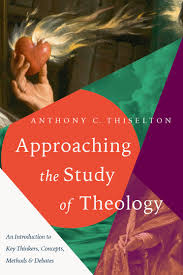
Approaching the Study of Theology by Thiselton

book app thro

Here’s a successful introduction to the study of theology by the revered scholar Anthony Thiselton. He has written major commentaries and highly-respected theological works including the companion volume Approaching Philosophy of Religion. With that body of work, Thiselton is the perfect candidate to write this type of overview to help students before they dive into larger theological tomes.

The Introduction introduces readers to the great categories of theology: the doctrine of God, humankind, human alienation from God, Jesus Christ: Redeemer, Savior and Lord, the Holy Spirit, and the church and sacraments. You might call them by different names, but these are the great categories of doctrine. Broad and brief, this section makes for a great review. The rest of the introduction is taken up with a history of theology from the church fathers through modern times. You might quibble over what’s left out versus what got in, but again it works as an introductory overview.

Part one discusses approaches to theology in nine categories. This will help students realize the many angles by which theology can be approached. Some are obvious like biblical theology, hermeneutical theology, historical theology, and systematic theology while others like political theology and theology of religions are not so well-known.

Part two looks at concepts and issues and shows us how fragmented the study of theology has become. It strikes me as along the lines of the good, the bad, and the ugly, but a student needs to understand these concepts that show up throughout the scholarly world.

The final part is a discussion of key terms in alphabetical order. This section is wonderful for browsing or reference. You might define certain words differently, but again, this section perfectly works as an overview for students.

Thiselton continues a prodigious output in his later years. You almost wonder if he’s reflecting on his career and writing to fill in where he feels there are gaps. In any event, he has succeeded in giving us a quite handy volume here.

I received this book free from the publisher. I was not required to write a positive review. The opinions I have expressed are my own. I am disclosing this in accordance with the Federal Trade Commission’s 16 CFR, Part 255.
The Beauty of the Lord by King

book beauty.jpg

This book by Jonathan King is part of Lexham Press’s Studies in Historical and Systematic Theology series. It’s the first volume in the series that I’ve encountered and I was impressed. It’s described as a “peer-reviewed series of contemporary monographs” that cover a wide array of subjects. This volume on the beauty of the Lord sheds light on so many places for me. The advertising blurb on the back cover (“restores aesthetics as not merely a valid lens for theological reflection, but an essential one”) doesn’t really capture what this book has to offer. It’s not so much a book about aesthetics as much it is one that exalts the beauty of the Lord as an overarching pedestal to understand the big picture of God’s word.

The book is well-written, deeply researched, and successful at probing what has been believed. The author never fears to cogently argue his case either. If you’re like me, you may find him easy to agree with whether it’s a topic you’ve deeply studied in the past or not.

The introduction is successful in establishing the goals of this book. By the end of it, there’s a good synopsis of every chapter. The chapter on beauty Triune is especially helpful if you are like me and have not spent a lot of time on the subject before. You will see how this subject ties into the doctrine of God, including His attributes, as well as its connection to the Trinity. I’ve been studying the Trinity lately and found some good information here.

The next chapter approaches creation as beauty’s debut. There’s more excellent theology here, particularly as the glory of the image of God in humans is discussed. The chapter on the incarnation sees it as beauty condescending. Just like its subject, this book is beautiful as it discusses the cross as beauty redeeming. Our salvation comes into view in the chapter on re-creation as beauty’s dénouement. The conclusion ties all these wonderful aspects together and proves the author’s thesis of the importance of the beauty of the Lord and give something of a systematic theology with palpable aesthetic value. There’s a lengthy bibliography as well if you want to look into further study.

There are some quality theological works being written these days and this book is one of them. Mark it down as a great success!

I received this book free from the publisher. I was not required to write a positive review. The opinions I have expressed are my own. I am disclosing this in accordance with the Federal Trade Commission’s 16 CFR, Part 255.


The Letters to Philemon, to the Colossians, and to the Ephesians by Witherington

book col phi;

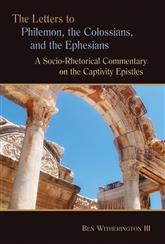
Ben Witherington III is easily one of the most prolific commentators of our day. It’s hard to believe that he has written major scholarly commentaries on as many books of the New Testament as he has done. As with all his commentaries, he provides what he calls a socio-rhetorical commentary. Here he tackles Philemon, Colossians, and Ephesians. When he says he commentates on the Captivity Epistles, you may notice that Philippians is missing. He explains in the Introduction that that omission is only because he had written a commentary on Philippians earlier. If you are familiar with any of his other commentaries, you will be comfortable in this one. As always, he writes well, he loves scholarly interaction, and he’s not afraid to chart his own course.

The Introduction runs at less than 40 pages and is an Introduction to the three letters together. This serves to highlight well the commonalities between the three. You won’t get far into this book before you see that his conclusion that these letters use an “Asiatic rhetoric” affects all his conclusions. While I find that hard to swallow, I did appreciate several of his conservative conclusions. He crushes the argument that the vocabulary of Ephesians denies it’s the possibility of a Pauline authorship. The other major component of the Introduction is the social settings of Paul and his audiences. In that section, he will cover Paul, his imprisonment, some of his companions, the effect of slavery in the Roman world and the philosophies at play in these regions. He provides a nice bibliography as well.

After one long paragraph of Introduction to Philemon he dives into the commentary. It is quite helpful. Colossians gets its own introduction before the commentary as does Ephesians. You won’t doubt that he has surveyed most all scholarship in his reading to prepare this commentary. He takes an egalitarian position in his commentary in the requisite passages in Colossians and Ephesians. (In Ephesians, he battled Peter O’Brien in his scholarly interaction and in my opinion lost badly).  Still, this commentary is a major contribution.

Witherington’s works are a great second commentary to refer to. This one has the quality and sparkle of all his other commentaries that I have seen.

I received this book free from the publisher. I was not required to write a positive review. The opinions I have expressed are my own. I am disclosing this in accordance with the Federal Trade Commission’s 16 CFR, Part 255.
Song of Songs (OTL) by Exum

book song otl

This volume covers the Song of Songs in the Old Testament Library (OTL) series. It’s best known for its literary criticism and I can see why as that’s clearly the emphasis throughout the book. As is common with this series, it takes a critical position throughout, but as is also common for commentaries on this book of the Old Testament, there are some strange theories suggested. It succeeds in what it attempts to do, yet I’m not sure it makes the same theological contribution as some others in the series. It’s not the place to look for application either. Though I did not at all agree with the overall arguments made in this commentary, there were some fascinating paragraphs.

The introduction is longer than most in the OTL series. After a substantial bibliography, the introduction begins by describing the Song as a love poem “about erotic love and sexual desire”. You will notice quickly how key the author finds this to be in the Song. I’ve seen a few popular commentaries that almost make it a book about marital intimacy, but this is the first major commentary that I’ve seen that goes as far as this one does. The most shocking part is the author takes what seems to be the strongest literal interpretation and then says there could be some allegorical meaning to it. The difference is it’s not an allegory of God and His people, but just of love. It’s surprising the way the author digs into this subject of love, relationship, and eroticism over many pages of the introduction. Along the way, gender studies are brought in. I really can’t agree with any of these conclusions, but this is the place I would suggest you go if you want to look into it.

There’s a look at poetic composition and style, including a discussion of whether it’s one poem or many, and a thorough review of literary arrangement and its significance. There’s a fine listing of how other commentators have divided up the book. From there more literary concerns are considered including the literary context of the ANE world. Copious examples are brought to bear. There’s a section on the historical-cultural context as well as a consideration of how this book made it to the Bible. The author concludes allegorization came about to explain its blunt material. There’s a good review of the historical interpretations that the Song has gone through.

The commentary itself is detailed and continues to be dominated by the things brought up in the introduction. Along the way, you will get a good representation of a critical outlook of the book. It’s not my favorite commentary in the OTL series, but it’s one of the most important critical commentaries available.

I received this book free from the publisher. I was not required to write a positive review. The opinions I have expressed are my own. I am disclosing this in accordance with the Federal Trade Commission’s 16 CFR, Part 255.
Qumran: A Carta Field Guide by Hanan Eshel

book qumran.jpg

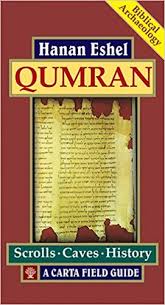
Let’s load up the buses and ride! I want to visit Qumran after seeing this fine book by Hanan Eshel. Somehow I missed visiting Qumran when I was in Israel, and now I regret it after seeing what the site has to offer. This Carta field guide covers history, biblical archaeology, and serves as a nice tour guide as well.

Eshel was a professor in Israel and has the historical and archaeological credentials to be the ideal writer of this book. He has personally led several excavations in Israel and knows how to lead the reader around a site of archaeological significance.

There’s a short introduction that outlines the importance of the Dead Sea Scrolls. Next, we get a thorough description of the near turbulent acquisition of the scrolls. That story would make a movie and it must’ve been the providence of God that they were attained!

As it turns out, there were 11 caves involved (see the map on page 83) so there’s a lot of stories to tell. The photos are gorgeous throughout! By page 96, the book shifts focus to helping you plan a trip to Qumran. Without this book, you would miss so much of what can be seen at Qumran National Park. Don’t miss the panoramic view provided by the photo on pages 138-139.

As you would expect, you will also find those awesome Carta maps and illustrations throughout. This book is the second Carta field guide that I’ve seen (En Gedi being the other) and I think we need these field guides done for every major site in Israel. I assure you that whenever I get to visit Qumran, this book will be in my hand!

I received this book free from the publisher. I was not required to write a positive review. The opinions I have expressed are my own. I am disclosing this in accordance with the Federal Trade Commission’s 16 CFR, Part 255.

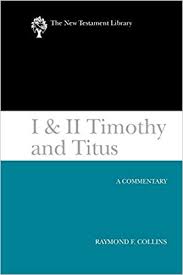
I & II Timothy and Titus (NTL) by Collins

book tim titus ntl.jpg

Raymond Collins wrote this commentary on the Pastoral Epistles in the New Testament Library (NTL) series. Its critical stance is in line with what I found in several of these NTL volumes, though there are a few a little less critical in the series. I’ve heard it criticized for having too little scholarly interaction, but that proved no detriment to me as he at least thoroughly articulates his own critical position. I’m not sure I found as much theology as can be found in some of these NTL volumes, but at around 400 pages he never skimps on various passages.

After a bibliography, Collins provides an overall introduction to the Pastoral Epistles. From several angles (second-century witnesses, how the Pastorals differ from other epistles, and a scholarly review of authenticity and literary form), he rejects Pauline authorship and dates late. He reviews other issues within the Pastoral Epistles and determines that it’s reasonable to assume a single author for all three epistles though they came from someone else’s hand after the death of Paul. Strangely, in a section entitled “engaged teaching”, he argues that the teaching presented is taken beyond that which Paul gave. It is in this section, though, that he outlines what are the main themes, in his opinion, of these epistles.

Next, he provides a short introduction to 1 Timothy alone. Mostly that is just to discuss its unique elements. From there, he dives into commentary on the text. The same pattern is followed with 2 Timothy and Titus. Though I often disagreed with him, he did give some good food for thought for several passages. He used the analogy of “text and context” to reserve some of the more debated passages in these epistles to Paul’s day alone (e.g., the Household Code).

While this might not be my favorite NTL volume, it does uphold the series’ aims and is a good representation of the critical position. It’s not as wordy as those in the Anchor Bible Commentary series and so is probably the ideal commentary for those who want to add a critical commentary to round out their studies.

I received this book free from the publisher. I was not required to write a positive review. The opinions I have expressed are my own. I am disclosing this in accordance with the Federal Trade Commission’s 16 CFR, Part 255.