A Week in the Fall of Jerusalem by Witherington

book week

Ben Witherington, scholar and prolific author, blazes a new trail in this work that’s quite a departure from what I’m used to by him. In this work, he still teaches as we would expect, but he uses a combination of historic fiction and scholarly sidebars into a wide array of subjects of Jerusalem at the time of its fall in 70 A.D. I would rate it as a success in its imaginative approach to that important background material.

The story begins in the smoke of Jerusalem. Though the story has fictional elements, some of the characters are actual characters from Scripture. They are older, of course, and look back on pleasant memories of the days of Christ that are already 35 years in the past. The story contained elements that I had never thought of, but that would make sense in that environment. Both the fear and the courage of the Jewish people affected are clearly displayed.

As you might imagine, the author must make some judgments on some things that are debated. His telling the story of Matthew wanting to write his gospel is a specific place where some of us might not agree. Still, this book takes material we often approach piecemeal and weaves it together in a story that makes it much more meaningful. The short blurbs, pictures, and maps dispersed throughout the text greatly enhance it.

There’s less of the horrors of Jerusalem’s destruction than I predicted, and the story ends more abruptly than most fiction works, but the book is still very interesting. I imagine it will be secondary reading in some Bible history classes, as well as a help to those doing individual Bible study. I’ve read that this book is one in a series of similar books being designed by IVP. It’s educational, not hard to read, and pleasant. I recommend it.

I received this book free from the publisher. I was not required to write a positive review. The opinions I have expressed are my own. I am disclosing this in accordance with the Federal Trade Commission’s 16 CFR, Part 255.
First Corinthians (NICNT) (Revised) by Fee

book corinth NICNT

This revised edition of Gordon Fee’s highly-respected commentary on First Corinthians in the New International Commentary on the New Testament (NICNT) series should be in every pastor’s library. I’ve used the old edition in my studies for some time, and I’m glad to see it revised to now extend its life several more decades. Fee is an acknowledged master of commentary writing. In other words, he knows how to argue his points and be interesting in every passage.

Though the bibliography is greatly expanded, the Introduction has not changed much since the original edition. I appreciate such an engaging Introduction in only 20 pages that really hits on what I’m looking for in the introductory material. He begins by describing the city and its people and transitions beautifully into the problem the Corinthian church faced. I’m not sure I fully reject, as he does, that this letter is a response to divisions becoming parties in the church. His proposed reconstruction that the problem is between Paul and the church itself is at least interesting, even if we can’t fully agree with it. There’s so much learning to be found whether you agree with that or not.

He covered critical questions in two paragraphs. I loved it! In one power-packed paragraph, he completely dismantles many of the critical theories floating around about the Corinthian letters today. From there, he dives into theological issues and begins with eschatology. He discusses the gospel and ethical life, and ends with the church itself. It’s good all around.

I found more editing and updating in the commentary proper. The overall conclusions are unchanged, but it is spiced up a bit. I still can’t agree with his extreme egalitarian viewpoint on some of the text (for example, check out page 545 for his somersaults on the idea of “head”). I can’t follow him in chapters 12 through 14 when he talks about his views on the Spirit, nor can I accept his excising of 14:34-35. That’s not a reasonable way to dodge a text you don’t like. Even with those caveats, this is a top-flight commentary.

At minimum, this is a top-three commentary among all commentaries on the Book of First Corinthians. Some of my friends say it’s number one. In any event, every pastor needs it at hand. You simply can’t do without it!

I received this book free from the publisher. I was not required to write a positive review. The opinions I have expressed are my own. I am disclosing this in accordance with the Federal Trade Commission’s 16 CFR, Part 255.
 

A Theology of James, Peter, and Jude by Davids

book theology j p j

Here’s another volume in the impressive Biblical Theology of the New Testament (BTNT) series by Zondervan that will include eight volumes when complete. This volume addresses between its covers James, Peter, and Jude. As you can imagine, this book covers the least addressed elements of theology in the New Testament. Peter Davids, the author, has spent his career in this portion of Scripture including two major exegetical commentaries on James and First Peter. He is the perfect author to tackle this subject.

Chapter 1 serves as an introduction that traces out common themes and issues among these New Testament epistles. He argues that the Greco-Roman background and educated writing style are true for each of these letters. Further, he sees a monotheistic outlook with a strong Christology. To his mind, all four letters put a strong emphasis on the the source of sin (desire or lust).

The other four chapters address each of these four letters individually. Issues commonly found in the introduction of an exegetical commentary are studied in each case, but its emphasis on theology is brought out in the latter part of every chapter. Mr. Davids wrote as one who greatly admired these four letters. He did agree with a few conclusions that I could not, particularly in the area of sources, but he has written a scholarly, predominantly conservative work.

Each chapter also gives an outline followed by a literary – theological reading of the book. I felt he covered well where commentary and theology meet. His tracing of the important theological themes in each of the letters was spot on in my opinion. As an added bonus, the book is attractive, well written, and contains a few charts where appropriate. Coming in at 300 pages, the author manages to neither dodge any important issue, nor become so prolix that he wearies the reader.

In my judgment, this book holds up well with the other fine volumes already released in this series. If you are beginning a study of James, Peter, or Jude, put this book in the must-buy category.

I received this book free from the publisher. I was not required to write a positive review. The opinions I have expressed are my own. I am disclosing this in accordance with the Federal Trade Commission’s 16 CFR, Part 255.
The Expositor’s Bible Commentary (Rev. Ed.)- Volume 9: Matthew-Mark

book ebc 9

Volume 9 of the Expositor’s Bible Commentary (revised edition) covers only the Gospels of Matthew and Mark. Fortunately, that means that Matthew, one of the most important books of the Bible, gets a great deal of extra space in the series. D.A. Carson, one of the most respected scholars of our day, handles Matthew in this volume. It seems to me that Carson’s Matthew is the most heralded volume in either the old set, or this new revised series of the Expositor’s Bible Commentary.

Although the rewrite was not substantial, Carson’s Matthew still holds its place among the commentaries on Matthew available today. Carson wrote a substantial Introduction. He begins discussing the criticism of Matthew, or in other words, how critical scholars have debated the book of Matthew. Considering Carson’s reputation in conservative circles, his credence of the opinion of some of the more critical scholars is somewhat surprising. Still, his work is outstanding. He addresses history and theology, as well as the synoptic problem, and again entertains more than I could. In any event, I can hardly imagine a better overview. When he discusses authorship, he is tentatively agreeable to the historic position of Matthew being the author. On subjects like occasion, purpose, and structure, he begs for restraint. His discussion of themes and special problems was well done. While the text of the Introduction was not altered greatly from the original volume, I noticed the footnotes and bibliography were updated a great deal.

The commentary on Matthew would just what you’d expect from Carson – detailed, careful, cautious, thoughtful, and with skilled scholarship. He is occasionally harsh, but this is one of the most important commentaries on the Gospel of Matthew available today.

The Gospel of Mark received a more substantial rewrite. The work of the late Walter Wessel, much appreciated by pastors in the old set, was thoroughly updated by scholar Mark Strauss. The Introduction was also updated a great deal, I noticed, when I laid the old and new volumes side by side. The upgrade was a success. The new work covers in its Introduction the place of Mark’s gospel in biblical studies, genre, authorship, origin and destination, date, occasion and purpose, literary features, and ends with a bibliography and outline. The commentary itself was also effectively updated.

The 2-for-1 nature of this volume, along with the fact that the Matthew portion is considered one of the premier commentaries on Matthew, means you can’t go wrong in adding this book to your library. It’s a good deal and I highly recommend it.

I received this book free from the publisher. I was not required to write a positive review. The opinions I have expressed are my own. I am disclosing this in accordance with the Federal Trade Commission’s 16 CFR, Part 255.
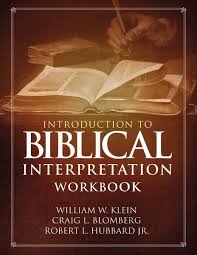
Introduction to Biblical Interpretation Workbook

book b i wb

I’ve already gone on record giving Introduction to Biblical Interpretation (3rd ed.) a high rating. Now the publishers have prepared an outstanding workbook to go along with that fine textbook by Klein, Blomberg, and Hubbard for those taking a hermeneutics class. As the cover states, a combination of study questions, practical exercises, and lab reports make this workbook the perfect complement to those using the textbook.

The workbook is flexible in that you wouldn’t have to do every exercise listed. Teachers can pick those they feel most appropriate. Some exercises are merely a template where the passage suggested could be substituted by the instructor for another passage.

This workbook increases the value of the already excellent textbook. I predict a wide usage of textbook and workbook and warmly recommend both.

I received this book free from the publisher. I was not required to write a positive review. The opinions I have expressed are my own. I am disclosing this in accordance with the Federal Trade Commission’s 16 CFR, Part 255.
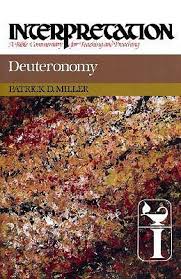
Deuteronomy (Interpretation) by Miller

book deut i

This commentary is one of the best we have today on Deuteronomy from a critical perspective. Just as the Interpretation Bible Commentary series is known for, Mr. Miller scours Deuteronomy for all kinds of helpful theology. Though I could not agree with several of the critical views represented here, I found in this book many thoughtful, well-written insights.

The Introduction begins with the meaning of the name Deuteronomy. If you are like me, you may not enjoy the source criticism found in the section “how did Deuteronomy come to be?”, nor the section on authorship. When Mr. Miller turns to discussing the literary setting of Deuteronomy and explaining what Deuteronomy is about, he becomes much more helpful in my opinion. He covers material about structure in a helpful way. The final short section explaining why we should read Deuteronomy gives eight fine reasons why we should. I agree with all eight reasons he gave.

As you might have guessed, the real value of this book is in the commentary proper. You will continue to cross critical presuppositions with which you may not agree, but the probing theological nuggets that others miss is why you will likely enjoy this volume.

As a conservative pastor who likes to have a few commentaries on each book from the critical camp to be well-rounded in my studies, I find that this volume is one of the best of that kind of which I’m aware. Plus, as I said before, he really will bring out theological reflections worthy of pursuing that you won’t find anywhere else. In fact, I’d rate this volume as one of the better of the Interpretation Bible Commentary series of the several that I have seen. For these reasons, I recommend this book.

I received this book free from the publisher. I was not required to write a positive review. The opinions I have expressed are my own. I am disclosing this in accordance with the Federal Trade Commission’s 16 CFR, Part 255.
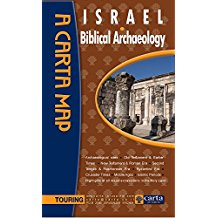
Israel Biblical Archaeology: A Carta Map

book archaeol israel

I wish I had had this map when I toured Israel! I can’t imagine a handier resource for either planning or touring Israel for one interested in Bible sites. With a quick glance, you can see all the archaeological sides of both the Old and New Testaments. As a bonus, you also see the sites of the Byzantine Era, crusader times, Middle Ages, and Islamic periods.

The map itself is well done in the usual Carta style. The legend used makes it obvious which period the site is from. Ancient main roads of Bible times are also added. Some modern roads are also given, but the map is never too busy. It’s eye pleasing in every detail. The areas of each of the Twelve Tribes is also highlighted with different colors, which adds another layer of information without detracting from the overall map. To the right and left of the map are columns of additional information about some of the most important archaeological sites. All of this is just side one!

Side two is a treasure trove of information for the Bible student or one touring Israel. There are several awesome Carta maps along with great information on the other side. There’s a map of the major archaeological sites in the old city of Jerusalem, one of Jerusalem at the time of Jesus, one describing the economy of the Roman province of Judah at the time of Jesus, one about Jesus’ ministry around the Sea of Galilee, one of the major routes in the holy land in ancient times (exceptional), one describing Masada, another describing Herodian, and one on Quran and the Essenes. Additionally, there’s one describing the Perfume Route, another on Caesarea, one on the exile of Judah, another on Jericho, one on the Roman provinces in the First Century, and one final map on the Crusader Kingdoms of the Middle Ages.

This map is one every traveler to the Bible lands should have. While you’re at it, look up the companion Jerusalem Biblical Archaeology: A Carta Map, which is in the same outstanding style. I’m so impressed with this map and I think you will be too.

I received this map free from the publisher. I was not required to write a positive review. The opinions I have expressed are my own. I am disclosing this in accordance with the Federal Trade Commission’s 16 CFR, Part 255.
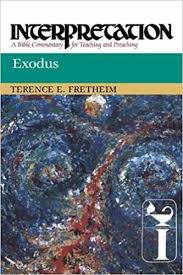
Exodus (Interpretation) by Terence Fretheim

book exodus i

This book is one of the very best in the Interpretation Bible Commentary series. This series is one from the critical camp that is aimed at preachers and teachers and is best known for its theological help. Terence Fretheim has received several accolades for this work on Exodus.

The Introduction begins with the big picture of what we have in Exodus. He describes Exodus is both a Pre-Christian and a Christian book. He gives great insights on the correlation between Exodus and the New Testament. Further, he comments on how we might honor both in the interpretive process. Next, he tackles the critical perspective of Exodus. While I could never agree with most of his conclusions, he still noted things worthy of tracing like the key transitional sections. There is even less I could agree with him in terms of history – he’s much too skeptical there.

The Introduction turns itself back toward great helpfulness when it offers a discussion on the theological task that we will find in Exodus. His discussion of the leading theological issues is eye-opening even if you couldn’t agree with every conclusion he makes. Still, this section alone makes the Introduction worth reading.

The commentary itself would fall into the mid-length category, but is especially theologically perceptive. For example, I thought he made some brilliant comments about the interaction between Pharaoh’s own hardening of heart and the Lord’s hardening of his heart. Taken as a stimulus for ideas rather than a straightforward guide, the commentary section will be beneficial to you.

If you are a conservative Bible student like me, I would suggest that you will still enjoy this book on many levels although you will find some paragraphs completely subversive. Not only is this commentary well written, but the author pulls out thoughts that others miss. You will be the richer for interacting with it.

I received this book free from the publisher. I was not required to write a positive review. The opinions I have expressed are my own. I am disclosing this in accordance with the Federal Trade Commission’s 16 CFR, Part 255.
40 Questions About Church Membership and Discipline by Kimble

book 40 questions

This book provides a unique format to get you thinking deeply about church membership and discipline. You can read through the table of contents for a specific question on the subject, or you can as I did, read through the entire book and be blessed to think through the issues from a variety of vantage points. Mr. Kimble has provided a nice resource here. Though there are many new titles in the area of church membership and discipline published recently, this book carves out its own niche and will be appreciated by readers everywhere.

The author divides the questions into four main parts. Part One defines terms and gets us thinking in the right direction for the questions that follow. Part Two contains general questions about church membership. These questions cover theology, ministry, and practicality. I can’t think of a question he left out, nor of a question he answered carelessly.

Part Three contains general questions about church discipline. If anything, the subject of church discipline is even more bewildering to most Christians than that of the little-discussed subject of church membership. The author again divides the questions into theological, ministry, and practical questions. Part Four asked two concluding questions about the significance of these two interrelated subjects.

As a Baptist pastor, I find this volume biblical, well-written, and helpful. Its design makes it the ideal volume to have on the shelf to pull down when a question comes to mind. Even if you squabble about some conclusion the author makes, he writes succinctly and carefully lays the issue out for you. The reader cannot help but be blessed by this volume. I highly recommend it!

I received this book free from the publisher. I was not required to write a positive review. The opinions I have expressed are my own. I am disclosing this in accordance with the Federal Trade Commission’s 16 CFR, Part 255.

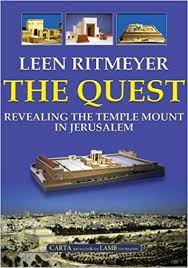
The Quest by Leen Ritmeyer

book quest temple

This book is without doubt the preeminent resource on the Temple Mount in Jerusalem available today. Whether you desire the historical or archaeological perspective, this is your book. This book’s success likely springs from the fact that no one but Leen Ritmeyer could have authored it. Both from his long years of working in this field and his work as the architect of the Temple Mount excavations, as well as his other work on the Temple Mount itself, demands that Ritmeyer produce this extraordinary resource.

This book is filled with pictures from the earliest scholarly explorations of Jerusalem, other helpful pictures on a range of issues, extraordinary reconstructions, and the wonderful, accurate Carta maps. It’s hard for me to effectively portray the visual treat the reader will have in this book. The text is the equal of the visuals and gives the most up-to-date, scholarly, detailed information that can be found on the Temple Mount.

The book begins covering the Herodian Temple Mount walls. Since archaeology digs down into older time periods, chapter 2 provides a lengthy chapter on the Temple of Nehemiah’s day. Some of the reconstruction models in that chapter were extraordinary. After a chapter on the Hasmonean Temple Mount, he turns to the interesting subject of the underground cisterns of the Temple Mount. I’ve never seen better on that subject. Chapter 5 examines how Herod extended the Temple Mount. That includes things like how he had to expand the drainage system and some of the gates he added. Chapter 6 nails down the location of the Temple on the Mount and has some great pictures of the inside of the Dome of the Rock.

In chapter 7 we find a reconstruction of the First Temple. Again, the graphics and reconstructions were eye-catching and instructive. In chapter 8 we follow that up with reconstructing the Second Temple and all the history behind it. The book goes full-circle with chapters on reconstructing the Herodian Temple Mount as well as Herod’s Temple itself.

Readers are going to love this book. I can’t imagine anyone finding something they thought was left out on the subject of the Temple Mount and its history. Helpful, beautiful, and thorough – what more could you ask for? I give this book the highest possible recommendation.

I received this book free from the publisher. I was not required to write a positive review. The opinions I have expressed are my own. I am disclosing this in accordance with the Federal Trade Commission’s 16 CFR, Part 255.