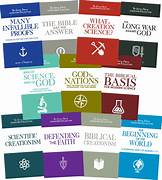
The Henry Morris Signature Collection

Here is a set of books that would be an incredible resource for any student of the Bible or any Christian family. Henry Morris is a stalwart figure in Biblical Creationism and for all the literature produced in recent years in that field you’d be hard pressed to find anything that he hadn’t already said here. I think of him as the perfect marriage between science and childlike faith. He has the skills to go to the deepest levels of technical science while making himself clear to those of us who’ve thought little of it since our school days. He’s no slouch in theology either.

I first encountered Dr. Morris when I was a young Christian including some of these books. It’s been fun to drink from these waters again and to encounter some titles never seen before. There’s not a dud in the lot, but let me focus on four titles:

  1. The Biblical Basis for Science—This huge book is a semester class in itself. In fact, I wish every young person went through it. Here is where the depth of Dr. Morris’ ability shines forth. Many of the great scientific disciplines are covered to the point you’d have a grasp of them and yet it’s tied to theology just as deep. At one point he was discussing the Triunity of God as well as the Hypostatic Union. Can you image the value of young people having this exposure? For that matter, most adults need it too. If I only wanted one of his books, I’d likely pick this one.
  2. Scientific Creationism—This one takes an interesting track. Seven of its eight chapters pit two items, e.g. chaos or cosmos; accident or plan, to discuss Creation versus Evolution. The final lengthy chapter tackles some of the main issues in Creationism with Scriptural evidence.
  3. Many Infallible Proofs—Don’t miss this one. It takes Scriptural issues and uses science to help with its assessment. This one is also on its own track and is not a regurgitation of other books at all.
  4. The Beginning of the World—I loved this commentary on the earlier chapters of Genesis.

Don’t overlook the rest of the set. “Men of Science, Men of God” is a jewel of a little book that shows that all the gifted fathers of Science were avowed Bible believers. “Biblical Creationism” is actually designed like many modern works of Biblical theology. He traces the theme from Genesis to Revelation, which is a wonderful way to consider a subject at the macro level. “God and the Nations” takes a look at civilizations in biblical history and casts an eye toward prophecy. In “The Bible Has the Answer” Dr. Morris tackles a wide variety of difficult questions. This is likely one you will reference rather than read cover to cover.

Two of the titles would be helpful especially from an apologetics standpoint: “Defending the Faith” and “The Long War Against God”.

I would read “What Is Creation Science?” last not because it’s inferior, but because it’s the most technical. After you ingested the others, you would no doubt be ready for it.

These books are awesome. There is some overlap with a few of the titles, but the learning that could gleaned here is incalculable. I highly recommend them.

I received this book free from the publisher. I was not required to write a positive review. The opinions I have expressed are my own. I am disclosing this in accordance with the Federal Trade Commission’s 16 CFR, Part 255.
How Do We Know? by Dew and Foreman

Here’s another volume in the “Questions in Christian philosophy” series that distills what I imagine would be a semester-long class. I enjoyed the earlier one on Logic especially, and found this one on epistemology helpful too. Though I read theological works regularly, this material is new to me. The subject itself, not the author’s writing, can be challenging. At times philosophy has split the hair too finely on what it is to “know”, and yet how powerful is the thought that we can “know” something.

As for the book itself, it’s clearly written. Often the examples are catchy and effective to make the idea clear. I imagine Dew and Foreman would be engaging teachers. The only problem I had with the book is that too often they wouldn’t pick a side. They never failed to give you the strengths and weaknesses of every viewpoint, but it almost seemed like they never champion any one of them. They never really forged their own new way forward either. Since this was newer material for me, perhaps I wanted that feature more than usual. Especially I wanted to know how a Christian ought to think as so many of the philosophers were not Christian. I am not saying they didn’t give information that you could dig out, perhaps, and find your own opinion. But that design would be better for those who are well-versed on the subject. I hope my one criticism of the book is not actually more one of my own self than of the authors, but I’ll leave that to your judgment.

Still, when I have a question on epistemology, I’ll be reaching for this book.

I received this book free from the publisher. I was not required to write a positive review. The opinions I have expressed are my own. I am disclosing this in accordance with the Federal Trade Commission’s 16 CFR, Part 255.
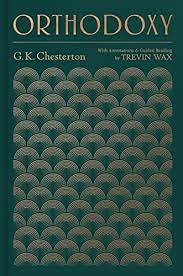
Orthodoxy by Chesterton–A Beautiful New Edition

Chesterton needs no recommendation from me. He’s never lacked an audience since his writings appeared decades ago. On the other hand, perhaps I could share something with those like me who had never gotten around to taking a dip into the unique world of Chesterton. Like it did for me, this new annotated edition presents you the perfect opportunity.

First, there’s Chesterton. I found him as fresh as any author today. You might call him idiosyncratic as he is refreshingly distinctive and even peculiar as any I’ve read. He sees things you don’t and when he pulls them out and lays them before you all you can think is why hadn’t you always known it. He has one of the best senses of humor I’ve ever encountered. Not in the sense of a comedian, but one in a successful effort at clarity who causes you to laugh out loud. He couldn’t be boring if he tried, but it appears he never tries.

Second, there’s his “Orthodoxy”. He approaches orthodoxy or apologetics in a whole new vein. Rather than following the template of most all apologetic works, he more shares the lofty journey that took place in his own mind. He takes the most common criticisms of our faith and turns them on their heads. He confronts the heavyweights of Bible critics and leaves them looking juvenile. Not that he is condescending, just that he sees the implications of what they believe so much more clearly than they do. He writes in a easy to follow style, except occasionally he saw more than I could take in. He’s an awesome writer and it was clear those few lapses were completely on my side. I had about two chapters that were a little too good for me, but what a joy to try. More often, I loved comprehending his beautiful thoughts.

Finally, there’s this new annotated edition by Trevin Wax. Wax met you briefly at the beginning and end of each chapter to foster success by you. The only dated material in this timeless work was his use of names, places, and movements. Wax succinctly filled that gap so you can keep rolling with Chesterton. Wax’s approach allowed Chesterton to be Chesterton and let you interact with him. I thought it the perfect approach, plus a nice introduction, and it’s exactly what I would want. For icing on the cake, the publisher delivers this title in a lovely hardback edition.

I hope we get more works just like this one!

I received this book free from the publisher. I was not required to write a positive review. The opinions I have expressed are my own. I am disclosing this in accordance with the Federal Trade Commission’s 16 CFR, Part 255.
Modern Technology and the Human Future: A Christian Appraisal

book mod tech.jpg

We must have discussions like this one. A couple of decades pass and our very world has changed with smartphones and other electronic devices. It has affected Christians along with everyone else. We are finally pausing to search out the implications of this seismic shift. Several practical Christian books have probed how we might deal with a world that has changed and is not going back. (One by Tony Reinke lies on my desk). In this volume by Craig Gay, however, the broader theological implications are mined. This book is less of how you ought to alter your life in the days to come and more of what does it even mean. Both types of books are needed and I’m rooting for their success.

The author writes with balance. He neither denies his own use of the technology he writes about nor encourages its complete rejection. In fact, his analysis seems to embrace its good at least to the extent of sharing the Gospel and other wholesome features while exercising caution on the other end. Our society has changed. To what extent should a Christian change with it?

To bulk up his premise, the author surveys other paradigm-shifting technological advances from the plow to automated manufacturing. He traces how economic concerns are usually the driving force. He turns his discussion toward theology by considering “ordinary embodied human existence” with the background of the Incarnation of Christ and God’s mission for us.

The book is deep reading. If you find that kind of theological reading difficult, this book will be a challenge. Theological junkies will find it the perfect discussion of an all-encompassing subject. If you can handle academic reading, and enjoy well thought out analysis, this is the book for you.

I received this book free from the publisher. I was not required to write a positive review. The opinions I have expressed are my own. I am disclosing this in accordance with the Federal Trade Commission’s 16 CFR, Part 255.
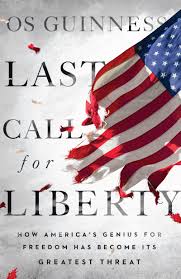
Last Call for Liberty by Os Guinness

book last call.jpg

I’m not sure how Os Guinness pulled off writing the book of the hour while at the same time giving us one for many generations to come, but in Last Call for Liberty he has done that very thing. He says so much to our generation, yet it will be the words that will be needed in a hundred years. At least if there’s any liberty left to cultivate and protect at that point. What is equally amazing is how he did it. There’s only a little of Trump or Obama, and even less of Republican or Democrat. He would have us stop drowning in the latest election cycle, or even the latest 24-hr news cycle. Our problems are more fundamental than the latest round of lunacy. His perspective spans the horizon. He looks at where we are, how we got here (since the 1960s at least), and where we are going. He holds us accountable to what freedom is and what it is not. He calls on us to embrace anew the precious gift of freedom or our twisting of freedom will be our destruction.

Guinness paints his portrait with the colors of the American Revolution of 1776 and the French Revolution of 1789. That comparison explains so much. I’ve always loved reading about that time period, so I’m a little ashamed I never saw this dichotomy before. How freedom was both approached and defined is why one of those revolutions has held for 200 plus years while the other is a historical footnote. Still, he isn’t giving us a historical survey. No, the problem is that much of America today has switched from 1776 to 1789 in their guiding of our nation. Peril awaits.

That’s not to say that this book is depressing. It’s like a teacher who believes in your intellect and boldly makes a case that assumes your ability to comprehend. He never talks down but sounds like he speaks to peers who will see what he’s saying when they face the logic. He comes across as positive there’s hope and all that’s missing is for us to slow down and carefully analyze the facts.

You will, without doubt, get some of the most perceptive analysis of the trends and events that define us today. He never comes across as shouting “this is wrong” as much as “here’s what’s behind certain behaviors and why they will hurt us all”. He never yells at us for assaulting freedom. It’s more of a proclamation that freedom is one of the greatest things that God has given us and it’s worth hanging on to.

I’m not going to give a chapter-by-chapter overview in this review. Just jump in and you will see things that perhaps you’ve never thought before and that now you see as the natural, unanswerable explanation of our turbulent nation. This book, if ingested by our nation, would revolutionize us all, or at least take us back to the beautiful place we began. Labeling a book as a “must-read” is trite, but read it and see if that isn’t exactly what you’d say.

I received this book free from the publisher. I was not required to write a positive review. The opinions I have expressed are my own. I am disclosing this in accordance with the Federal Trade Commission’s 16 CFR, Part 255.
A W. Tozer: Three Spiritual Classics in One Volume

book 3 tozer

It’s hard for me to find the words for how outstanding this volume is! Count me as one of those people who finds A. W. Tozer as one of the most penetrating, spiritual writers of all time. This beautiful, hardback collection of three of his spiritual classics can’t be missed. These titles have mostly been available as paperbacks in the past, but now we have something a little more worthy of these treasures. I wouldn’t be surprised if people call this one of the great publishing events of the year.

The first title, The Knowledge of the Holy, must be included in any list of the greatest Christian books of all time. It is, out of an impressive list, Tozer’s greatest work. This book impacted me several years ago, and it was a joy to go through it again. In conversational language he presents God Almighty in a way few ever have before. The theology is incredibly deep yet perfectly accessible. He astutely feels that so much of what’s wrong with Christianity today is our misunderstandings of God Himself. The attributes of God are shorn of any sort of dry, academic language and are presented in a way that makes you love, respect, and be in awe of God more.

The second title, The Pursuit of God, is another of his best-known works. He disdains our resting on the laurels of our conversion and pushes us to go hard after really knowing God. This book makes us thirst after our Lord and is a true masterpiece.

The third title, God’s Pursuit of Man, might fall slightly below the two mountain peak titles above, but it is a true sequel to The Pursuit of God. It moved me as well.

Not only is this volume with its three incredible titles worthy of the reading time of every Christian, I imagine it would change Christianity itself if it were widely read.

I received this book free from the publisher. I was not required to write a positive review. The opinions I have expressed are my own. I am disclosing this in accordance with the Federal Trade Commission’s 16 CFR, Part 255.
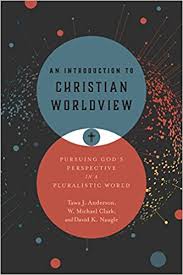
An Introduction to Christian Worldview–A Fine New Textbook

book int chr worldview

It’s great to see this outstanding textbook come down the pike on Christian worldview. Tawa J. Anderson, W. Michael Clark, and David K. Naugle have teamed to produce an eminently readable book on understanding worldview as it presents itself in a pluralistic age. Teachers will love it for its accuracy while students will appreciate it for its clarity.

The book is divided into three main parts. In Part 1 three chapters introduce worldview, in Part 2 three chapters explain the contours of a Christian worldview, and in Part 3 two chapters analyze various worldviews.

Part 1 succeeds in explaining the overall concept of worldview. Philosophy and logic are expertly brought in while up-to-date examples are provided. For example, it was amazing how one of the author’s love of TV detectives could be brought in on a few occasions to make a great point. I loved it.

When Part 2 transitioned to explaining a Christian worldview, the book continued to deliver. In this case, I was amazed at how well theology, and I mean in-depth theology, was worked into the discussion in a perceptive way.

Part 3 was somewhat less interesting to me but had to be discussed in a book of this nature. Western philosophical alternatives, as well as global religious alternatives, were reviewed. The conclusion tied the parts together in a meaningful way.

You will appreciate, as well, how the book is laid out. In each chapter, you will find reflection questions, illustrations entitled “scenic view”, as well as some charts that really advance understanding. Every chapter ended with a list of things that you should be able to do if you mastered the chapter, a glossary of terms for that chapter, and even a list of possible term paper topics.

This book exceeded my expectations. I’m convinced I will be pulling it down from the shelf with profit in the future. It deserves an A+ rating.

I received this book free from the publisher. I was not required to write a positive review. The opinions I have expressed are my own. I am disclosing this in accordance with the Federal Trade Commission’s 16 CFR, Part 255.
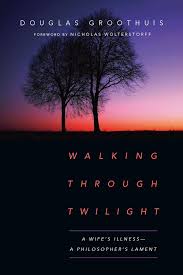
Walking Through Twilight by Douglas Groothuis

book teilight

This book grabs you. You pick it up, anticipate what you will find, and then get surprised. Though being real, or “raw” as they say, is all the rage these days, after you read this book you may decide, as I did, that you’ve hardly ever read something that’s “raw”. So much of the rawness of our day is merely façades more painstakingly crafted, but here the author detonates dynamite under his façades. He is a philosopher, an academic, an accomplished speaker, the man that is supposed to have it all figured out, but in the waves of bewilderment that crashed upon his soul as his wife descended into the twilight of dementia he found out he did not. What he could figure out when he forced himself to examine this bizarre, unexpected place is worth contemplating. It reminded me of my dark places, which were not as dark as his, and taught me what to examine the next time.

This effort is not along the same lines as the other titles Mr. Groothuis has produced, other than his quality writing skills. For example, I was greatly instructed by his “Philosophy in Seven Sentences”. He was able to marshal philosophy and especially the Bible for his struggles. He did it without an ounce of superficiality. He wasn’t able to tie everything up in neat little packages either. The profound part was that the more crushed he became the more sufficient his Savior became. I was moved.

Usually, when I review a book I overview the contents, but I think that would be a mistake in this case. Just experience it. Approach every chapter with a clean slate. You won’t regret it!

I received this book free from the publisher. I was not required to write a positive review. The opinions I have expressed are my own. I am disclosing this in accordance with the Federal Trade Commission’s 16 CFR, Part 255.
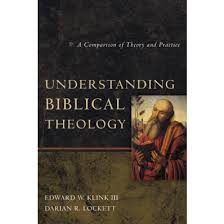
Understanding Biblical Theology by Klink and Lockett

book und B theo

Edward Klink and Darian Lockett join forces to guide us in defining the term “biblical theology”. In doing so, they will divide the scholarly world into five major schools of thought on the subject. In addition, they will compare theory and practice as well as the origin of it being the church or the academy. Both authors have already published major works. In particular, I greatly admire Klink’s recent commentary on the Gospel of John in ZECNT. I see him as a theological and scholarly writer to keep an eye on in the future.

The introductory chapter surveys what the authors call the spectrum of biblical theology. Though I read widely, I was a little surprised to see what I thought was a commonly accepted term so exactly defined and widely debated. Along the way, they will further try to separate the concept of biblical theology from systematic theology. As will become important as you read the rest of the text, in this introductory chapter they define the issues involved that divide scholars. How the Old Testament connects to the New Testament, whether we should look for historical diversity or theological unity, the impact of the scope and sources of biblical theology, what the actual subject matter of biblical theology is, and finally, whether biblical theology should be defined by the church or the academy. Make sure you linger over the small chart on page 22 that shows a logical way to view the five schools of thought. Spoiler alert: there’s an outstanding summary chart at the end of the book that will make it possible for you to review and make sure you followed the line of thought given in this book.

The design of the book is simple. There’s a chapter of defining the particular school of thought followed by a chapter that fully examines one of its major proponents. In a nutshell, you have biblical theology as historical description with James Barr, as history of redemption with D. A. Carson, as worldview-story with N. T. Wright, as canonical approach with Brevard Childs, and as theological construction with Francis Watson. Please don’t ask me where I land even after reading this book, though I find myself vacillating between the first two schools of thought. Strangely, each point of view had some aspects worth considering, even if some of them had more serious drawbacks.

Some might find this subject a hair too finally split, but I can’t imagine a resource that could more capably define the parameters of this subject. Believe it or not, the authors were so faithful to their task of explaining why this issue is hard and how it’s been viewed that they never championed one viewpoint over the others. This is THE book on the subject.

I received this book free from the publisher. I was not required to write a positive review. The opinions I have expressed are my own. I am disclosing this in accordance with the Federal Trade Commission’s 16 CFR, Part 255.

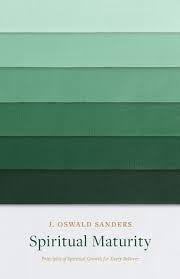
Spiritual Maturity by J. Oswald Maturity

book spiritual mat

Oswald Sanders writes in a similar vein as he did in “Spiritual Leadership”. Though this title is not as well-known as his leadership classic, it probes with the same depth into spiritual maturity. As the subtitle says, he brings out principles of spiritual growth for every believer. It is an outstanding book.

He has a Trinitarian breakdown in the three parts of this book. In part one he writes on the overruling providence of God, in part two on the supreme vision of Christ, and in part three he writes on the Holy Spirit as the breath of God. As the editors say in the preface, this title “is not just a ‘how-to’, but a ‘be’ volume”.

In part one, he first tackles Romans 8:28 and goes beyond the usual shallow interpretations we find for that verse. He does find the good. In the next chapter, we get an outstanding vision of our God and how it always led to “profound self-abasement”. I love this chapter. Next, he finds the persevering love in the Lord being called the God of Jacob. In another chapter, he reviews the purposes of God’s disciplines as well as the perfected strength He gives. In chapter 6, he probes the ugliness of pride. After that, he discusses faith, deliverance, and the compensations of faith.

In part two, he first uses Revelation 5:9 to look at the transcendent worthiness of Christ. Chapter 10 looks at intercession, which he calls the unfinished work of Christ. In chapter 11, he takes one of the Beatitudes and describes Christ’s ideal of character. We also get looks at discipleship on Christ’s terms in one chapter and another on seeing the message to the church at Ephesus as a personal letter from Christ. In chapter 14, he describes what he calls a “reigning life through Christ”.

In part three, he first describes what he means by the Spirit being the breath of God, followed by an explanation of the transforming power of the Holy Spirit. Later chapters consider the purging fire of the Spirit, the mighty dynamic of the Spirit, and the missionary passion of the Spirit. The remaining two chapters makes sense of the controversial subject of speaking with tongues.

I underlined many lines in every chapter. The beautiful part about this work is how he draws his conclusions from the biblical text itself. In addition to being such a helpful devotional book, this is a good example for preachers in communicating truth. Mark down this title as a real jewel.

I received this book free from the publisher. I was not required to write a positive review. The opinions I have expressed are my own. I am disclosing this in accordance with the Federal Trade Commission’s 16 CFR, Part 255.