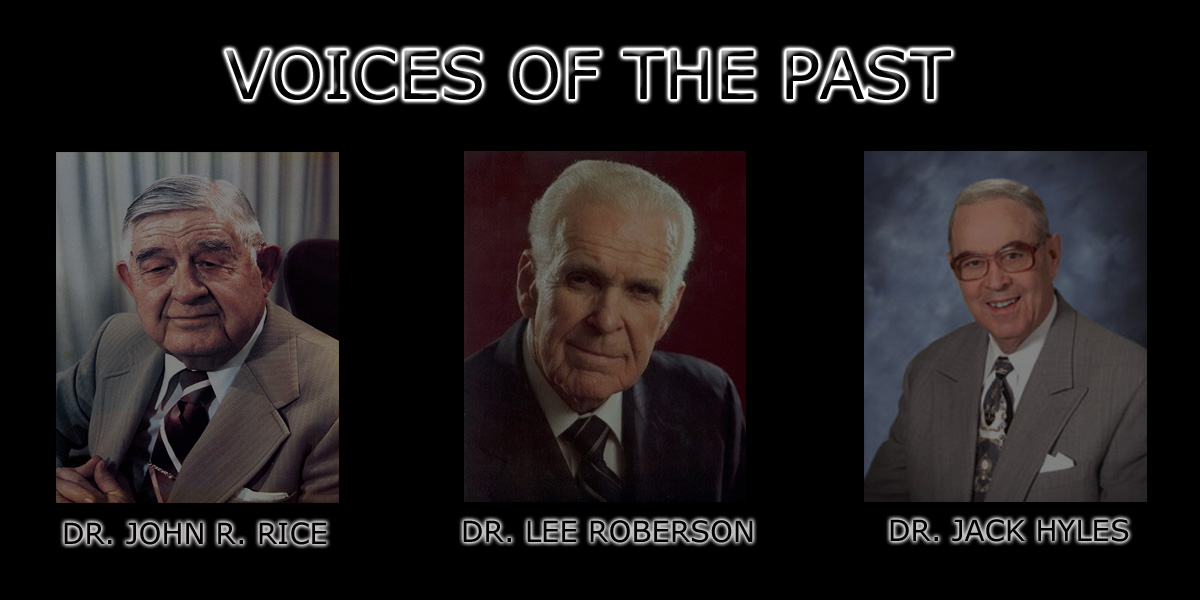
The Ghosts of John R. Rice, Jack Hyles, and Lee Roberson (IBTR #44)

voicesfrompast copy (3)

They made a mark. No trio of names among Independent Baptists could possibly have more admirers. This question about them is worthy of examination: why did they become so well known? The usual answers– books and newspapers, large churches, large meetings, large colleges, and large numbers of professions of faith– are not, in my opinion, what really took them from among the ranks of preachers and lifted them up.

You would have to go back to when they were younger men. You would have to back to before they were Independent Baptists to when they were part of the Southern Baptist Convention. A battle raged in those days as many felt that liberalism of the worst sort (full-blown unbelief in Scripture) was creeping in. Many like these men started standing against it. As can happen within any denominational setting, pressure was brought to bear to not buck the denominational leadership. These three men were particularly charming, dynamic, and natural leaders. I’ll leave their legacy for someone else to figure out, but even their worst enemies could not deny this fact. So more than usual pressure was applied because of the influence they clearly had from their youngest days.

Many around them in those days could not help but admire them paying the price. And pay it they did. If you listened or read them enough, you realize they were threatened to the point they were told they would never find another Baptist church to preach in. You know they were nervous about it. You know it because you can never know how such things will turn out. The cost of going independent was real and great. Still, they did it.

Whatever you would want to say about these three men, only following what they believed to be true could explain the decision they made. No pressure from others could cause them to violate their consciences on matters they felt important before the Lord. People saw this for what it was and they each had a following the rest of their days.

After those pivotal days they each had a ministry that lasted many years and influenced many preachers and families. As with anyone else in ministry they made decisions about every detail of life and ministry. We can’t criticize that as every single one of us do the exact same thing. They were never afraid to let others know what they thought as you might expect from such strong personalities.

Now fast forward to the latter years of their ministries and even now after they are gone. The throngs of people who count them as spiritual fathers number in the thousands. These followers understand that these men possessed something of greatness (as men go) and see themselves as following in their footsteps. My question is simple: Do they really follow these three men? Do they really follow in the one vital element that made them great? The greatness that said no man or group will dictate to our consciences?

It seems that many of their followers today do not follow them in the defining step of their lives. Not only do they not follow, but also they fully reject and ask of others the very things that Rice, Hyles, and Roberson were asked years ago. You know…follow us or pay the consequences. Don’t rock the boat. Do exactly what we do simply because it is what we do. Years ago these three were told to be good Southern Baptists and today how many times within the Independent Baptist world is the argument little more than that you had better make sure you are a good Independent Baptist?

 I hope you see that my point is in no way Southern Baptists versus Independent Baptists, but rather soul liberty versus denominationalism. Despite all the wonderful Independent Baptists I know and I admire for their love of Jesus Christ, and despite the fact that I am personally an Independent Baptist myself; we must admit that denominationalism now runs amok. Allegiance to our group is now the separating point rather than the Person of Jesus Christ or even the more well-known tenants of Baptist thought. The minutest detail about how a church service looks or the precise details of what we wear or watch or listen to, are in play to turn away from someone. In other words, soul liberty has been sacrificed upon the altar of the acceptance of men.

I’ll tell you what it is. It’s a wasting of a legacy. It’s a repudiation of the historic Baptist position. It’s a direct assault upon our consciences. And worst of all, it’s disloyalty to Jesus Christ.

Do you see their shadow? If you listen carefully do you hear their ghosts passing through the Independent Baptist world? I suggest you look and listen more carefully and not miss the best lesson they ever taught us.

The Theme Of The Gospel of Matthew

matthew

Welcome to Kyle Shearin’s class at the Crown College. Glad to have this opportunity to share this with you.

The Gospel of Matthew holds a special place among the books that make up the Word of God. We must carefully analyze the features of Matthew to determine what our Lord intended us to have in giving it to us.

The Theme of Matthew     

             Traditionally, the theme of Matthew has always been described as Jesus is the King of the Jews. Without doubt, there is much about Jesus as a King with His Kingdom in this Gospel. Israel is especially in view and the Jewish people are clearly the original intended audience. However, does that really express fully the purpose of our Lord giving us the Gospel of Matthew? We believe the idea that Jesus being the King of the Jews starts us down the path to an understanding of Matthew’s Gospel, but does not alone capture the essence of what we are to see here. The purpose for this Gospel is not so much that Jesus is the King of the Jews, but rather coming to terms with who Jesus the King of the Jews really is.

As we consider Matthew, how do we get to the theme? We find that various strands of thought are woven together with divine hands.[1] If we think about Matthew, what are the key elements that we find? With the Jewish emphasis of Matthew’s Gospel, surely the thought of Jesus Christ fulfilling all that the Old Testament said about the Messiah is one. As we progress reading, we see that Jesus Christ shows Himself mighty as He performs miracles of the greatest magnitude. As stated before, there is much about the Kingdom and we find that Jesus Christ the King explains, and in a way never seen before, governs His Kingdom. What also becomes progressively clear as one proceeds through Matthew is that Jesus Christ faces rejection. That rejection comes amid the irony of the great evidence of Who He is. These strands of thought taken together bring the theme of Matthew clearly before us. The theme of the Book of Matthew, then, is that Jesus Christ the King of Israel is the Son of God.

With this theme in mind, we can see how carefully it is carried through the Book of Matthew. Jewish people had their ideas of what a king and his kingdom should be and this had to be shown, particularly to Jewish readers. This kingdom is not made up of political elements as much as spiritual ones. Why would this need such careful explanation? The Jewish people, Matthew’s original audience, knew their Messiah would be a powerful and mighty king, but they were not seeing that He was the very Son of God. He is the fulfillment of Old Testament prophecy, but the Old Testament only touched the hem of the garment. King Jesus, the long-awaited Messiah, is the Son of God.

In developing the case that the theme of Matthew is that Jesus the Messiah was the Son of God, we notice many trends contained in the pages of Matthew. Take the title “Son of God”, which is mentioned 8 times in Matthew, and notice its usages. The first three mentions of the title are spoken by either Satan or a demon.[2] Matthew even highlights the irony of the depths of the rejection Christ faced by showing that the Devil and his henchmen admit what those in Israel could not. The double irony also developed is that this rejection in no way overthrew or even hindered what King Jesus planned for His Kingdom. Particularly in 8:29, the demons, in a state of abject fear, tell what they know to be fact when they call our Lord “Jesus, thou Son of God.” What better evidence could there be than this confession? In the Gospel of Matthew the Jewish reader, as well as all other readers, must grapple with the fact that Jesus, though not the king Israel wanted, is the King Who is the Son of God.

Another usage of the title “Son of God” appears in Matthew 14:33. There in one of the greatest physical miracles that Jesus performed in His earthly ministry He rescued His terrified Disciples in a ferocious storm on the Sea of Galilee. Matthew gives the most detail on this great miracle. Only he records Peter walking on the water to Christ, growing afraid and sinking, and then being grabbed by Christ before going under. When Jesus stepped into the boat, the winds ceased. This miracle was so awe-inspiring that the Disciples with worshipful hearts proclaimed: “Of a truth thou art the Son of God.” For the record, Matthew was one of those Disciples. Jesus Christ is clearly more than an earthly king, more even than a king with God on His side. He is the Son of God.

The next three usages of the title “Son of God” come from His enemies.[3] Each case is one of mocking sarcasm. The High Priest at His sham of a trial, the crowd of human vultures around His cross, and finally the chief priests, scribes and elders at His cross ridicule Him in His sufferings. The irony the reader of Matthew sees is all that the first 25 chapters told us of Him. His reception does not match the facts of His Person. He is the Son of God.

The final usage of “Son of God” in Matthew is the most ironic of all. Jesus has just died on the cross. Matthew records the statement of a Roman centurion: “Truly this was the Son of God” (27:54). With his rank in the Roman army, this was not the first crucifixion he had witnessed. Likely, he had grown accustomed to the grisly scene of death. This story happens against the backdrop of Israel’s rejection. This soldier’s allegiance is to a king in far-away Rome while the King Who was worthy of all allegiance is rejected by the people privileged to have Him in their midst. The irony–even a despised soldier of the occupying army could see that He was the Son of God. How powerful this presentation must be to the heart of a Jewish person that is Matthew’s target audience. In that a book of the Bible is for both the generation when written as well as later generations, this theme of Matthew makes a powerful appeal to those who read it today.

In a passage unique to Matthew, Peter’s confession of Christ is given (16:16). Peter was a man of many, often misplaced, words, but here is his shining moment. He proclaims, “Thou art the Christ, the Son of the living God.” Jesus is the Christ, the great Messiah-King. Matthew’s Gospel presents Peter’s statement as a positive statement of obvious truth. In 16:17, 18 Jesus Himself agrees with and commends Peter’s statement. As the Jewish reader considers what he reads in Matthew, he cannot fail to see that Jesus claimed to be the Son of God. In addition, Peter, one close to Him, claims the same thing. Peter is a Jew, raised with full knowledge of Jewish teaching and custom, and an intimate association with Jesus makes him willingly state that Jesus is the Son of God. Again, that ought to be fodder for thought to a Jewish person in Matthew’s target audience. Would you not agree that after 2000 years it has lost none of its punch? We Gentiles, not part of that original audience, are at no loss whatsoever. Matthew’s Gospel remains the profound book that moves us to see that Jesus our Savior is the Son of God. Such are the timeless writings of the Almighty God.

The theme of Jesus the Messiah being the Son of God is shown throughout Matthew beyond the usages of the title “Son of God” itself. Chapter 1 begins showing that Jesus is of the kingly line of Israel but moves right into showing that He is the Son of God. Matthew 1:1-17 gives us Jesus’ pedigree, which proves a legal right to Israel’s throne. This genealogy is beyond dispute, as the Sanhedrin would have exposed any evidence to the contrary. There was none. The best they could do was to deny the Virgin Birth and call Him the “carpenter’s son”. Joseph, a man who grew up in the Jewish mindset, became convinced He was the Son of God. For the record, though the kingly line has long since been cut off, Joseph is the one man in that line and he believes. In fact, the Sanhedrin never once denied His kingly heritage, but always denied that He was the Son of God. Matthew’s Gospel carefully shows this to its readers. Israel desperately wants a Messiah, but Jesus the Messiah is the Son of God and has ideas contrary to all of Israel’s plans. There is where the conflict arose and that is what Matthew is giving the Jewish reader to contemplate.

We cannot even get out of chapter one before all this becomes fully apparent. Matthew 1:21 says His name is JESUS, which is Savior. Israel would gladly accept a king to save her from her political troubles. Matthew’s Gospel, though, tells us “he shall save his people from their sins.” That is another matter altogether and explains a great deal of the rejection Jesus Christ faced.

Matthew 1: 22-23 goes on to tell of His Virgin Birth. Matthew’s Gospel of the four Gospels gets the task of highlighting the Virgin Birth. Can you guess why? Surely, it is to help the Jewish reader see that Jesus the King, Israel’s great Messiah, is more than a great king. It is not that He is more dynamic as a king, or that He is innately greater because He is Jewish, or even that He is more favored by God than any other king that has ever lived; no, it is because He is the Son of God.

Another strand of thought that brings our theme together is that Jesus fulfills all the Old Testament prophecies of the Messiah. Matthew 1:23-24 offers Jesus as the fulfillment of Isaiah 7:14. It relates what Jewish readers of the Old Testament apparently missed. Jesus Christ, the King, is Emmanuel, or “God with us.” God is with us in the person of God the Son. The Jewish reader has that groundwork laid early in Matthew’s Gospel in order to think about it as the remainder of the Gospel is read. It is the essential theme for the Jewish reader or for us, in that; it takes that essential truth–Jesus is the Son of God– to gain from the life of Jesus Christ. That it is a continuation of God’s revelation begun in the Old Testament only adds to it.

Matthew does not give all the human-interest side of Jesus’ birth as does Luke, but only Matthew’s Gospel gives us what is found in chapter two. Many of the strands of thought that combine to give us Matthew’s theme comes out here. An obvious allusion to Daniel 9:27 for timing and Micah 5:2 for place shows Old Testament fulfillment. Miracles involving the star and supernatural warnings show the uniqueness of Jesus and are a prelude to His mightiness that will be shown throughout Matthew’s Gospel. He is the King of the Jews as even the Wise Men can see. The irony of His rejection comes into clear focus as the religious leaders of Israel who through the Scriptures know the time and place of the Messiah’s birth ignore Him. There is no celebration at His birth and no one even makes the effort to go the six or so miles from Jerusalem to Bethlehem. That would surely smite the Jewish reader’s heart. The reader is left to wonder if the Jews who claimed to want a Messiah, and who did want political help with Rome as well as more freedom and power, knew more than they let on. Did they see that He is the Son of God with a spiritual agenda? Is that why they have no use for Him? The wonder of the Holy Spirit’s design in Matthew’s Gospel is that this all works together as a powerful polemic to accept Jesus Christ as the Son of God.

No doubt, Jesus’ earthly ministry was far removed from what many Jews expected. It is not what you would think an earthly king would do. For example, Jesus inaugurates His ministry with a baptism.[4]  Where is the coronation? We should see, however, that no matter what expectations were, Jesus is the Son of God. The dramatic scene at the Jordan River shows us. The Father Himself states: “This is my beloved Son, in whom I am well pleased.” Israel is not pleased, but the Father is. Ouch. How this must pierce the heart of the Jewish reader. In that there is rejection in all of our hearts, this should move us as well.[5]  It is as if the Father reserved for Himself the first mention of Jesus being the Son in Matthew, the first of the New Testament in fact.

Chapter 4 moves on into Christ’s temptation. Besides the practical teaching on facing temptation, the reader can see that this Jesus Christ is not a mere man. Not even the greatest man, nor the strongest king, could triumph as Jesus did here. He is the Son of God.

The Sermon on the Mount in chapters five through seven given us early in this Gospel shows us His perfect teaching. Matthew’s Gospel records the fullest account of that famous sermon. You hear the ring of the Old Testament in it, yet it is so much more. So spiritual, so discerning, so unselfish, and so unlike the heart of man is His sermon. He is the Son of God.

Matthew’s Gospel presents its material in a uniquely organized way. While the other three Gospels are for the most part chronological, Matthew has one whole section that is not.[6] Outside of this section Matthew is mostly chronological, but in this one section the material is given in topical form.[7] In relation to the theme, Matthew’s Gospel puts some of the greatest miracles early.[8] This might especially help the Jewish reader to see that Jesus is the Son of God. In Matthew’s design the earlier this truth can be ascertained the better. You and I now with four Gospel records to read are blessed to have one of them with this approach.

After the aforementioned special topical section in Matthew’s Gospel, there are other places where the theme shines through. Besides the episodes where the title “Son of God’ is mentioned, there are passages like the Transfiguration in Matthew 17:1-13. Yes, two other Gospels tell the same story, but reading Matthew straight through you see it falls in line with the theme. That Jesus stands above Moses, the great Lawgiver, and Elijah, Israel’s famous larger-than-life prophet, speaks volumes. A great king would not have credentials to overthrow them, but the Son of God does. That no misunderstandings develop, the Father speaks again: “This is my beloved Son, in whom I am well pleased, hear ye him.” Notice too in the story of the Transfiguration that Matthew puts great emphasis on Jesus’ brilliant radiance so that we would not miss that we read about the Son of God.

Then there is the account in Matthew 18:20 where Jesus says, “For where two or three are gathered together in my name, there am I in the midst of them.” While a king could not do that, the Son of God could. Jesus also told parables with Himself in them.[9] For example, in the Parable of the Wicked Husbandman Jesus is the unique son.[10] Even the casual reader can see that “the son” is none other than Jesus Christ the Son of God.

In the aforementioned trial of Christ where the High Priest sarcastically mentions the title “Son of God,” that same episode gives another irony that the reader of Matthew’s Gospel should not fail to see. Jesus is condemned on the very charge of claiming to be the Son of God.[11]  By this point the reader of Matthew already knows He is the Son of God and it is Jesus’ accusers who are the blasphemers.

Another thing we see throughout Matthew’s Gospel is that Jesus forgives sin.[12]  What would be evident to all readers is that only God could do that. Matthew’s Gospel, then, has presented its theme in various ways since chapter one so the foundation is laid before we are told of the greatest event of human history¾the Death, Burial, and Bodily Resurrection of Jesus Christ. Jesus on the cross is the act of paying for sin so that it can be forgiven. No king could do that deed; no, only the Son of God could.

Think of His Resurrection. We are so beyond the pale of men, so beyond a great king, and so beyond what even the most optimistic Jewish person could hope for in a Messiah. He conquers death! He is the Son of God.

Even how Matthew’s Gospel ends highlights our theme. Each of the four Gospels ends highlighting a different event. Matthew’s Gospel ends with the Great Commission that is the King’s orders until He returns. Still, Matthew 28:18 is the pinnacle of what Matthew has been saying to his Jewish readers and to us. There Jesus says, “All power is given unto me in heaven and in earth.” Look at the scope of His power. Look at the borders of His Kingdom. He is not a mere king, or even the greatest king. Israel is just a portion of His vast Kingdom. Israel’s Messiah is just a snapshot of His Eternal Person. The Jewish perception cannot contain Him. No, it is clear, as Matthew’s Gospel labors to show, that Jesus Christ the King of Israel is the Son of God.


[1]      See the chart “The Theme of Matthew”

[2]      Matthew 4:3, 4:6, and 8:29.

[3]      Matthew 26:63, 27:40, and 27:43.

[4]      Matthew 3:13-17.

[5]      The point of this discussion is not to highlight Israel’s guilt regarding Jesus Christ as much as to show a loving appeal given on their behalf.

[6]      The section is Matthew 4:12-14:13. It corresponds to the “Early Great Galilee Ministry” as shown on the chart “Overview Harmony of the Gospels”.

[7]      See the Chart “Shadow Division of Matthew IV”

[8]      Matthew 8:1-9:34.

[9]      These particular parables are often called Kingdom Parables.

[10]      Matthew 21:33-46.

[11]      Matthew 26:57-68, particularly verse 65.

[12]      Matthew 1:21; 20:28; 26:28.

Email me if you want a pdf of any chart referenced.


Check out my books here

Dress Standards and a Change For The Reagans

After months of prayer and study, we have reached a different conclusion on an issue that is big in some circles. After reflecting on the issue, I’m amazed that it is so big. The issue is whether a Christian lady must only wear skirts or not. The issue of clothing is, of course, broader than that, but the explosive issue is skirts versus pants. (To my readers who wonder what in the world I am talking about, this issue is big in the Independent Baptist world as well as some other Christian groups. While you read my disagreeing with some in this blog post just remember that I am disagreeing with friends and not fighting enemies.)

Our position now can be stated in 2 simple points:

1. The Bible demands modesty.

We have always believed this to be true. We believe that we have lost focus on this subject by taking ourselves away from the issue and reorienting on clothing styles. The idea is that a style of an article of clothing defines modesty more than the covering itself. For example, a skirt could be more immodest than a pair of pants by being too short, or even if longer, by carelessly sitting, etc. We maintain that the issue is not showing the private areas of the body. Despite what has been preached and taught, any honest, godly man can tell you that the issue is not along a simple divide of pants versus skirts, but along the divide of revealing versus not revealing. There are women in skirts that a godly man must quickly turn while his eyes away from while there are very attractive women in pants that he doesn’t have to turn his eyes away from. The issue isn’t pants versus skirts but modesty versus immodesty. One incites lust of men who want to do right and the other does not.

2. The Bible does not teach that pants would be wrong on a woman.

There is no Bible passage that states this idea. There are places where some wonderful people believe an inference is made and I will discuss these items later. Still, there simply is no passage that expressly teaches it.

There are many arguments given and many feel they can conclude “no pants” from principles of the Bible. I’d like to carefully discuss some of the most common ones, ones that I have thought deeply about as I tried to determine exactly what the Lord was really asking of us.

1. This violates the Biblical prohibition of cross dressing.

Deuteronomy 22:5 is always given as the key verse that would prohibit a woman from wearing pants because it would be man’s apparel. Whatever that verse means, it couldn’t really mean what it is often said to mean here. In fact, those sincere people who use the verse this way forget that they might wear the same t-shirt or socks as their spouse. Logically, you can’t pick and choose if the verse means what some say. I would think that would refer to what is obviously for one sex. I’d worry about the man who wore a pink, frilly shirt! Some would argue that pants are that distinctly male, but most would disagree with you.

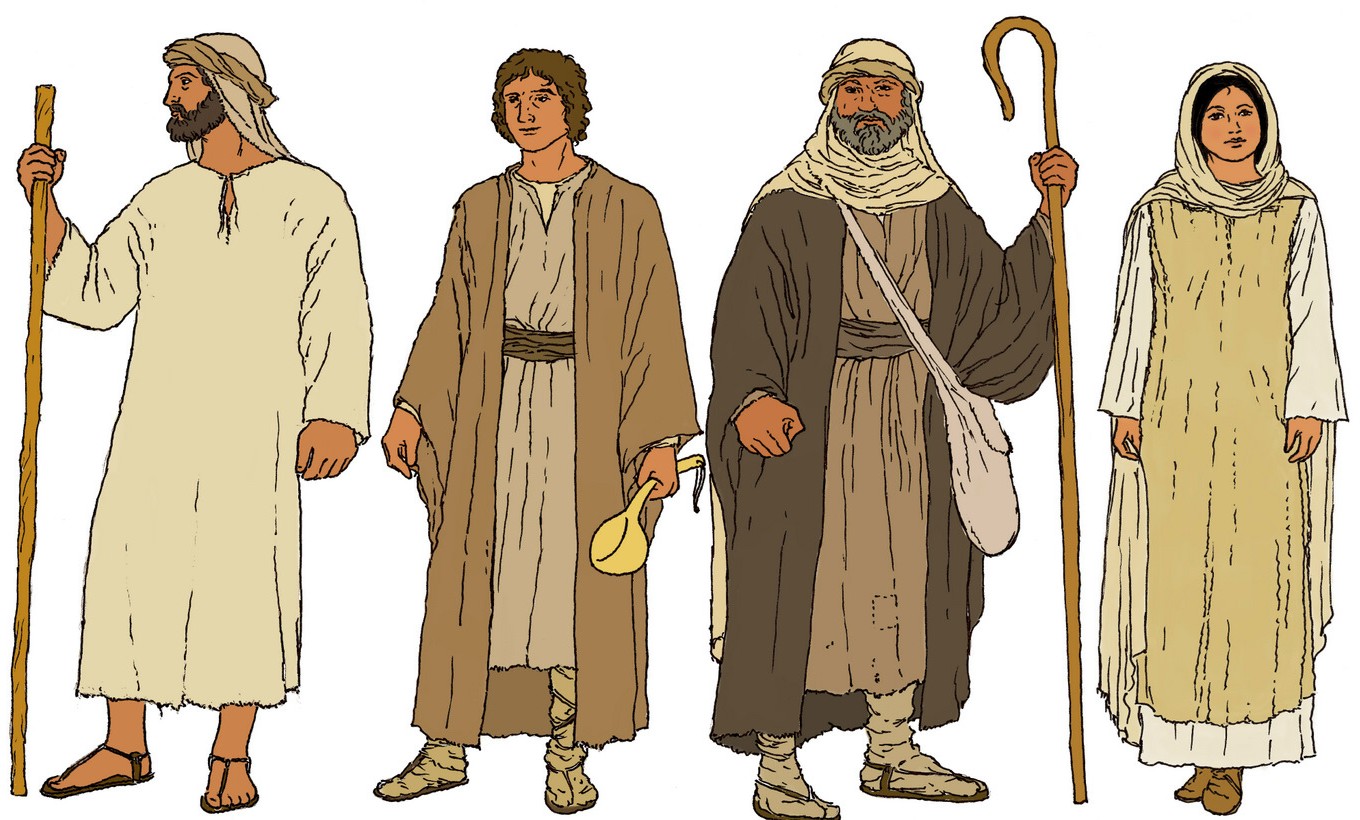
Have you ever looked carefully at pictures of clothing from Bible times in any Bible dictionary or encyclopedia? Look at this picture:

Biblical dress-1

Do you notice anything? Just how different is the clothing for male and female? Many cite Aaron’s “breeches”, but they were under his robe-like garment and weren’t that noticeable. At least you would have to admit that the difference between male and female dress in Bible times is not as large as the difference between pants and skirts now? Skirts are fine, but can they be demanded when the difference required is greater than that when the cited Scripture was given? The verse likely refers to battle apparel, but in any event, it can’t be pushed farther than the context allows.

2. Pants are a giving in to modern culture.

It is true that 70 years ago all women wore skirts only. It is also true that our culture changed. Perhaps it would be fair to say that those who first changed were making a statement that ladies today are not necessarily making. It was not culturally acceptable then. What I am afraid we fail to see is that culture is the last line of consideration for the Christian after the issue of covering our nakedness is addressed. For example, walk up and tell some burly Scottish guy in his kilt that he looks feminine or girly and as you pick yourself back up off the ground, you will probably realize he was all man and a cultural issue was involved.

Why won’t you wear the outfit of the people in the above picture from Bible times to church, or even Wal-mart? Because you know that people would roll their eyes at you. In other words, it isn’t socially acceptable. And if some measure of changing with culture within the confines of modesty is wrong, how are the church dresses of today acceptable? They don’t look like those worn in the 1800s. Dresses went to the floor then and the sight of even the ankle was a scandal. You how the 1950s became the standard for all time. That more or less is the look of most who hold the stricter position today. It is an attractive look, but can it honestly be said to be the God-given standard for today? I don’t feel there is any way I could honestly hold that position.

It is true that there are things acceptable in our culture today that are unacceptable to the Christian. But we dodge that error by our first line of defense: modesty. Modesty means I particularly cover the private or sexual parts of my body so as not to enflame others with lust. It means drawing the wrong kind of attention. To put it simply, there are 2 factors that determine what we wear: 1) modesty, and 2) culture.

3. To start wearing pants is a move to the left and therefore wrong.

There is no Scripture on it being a sin to move to the left. Actually, the only thing the Bible teaches is that you adjust to the Biblical position no matter if you need to go right or left to do it. That really is an argument for appearances. What we are all called to do is figure out what the Lord is saying to the best of our ability and adjust accordingly.

4. Ladies should not wear pants in order to take the highest road.

It is an assumption to say it is the highest road. Is it a higher road to wear a button-up shirt over a polo shirt? Is it a higher road to have a land line instead of a cell phone? How do you know that is true? In any event, I so support anyone who feels they need to not wear pants for the Lord. But in fairness, let’s support those who do not feel that way equally. If there are no clear Biblical guidelines then it must be along the lines of Romans 14:6 (“He that regardeth the day, regardeth it unto the Lord; and he that regardeth not the day, to the Lord he doth not regard it. He that eateth, eateth to the Lord, for he giveth God thanks; and he that eateth not, to the Lord he eateth not, and giveth God thanks.”)

A Plea For Consistency

Is pants- versus- skirts the big issue in the Biblical idea of modesty? Do we do the issue justice to reduce it to one area? Men, do you turn your head from every woman in pants? Or just from those who are flaunting their bodies? That really proves the point, doesn’t it?

Are pants worldly and a leaving of “the old paths”? Why do we pick this one modern development? Didn’t some think the same thing at other times about automobiles, or makeup, or jewelry, or cell phones, or electricity? Can’t you imagine some Christian years ago lamenting the shameful worldliness of bringing indoor plumbing into your home? Why would someone else get the privilege of picking and choosing such things for me?

Do you really believe that pants are a form of homosexual cross-dressing? Really? For every woman you know who wears pants? Are there not some women you admire as Christians who wear pants? Does, then, a lesbian putting on a skirt make her straight? Doesn’t this show how far adrift we are in our thinking? Cross-dressing? Where’s the outrage for issues the Bible takes care to often discuss on the level of what we see here? Is pride or anger a lesser issue than pants when you read the entire Bible? Then why are these issues not getting at least equal publicity with the pants issue?

Is the entire issue of avoiding lust on women’s shoulders? Does the man, who is truly a visual creature, not have some of the responsibility? If a lady wears something she shouldn’t, is he off the hook for wherever his mind goes? Let’s get real—does every pair of pants give men problems? If it does, could maybe he have a problem? Can a man not lust after a woman in a skirt? Even if a woman is immodestly dressed, is a man still not 100% responsible before God to keep his thoughts pure? On the other hand, does this not mean that there could be something called modest pants?

Finally, isn’t it true that there is no “thou shalt not wear pants” command? Isn’t it true that the Scriptures used are not as clear as some say? Isn’t it true that many of the arguments used are not Biblical, but are philosophical at best? Isn’t it true that where the Bible doesn’t clearly speak it is each Christian’s responsibility to seek the Lord? Do we, then, have a right to be upset if a brother or sister in Christ doesn’t arrive at our same conclusion?

Speaking for me and my family, these things settle it for us.


I really feel that women in the Independent Baptist world really fall into three categories:

1. Those who have a personal conviction to not wear pants.

To those in this category, we love and respect you. No one should back away from what he or she believes to be true—that is the beauty of soul liberty. We will never treat you any differently or look down on you. We are firm believers in every person following the Lord’s leading personally. Let us all do this very thing.

2. Those who hold no such conviction and feel free to wear pants.

That is where we are. We would appreciate you allowing us the same grace to follow the Lord.

3. Those who only wear skirts but do not personally have a conviction.

It’s sad these ladies must make choices because of pressure. They just don’t want to infuriate their pastor or their family and are living by others’ choices now. In some cases, they do it for a husband who just doesn’t want the family criticized. 

In any event, dear friends and family you now know where we stand. We know the risk we are taking. We know how we Independent Baptists are so quick to “separate.” We know how quickly a person can be written off completely.  This is a personal life issue for us. I have never made this an issue in my ministry and have no ministry changes I must make. I have never preached on this issue, so this is just a family issue. By the way, the idea of not causing others to be offended can be taken too far—I believe no one would feel compelled to sell their Toyota because someone was offended it was foreign made. 

This issue has been so blown out of proportion!

Since writing this article, I have started a series called Independent Baptist Truth Revolution. Find all posts here.   

NOTE: As the years have past since I wrote this article, it’s mazing how little an issue it is now to us. That is the place you will finally get to as well!

If I Were God

Ever have the thought cross your mind “If I were God…”? Did you think “Here’s what I would do…”? I’ll do it because it should be done! You know what I speak of. Some person does some despicable thing and his life seems undisturbed. Someone else having done comparatively little or nothing seems to have a truck load of trouble dump on them.

Why do those who legalize abortion get away with it? Why do those who abuse or molest children get to go on their merry little way? And on and on we go.

The Bible addresses this subject on a few occasions, but this just recently jumped off the page at me. 1 Timothy 5:23-24 says:

Some men’s sins are open beforehand, going before to judgment; and some men they follow after. Likewise also the good works of some are manifest beforehand; and they that are otherwise cannot be hid.

There’s a great explanation for us. The Lord tells us to expect that some men’s sin blow up in their faces almost immediately while others may never in their lives face many obvious results. They do experience consequences, just not those dramatic, out-in-the-open ones that we so love to see. I mean some Nazi tormentors were brought to justice in 1945 while others are dying of old age with new identities in beautiful locales around the globe. How haunted they have lived, however, or how much time they spend jumping at every shadow, we have no clue.

Some of us have our sins knock us over before we leave the scene of the crime while others spend their lives being chased by their sins. The lesson is the same: sin is devastating and we must run to Jesus Christ.

You may be glad to have Christ’s forgiveness, but have something stuck in your craw about some who are “getting away with it.” What we are really questioning is the justice of God. Does He hand out unfair judgments in His world? In our more sane moments we know our God is just and even explains that He will not “be mocked” (Galatians 6:7).

So our two issues really are:

1. Appearances—The Lord is not making the judgment as apparent as we would like.

2. Timing—The Lord is not acting as quickly as we would like.

Besides the issue of it just being all about our likes and dislikes, we forget that the Lord lives in eternity while we live in time. Yes, my life is passing, but His is not. I may have occasion to get in a hurry as I may run out of time, but He never has reason to get in a rush. The problem is that I view the finish line as my time here while He has time until His Kingdom is brought to completion.

Verse 25 tells me more. The positive side is true as well. Some have their good honored here while others die unsung. Remember no martyr ever gets to read the glowing accounts of his or her sacrifice. Sometimes in life little recognition comes while others receive multiple accolades.

The Lord will catch all of that up, too. Remember He has eternity to work in. All accounts will be settled and not one shred of injustice will survive eternity.

20130723-201729.jpg

I originally wrote this for Partners For The Gospel.

Headline For Tomorrow Morning After The Election

Let the Reagan Review get the scoop on news media and give you a headline for tomorrow morning right now. Many major newspapers probably have two ready but aren’t for sure which one they will be using late tonight. We are ready here at the Reagan Review! Here it is:

Christ Is Still Seated On The Throne On The Universe

My friends that is true everyday, but really has a bearing on this election. I would go so far as to say it is the most key fact of all.

I know you thought I would announce Romney or Obama. On Facebook I predicted Romney would win based on what I imagined would happen after watching politics all my life. Of course, I may miss it by a mile, but that is just a guess. I want to report hard fact, or real news, here.

Here’s a verse I studied for last Sunday and this season of all our lives.

Psalms 110:1 “The LORD said unto my Lord, Sit thou at my right hand, until I make thine enemies thy footstool.”

If you are a Bible student, you know that we are privy here to a private conversation between the Father and Christ, Who is the King. No wonder this is the most-quoted Psalm in the NT as we are always subject to so much from those who rule over us in this world.

Do you notice that Christ the Lord sits on the throne? He sits because He is there to stay. He sits because He has already won. He sits because His work is finished. He sits because He is calm. He sits because His enemies are so powerless against Him. He sits because His throne is eternal, stable, and victorious!

In fact, while we quiver in fear at world events Psalm 2:1-5 paints a far different scene in Heaven. “He that sitteth in the heavens shall laugh” when these leaders in their vain imaginations suppose to have the world in their control.

It’s true that enemies to Christ still exist and that world leaders violently oppose His ways, but He still sits on that throne. His plan is on schedule. The election won’t change it one iota either.

I used to put more stock in politics than I now do. When I was a 10-year-old boy Ronald Reagan was running for President, and since I am Jimmy Reagan, my choice was easy. (By that same logic I picked Jimmy Carter when I was 6). I also became a Christian in that year. Within a few years I was an avid supporter of President Reagan as his platform matched my Christian beliefs very well. I also loved the man, still think he was sincere, and a real believer in Christ. I probably have 10 or more biographies of him and fought back tears when I watched his funeral on TV.

But here’s the truth. For all the good he did, he couldn’t do so much of what I, or I think even himself, would have wanted done. My friends, if Ronald Reagan couldn’t stop abortion, no other President can. That is the cold, hard facts. The answer, as so many have said, is truly not in politics.

Don’t take me wrong. I’ll vote today. I really think you should too. I’ll probably stay up far too late watching the election returns. I’ll even be bummed if the results don’t go my way. But my hope is not in this election. Even if the election goes completely my way, the trouble my beloved country is in won’t simply float away.

Even if it goes the wrong way, my real King, the One to Whom I’ve sworn the ultimate allegiance, will be in full control. My King won’t worry at all about the election. He won’t call a special meeting of the Godhead to asses the situation. No, His Kingdom will just keep marching on.

I do wish, however, that my country could see Who is really in control and humbly turn to Him. I wish they could see that He has woven the law of sowing and reaping into His Universe and there is no way around it. I wish my country could see that He allows us to make choices, but He does not let us define consequences.

But whatever happens in beloved country today, my real King is still in control. You can take that to the bank and can write it in ink right now:

Christ Is Still Seated On The Throne On The Universe

(This is the third entry for this election season. The first 2 are:

It Is An Evil Time 

The Two Biggest, Seldom-Mention Issues Of the Election )

It Is An Evil Time

What do you think of the days in which we live? More importantly, what should you and I do about it? As Christians, what exactly does it mean for us when we state the obvious “It is an evil time?” Are we to sink into despair and hopelessness?

The Bible has more to say than many think; not only what constitutes evil days, but how we should approach them as well. Look at Amos and the dark days he lived.  It was in Amos 5:13 that the statement itself was made: “It is an evil time.”

Those days were filled with injustice. Official judgments were pathetic. Those who were supposed to rule righteously, judge fairly, and protect the helpless were failing at every level for their own selfish ends. Sound familiar?

We live in times of such injustices coming at every level. Whether it’s the local official taking care of his buddy, or a high-ranking official fleecing a multitude, or a court failing to protect the helpless, it’s the norm of our times. The severely disabled, the elderly, the unborn, and the poor live without the common decency that should be afforded them. I just heard of a court approving a parent’s request for surgery to alter their severely disabled daughter for their convenience. They made it where she couldn’t grow anymore, gave her a hysterectomy to avoid any sort of monthly inconvenience, and the ethics committee of the hospital approved it! Yes, it is an evil time.

Our text laid it out plainly, but I am so glad the Lord has more to say. In Amos 5: 14-15 we are told: Seek good, and not evil, that ye may live: and so the Lord, the God of hosts, shall be with you, as ye have spoken. Hate the evil, and love the good, and establish judgment in the gate: it may be that the Lord God of hosts will be gracious unto the remnant of Joseph.

The trouble with most of us is that we don’t have more to say. We moan and say “It is an evil time.” That’s it. If that were really all of it, it would be the most hopeless, depressing message imaginable. The Lord tells us what to do and moaning has nothing to do with it.

Seek the good. What the world is doing around you should have no effect on what you are doing. Despite the evil and death all around, you have the vibrant life of Christ and His fellowship. When the Lord in His holiness is forced to raise His hand in judgment, you can still be held close to His heart!  He “shall be with you.”

Then, hate the evil. Don’t be part of it. You treat those others fairly and provide honest and righteous judgement in everything. Yes, you will be the proverbial fish out of water in our culture, but what is at stake? Did you notice the last part of the above verses? (“ it may be that the Lord God of hosts will be gracious…“) It may just be that you will extend God’s mercy to your own people. It’s not that you sway the Lord, or that He is indebted to you, but that you have made it so a Holy God can legitimately extend the mercy He wants to give.

Yes, things are a little bleak these days. Is our task just to gripe? No, we have much more to do now that “it is an evil time.”

I’ll Never Understand It

I have watched the scene play out many times. Someone stares the reality of not being acceptable to God in the face. The truth of sin can not be avoided any longer and yet Christ is rejected. I don’t get it. I’ve been born again for 32 years now so maybe I am too far removed to remember what might entice someone to resist the Person of Jesus Christ.

Here’s how it looks to me now. I’m wrong with God, I’ve chosen darkness over His light, and my deeds are inexcusably evil. There is no way I can atone for my sins, no way I can bridge the chasm that I caused between me and God, and my future is eternally horrible.

In that helpless state, He moved to rescue me when I am the one in the wrong. Rescuing me came at tremendous cost to Him. Jesus left the splendors of heaven, came and suffered the humiliation of taking on a body, lived a giving life of hardship, came to a grotesque cross, bled, died, was buried and rose again–all for me! If I but accept His payment made on my behalf, my sins are forgiven, my eternal future secure, and the rift between us is healed.

To top it off, He offered to me at no cost. No cost to me at least! He even went so far as to send others to tell me about Himself and what He wants to do for me. So, to reject that–I’ll never understand!

I watched many people, though, do that very thing. Like as told in this poem:

JESUS WEPT

I saw a man

With Christ on the veranda of his soul

As gentle as a mare over a coal

Jesus knocked.

I heard a man

Who ignored the overtures to his heart

And said that he wanted no part

Jesus sought.

I watched a man

With no sense of impending doom

And of the judgement that did loom

Jesus pleaded.

I saw a man

Who thought he could delay

As if there were always another day

Jesus tugged.

 I heard a man

With all around him a swirling flood

And then trifle with the Blood

Jesus gave.

 I watched a man

Who could have triumphed over strife

And have received eternal life

Jesus loved.

 I felt for a man

Who stood on sinking sand

And overlooked a nail-scarred hand

Jesus wept.

The Day Of The Crucifixion


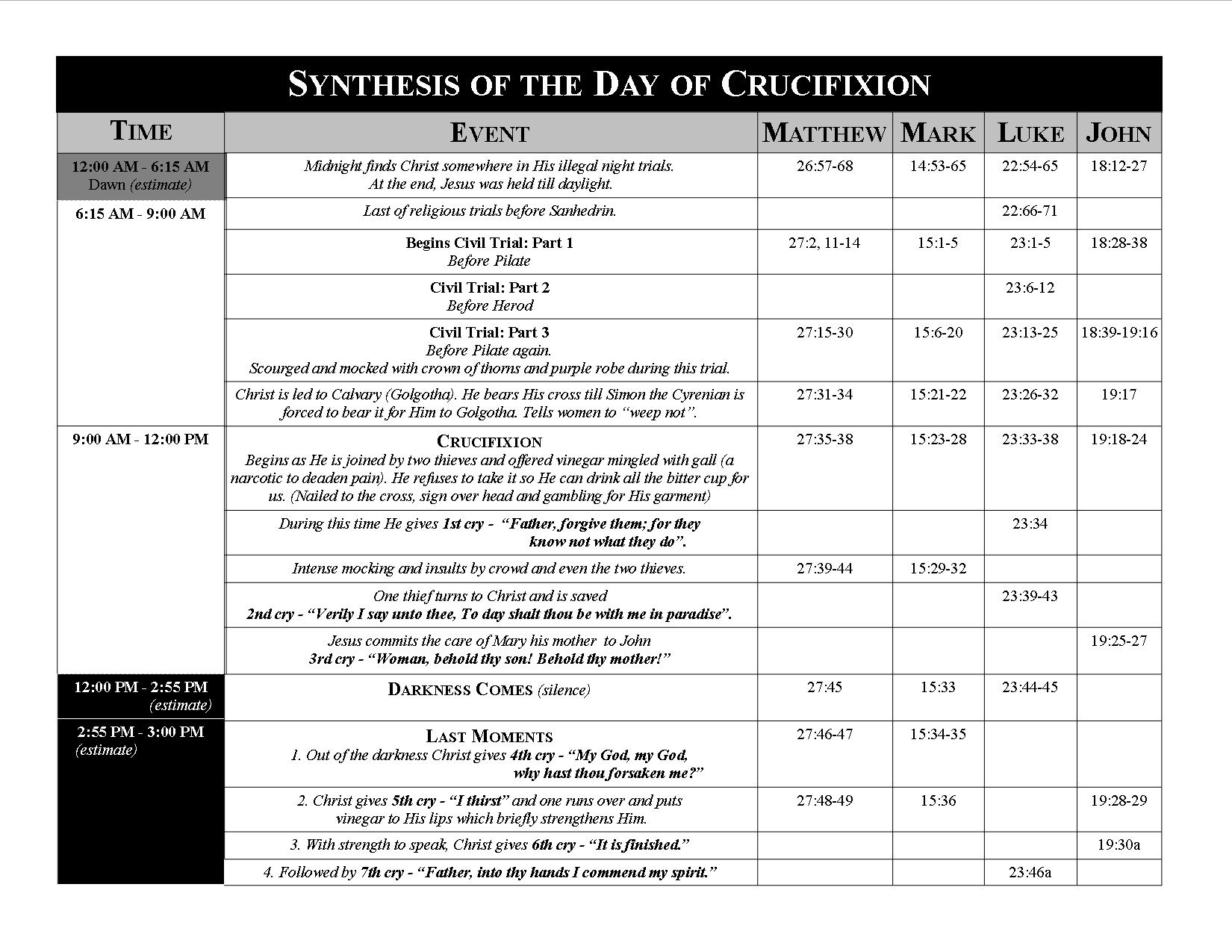
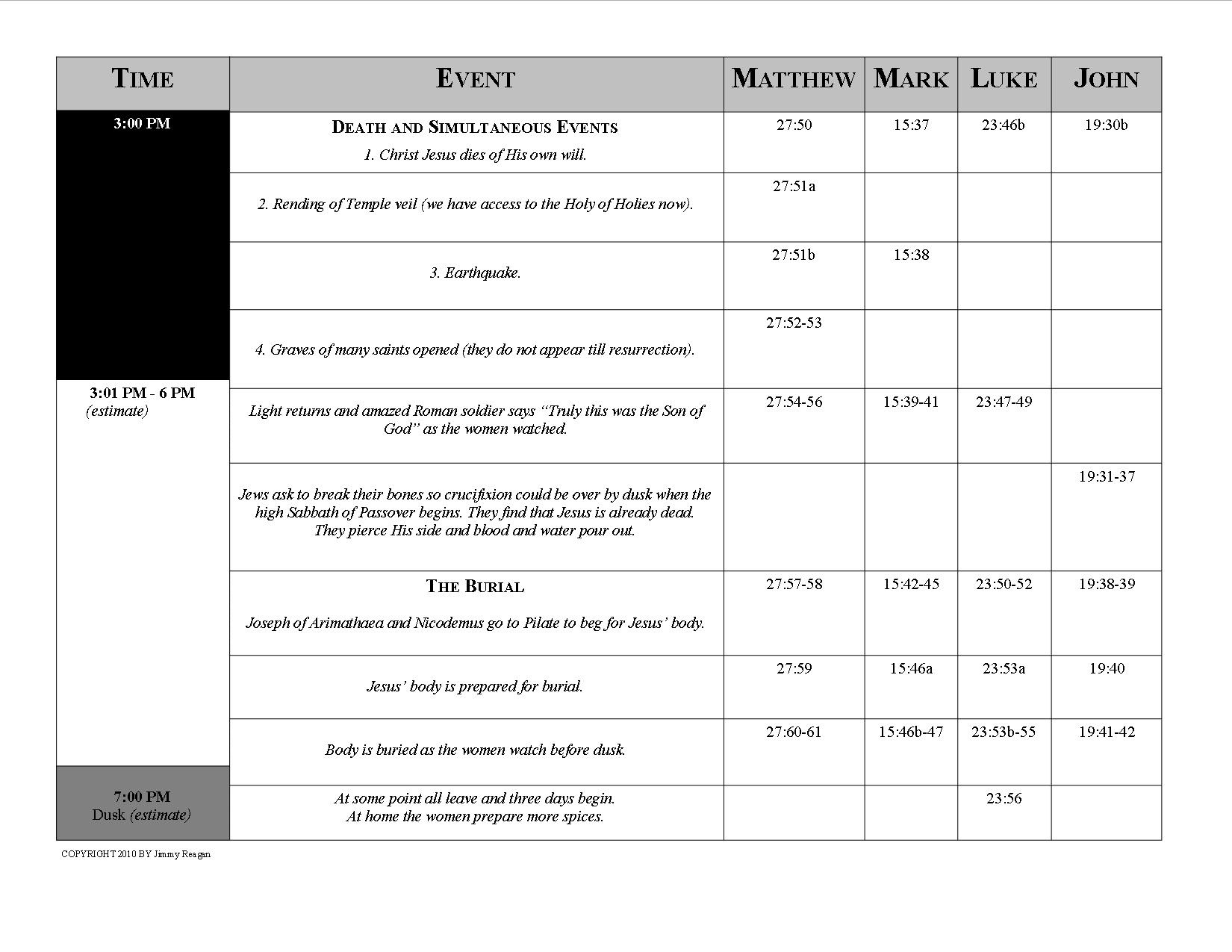
Synthesis of Crucifixion Day (Click here for a .pdf of the chart below. Feel free to print out for personal study.)

(Click image for larger view).

It’s no surprise that this most pivotal day of human history has the most details given in Scripture. Perhaps they aren’t given in the way we like things given today. There’s 4 Gospel records and the design behind which Gospel gets to tell which detail is far beyond us. In fact, the way the Lord has given us the Scriptures means that I am at no loss at all to, say, read Matthew straight through. Several facts are missing, but the great theme shines through.

________________________________________

If you enjoy this chart, it and several others from the Gospels have been collected in my new book “Following Jesus Through the Gospels”. Click HERE for more information.

______________________________________

Still, as I study God’s Word, I may want to put those details together for my own study. Who could blame me? That day made forgiveness, salvation, and Heaven itself all possible for me. It seems as one grows as a Christian there will always be a growing, healthy fascination about Christ–what He did, Who He is, and on and on. That will entail the production of a Harmony of the Gospels. Many exist. Most are fairly standard, except for a few hard-to-pin-down places. Only those who can’t come to grips with the idea of an infallible Word might shun the whole idea.

What some Harmonies fail to do is slow down at the Crucifixion. Each Gospel gives from a third to a half of its pages to that week. There is a reason for that. Then the pace slows even more for the day of the Crucifixion. My approach on the above chart is totally geared toward our culture. Midnight not only didn’t start a new day for those in Jesus’ time, but also it didn’t mean anything to them. Their day began with sundown. That’s totally unusual to we who even wait up till midnight to watch the new year come in.

Jesus makes it to the Garden of Gethsemane on this day. The horrors, the betrayal, and the arrest all happen after dark and so on this new day. By the time midnight comes Jesus has already endured at least part of the 3 religious trials He faced before Jewish authorities. Peter denied 3 times and ran off weeping. It was already a hectic day before our midnight kicked in. Here our chart picks up.

Dawn came pretty early then in those days of no daylight savings time. The custom of that day would be to get up early and get going, so Jesus’ civil trial before the Roman authorities all being done before 9 a.m. would not be not that remarkable. Even though we think of His suffering starting a little later, He probably has had no sleep in 24 hours (unless He caught a cat nap while being held till morning), He had a near-death experience in the Garden, and He suffered one of the most gut-wrenching betrayals ever known at the hands of Judas. Those supposedly still on His team are shivering in their sandals somewhere. Plus the trial had been a joke. One terrible false accusation after another has been hurled at Him. Finally, He is scourged with a cat-o-nine tails whip and is forced to carry His Own cross. No wonder He collapsed under the weight of the main beam of the cross.

By 9 a.m. He is actually hanging from that cross facing one of the most gruesome execution methods ever devised. Here’s where a synthesis of the Gospel records proves handy. So much happened. There were 3 hours of light and interaction with those around Him including much ridicule. He, as you surely know, never wavers. The three statements He makes during this time prove that pain and suffering couldn’t squeeze His great love out of Him.

At Noon a darkness overtakes all around. It was a darkness you could almost feel. You can sense an edginess by many. The suffering intensifies as every moment brings Him closer to death. What might not be obvious in any one Gospel record is that He gives His last 4 statements near the end. These all have to do with the agony of the sin He bears for us. “It is finished” is profound in its meaning, and exhaustive in its scope. All that could ever be required for my sin is given here.

At 3 p.m. He dies. More accurately, we say He laid down his life as He chose the time and the place. No person in Jerusalem that day could ever forget what it was like at 3 p.m. that day!

Others things happen, as you can see on the chart, but are rarely discussed as what happened at 3 p.m. eclipses all. Can you imagine how those women felt who left at dark after watching the stone being fully in place at His tomb? Remember for them it ended the Day of the Crucifixion. For us it might as well have even though midnight was roughly 6 hours away. Put a marker in your mind for that ending day as it set in motion a 3-day period that at its end will melt all the gloom there away forever.

Questions For Study

1. How do our customs affect how we view the story of the Crucifixion?

2. What is the difference in how the 4 Gospels present the story to how we looked at it in our chart?

3. What are your thoughts on the scope of Christ’s suffering?

4. Describe your thoughts on the few minutes before and after His actual death.

5. Compare and contrast the Day of the Crucifixion and the Day of the Resurrection.

The Backflow Of The Schaap Tsunami

When the wave of the tsunami flows back to sea you are left with destruction. If you walk through the muck and look closely you can start to understand the ruinous conditions wrecked upon the landscape. I’ve looked. Two days ago I wrote   The Tsunami of Jack Schaap and I can’t believe what I see. This post has nothing to do with Mr. Schaap per se, but what is going on in Independent Baptist churches.

Two hideous things jump out. First, people who love the Lord and desperately want to do right are at a complete loss with how to handle an abusive pastor. I have received calls and emails  asking, “what can we do?” The answers aren’t easy. As a pastor, I know you don’t want to make petty criticism fashionable. You know the type–that’s the wrong color of paint, that’s a stupid song to sing, that’s an inferior way to illustrate that point, or even it’s criminal to have a service at 6 p.m. instead of 7 p.m. We pastors can take a little abuse too!

But pastors becoming enraged, engaging in verbal battles, and threatening their church members is epidemic. Of course there are many wonderful pastors serving selflessly. I know some of them. On the other hand, we’ve heard stories of chest bumping, yelling, and threatening to have you shunned.  I am well aware of troublemakers, but I am referring to people who are torn because they fear hurting the church and hurting others while knowing that type of pastoral behavior is unreasonable and unchristian. It should be dealt with, but how?

I’m still thinking it through, how to balance pettiness and real issues. I imagine the answer lies in the Biblical qualifications of a pastor (1 Timothy 3). Things like “brawling” are sufficient to opening the discussion of a man being disqualified to pastor. As it is now, it seems “husband of one wife” is the only one that counts. The Bible, however, makes no such distinction. If a real qualification is breached, it must be dealt with. If it’s something less than a stated Biblical qualification, let it go. Lord, give us wisdom.

Even if you, as I, think highly of the office of the pastor, we must honor it further. We must not sully its call, nor corrupt its beauty. We must hold it accountable to protect its great honor. And may God help us.

Regrets

Regrets. Failure accumulates as the years roll by and what grows with it? Regrets. You know, those things no one knows. Or even worse, those things that someone well knows. Those things for which we grab the eraser only to find you didn’t write it with pencil but the strongest ink.  How are you and I to deal with regrets?

Paul had regrets. You can sense at various places in the Epistles that they had the potential to haunt him were it not for the fact that he had learned some things about dealing with them. Take for example, Philippians 3. He begins the chapter rejoicing and speaks with passion about a life of serving Jesus Christ. By verse 10 he reduces the focus of his life to the simple idea of intimately knowing Jesus Christ. As he continued it was mingled with reflection. As said before, things that he didn’t really like to think about rushed again into his mind like a wave races across the sand on the seashore.

In verse 12, though a great man, he let us in on the cold hard facts of his existence. He had not “already attained”, which is like saying he hadn’t fully arrived. Nor was he “already perfect”, which is not so much perfection as it is to be complete in his maturity. He was saying, “I’m not finished yet. I’m still a work in progress.”

Then he said “But I follow after”. Compare that to “press forward” in verse 14 since it is the same idea.  In verse 13 he confesses he doesn’t understand everything, but he has one thing down pat. It turns out to be the secret to getting beyond regret.

It’s rather simple:

1. Forget. The blood of Jesus Christ cleanses us from all sin including the very guilt of it that so fuels our regrets.

2. Press on. The meaning is not stroll on down the road, but a vigorous and speedy travel. Reach forth for those things that are higher, higher than the living you did in forming your regrets. It’s the “high calling of God in Christ Jesus.”

As you press on and reach up remember that the One Who called you to this higher call is the One Who best knows, even in vivid color and detail, the things you did that made for regrets. If He knows and calls you still to live for Him, why can’t you go on past regrets today? Let’s take Paul’s secret and use the transforming power of Jesus Christ!