Transforming Discipleship by Greg Ogden (Revised)

Here’s a revised and expanded edition of an influential book on discipleship. Ogden is one of the most respected authors on the subject and he is passionate about the subject as well. He gives the reader a lot to chew on.

The book is in three main parts with the first one covering what has gone wrong with discipleship. He exposes the superficiality in Christians today as the proof of discipleship going awry. He says people worship “with a reviewer’s mentality.” He cites studies that show few Christians have a goal of being committed to Christ, but are more focused on the American Dream. He laments how the lifestyles of Christians and non-Christians are indistinguishable. He says, “It would appear that Christians have been almost as seduced by self-focus as the broader population.”  He surmises that we have been diverted from the main calling we have. We are consumed with programs that does not actually disciple people. We says people don’t have the right idea about church and churches don’t have it about discipleship.

The next part is where he traces discipleship in the New Testament. He goes, of course, through Christ’s ministry. Next, he tackles Paul and even admits that Paul doesn’t use the word “disciple.” He shows Paul speaks of parenting young believers and transforming lives. He draws it out with great detail.

The balance of the book is a detailed explanation of his particular method of discipleship. He emphasizes relationships and  not expecting quick results. It’s interesting, but strikes me as working better in some areas or with professional people. Still, it’s worth considering. In an added chapter, he unnecessarily pits preaching and discipleship and is too harsh on preaching. 

This book is necessary for our shelves in discipleship.


I received this book free from the publisher. I was not required to write a positive review. The opinions I have expressed are my own. I am disclosing this in accordance with the Federal Trade Commission’s 16 CFR, Part 255
.

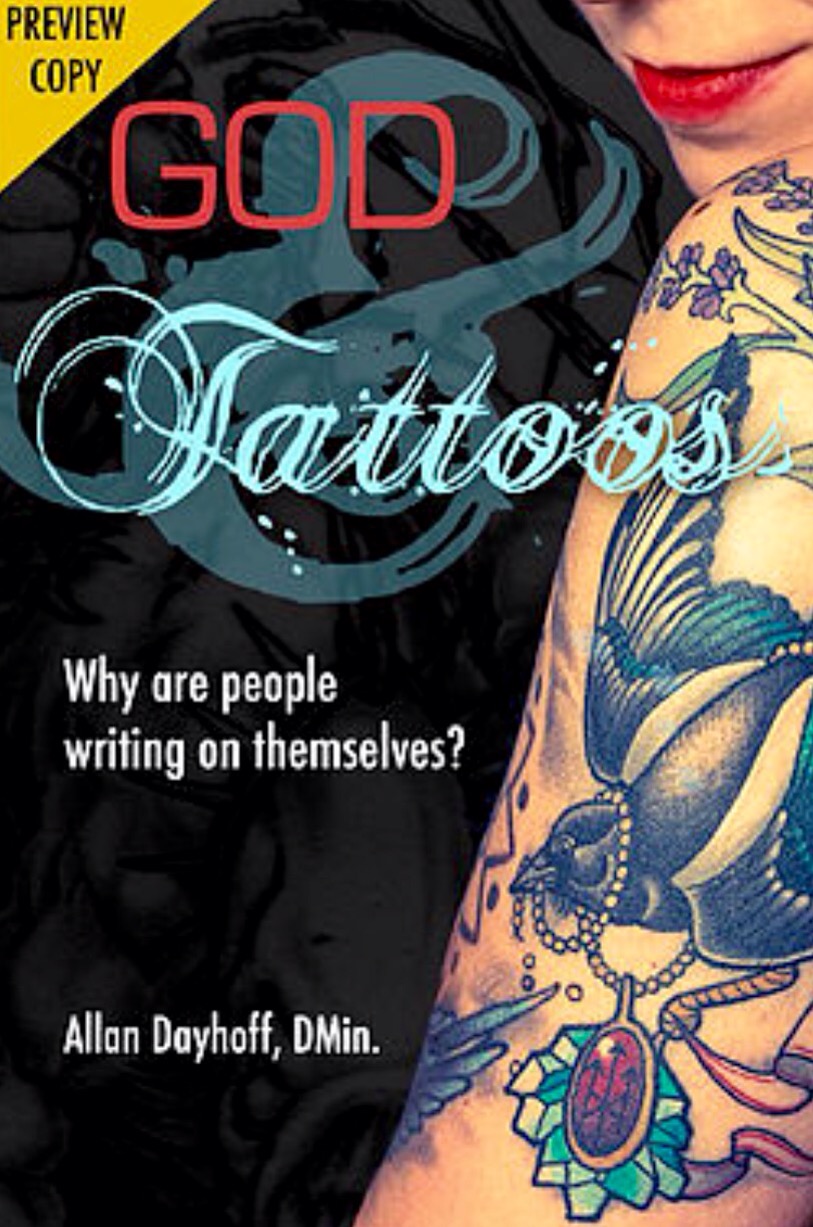
God and Tattoos by Allan Dayhoff

Have you ever read a book that was both provocative and somewhat outside your comfort zone, but still opened your eyes? This book by Allan Dayhoff was such a book for me. Tattoos to my mind were gross, ugly, and wrong. While I still am not a fan of tattoos at all, this book chided me for never considering what is going on in the souls of those with tattoos. Why are tattoos exploding in our day? More importantly, what should a Christian see in this trend of people writing on themselves? 

The author did what it never occurred to me to do: ask people why they have tattoos. He asked them what their particular tattoos meant and that opened up a massive flow of information from which some conclusions could be drawn.

He found that some are doing it because it is the “it” thing to do in our generation. In other words, for some it is merely a jump on the cultural trend bandwagon. I suspected this one, but sadly never thought about the other reasons involved. It’s in those other reasons that this book is eye opening. 

It seems as though people are needing empathy and to have meaning. In that they do not have those needs mets, Dayhoff explains that their souls are crying out these needs and writing them on their own skin. People are finding this new way to say who they are. Often, the story on their skins is one of deep pain. Other insights abound.

I met the author and while I could not do all his methods, I saw that he was sincere in sharing his faith. I must warn you too that in some cases he directly quotes his interviewees and that means some really bad language. That arose, no matter what we feel about it, from his approach to write a book that would teach Christians and could be used with non-Christians at the same time. 

It’s probably not a book for everyone, but I found it instructive and fascinating.

I received this book free from the publisher. I was not required to write a positive review. The opinions I have expressed are my own. I am disclosing this in accordance with the Federal Trade Commission’s 16 CFR, Part 255.
Ministering in Honor-Shame Cultures by Georges and Baker


This book is profound on many levels. For me personally, I can’t remember when I last read a book that made me feel like I didn’t know a thing about the subject before I read it as was the case here. It’s not that I hadn’t traveled or been in mission work in other cultures, but that I didn’t know specifically why those other cultures even seemed to think differently than my own. My culture, as is so well described in this volume, is based on guilt whereas many other cultures think more with an honor-shame mindset. Even more surprising, my Western culture is by far in the minority in our world.

The authors, Jayson Georges and Mark Baker, are well qualified to write on this subject and I particularly appreciated how they shared their own trial and error while serving in other parts of the world to gain some of their knowledge the hard way. 

Though they tackled three distinct areas–deep analysis of what the honor-shame culture is, a careful explanation of how it fits in with biblical theology, and how to take this understanding and practically minister to those who view the world through an honor-shame lens–they amazingly prove themselves adept in all three disciplines.

In the first area they really helped you get into the mind of someone who thinks in terms of honor-shame and see why it makes as much sense to them as our more legal outlook does to us. In the second, while there is a forgiveness/legal/guilt outlook in Scripture, there is clear honor/shame outlooks as well. We may have been overlooking key theology here. Finally, the practical side is amazing. The chapter on evangelism is worth the price of the whole book.

This book should be required reading for every missionary or persons working with different cultures. It might make the difference in effectiveness more than you realize. For that matter, every Christian should read it both for its theology and ministry training. This book is home run all the way!

I received this book free from the publisher. I was not required to write a positive review. The opinions I have expressed are my own. I am disclosing this in accordance with the Federal Trade Commission’s 16 CFR, Part 255.
Unchanging Witness–A Book For Our Day

book

This issue of homosexuality is the roaring issue on the doorstep of Christianity. That the world is embroiled in it is no surprise, but that some corners of Christendom are bowled over by it is.  The biggest shock of all is what is proclaimed to be biblical and historic in Christianity on the subject. That is why this new book by S. Donald Fortson III and Rollin G. Grams is so timely, helpful, and important.

The task these scholars tackle with such aplomb is showing that homosexuality has always been biblically and historically wrong  in our Christian faith. They show in one succinct chapter how the gay movement has proceeded since it embarked upon a political path in the 1960s. Then the next 6 chapters show what all parts of Christianity has believed on the subject since the beginning with plenty of direct historical quotation and analysis. They may provide more than you will feel you need, but you will appreciate their careful labor.

The balance of the book examines the biblical passages mentioning homosexuality. They spend time mentioning every argument presented by pro-homosexual scholars. You see these other scholars have been incredibly unscholarly, careless, and even dishonest. Some may not like all that scholarly interaction, but this is a case where it’s needed appreciated.

A person can say they think homosexuality is acceptable because they choose not to accept the truthfulness of Scripture, but one cannot logically or honestly say the Bible supports homosexuality. These authors have put any Christians who study this subject in a great debt by so ably providing that proof.

I received this book free from the publisher. I was not required to write a positive review. The opinions I have expressed are my own. I am disclosing this in accordance with the Federal Trade Commission’s 16 CFR, Part 255.
Introduction to World Christian History by Derek Cooper

book chr history

This book serves as a short introduction to Christian history and actually covers that territory in 250 pages. It’s other unique feature is the extent it goes to prove that Christianity has a global rather than a western history.

The volume was successful in proving what we often forget–Christianity has had peak periods all over the world. I personally wasn’t aware how some areas, like, for example, the Far East, had periods of flourishing in Christianity. The history is presented in broad sweeps, but you could easily get the big picture and know where to pursue other studies.

Reading a broad introduction also made it easy to notice trends. I was amazed how getting close to any government often spelled a sudden destruction of Christianity. There was proof given too of how European countries that once were highly Christian are now  mostly secular.

The downside of the book is that it makes no distinction of anything ever called Christian. It passes no judgment except where western excesses were presented, or so it seemed to me. In an effort to make a global case, it was too threadbare in presenting American Christianity.

Still, it is a great book for a broad perspective and a global emphasis.

I received this book free from the publisher. I was not required to write a positive review. The opinions I have expressed are my own. I am disclosing this in accordance with the Federal Trade Commission’s 16 CFR, Part 255.

The Fourth of July and the Church

Fourth July

A subject that I had not giving a lot of thought to is the appropriateness of celebrating America’s Independence in a worship service of the local church. Perhaps it is so common I had never had occasion to consider it, but a thoughtful article by Thomas Kidd on The Gospel Coalition (article here) gave me pause to consider it.

He carefully traced the history of the churches of Early America having a celebration on the Fourth of July unless it fell on Sunday, but not in the regular worship services until later years. Kidd felt it blurred some important lines and made suggestions on how to handle the situation. You can read the article yourself to form your own opinions.

After some thought, I believe the issue is what it actually means to you. Do you love America right or wrong? By love I mean that she retains superiority no matter what? Is God indebted to our nation? Do you love your God far more than your nation? When conflict arises, who is to blame–the Lord or the good old USA?

When I spoke of America to our congregation and when sang the patriotic hymns, I specifically meant:

1. I love the country the Lord allowed me to be born in.

I suspect people from other countries would feel the same way about their homeland. I’m not claiming superiority, just that the land of your nativity naturally will always be a warm spot in your heart– a spot that a Christian will be thankful for.

2. I love the Christian heritage of my country.

I love it so much that I praise my God for it and the blessings that we still derive from it to this day. We were once a truly Christian nation and the precious possession of freedom sprang directly from it. As we lose these freedoms and run from our Godly heritage, I, of course, lament the losses, but I praise the Lord even more. I feel like the hearts of our congregation was united on that point. I have to believe the Lord would be pleased that our thanksgiving on that matter would be directed back to Him.

On the other hand, our love of country and patriotism does not blind our eyes to its sins. To balance our perspective, we further believe:

1I hate the sin that is destroying my country.

Without hesitation, we proclaim where our country is fighting God and heading to judgment. When an issue comes up, we never cover it for our nation. The Lord is right and our nation is wrong. Period.

2. I feel compelled to pray for my country.

God is just and our country has no free pass on its wickedness. That means we prayed for our country–Lord forgive our sins, Lord turn our nation back, Lord send revival. As I prayed, I believe the people had the appropriate attitude of heart. At other points of the service, I noticed men leading in prayer returning to that same theme.

We are blessed too that our patriotic hymns turn us back to the Lord acknowledging His help and mercy in our lives. I see no conflict in singing those songs to the glory of my God.

We had a patriotic element in our service, but the last song we sang was wholly about worshiping the Lord. Our sermon was totally about yielding to God in our personal lives because He and His Word are the ultimate authority.

All in all, I am in favor of an appropriate patriotic element in our July 4th services as long as everything is in its place–our Lord is supreme and our nation is not. God bless America!


The Emperor Has Spoken

emperor

The edict has just come down from the Imperial Palace, formally known as the White House, directing all public schools in our nation to allow so-called “transgender” students to use the bathroom they self-identify with. I guess in a country where a President can self-identify as a king and can get away with it, even to the degree that other members of our republican government join the facade and put on the costumes of court subjects with most fighting over the one of the court jester, it was inevitable a high school boy could “self-identify” (wink, wink) and get into the girl’s bathroom or gym showers.

We were already forced a few weeks ago to think through this issue (as I did here for myself), and many of us decided that this wasn’t going to work for our families. Now in a move shocking both in its suddenness and brashness, we have a nationwide proclamation that hits in a place that should definitely be protected from such shenanigans: our schools.

I’m heartbroken for our country. I’m heartbroken for the family that has no other option besides public schools. I’m heartbroken for the good public school teachers who will now be put in a hopeless situation. I’m sorry for the accredited Christian schools or colleges who will have trouble avoiding this ruling. Most of all, I am sorrowful for the helpless children who will suffer.

The children of our country deserve better. Many children who abuse another child are ones who have been abused themselves. The adults need to protect them all. A safe bathroom is a minimum requirement, wouldn’t you say?

I do want to thank God that homeschooling is still a legal option.  I applaud all homeschooling mothers, who even though you may want to pull your hair out at times, you are one of the true heroes of our generation. I want to thank those involved in providing Christian schools too. With what is going on in public schools, homeschoolers and Christian school families need not split hairs.

There’s another thing that needs admitting at this time. Perhaps the drama of the 2016 presidential election with Trump and Hillary and the others made us forget for a moment. Obama is the most perversely effective president in our nation’s history. He has gotten through so much of his grotesque agenda, an agenda far beyond what we thought in 2008. He has used methods not mentioned in our Constitution, methods never heard of before, and they have worked with apparent ease. Every few months now we are getting the shock of our lives. And that’s exactly what this nationwide “transgender” bathroom edict really is. May God help us.

Schizophrenic–A New Book Diagnosing The Independent Baptist Movement

brennan

Can you believe it finally happened? Someone deep in IFB culture wrote addressing the critical issues facing the movement. Tom Brannan was raised in an IFB home and has pastored IFB churches for several years. This book is unique in that though others in the Independent Baptist world (including me) have written on these issues, Mr. Brennan is the first writer to stay within the standards that some of us believe are beyond Scriptural requirement to do so. I applaud his efforts and imagine he will reach an audience no one else can.

In Book One he addresses what he feels is right in IFB churches. Though I could not agree with all his conclusions, he wrote in a calm manner that would be a model for some others from the same background.

In Book Two he writes on what is wrong in those same churches. I thought he candidly addressed many of the issues others of us would label as the problem. He rightfully began with pride. In his chapter on “We elevate young men” he explained how young men get the positions in Bible colleges because complete agreement outranks depth of thought. In other chapters he explained how loyalty could be taken too far. He actually gave soul liberty its props and he wasn’t afraid to say “we cover up sin.”

I especially appreciated how he addressed the quality of both preaching and study and admitted it was often woefully inadequate. He didn’t dodge how separation was out of hand in many cases. He looked at several other issues and even dropped the truth bomb: “Pharisee”. He ended his book politely calling for reforms.

There may be some who completely write him off for Book One while others will do the same for Book Two. I would suggest the former give him credit for doing what no one else around him is doing and the latter for being the first of their number to say what needs saying. I recommend the book and am excited for those he will reach that no one else can. I just pray he doesn’t get thrown under the bus in the process.

______________________________________________________________

My writing on the same subject can be found in The Truth Revolution series here.


Biblical Counseling And The Church by Kellemen, Editor

counseling

This attractive book is likely all you will ever need on the subject of counseling and the Church. Notice I didn’t say on counseling, as this volume zeros in on how churches might carry out counseling ministry. It will not replace volumes on how to actually do counseling itself, though it evens offers many insights in that area too.

Part 1 was my personal favorite, and outstanding in every way. Chapter one looked at how churches, pastor and people, should see counseling as part of what we do. The superb chapter 2 called on pastors to see that their role to shepherd required that they counsel in addition to preaching.  Drawing that conclusion from passages like I Peter 5:1-4, Ezekiel 34, and John 10 made that conclusion unanswerable. The next chapter tied in culture’s impact. We had a chapter on uniting the public and private aspects of giving the Word among others. The section on church discipline was well done too.

The balance of the book talked about how to implement counseling into the ministry of the church. Though I finished some chapters thinking that wouldn’t work in our church, the book strove to speak to churches of all sizes. It think it did a fine job in that regard.

The book was well written, had a high view of Scripture, was passionate about its subject, and clear in its suggestions. I recommend it.

I received this book free from the publisher. I was not required to write a positive review. The opinions I have expressed are my own. I am disclosing this in accordance with the Federal Trade Commission’s 16 CFR, Part 255.
Ready To Return by Ken Ham

return

Ken Ham returns to a subject that he has written on before–our losing the younger generation from the faith. As you would expect from this famous creationist, he sees the denial of the historicity of the Genesis account as part of it. Still, he and co-author Jeff Kinley, assisted by researcher Britt Beemer, probe deeper to all aspects of moral relativism and an insufficient view of God’s Word that have brought on this problem.

The research is at once fascinating and heartbreaking. His assessments of why we are where we are seem spot on. When he shares that children being raised in Sunday School are leaving churches and the faith at a higher rate than those who weren’t, we get the greatest shock of all. His explanation that how we teach Bible “stories” is adding to the problem gets one thinking.

The book is excellent, the analysis keen. The only downside is there is a bit of repetition at times. Still, he looked at issues from several vantage points. Public school was shown to statistically predict a bad turnout for children. He well showed differences in only borrowing someone else’s faith. The chart on page 99 showing “renters” versus “owners” well illustrated the problem.

Chapter 9 was the best as he gave a plan that used the Bible as the basis for our raising our kids with results different than these dismal statistics he shared. His analysis of current trends nationally shared in appendixes was helpful. This book is a fine resource!

I received this book free from the publisher. I was not required to write a positive review. The opinions I have expressed are my own. I am disclosing this in accordance with the Federal Trade Commission’s 16 CFR, Part 255 .