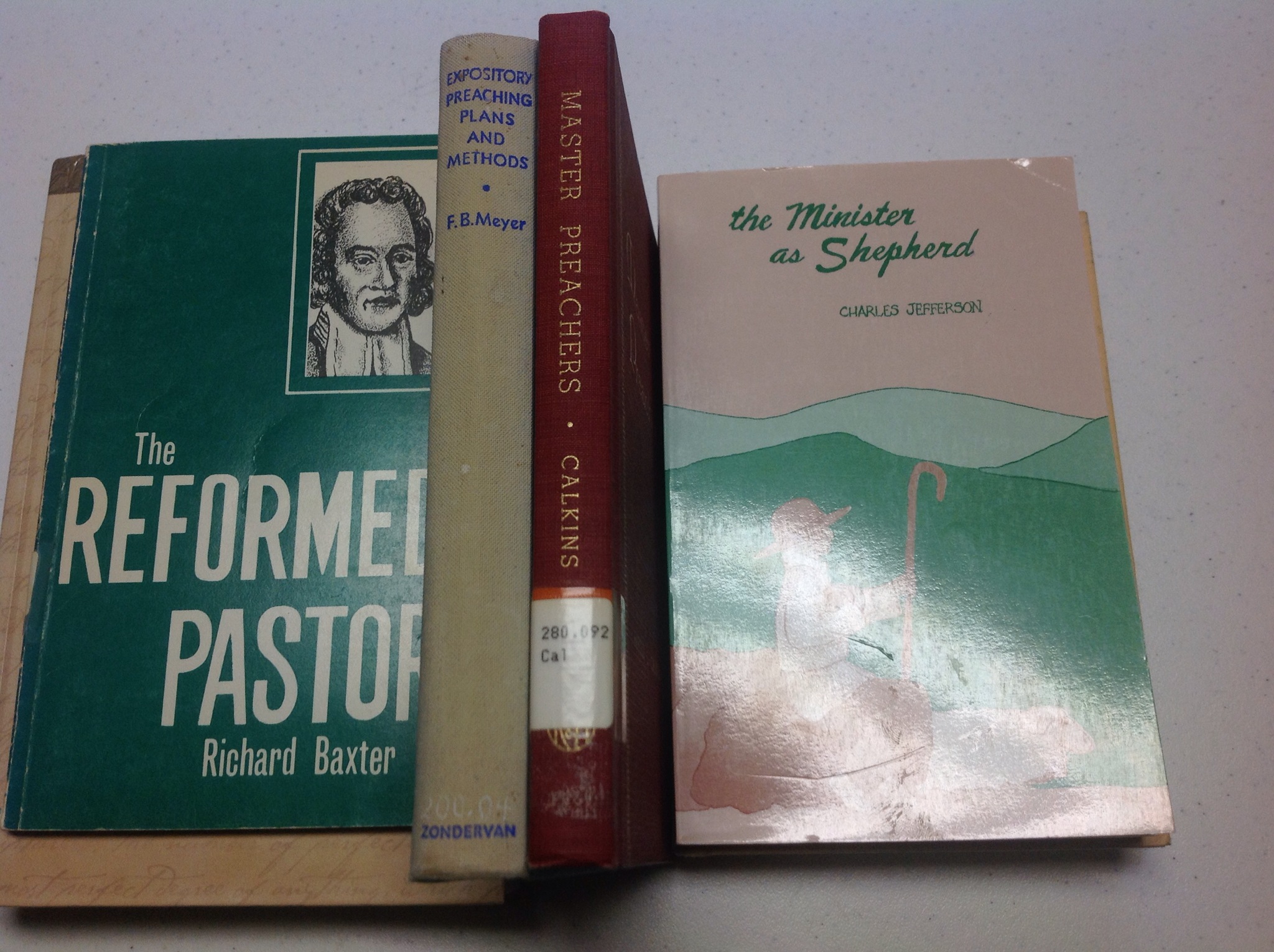
Here are four more outstanding volumes on the ministry. Two are timeless classics, and the other two are lesser known but well worth reading.
1. The Minister As Shepherd by Charles Jefferson
I read this volume in the very early days of my first pastorate and no book has shaped my thinking more about what pastoring looks like. In line with Scripture, he deftly compares our work to that of a shepherd. There could hardly be a better approach. We could use his wisdom today. He says so many good things!
“It is not necessary to put grass into the sheep’s mouth.” “Dictators are out of place in the pulpit.” Of us: “They are his representatives, but they do not take his place, nor possess his power. There is but one Lord, Jesus Christ, God’s Son.” He points out that Jesus says, “Feed MY sheep.” He tells our reward as: “The reward of the shepherd is that he becomes increasingly like the Good Shepherd.” Wow!
Pastor, this book will change your life.
2. The Reformed Pastor by Richard Baxter
That this classic volume is still such a blessing shows the timeless nature of what we do. When I finished this book years ago I wrote on the fly leaf: “Excellent! He cuts pastors no slack! We must wholeheartedly serve God!”
He tackles some of the harder aspects of pastoring, including dealing with matters of church discipline. “Reformed” in this case means “revived” and you will see that he writes with the gusto of one revived!
This book has been incredibly influential for a long time and still has something to say.
3. Expository Preaching Plans And Methods by F. B. Meyer
When one is an expert marksman in tracking out warm, glowing expository messages from the pages of God’s Word, his words on expository preaching are worth hearing. F. B. Meyer was such a man. You will be blessed reading any of his messages.
Whether it be specific pointers or speaking to the big picture of expository preaching, he is quite helpful. I love how he quoted Philip Henry who didn’t go over their heads, nor under their feet, but to their heart.
Take this to heart: “Many a track of Scripture, when we first read over it, seems as though it were hardly worth considering, and then the hidden Christ is suddenly discovered.”
Another gem!
4. Master Preachers by Harold Calkins
Here is something different. He takes several of the great masters of preachers and tells us about their study and devotional habits. For me, it didn’t hurt that he covered some of my very favorites–Maclaren, Spurgeon, Morgan, Parker, Whyte, Jowett, Muller and others. I am shocked he included Harry Emerson Fosdick, but one gravel among diamonds can be handled I suppose.
He writes that you and I may have more effective and fruitful ministry. I can’t imagine the reading required to put this volume together. There are so many illuminating nuggets. Did you know that Whitefield read Matthew Henry through on his knees? Did you know that Muller prayed even more for his sermons than financial needs? He explained how MacLaren would draw out shades of meaning and people would respond how it was all in the text and how did they miss it. There is so much more.
Happy reading!
For all articles and books discussed in this series click here.





 The Reagan Review