The Bible and Archaeology by Richelle

book bib arch.jpg

Here’s the perfect book for either pastors or Bible students to get a clear overview of the connection between Bible and archaeology. This book succeeds because it strikes the perfect balance between archaeological detail and basic understanding. In other words, you will not drown in the minutia of archaeology, but you will have an informed grasp of both the value and limitations of archaeology in your Bible studies.

Matthieu Richelle, a respected professor of Old Testament, has a nice list of credentials to be able to produce this work on archaeology. I appreciated his respect of the Bible, his academic integrity, and his civility toward other archaeologists with whom he might disagree. In the same vein, while I might disagree with him on a few points myself, I respect greatly what he has produced here. To take something as complex as archaeological methodology and make it accessible to a popular audience is a gift. It’s a gift that’s present in this book. He will walk you through some subjects you might normally dodge, but he will guide you in a way that you can both learn and easily comprehend.

In the introduction, he describes his disdain for sensationalists and his desire to give us the tools to understand the clearly divisive controversies of biblical archaeology. Chapter 1 explains what archaeologists are looking for, or at least what they usually find. He guides us through archaeological sites, he explains what a “Tell” is, and uses some popular Bible sites to explain. He explains why these “Tells” have developed the way that they have and why they make it possible for archaeological discoveries. He explains the important difference between relative and absolute chronology and commonly accepted archaeological periods. He describes the main tools that archaeologists use to make their conclusions. Further, he explains what they tell us about the people, the architecture of the time, and what can be learned about life in ancient Israel.

Since chapter 1 only took us through what can be learned about life in general, the rest of the book must take us into the things that archaeologists discover that help with the more critical subjects of dating and verification of historical information. You will learn about the principal types of inscriptions and the difficulties of epigraphy. He doesn’t hide the dark side of the archaeological world that includes things like forgeries and other unscrupulous behavior.

Chapter 3 is outstanding and proves his balance. In this chapter, he discusses the limits of archaeology. He confesses the lack of certainty that exists, how that sometimes we can only say what is possible and not what is proven, and that there is much interpretation of the findings that can truly be biased. He talks about other natural limitations like the fact that what is excavated is ruins in the first place.

Chapter 4 finally broaches the subject of the Bible and archaeology. He is very gentle in this chapter and explains some of what I would call the more radical beliefs in the archaeological world. Those radical theories show a true bias to the Bible. He’s almost fair to them than seems reasonable, but he lays out the information so kindly that you will be able to come to the right conclusion. Chapter 5 is a case study involving David and Solomon. Because of their centrality to the story of Israel, their historicity is commonly attacked. Chapter 6 is a little more technical in that it describes writing in the times of David and Solomon and how that might help arrive at dating. The conclusion is short and to the point yet is reasonable. There’s a final listing for further reading if you’re interested in extending your studies.

This book is a complete success in what it sets out to do. Not only is it a perfect book for pastors and Bible students, but I imagine for most of them it will be all they want or need.


I received this book free from the publisher. I was not required to write a positive review. The opinions I have expressed are my own. I am disclosing this in accordance with the Federal Trade Commission’s 16 CFR, Part 255.
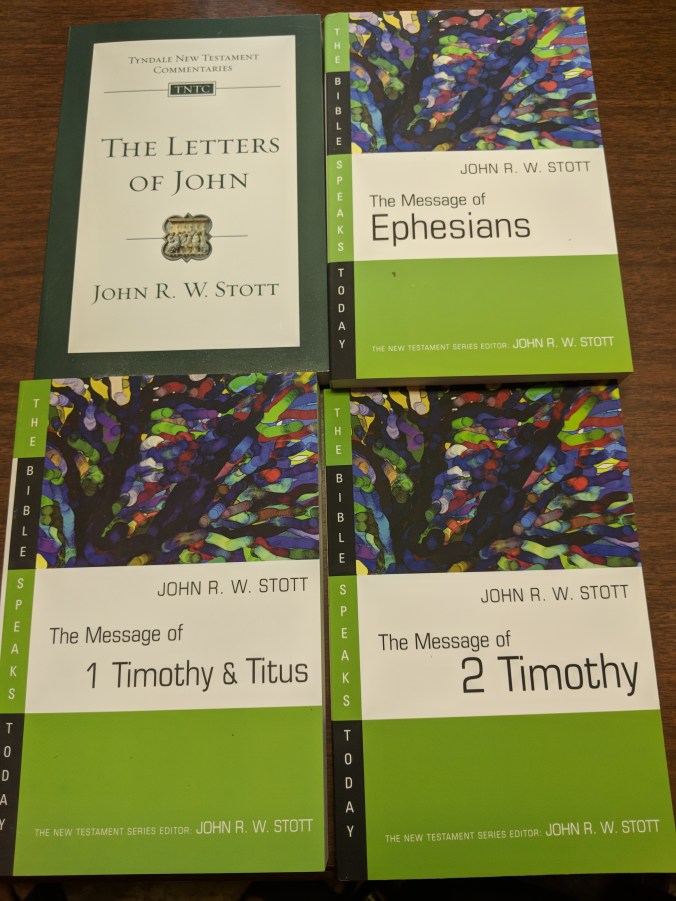
Some Great John Stott Commentaries!

MVIMG_20180624_150656_exported_3451528252453627044.jpg


Mr. John Stott remains one of the more beloved writers of Christianity today even though he’s been passed away for a few years now. He was widely published and has books carried by several publishers, but he had a special relationship with IVP and they carry all his great commentaries. In this blog post we will review a sampling of four of these great commentaries. In addition to these reviewed below, he has some equally fine commentaries on the Sermon on the Mount, Acts, Romans, Galatians, and Thessalonians.

  1. The Letters of John (TNTC)

This commentary is, perhaps, his most well-known. At the least, I’ve seen it quoted time and again in later major exegetical commentaries on the Epistles of John. It’s his only commentary in the wildly popular Tyndale New Testament Commentary (TNTC) series. I imagine this series has been one of the best-selling of all time because of its broad usefulness. Despite its age, I still see it widely recommended and even called the best in this series by many reviewers.

The thorough introduction is wisely divided into three parts: authorship, occasion, and message. He reasons beautifully for the authorship of the letters by John. He has wonderful things to say about occasion and message. There is much learning there. He seems to conclude much as the earlier commentator Robert Law did, though he’s far easier to follow in my opinion. I don’t exactly agree with Law’s premise, but it’s well explained here.

The commentary proper is model commentating. The introduction and commentary on II and III John are equally compelling. This book lives up to all its hype.

The TNTC is currently going through its second major revision. That means this title will likely be replaced by a new author. I’m confident that IVP will not allow this book to go out-of-print and if you ever can’t find it in the TNTC look for it is as a classic reprint by them. Get this one!

I received this book free from the publisher. I was not required to write a positive review. The opinions I have expressed are my own. I am disclosing this in accordance with the Federal Trade Commission’s 16 CFR, Part 255.
  1. The Message of Ephesians (BST)

You could never accuse the beloved Mr. John Stott of shying away from the more difficult books of the New Testament. I mean he’s written on Romans and Galatians and has also tackled the sublime Book of Ephesians here in the Bible Speaks Today (BST) series. In fact, as the editor for the New Testament volumes of this series, it appears the whole series was a labor of love for him. For the record, he produced its best volumes in the eight he contributed. This series has a different design than the TNTC and he excelled in both.

He allows the introduction to the letter to be handled in his commentary on Ephesians 1:1-2. I personally don’t see any loss in that design. With skill he argues for the authorship of Paul even though the scholarly world has mostly gone in the ditch on the subject. He covers the recipients and the message of the letter here as well.

The commentary is wonderful. It has the positive aspects of both good commentary with all the requisite background information as well as the warmth of an outstanding sermon. Whether this book is in the BST series or not, it has no shame on the shelves among the big boys. It would be a mistake to not own it!

I received this book free from the publisher. I was not required to write a positive review. The opinions I have expressed are my own. I am disclosing this in accordance with the Federal Trade Commission’s 16 CFR, Part 255.
  1. The Message of 1 Timothy & Titus (BST)

This fine commentary by the late John Stott is a two-for-one special as you get commentary on both I Timothy and Titus. It’s another of Mr. Stott’s outstanding commentaries in the exposition – friendly Bible Speaks Today (BST) series. I consider this volume one of his more underrated commentaries. His pastoral heart made him the ideal commentator for these two New Testament books.

This book begins with a special section discussing the authenticity of the Pastoral Epistles. I’ll never understand why the scholarly world is so preoccupied with denying Paul authorship of a handful of his letters, but I wish scholars would punt the ball and make what Mr. Stott says here the 20-yard line.

The commentary on both these letters is warm, accessible, yet in no way shallow. Perhaps the comments are shorter, yet they say more than many commentaries twice the length. Mr. Stott has lived up to his own subtitle of “guard the truth” in this fine volume that you need in your library!

I received this book free from the publisher. I was not required to write a positive review. The opinions I have expressed are my own. I am disclosing this in accordance with the Federal Trade Commission’s 16 CFR, Part 255.
  1. The Message of 2 Timothy

The quality of Mr. Stott’s commentating never wavers as you can see in what is, perhaps, one of his lesser-known works in this commentary on II Timothy in the valuable Bible Speaks Today (BST) series. Until this whole series is revised and replaced, I won’t be able to think of it in any other way than Mr. Stott’s baby.

I have no idea why II Timothy has its own volume while I Timothy and Titus are put together, but since you need all these commentaries anyway it’s better to have to buy two instead of three! Don’t be surprised if someday when this series is revised that all three Pastoral Epistles found in these two of Mr. Stott’s commentaries end up in a classic reprint by IVP.

He gives an introduction that champions Paul as author and explains the contents in regards to his life and work with Timothy. While the commentary is not especially long (only 127 pages), there’s not a wasted word. I’ll always consult it no matter how many thick volumes sit beside it on my shelves. For pastors, this book is indispensable.

I received this book free from the publisher. I was not required to write a positive review. The opinions I have expressed are my own. I am disclosing this in accordance with the Federal Trade Commission’s 16 CFR, Part 255.

Revelation (TNTC) by Ian Paul

book rev tntc

Here we are in the early stages of the second full revision of the venerable Tyndale New Testament Commentary (TNTC) series and we have a new entry on the Book of Revelation. This replaces the volume by the second series editor, Leon Morris. As much as I love the works of Mr. Morris, I’ve never heard his commentary on Revelation being talked up as his best. This new volume by Ian Paul is a substantial entry at 370 pages. I feel that Mr. Paul fully grasped the parameters of this series and put it to good use.

I’m going to rate this commentary highly even though I subscribe to a different theological perspective on prophecy than is entertained here. In my judgment, this book has these key superlatives: incredible background information of the time John wrote, profound but sane discussion of numerology, a fairness in mentioning other viewpoints since Revelation is one of the most debated books of the Bible, and solid exegesis. Even as one who takes a pre-millennial outlook, I think every pastor or Bible student needs a book from this viewpoint, especially since it dominates current scholarship. The beautiful thing about this volume is that it covers the same ground well and much more succinctly. Osborne, Beale, or Aune would take much more of your time while Paul here can give you all you need.

Even with my differing viewpoint, I found his introduction filled with good things worth pursuing. No matter your theological perspective, you will find much to mine here. The commentary itself, though if you’re of a different theological persuasion you may broadly disagree, is still filled with great insights into the words of the text and other parallels. You won’t regret consulting this book!

I received this book free from the publisher. I was not required to write a positive review. The opinions I have expressed are my own. I am disclosing this in accordance with the Federal Trade Commission’s 16 CFR, Part 255.
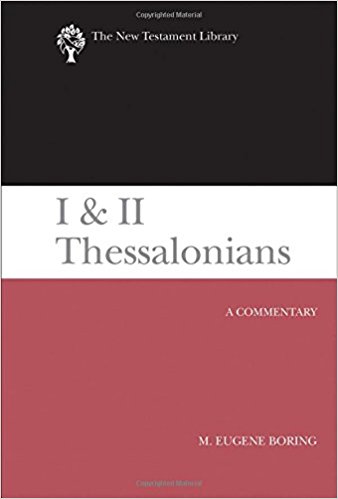
I and II Thessalonians (NTL) by Boring

book thess ntl.jpg

Prolific writer Eugene Boring gives us this thorough commentary on I & II Thessalonians in the New Testament Library (NTL) series. A decade earlier he produced the commentary on Mark’s Gospel in this same series. That shows that he has far-ranging interests in New Testament scholarship. You will find that the same areas that he received praise for in the Mark commentary are true here. In short, he excels in historical scholarship and background information.

The book is designed with an introduction to I Thessalonians followed by commentary on it, and then an introduction to II Thessalonians followed by its commentary. I enjoyed the introduction to I Thessalonians much more than that for II Thessalonians because I just can’t agree that the second letter came from some hand other than Paul’s.

He begins the introduction by explaining what it is to read in varying contexts including the reader, the canonical context, the mediating context that reviews church tradition and academic research. He also has some insight on recent scholarship. What follows is the highlight of the introduction: his description of the historical context of I Thessalonians. That includes a look at Paul’s life, the city of Thessalonica, and the church therein. He has a few words on the genre and rhetoric of the letter. After an outline and a brief discussion of structure, he gives his theological perspectives on the book. The commentary proper is quite helpful and teems with great historical information.

The introduction to II Thessalonians is consumed with it being Deuteropauline. Though that is a common thought modern scholarship, I find the arguments particularly weak and circular. The commentary, however, is equal to that in the first letter.

Mr. Boring is one of the most respected writers in this series and I can understand why. This is a fine commentary.

I received this map free from the publisher. I was not required to write a positive review. The opinions I have expressed are my own. I am disclosing this in accordance with the Federal Trade Commission’s 16 CFR, Part 255.
On Pastoring by H.B. Charles Jr.

book on pastoring

This book is real. It doesn’t sound academic but is more of the I’ve-done-it-and-lived-to-talk-about-it variety. H. B. Charles Jr. has pastored for 25 years and has been through battles and crises, so you feel that he understands as you reflect on your own in the ministry. The spiritual temperature of this book is high, its God-honoring viewpoint is apparent, its proclamation of the primacy of the Word in preaching is clear, and its general encouragement to stay at it is unwavering.

Mr. Charles covered every topic that you’ve come to expect in these type volumes, but here you find more heart. There’s a rawness that says the author has learned through both success and failure. There are things he’s been taught by others as well as things he’s learned the hard way. In some cases, his main benefit is the affirmation of your own conclusions that have also developed in the turbulence of ministry. He will encourage you to never lose the awe of your call, nor the wonder of your work, even if you are inflicted with the occasional scar.

The book is divided into three main parts: the pastor’s heart, the pastor’s leadership, and the pastor’s public ministry. Each part gets 10 down-to-earth chapters. I agreed with his conclusions again and again. I appreciated the needed reminders of what I already knew. All in all, this book left me encouraged. What could be higher praise for a book on pastoring?

I received this map free from the publisher. I was not required to write a positive review. The opinions I have expressed are my own. I am disclosing this in accordance with the Federal Trade Commission’s 16 CFR, Part 255.
Understanding Biblical Kingdoms & Empires

book under bib kingdoms.jpg

These Carta introductory atlases are a lot of fun. This title introduces and compares the biblical kingdoms and empires that framed the Old and New Testaments. It’s written by Paul H. Wright who has produced a major atlas and other of these introductory atlases. I’ve found all his works accessible, helpful, and well-written. This title is no exception.

After briefly describing the world of the Bible on a physical map, he describes the origin of the people of Israel as well as the earlier kingdoms around them that influenced their history. From there, he gives a good overview of the rising kingdom of Egypt as well as their famous interaction with Israel. After that interaction, Egypt, as you well know, greatly declined and Israel went from a tribal nation to a monarchy. The heights of her glory were the empires of David and Solomon. This is all well described. Next, we have the Assyrian Empire (after this point Israel always had to deal with the dominant world power to some degree) and Israel’s divided kingdom. You will learn about the Assyrian Empire, the Babylonian Empire, the Persian Empire, and Israel’s trials during these periods. Perhaps lesser-known to some Bible students, you will then learn of the Greek Empire of Alexander the Great, the Ptolemaic and Seleucid Empires as well as the Hasmonean Kingdom. The balance of this book of 40 attractive pages introduces us to the Roman Empire that brings us into the New Testament.

The work is the expected Carta experience. Beautiful photographs, timely illustrations, and the best maps in the business. When you factor in the essential nature of understanding the kingdoms that affected Israel during the Old Testament, this book meets a real need and I highly recommend it!

I received this map free from the publisher. I was not required to write a positive review. The opinions I have expressed are my own. I am disclosing this in accordance with the Federal Trade Commission’s 16 CFR, Part 255.

First and Second Samuel: Interpretation Bible Commentary

book i sam.jpg

I’ve thought for some time that the value of the Interpretation Bible Commentary series is in its theological reflection. It’s a critical series, but I often find the theology valuable enough to check out even though I don’t agree with the criticism nor the methodology that’s used. Walter Brueggemann is perhaps the best writer in the series for pulling out these theological gems that no one else thinks of. People all across the theological spectrum are impressed by his creative writing.

The introduction given is hardly an introduction for the books of Samuel at all. In only a few words, he describes the period of the books of Samuel as one of major social change. Going from a tribal system to a monarchy would indeed be quite a transition. He sees three factors in that social change that we can easily agree with. From there, in a few more pages, he provides more introduction to his approach than to the overall books of Samuel themselves. This is not a standard academic introduction.

While he may have had little interest in the introduction, he poured all his efforts into the commentary itself. Again, there are critical perspectives you may not agree with, but there are nuggets all around for those who are looking. Every passage will likely have them. These nuggets will be both theologically profound and exquisitely stated. This commentary is worth looking up.

I received this map free from the publisher. I was not required to write a positive review. The opinions I have expressed are my own. I am disclosing this in accordance with the Federal Trade Commission’s 16 CFR, Part 255.

The Bible Unfiltered by Michael Heiser

book bible unfiltered.jpg

This book is unique. There are 60 short chapters that cover many topics. What makes the book stand out on the shelves is that the topics it covers are often those you won’t find many other places. His title suggests his point – we place too many filters on our Bible before we even open it to study. The subtitle “approaching Scripture on its own terms” is a call to fresh study with real attempts to remove those filters.

The 60 chapters are divided into three parts. Part one addresses the broad issues involved in interpreting the Bible responsibly. It’s in this section that he attempts to prove to you that you do, in fact, have unhelpful filters on your Bible. Parts two and three cover the Old and New Testaments respectively. These two sections are different than the first one in that they are not really looking at broad hermeneutical mistakes made in either Testament, but rather specific points where we drop the ball.

If I had a criticism of this book, it would spring from the same place where its celebrated uniqueness comes from. At times, it seems Mr. Heiser interprets on the edges. Too much time on the edges is dangerous for some Bible students because they lose the big picture. To get around this criticism, you must accept this book for what it is: a provocative attempt to force you to see if you are reading from the Scriptures rather than into them.

Several of the topics covered were fascinating. A few I simply could not agree with based on the scriptural evidence. A case in point would be chapter 12 where he claims that all our Genesis commentaries are eight-track tapes. I’m sorry, but what one scholar wrote about in 2010 does not instantly become the gold standard for all Christians, even on an obscure topic like the one in that chapter.

You have got to appreciate what this book is trying to do. We often neither search the Scriptures diligently enough nor think deeply enough. This book will push us to do better and that’s its value. Along the way, you will likely gain some new insights on scriptural subjects you have thought about in some time.

I received this book free from the publisher. I was not required to write a positive review. The opinions I have expressed are my own. I am disclosing this in accordance with the Federal Trade Commission’s 16 CFR, Part 255.

Sharing Jesus Without Freaking Out by Alvin Reid

book shar jesus

Alvin Reed writes to any who freak out about witnessing no matter where you are in your Christian journey. The book is accessible enough that either the new Christian or the Christian who has served the Lord for a long time can find help with witnessing. Mr. Reed has already written the more formal and comprehensive Evangelism Handbook, available from the same publisher, but the two books make separate, distinct contributions. There’s no salesmanship, nor prepackaged presentation here. Ultimately, this book wants to make us more thoughtful conversationalists. We just need Jesus to be part of all of our conversations.

There’s a brief introduction that even talks about how to read this book. Chapter 1 makes the initial case that we are to spread the Word but we need not overcomplicate it as so much of our training has led to. He disdains the idea of “Marvel superhero version of soul winning” and confesses that many of us feel awkward in approaching people and talking. His goal is to make witnessing easier and more natural. In the next chapter, he chips away at the idea that God is mad at all of us for our witnessing efforts. No doubt, we are to witness, but He is not holding us responsible for results as we have been told, nor does He miss the fact that He made us with different talents and abilities.

Chapter 3 advances the idea that we think in terms of conversations and not presentations. Chapter 4 reminds us that we have an important part, but that the power is the Lord’s. Chapter 5 is a practical look at conversation starters and signposts in conversations. Chapter 6 reminds us to care, listen, and even expect people to be open to the gospel. Chapter 7 explains that we are to talk but we are to remember the level of acquaintance dictates the level of concern that must be evident. Chapter 8 reminds us that it’s more important to make friends that we can talk to than scheduling official visits. You will notice as you go through all of these chapters that the author has made eight simple principles to help us with witnessing. They are stated throughout the chapters and then they are listed together at the end of the book.

There’s an added eight-week challenge at the end of the book that makes it possible for groups to work through this material.

This book isn’t earth-shattering but could be quite helpful to us in our witnessing if we would just calm down and think about what this author is telling us about a caring, conversational manner of witnessing. This book is worth checking out!

I received this book free from the publisher. I was not required to write a positive review. The opinions I have expressed are my own. I am disclosing this in accordance with the Federal Trade Commission’s 16 CFR, Part 255.

Understanding the Holy Temple of the Old Testament

book holy temple ot

Leen Ritmeyer is my favorite modern writer on the Tabernacle in Israel’s earlier history and the Temple from Solomon’s Temple all the way to Herod’s Temple. His earlier major work, The Quest, is the gold standard on the Temple from either a historical or an archaeological perspective. Now Carta gives us one of their fine introductory atlases (They have a whole series of these helpful books) on the Holy Temple of the Old Testament. For this colorful, attractive work Mr. Ritmeyer is joined by his capable wife, Kathleen, to produce this helpful book that you will find incredibly enlightening.

The book begins with an introduction that reminds us that holiness is a key element in thinking about the Tabernacle. That’s followed by a section called the Genesis Sanctuary as the authors describe what they call the Proto-Tabernacle. That’s an interesting perspective that I hadn’t thought of. Next, we have some information on Melchizedek and Abraham, followed by great information on the Tabernacle. Every major component is explained and profusely illustrated. There’s even a section on the journeys of the Tabernacle and how that was done.

Solomon’s Temple is carefully explained, as well as the differences we find in its description between Kings and Chronicles. There are some great explanations of the rock at the top of Mount Moriah and its relation to the current Dome of the Rock. They will explain Hezekiah’s Temple as well as Ezekiel’s Temple and the Temple Scroll. Next, we will learn about the Post-exilic Temple, the Hellenistic Temple Mount, and the Hasmonean Temple Mount.

This book is the perfect way to learn a clear overview of the Tabernacle and Temple in 48 large pages. The word that comes to my mind for this book is “ideal”. You will want to look up its companion volume, Understanding the Holy Temple Jesus Knew, which is also an outstanding asset.

As with any Carta resource, there are outstanding pictures and maps. What stands out especially in this book is the diagrams of the Temple as well as pictures of reconstructed models. This book is well done!

I received this map free from the publisher. I was not required to write a positive review. The opinions I have expressed are my own. I am disclosing this in accordance with the Federal Trade Commission’s 16 CFR, Part 255.