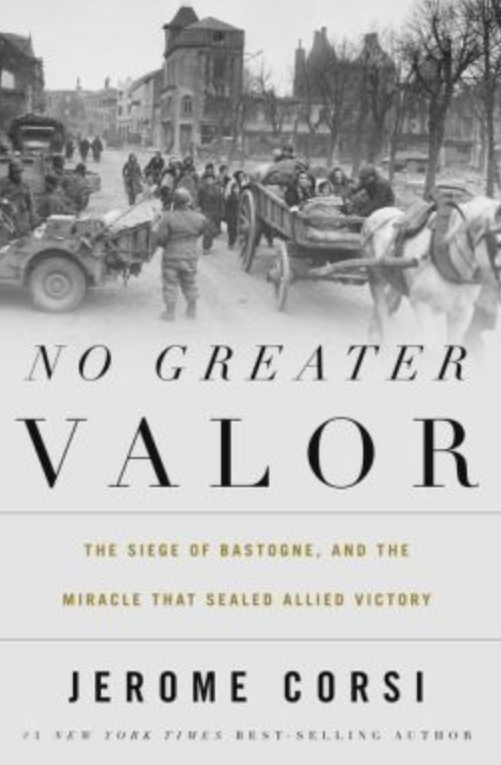
No Greater Valor–A Thrilling Read

Looking for an exciting historical read that at least acknowledges that the Lord works in the affairs of men? You will love the fast-moving story given by Jerome Corsi on the Siege of Bastogne. The action vivid, the characters real, this story comes alive in its 300 pages.

It is not, in my opinion, a Christian book. It is respectful of Christianity, though it even makes no theological distinctions between, for example, Protestant Christians and Catholics. The heroes from both (particularly chaplains) are presented glowingly, just as they should be, though the differences that will always divide are never mentioned.

What makes this volume be published by a Christian publisher (Nelson) is its recognition that God made the greatest move and the heroes of the battle are the first to admit it. Most importantly the weather, followed by fortuitous developments that were clearly beyond just good planning, and finally some smaller unexplainable events, worked together to show God’s favor.

Much is made of the prayer that Patton pushed out among the men, who clearly embraced it, and that thankfulness to God that followed the results.

The story of the incredible soldiers involved was well told too. Eisenhower listened to all sides and made the big decision. He was moved by the sometimes reckless Patton, whose unorthodox ways were made for this battle. Patton, a living paradox who was obsessed with God’s favor and prayer and yet cursed often and worked reincarnation into his Christianity, was the man of massive ego who yet pulled off the most amazing pivot northward of an army on record. General McAuliffe, the understated commander in besieged Bastogne, was a model of courageous leadership. There seemed to amazing courage, and as the title suggests, no greater valor, in every group involved.

I think you will enjoy this book. I recommend it.

I received this book free from the publisher. I was not required to write a positive review. The opinions I have expressed are my own. I am disclosing this in accordance with the Federal Trade Commission’s 16 CFR, Part 255.

E
IMG_2318

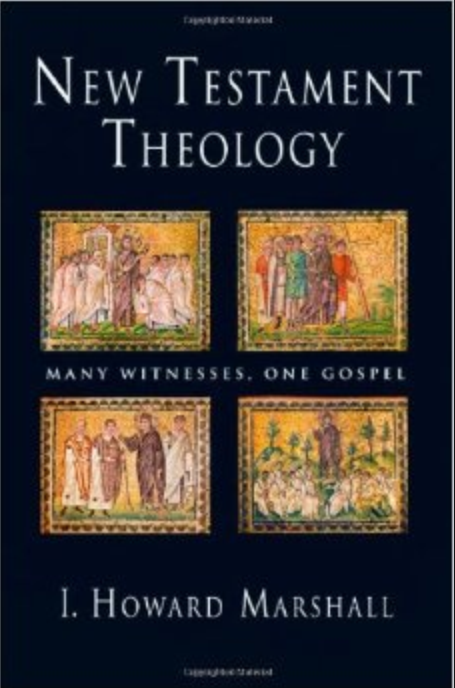
New Testament Theology by I. Howard Marshall

This massive volume by highly-respected scholar I. Howard Marshall leaves few stones unturned in a scholarly presentation on New Testament Theology. New Testament theologies are usually written as either tracing theological themes across the entire NT or discussing theology book by book. This IVP published volume approaches theology by the latter method. I prefer the first method, but we surely need both approaches.

The strengths of this volume are that with distinct acumen Mr. Marshall tells us what modern scholarship thinks and always weighs in with his own thoughts. It almost seems encyclopedic in that way. His writing is clear and you leave knowing what the consensus of modern scholarship is.

The weaknesses include an exaltation of modern scholarship at the expense of previous generations. He puts modern scholars, apparently, as the final authority of biblical thought. Perhaps you would think me biased, but I do not agree with that thinking. So that can make for a mixed bag at times. Of course modern scholarship is an extraordinary asset to us, but some of the excesses–the certainty of the existence of “Q” or other conclusions by scholars repeated so often till some accept as fact though no concrete proof exists. Of course I have many volumes that speak of “Q” on my shelves, but this book makes so many conclusions on a certainty of what came from where that the section on the Synoptics seemed flawed to me. Other similar conclusions were made. At times I read more like a collection of NT book introductions than a theology too.

Despite the weaknesses, there are insights in many places. This volume will not hold the primary place among the theologies on my shelf, but it will be consulted. If your goal is learning modern scholarly thought, give this volume 5 stars. If it is a well rounded, spiritual you seek, give it 3 stars. So let’s average the scores and say 4 stars. Fair enough?

I received this book free from the publisher. I was not required to write a positive review. The opinions I have expressed are my own. I am disclosing this in accordance with the Federal Trade Commission’s 16 CFR, Part 255.

2015/01/img_2317.png

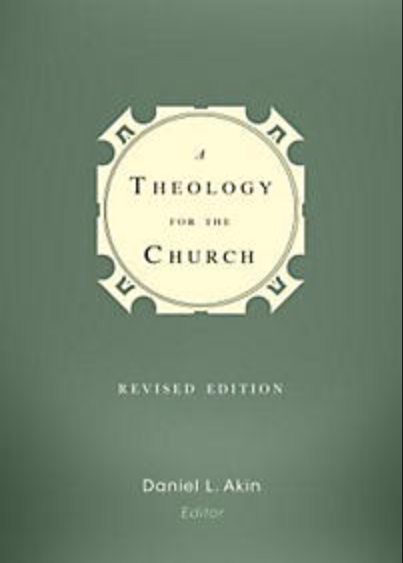
A Theology For The Church, Revised Edition

A Theology Of The Church, Revised Edition, edited by Daniel Akin and published by B & H Publishers, is a fine volume that no Baptist pastor can afford to be without. Sadly, I missed the original edition, but am glad to possess this revised edition.

This book is not so consumed with Baptist thought that it can’t on its own two feet as a quality systematic theology–it stands well. What it adds is that extra few pages in each section on how Baptists in particular have wrestled with that doctrine. I find that invaluable and something that can be found no where else.

Each chapter is written by a different Baptist theologian, and as is the common problem of such a setup, there isn’t always complete consensus. Still, that is no difficulty because the editor must have strictly enforced the notion of being kind and fair to other viewpoints, particularly other common viewpoints. There is variety in Baptist thought and this succeeds at being helpful to all. In fact, I believe even one not a Baptist would love this volume.

I must call out for special recognition the chapter by Kenneth Keathley on the Doctrine of Salvation. Since you may have guessed the possible bias, I will admit that I agree with his conclusions. Still, he so deftly defines issues and the points of debate. He confesses weaknesses in every viewpoint, including his own. He was charitable to all and I believe no matter your viewpoint you should read this chapter.

I did not read every page in reviewing this book, but took care to read enough to get a feel for what it taught. The chapter on Human Nature was another favorite. The chapter on Eschatology was less of what I expected ( he seemed to assume we started with a basic position and understood the main ones), but still gave wonderful material needed to grasp this issue in our day. Albert Mohler’s charge to the volume’s most likely users–pastors–was spot on too.

This volume is a new favorite for me.

I received this book free from the publisher. I was not required to write a positive review. The opinions I have expressed are my own. I am disclosing this in accordance with the Federal Trade Commission’s 16 CFR, Part 255.

2015/01/img_2281.png

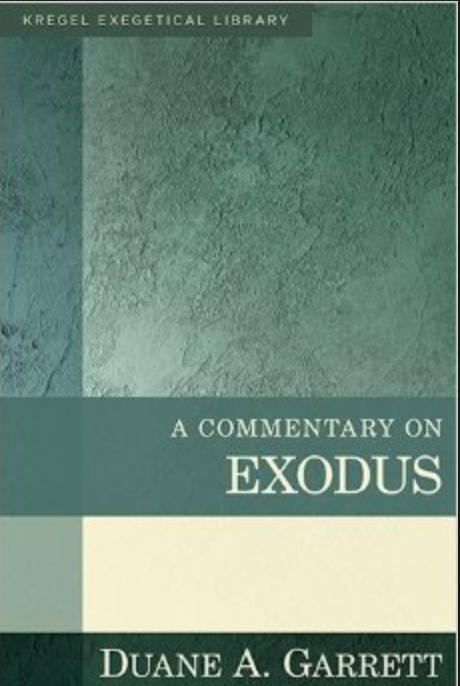
Exodus by Duane Garrett (Kregel Exegetical Commentary)

Exodus by Duane Garrett, the latest of the emerging Kregel Exegetical Commentary series, is a winner. As pastor-friendly as the earlier volumes, this commentary can stand without embarrassment beside the most scholarly of volumes.

The Introduction was a joy to read. He approaches the unfortunate waste of time in the study of source criticism and concludes it as having “contradictory conclusions and a general lack of clarity.” In further discussion of the documentary hypothesis, he speaks of some of the so-called varying sources and says, “That path is a dead end.” I love his approach!

He gives good background on Egypt as he feels that is one of the most glaring deficiencies of Bible students today. Finally, he approaches the hotly-debated subject of the date of the Exodus. I appreciate how he fairly represented all sides. He then ventured into the equally controversial discussion of the location of the Red Sea crossing and Mt. Sinai. I don’t actually agree with his conclusions, but what a wealth of information he marshals for us to decide for ourselves.

The commentary is helpful. It is always thought provoking. He seeks out natural explanations for the Plagues (though he believes in a supernatural God) that I feel does not do justice to how supernatural they seemed to Pharaoh himself. Nothing natural could have surprised him.

Check out the chart and Excurses on “The Hardness of Pharaoh’s Heart”. I have never read better.

All in all, this volume is a great commentary to secure.

I received this book free from the publisher. I was not required to write a positive review. The opinions I have expressed are my own. I am disclosing this in accordance with the Federal Trade Commission’s 16 CFR, Part 255.

/home/wpcom/public_html/wp-content/blogs.dir/39c/34718138/files/2015/01/img_2270.png

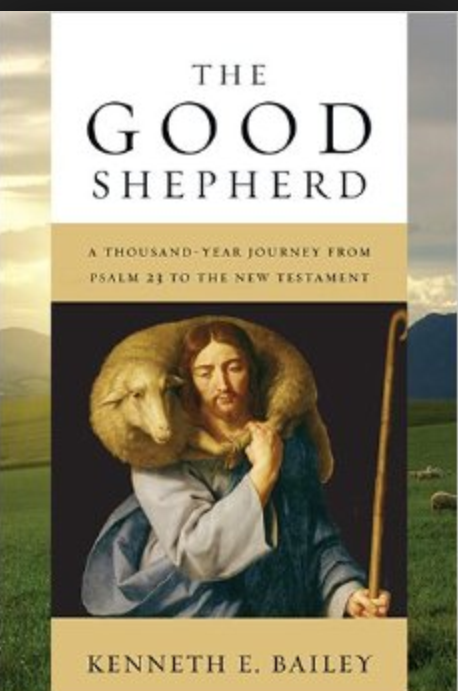
The Good Shepherd by Kenneth Bailey

The idea of the Good Shepherd is one of my personal favorites of Scripture. Here is a volume that really fleshes out that concept. The subtitle “A Thousand Year Journey From Psalm 23 To The New Testament” really captures what Kenneth Bailey has to say in this book published by IVP.

Mr. Bailey spent 40 years living and working in the Middle East including Egypt and Lebanon. Though he taught the Bible, he had plenty of opportunity to see culture not that far removed from Bible times. Merging those two–teaching and observation–has made this book a success.

His approach on the technical side is one where you will have to decide for yourself. His ideas of sequence and “step parallelism” are explained and traced in every passage he deals with. His ten themes well represent the items that we will find in shepherd passages, though all ten are rarely present in any one passage. In any event, I don’t find that the strength of the book.

The real value in this volume is the light it sheds on each passage it tackles. For example, as much as has been written on Psalm 23, he still had something to say. Check out the illustration he shares on page 42! How this shows God’s love and care for us is well drawn out.

Others passages include all the chief ones on the Shepherd theme. Jeremiah 23:1-8, Ezekiel 34, Zechariah 10:2-12, Luke 15:1-10, Mark 6:7-52, Matthew 18:10-14, John 10:1-18, and I Peter 5:1-4. They were all helpful, but the New Testament passages were especially rich. The last two were my favorites.

I recommend this volume.

I received this book free from the publisher. I was not required to write a positive review. The opinions I have expressed are my own. I am disclosing this in accordance with the Federal Trade Commission’s 16 CFR, Part 255.

/home/wpcom/public_html/wp-content/blogs.dir/39c/34718138/files/2014/12/img_2258.png

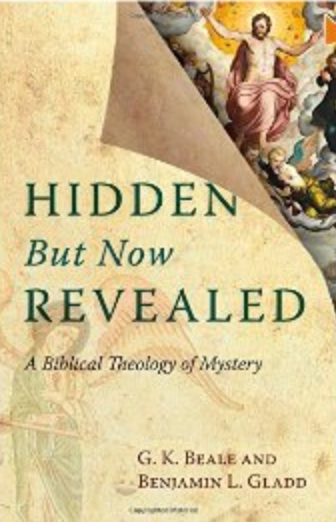
Hidden But Now Revealed by Beale and Gladd

Are you fascinated by the concept of mystery as you encounter it in Scripture? It is important, vitally important, to understanding the big picture of Scripture itself. As I see it, mystery as a concept is the nuts and bolts of how progressive revelation works. G. K. Beale and Benjamin Gladd delve deeply into this subject in this book published by IVP, subtitled aptly “A Biblical Theology Of Mystery”. Technical enough to be the scholarly touchstone on the subject, it still is profitable for pastors to grasp how the words of God progressively came to us.

This answers difficult questions like why was Jesus so misunderstood when He talked about His Kingdom or His mission. It even affects how we, for example, read the Old Testament today–how we see things they did not see then.

They define “mystery” as “the revelation of God’s partially hidden wisdom, particularly as it concerns events occurring in the ‘latter days'”. In the Introduction the authors establish the meaning of mystery and in the first chapter discuss how Daniel’s use of mystery is truly the foundation of the concept. Before coming to the New Testament they discuss the use of “mystery” in early Judiasm. That was not as helpful to me, yet I see why they included it.

Next we have a chapter each for mystery in Matthew, Romans, 1 Corinthians, Ephesians, Colossians, 2 Thessalonians, 1 Timothy, and Revelation–all the places the New Testament discusses mystery. Because of a good scriptural index, you have a lexical/commentary reference on your shelf after you read it.

It is slow to read through, at least for me, yet I doubt it will even be superseded as an authority on the use of “mystery” in the Bible. I recommend it.

I received this book free from the publisher. I was not required to write a positive review. The opinions I have expressed are my own. I am disclosing this in accordance with the Federal Trade Commission’s 16 CFR, Part 255.

IMG_2251.PNG

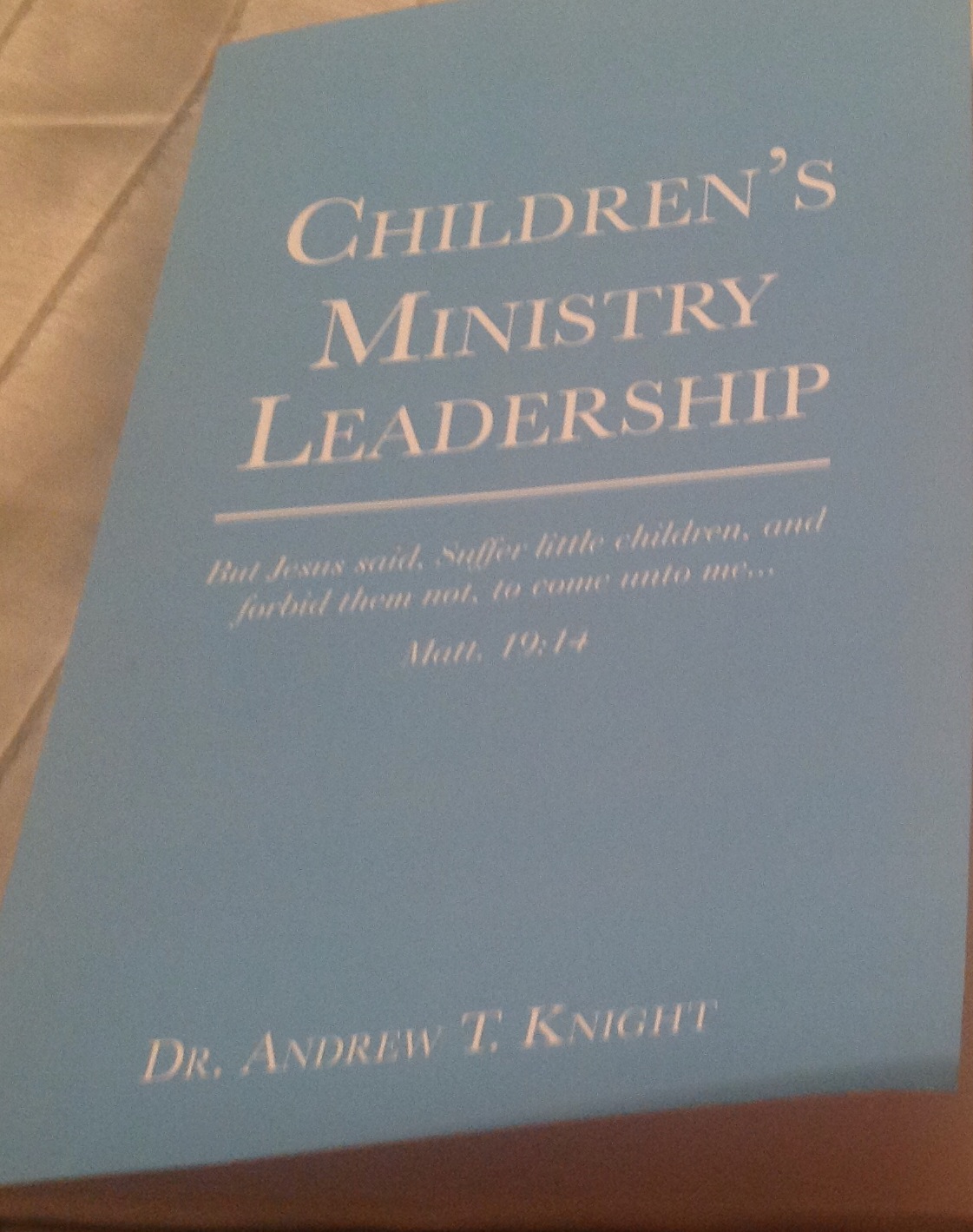
Children’s Ministry Leadership by Andrew Knight

Dr. Knight did research on Children’s Ministry, particularly within the Independent Baptist world. This volume gives the results of that research.

He begins with a fine chapter on the importance of reaching children as well as the struggles we face in getting it accomplished. Too often we minister with little discernible results.

He then describes the project he did within a large Independent Baptist church to assess what improvements we might glean. It seems the project faced several obstacles.

He also interviewed several pastors with large churches to gain their insights. He concludes with materials for teaching children for more lasting results. At times it almost seemed like a catechism.

If you are giving thought to children’s ministry today, you might want to check out this volume.

I received this book free from the publisher. I was not required to write a positive review. The opinions I have expressed are my own. I am disclosing this in accordance with the Federal Trade Commission’s 16 CFR, Part 255.

IMG_2211.JPG

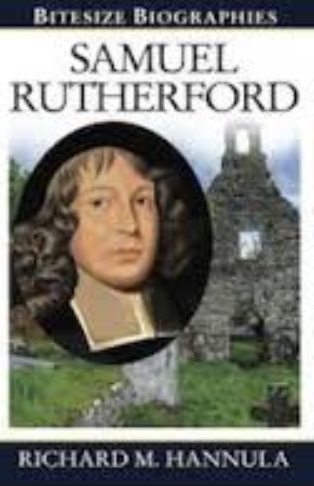
Samuel Rutherford–A Bitesized Biography

A great Christian worth knowing, Samuel Rutherford, lived a life of devotion to Christ. Many Christians, sadly, know little of him. Personally, I knew of his famous letters and have even read some of them devotionally, but I knew little of the man. So this volume by Richard M. Hannula and published by EP did me a service by filling in my lack.

He had the heart of a pastor and the skill of a scholar. His gentle fellowship with Christ, frankly, challenged me. His grace under fire refined that devotion rather than curtailing it. He was tried and exiled from his beloved congregation. From that lonely place he wrote his letters.

The Crown in England was always a thorn for Rutherford and his fellow Presbyterians in Scotland. If that weren’t enough, his first wife and eight of his nine children died. He had some serious illnesses himself. He seemed only to draw closely to Christ in all these tragedies.

He found Independents and Baptists to be a major problem as he helped formulate the church policies of England in later life. This only serves to show that you can strongly disagree with someone on a few points and yet be moved by their love for your Savior.

Thanks Mr. Hannula for this quick, informative, and pleasant read. For what it strives to be, it could hardly be better. This is my first of the “Bitesize Biographies” series, but they are helpful. We could likely pass these on to our children to read after we have finished them.

I received this book free from the publisher. I was not required to write a positive review. The opinions I have expressed are my own. I am disclosing this in accordance with the Federal Trade Commission’s 16 CFR, Part 255.

IMG_2188.PNG

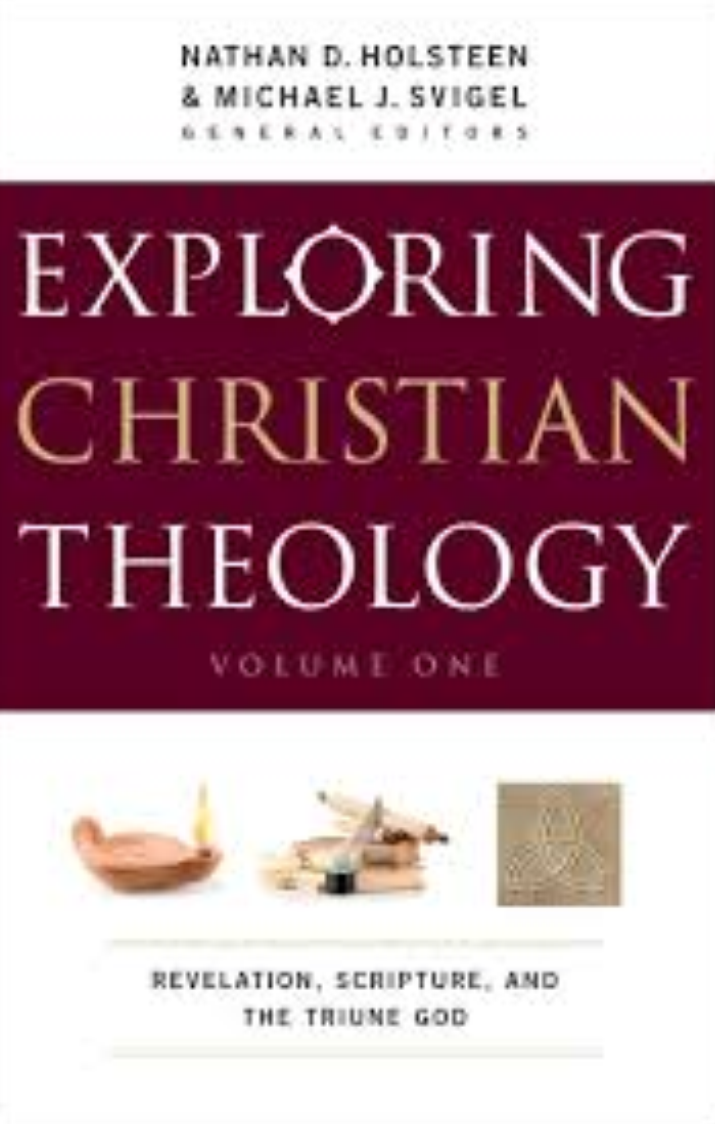
Exploring Christian Theology–a Fine New Volume

Are you intimidated by the ten-pound systematic theology volumes out there? Do you still want some real depth and genuine help? You should check out the first volume, then, of the projected three-volume series Exploring Christian Theology, edited by Nathan Holsteen and Michael Svigel, with this first volume written by the editors along with Douglas Blount and Glenn Krieder.

For some reason, I opened this volume with low expectations. I read those ten-pounders sometimes and enjoy it. Then in the first few pages I read language that I felt was trying too hard to engage modern readers. As I kept reading, however, I was won over. This volume is a treat.

The editors claim their perspective here “differs from other mini-theologies in that strives to present a broad consensus, not a condensed systematic model of one evangelical teacher or Protestant tradition.” To my mind, they succeeded. They may not have written from one narrow angle, but they stayed safely within the confines of conservative, Bible-believing parameters. Can you tell I liked it?

The first part covers Revelation, Scripture, and Truth. Their explanation of inspiration and inerrancy was choice. I might squabble over a detail here or there, but they provoked thought and explained the touchiest issues of our day well.

The next section on the Triune God was simply superb. The section on the kenosis of Christ and the debates of the Early Church on Christology was one of the best I have ever read. It rivals the ten-pound volumes!

Each section ends with quotes from all time periods of Christianity on the subject. You could see, for example, that full inspiration of Scripture has been the historic position. Newer positions are clearly deviations.

Get this book. Better yet, read it carefully. I highly recommend it.

I received this book free from the publisher. I was not required to write a positive review. The opinions I have expressed are my own. I am disclosing this in accordance with the Federal Trade Commission’s 16 CFR, Part 255.

IMG_2172-1.PNG

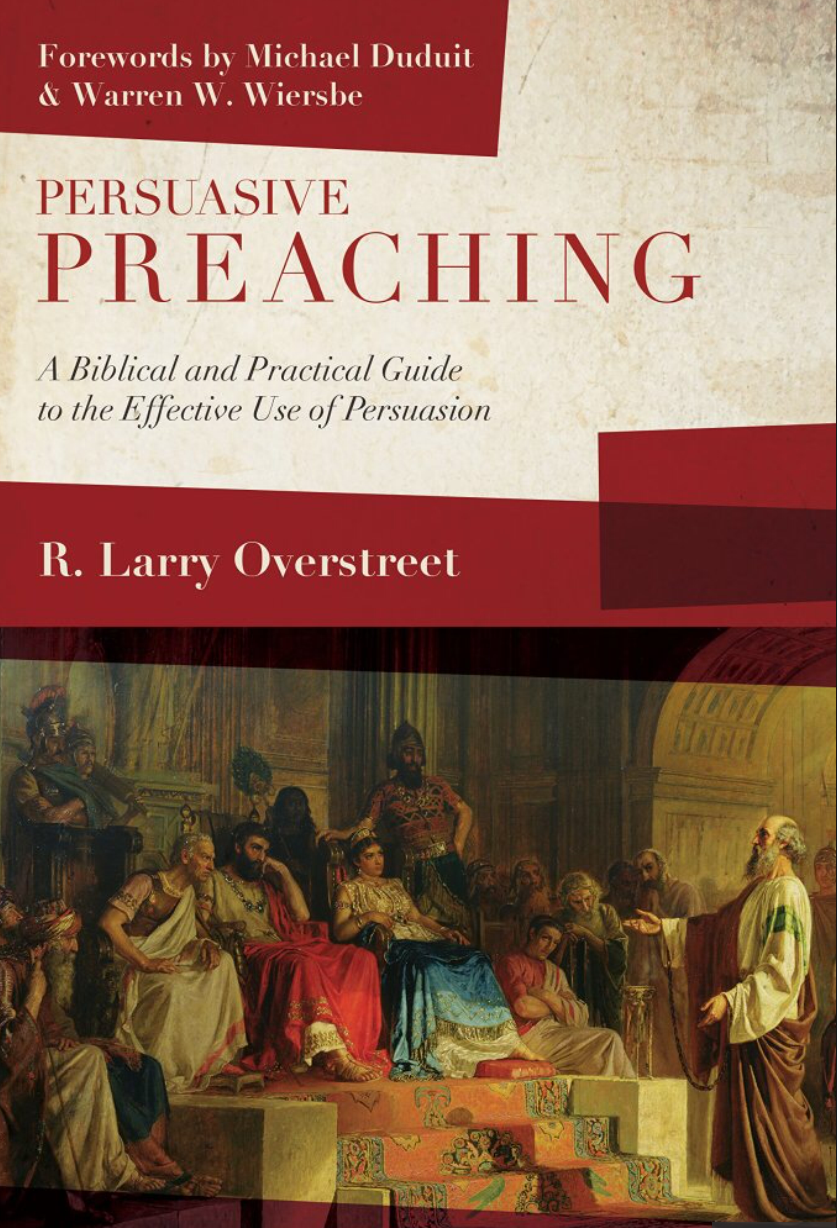
Persuasive Preaching by Overstreet (Books on the Ministry #16)

Have you ever given thought to the role persuasion plays, or should play, in preaching? What are its legitimate roles? You will, then, appreciate this new volume entitled Persuasive Preaching by R. Larry Overstreet and published by Weaver. The subtitle “A Biblical and Practical Guide to the Effective Use of Persuasion” aptly describes the author’s approach.

He feels persuasion is getting a bum rap these days and the quality of preaching suffers accordingly. With a scholar’s touch, he defines persuasion and what it has looked like in preaching in the past. God’s Word, to be sure, calls for a response. He had an excellent discussion on post-modernism and how that has negatively affected preaching. He was spot on.

He gives deep discussion on the Hebrew and Greek associated with preaching as found in Scripture. That may be heavy for some readers, but his point was surely proven–persuasion is part of preaching.

Chapter 6 on ethos with its vivid discussion of important passages was my favorite in the book. It was, can I say, the most persuasive.

Toward the end the book turned more toward how to practically put persuasion in our preaching. Particularly helpful was the the discussion on persuasion versus manipulation. Finally, he points out the necessity of the Holy Spirit in our preaching.

We preachers should wrestle with this subject and this book is likely the best we have on this specific point. I recommend it.

I received this book free from the publisher. I was not required to write a positive review. The opinions I have expressed are my own. I am disclosing this in accordance with the Federal Trade Commission’s 16 CFR, Part 255.

Other books in this series

IMG_2165.PNG