The Making of the New Testament

book making nt

Here’s enlightenment where we really need it. The story of the making of the New Testament all the way through canonization is a weak area for many. Coupled with our insufficiency is how this issue has grown into one that Bible critics have coalesced around. Whether you would agree with every conclusion that Mr. Patzia makes or not, this book richly repays the reader who wrestles with it. I understand that this revised and expanded edition is used by many as a textbook, but I believe it’s needed by pastors and Bible students as well.

Part 1 gives an outstanding background of the literary world of the New Testament. You will gain an overview of the Hebrew Scriptures, the Septuagint, the Old Testament Apocrypha, the Old Testament Pseudepigrapha, the Dead Sea Scrolls, and Greco- Roman literature. These things are rarely presented with any kind of balance in popular articles, so this even has a wonderful apologetic value.

Part 2 describes the making of the Gospels. The first section describes the Gospels going from oral to written status. In mentioning form criticism, he is more than fair in describing its shortcomings. There’s another discussion about why the Gospels were written before he dives into how they were written. I can’t follow all he had to say about the synoptic problem, source, or redaction criticism. More helpful is his explanation of our fourfold gospel collection. He will give us both a positive argument for these four while suggesting why others are spurious. He covers the history of their acceptance as well.

Part 3 takes Paul’s letters on a similar journey to the one he did with the Gospels in the previous section. There are some additional debated points like Paul’s use of a secretary or that some scholars champion pseudonymity. The best part, again, is his taking Paul’s letters through their collection acceptance. Part 4 takes all the other parts of the New Testament through the same process.

Parts 5 and 6 are invaluable. They describe how the canon came together and counteracts the tilted scholarship of folks like Bart Ehrman. Paleography, types of materials used for writing, the forms of books like the roll and the codex, the actual writing of New Testament manuscripts, and the transmitting of them. I found less value in Part 7 on his explanations of textual variants and textual criticism.

This book is a major success. It’s now one of my favorites on the subject of canonization. I give it the highest recommendation!

I received this book free from the publisher. I was not required to write a positive review. The opinions I have expressed are my own. I am disclosing this in accordance with the Federal Trade Commission’s 16 CFR, Part 255.
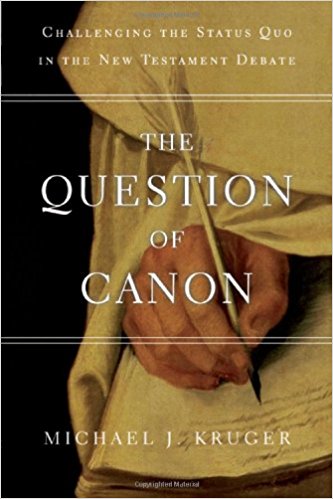
The Question of Canon by Kruger

book canon

This book on the canon of the New Testament comes at a different angle than most I’ve seen. In my view, it’s a breath of fresh air and displays a wonderful viewpoint. He goes beyond the usual question of which book should be included in the canon to the more fundamental one: why is there a canon of the New Testament in the first place? Along the way, he exposes where the scholarly world has gone awry in this discussion. Where I felt that those scholars were predisposed against the Bible, Mr. Kruger was content to look at the Bible, what was logical, and weigh scholarly opinion against it. I may have disagreed with him on a small point or two, but this book was a grand success!

In the introduction, he lists five tenets that are prevalent in a wide array of scholarship. These five assumptions lead to conclusions that put the canon of the New Testament in jeopardy. The five chapters of this book tear these five assumptions to pieces. Since the canon of the New Testament is under relentless attack in our day, it’s great to see how lacking these assumptions are on a variety of levels. Someone should send Bart Ehrman this book for a Christmas present!

Call this book a needed corrective. Call it a helpful apologetic. But most of all, call it a book that you need to read.

I received this book free from the publisher. I was not required to write a positive review. The opinions I have expressed are my own. I am disclosing this in accordance with the Federal Trade Commission’s 16 CFR, Part 255.

In Defense of the Bible–A Great Book!

book def bib

This is a needed book! Its subtitle explains its approach: “a comprehensive apologetic for the authority of Scripture”. Edited by Steven B. Cowan and Terry L. Wilder, this book gathers a fine collection of articles by competent writers. I was especially impressed that though these writers were scholars, they truly succeeded in writing in a way that was accessible to a wide array of readers.

You will find this book to be expertly designed. After a brief introduction, Part One discusses philosophical and methodological challenges in four chapters. That covers things like special revelation, the veracity of the Bible, what higher criticism says and how it’s wrong, as well as our ability to understand the Bible. Part Two explains textual and historical challenges in seven chapters. In this section, you will learn how that neither the Old nor the New Testament are hopelessly corrupted. You will also be made aware of the reliability of each Testament and how to view apparent contradictions in the Bible.

Part Three, which was my favorite, looked at ethical, scientific, and theological challenges in six chapters. It covers subjects that often bewilder Christians when the world attacks. What about the Bible’s apparent condoning of genocide? There’s a profound chapter answering the question–does the Bible condone slavery and sexism? There’s another chapter on the Bible’s conflict with science, and though I did not agree with all of it, it did give some help in understanding the subject. Considering the charges that our Bible is missing several books, the chapter on Canon was especially enlightening. All in all, every chapter was a winner.

My library contains just about every major work on the authority and inspiration of the Bible. I have all the old standbys and love them, but if I had to choose to recommend just one volume to someone wanting to really dig into this subject, I would choose this book. The main reason that it’s so valuable is that it takes a high view of Scripture just as the best books have in the past while focusing on the most turbulent issues that our non-Christian culture hurls at the Bible today. It’s fair to say this book succeeds in both defending the Bible and in offering an apologetic for our day. Every pastor could benefit from this book, but I recommended it to anyone feeling overwhelmed by the criticisms widely broadcast against the Bible in our day. This is an awesome resource!

I received this book free from the publisher. I was not required to write a positive review. The opinions I have expressed are my own. I am disclosing this in accordance with the Federal Trade Commission’s 16 CFR, Part 255.
God’s Mediators (NSBT) by Andrew Malone

book gods mediators.jpg

God’s Mediators: A Biblical Theology of Priesthood by Andrew S. Malone is one of the latest entries in the versatile New Studies in Biblical Theology (NSBT) series by IVP. This series is so multifaceted that you never know what to expect next. Often, you come across a subject that you haven’t studied much before. Such is the case for me in this volume. I had no books in my library from the scholarly world on the concept of priesthood in the Scriptures. Now I have a go-to volume on the subject with this book that probes the subject deeply.

The first chapter is an orientation. The author gives his own background, followed by the academic and pastoral perspectives that are out there. In addition, he seeks to place priesthood within biblical theology.

Chapters 2-5 make up Part One that looks at God’s individual priests. There’s a chapter on the Aaronic priesthood, one on biblical antecedents to that priesthood, and one on Old Testament prospects. Chapter 5 is one of the most interesting in the book as it looks at new-covenant transformations. That entails a careful look at Jesus as priest both in the Gospels (that’s a scholarly debate) and in Hebrews (where it’s obvious to everyone).

Part Two looks at God’s corporate priesthoods in three chapters. I could see the wisdom in breaking down the subject between individual priests and corporate priesthoods. Chapter 6 looks at Israel as a kingdom of priests, which was quite enlightening. Chapter 7 considers the church’s priestly commission in the New Testament. It was also helpful, but I thought he might talk more about the individual priesthood of the believer. Chapter 8 was a nice conclusion. The book ended with a lengthy bibliography.

This title is another good one in this much-appreciated series. My only gripe is that I thought the author retained a wee bit too much scholarly jargon when perhaps a little less would have made the book more accessible to a wider audience. No one, however, could possibly have a gripe with his thorough scholarship.

The book helped crystallize my thinking on a few points, and so it’s much appreciated. I recommend this book!

I received this book free from the publisher. I was not required to write a positive review. The opinions I have expressed are my own. I am disclosing this in accordance with the Federal Trade Commission’s 16 CFR, Part 255.
The Revelation of God by Peter Jensen

book rev god

This book on the revelation of God is part of the Contours of Christian Theology series. Having used and been impressed with some others in this series, I looked forward to checking this one out. As with others in the series, it was a good mixture of going deeply into the subject while being written in an accessible manner. Even the systematic theologies I read do not go into the foundational subject of the revelation of God in their presentation of the doctrine of the Scriptures with near the thoroughness that this volume does. Though I can’t agree with all his conclusions, he gives you much to think about.

The author, Peter Jensen, believes the gospel is central to the idea of revelation from God. His first chapter makes a beautiful case for that fact. In chapter 2 he clarifies the nature of the gospel. In chapter 3 he explains the role the gospel plays in our grasping the knowledge of God. In the next chapter, where he explains the gospel as a pattern of revelation, he concludes that the gospel is the measure of all revelation. He makes a great case for his premise.

In chapters 5 and 6, he transitions to revelation and experience. In other words, he defines the essential revelation that we must grasp in the gospel. In chapter 7, he finally reaches the subject you would expect when analyzing this doctrine: the authority of Scripture. It is in this chapter that he explains the concept of inspiration. He takes a strong, conservative position and shares much great food for thought. The final chapters address our reading Scripture, the role of the Holy Spirit, and contemporary revelation.

This book taught me. It expanded my horizons and I was blessed by what I learned. I warmly recommend this book!

I received this book free from the publisher. I was not required to write a positive review. The opinions I have expressed are my own. I am disclosing this in accordance with the Federal Trade Commission’s 16 CFR, Part 255.

The Message of the Word of God by Tim Meadowcroft

book bst word.jpg

The Message of the Word of God by Tim Meadowcroft in the prolific Bible Speaks Today (BST) series tackles the doctrine of the Bible. My interaction with this series has led me to believe that the editors give each author wide latitude in how they approach their subject, particularly in these ones about doctrinal subjects. The author here takes the unique approach of exegeting 20 key scriptures on the subject. At first, I thought that an odd approach, but after reflecting on it I realize that that’s probably how many pastors would teach it over the years. For that reason, then, this volume stands out among the plethora of books on the subject.

His choice of texts was ideal including both the usual suspects and a few you might not have thought of. He divides them up into four parts: God speaks, God speaks in the written word, God speaks in Christ, and God speaks today. In my judgment, a few that particularly stood out were Proverbs 30, 2 Peter 1, Hebrews 1, Revelation 5, and Nehemiah 8. In addition, his short chapter on the key 2 Timothy 3: 10-17 passage was insightful.

Only in a few cases did he seem to bog down into some scholarly observations like you might find in a detailed exegetical commentary. They seemed out of place in this volume, but maybe they only seemed worse to me when I didn’t agree with them!

Pastors and Bible students will be blessed by this book. As said before, it will be unlike most others on your shelves on the subject. That unique approach allows it to make a distinct contribution. Worth adding to your library.

I received this book free from the publisher. I was not required to write a positive review. The opinions I have expressed are my own. I am disclosing this in accordance with the Federal Trade Commission’s 16 CFR, Part 255.
Bible Matters by Tim Chester

book bible matters

Tim Chester has written the perfect book to help people approach the Bible. Though it would help Christians at any point in their journey, it’s especially instructive to those who are new at wrestling with the Bible. Along the way, Mr. Chester will both enlighten the reader on the doctrine of the Bible and give some guidance on how to properly study the Bible. Through quality writing and timely illustrations, he helps you see that the Bible is no mere book, but a word from God to us.

Though he covers a lot of ground that you also find in other books about the Bible, he certainly traces out his own path. Still, he begins by explaining that the Bible is from a God who speaks. Next, he gives us a particularly helpful chapter on how God spoke in the Bible. This chapter will answer a lot of questions. In the third chapter on God speaking in the Bible, he explains the Holy Spirit’s role. In chapter 4, he sees Jesus as a key theme of Scripture.

Though it is often overlooked by other writers, Mr. Chester explains how the Bible is relational. This chapter really helps you to get your head on straight about the Bible. Likewise, the chapter on the Bible being intentional proves what many critics deny. I enjoyed the chapter explaining that the Bible is enough too. You wouldn’t think that would have to be explained, but many Christians need to hear that message.

In chapter 8, he finally gets to the chapter that’s going to be in any book on the Bible – one discussing its reliability. He does a fine job with that subject, but appropriately uses Spurgeon’s analogy that a lion doesn’t need defending! The chapter on the Bible being accessible will help those who are always looking for some message in code. Hint: it’s not there. He rounds out the book with a chapter about reading the Bible, and a short conclusion on why he loves it.

There’s a substantial study guide at the end of the book. With that resource, every chapter could be turned into a study group discussion.

This book is profitable and is worthy of a wide audience. I highly recommend it.

I received this book free from the publisher. I was not required to write a positive review. The opinions I have expressed are my own. I am disclosing this in accordance with the Federal Trade Commission’s 16 CFR, Part 255.
Preaching in the New Testament (NSBT) by Jonathan Griffiths

book preaching NSBT

This recent release in the New Studies in Biblical Theology (NSBT) series, written by Jonathan I. Griffiths and edited by D. A. Carson, is a winner! It matches the depth of the series that is respected all around while having something to say about preaching that will be meaningful to every preacher. While I have read and enjoyed many volumes on the subject of preaching in the New Testament, this one is different and lives up to its subtitle in that it goes hard after being an exegetical and biblical-theological study. In other words, it’s less a motivational approach and more of a declaration of what the New Testament specifically says about preaching. By the end of the volume, you will have no doubt that the task of the preacher, or “authoritative public proclamation”, is the design of the Lord revealed in the New Testament.

After a brief Introduction explaining the purpose of this book, the author tackles in Part 1 what he calls foundational matters. He will explain in three chapters the basis of the Word of God in biblical theology as well as the key Greek words for “preaching” in the New Testament. That chapter on those keywords is fascinating (don’t miss the fine charts) and really proves the authors premise by its end. This section is followed by an excursus on who the preachers are in Philippians chapter 1.

Part 2 covering chapters 4 through 9 exegetes six key passages where preaching is discussed in the New Testament. 2 Timothy 3-4, Romans 10, 1 Corinthians, 2 Corinthians 2-6, 1 Thessalonians 1-2, and Hebrews are all superbly covered. In some cases, the focus is on a few chapters while others trace words for “preaching” throughout an entire New Testament book. The author succeeds in both of these approaches, and again, in my opinion, proves the place of preaching in the New Testament beyond doubt.

Chapter 10 shares a summary and conclusions. He gives a summary of exegetical findings, followed by his biblical–theological conclusions. I found it easy to agree with every one of his conclusions made here after reading this book. In a day when preaching is held in less repute than former days, this book is just what we need. I’m glad it’s been written and glad to recommend it.

I received this book free from the publisher. I was not required to write a positive review. The opinions I have expressed are my own. I am disclosing this in accordance with the Federal Trade Commission’s 16 CFR, Part 255.
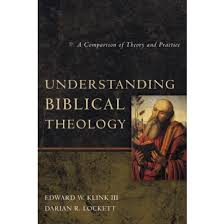
Understanding Biblical Theology by Klink and Lockett

book und B theo

Edward Klink and Darian Lockett join forces to guide us in defining the term “biblical theology”. In doing so, they will divide the scholarly world into five major schools of thought on the subject. In addition, they will compare theory and practice as well as the origin of it being the church or the academy. Both authors have already published major works. In particular, I greatly admire Klink’s recent commentary on the Gospel of John in ZECNT. I see him as a theological and scholarly writer to keep an eye on in the future.

The introductory chapter surveys what the authors call the spectrum of biblical theology. Though I read widely, I was a little surprised to see what I thought was a commonly accepted term so exactly defined and widely debated. Along the way, they will further try to separate the concept of biblical theology from systematic theology. As will become important as you read the rest of the text, in this introductory chapter they define the issues involved that divide scholars. How the Old Testament connects to the New Testament, whether we should look for historical diversity or theological unity, the impact of the scope and sources of biblical theology, what the actual subject matter of biblical theology is, and finally, whether biblical theology should be defined by the church or the academy. Make sure you linger over the small chart on page 22 that shows a logical way to view the five schools of thought. Spoiler alert: there’s an outstanding summary chart at the end of the book that will make it possible for you to review and make sure you followed the line of thought given in this book.

The design of the book is simple. There’s a chapter of defining the particular school of thought followed by a chapter that fully examines one of its major proponents. In a nutshell, you have biblical theology as historical description with James Barr, as history of redemption with D. A. Carson, as worldview-story with N. T. Wright, as canonical approach with Brevard Childs, and as theological construction with Francis Watson. Please don’t ask me where I land even after reading this book, though I find myself vacillating between the first two schools of thought. Strangely, each point of view had some aspects worth considering, even if some of them had more serious drawbacks.

Some might find this subject a hair too finally split, but I can’t imagine a resource that could more capably define the parameters of this subject. Believe it or not, the authors were so faithful to their task of explaining why this issue is hard and how it’s been viewed that they never championed one viewpoint over the others. This is THE book on the subject.

I received this book free from the publisher. I was not required to write a positive review. The opinions I have expressed are my own. I am disclosing this in accordance with the Federal Trade Commission’s 16 CFR, Part 255.

2 Great Books on the Doctrine of Christ

book mess christ

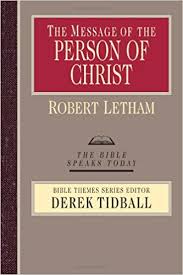
The Message of the Person of Christ by Robert Letham

This book by Robert Letham on the message and Person of Christ is in the well -received Bible Speaks Today (BST) series edited by Derek Tidball. I found the book to be pitched at just the right level for the aims of this series and helpful for Christians new and old. It was thoroughly accessible and even included a nice study guide at the end.

There’s 24 chapters in five sections entitled Christ promised, Christ incarnate, Christ crucified, Christ risen, and Christ ascended. The book begins with a quite lengthy bibliography followed by a short introduction of what the author hopes to accomplish in this book. There’s also a prologue explaining man as being in the image of God.

The section on “Christ promised” explains Christ as the offspring of the woman, and then tackles the important subjects of Jesus being of the seed of Abraham and the son of David. Further, he sees Jesus as King as related to us in the Old Testament, followed by two chapters that cover the Servant of the Lord passages in the Book of Isaiah that are about Jesus Christ.

In the next section, the author begins by describing the birth of Christ. I would have expected a lengthier section on the Virgin Birth of Christ, but what we have is very good here. Jesus is followed through His ministry and His humanity before we finally come to the deity of Christ in chapters 11 through 14. There’s much to learn here.

The balance of the book from various angles covers the death, burial, resurrection, and ascension of Christ. The author relates many wonderful thoughts here. In fact, I’d call this a great overview. There is an appendix studying church history on this important doctrine.

This book is the perfect first in-depth book to study on the doctrine of Christ for any Christian. I warmly recommend it.

I received this book free from the publisher. I was not required to write a positive review. The opinions I have expressed are my own. I am disclosing this in accordance with the Federal Trade Commission’s 16 CFR, Part 255.


book person christ

The Person of Christ by Donald MacLeod

Here’s the book on the doctrine of Christ you need if you really want to dig deep, both about the doctrine itself and its historical development. Frankly, it taught me so much. It’s part of the respected Contours of Christian Theology series edited by Gerald Bray and published by IVP.

I thought the author’s approach was unique and ideal. He took most of the main concepts of the doctrine and traced the debate that formalized them in church history. In fact, he took these concepts in the order that they were debated. Along the way, he fully explained each doctrine, the viewpoints that fall short of an accurate Christology, and a wonderful definition of some of the more obscure theological terms. Though he covered concepts that are barely mentioned in many theological works, I found him easy-to-read and follow. In short, I loved this book.

He divides the book into two sections. Part one goes from the Gospels to Nicea, which he calls “very God of very God” and traces out the deity of Christ. In this section, he will cover the virgin birth, the preexistence of Christ, Christ as the Son of God, and the Jesus of history and the faith.  Those last two chapters of that section I found to be profound and so helpful to me.

Part two goes from Chalcedon on through most major theological questions on the doctrine of Christ, which he calls “very God, very man”. In this section, he discussed the Incarnation, the fact of Jesus being perfect both as God and man. He beautifully explained the Kenosis of Christ, as well as the sinlessness of Christ. I have several pages with a multitude of underlined sentences that were greatly illuminating for me.

I wouldn’t necessarily call this the first book to pick up if you were studying the doctrine of Christ, especially if it was your first time to do so; but if you really want to dig out this doctrine, you cannot pass by this great book. I’ll put it in the must-by category for sure!

I received this book free from the publisher. I was not required to write a positive review. The opinions I have expressed are my own. I am disclosing this in accordance with the Federal Trade Commission’s 16 CFR, Part 255.