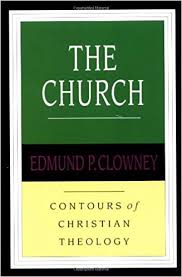
The Church (Contours of Christian Theology) by Edmund Clowney

book the church

By this point, I have used almost every volume in the Contours of Christian Theology series. All these volumes have run between good and great. They all are books to ponder after you’ve already consulted your systematic theologies. None of them are for shallow readers but are for those who are interested in really digging in the theology. This volume on the church by Edmund P. Clowney is one of those that fall on the “great” end of the scale. He has such probing, interesting things to say about the church and handles beautifully where ecclesiology touches on any of the other main doctrines.

There are 18 chapters that cover the church from every conceivable angle and address every theological issue I can imagine on ecclesiology. While I might not agree with a few statements here and there, this volume definitely leans to the conservative point of view. Just check his references and endnotes and see who he quotes. That will make it clear where his perspective comes from.

The beauty of the book was how he took very familiar concepts, exactly those concepts you would imagine you’d find in a book about the church, and said them in new ways that stretched your thinking. He wrote a book of scholarly depth and theological precision without sacrificing clear, persuasive writing. Concepts within ecclesiology are highly debated and rigidly held so there’s little hope that he will fall exactly where every reader does but don’t let that keep you at bay. You will work through all these issues in a much more thorough fashion with far more satisfying results if this book is one you carefully use. A well-done volume!

I received this book free from the publisher. I was not required to write a positive review. The opinions I have expressed are my own. I am disclosing this in accordance with the Federal Trade Commission’s 16 CFR, Part 255.
Check Out The New “Best of Christianity Today” Series!

book CT

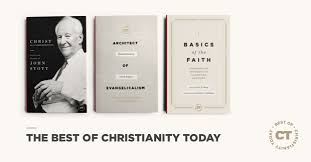
Two out of the three new releases in the Best of Christianity Today (CT) series published by Lexham Press have come across my desk:

Christ the Cornerstone: Collected Essays of John Stott

John Stott is a writer who always says something I find worth listening to. It doesn’t matter if I even agree with him on the point in question or not, as he speaks to me deeply with any words he has ever penned. To be honest, I wasn’t even aware that he had written a series of penetrating articles for Christianity Today between 1977 and 1981. This lovely hardback volume with its attractive dust jacket includes a short introduction that explains these essays and the type of writing Stott does in them. Though he wrote the articles randomly to speak to readers then, this volume collects them in six categories: Scripture and theology, the Christian disciple, the mission of the church, the church around the world, church challenges, and social concerns.

While some of these articles are more theologically probing than others, they teach us many things. Some of the articles are specific to a specific condition of those years that might not be exactly the same in our day but the value of the essays is in how to biblically think about the world and what’s going on. To be sure, there may be places where you might completely disagree with some political observation he makes. Ignore that as you read because the real issue is what spiritual concerns are involved. One of the reasons Stott is so helpful is that he makes you a better thinker. He never seems in-your-face but rather a gentle, kind man with a keen mind who would love to talk to you about issues with the Bible open. He strikes me as the man who would have no problem with you disagreeing with him on some issue as long as spiritual concerns were kept front and center.

This book is a gem!

I received this book free from the publisher. I was not required to write a positive review. The opinions I have expressed are my own. I am disclosing this in accordance with the Federal Trade Commission’s 16 CFR, Part 255.
Architect of Evangelicalism: Essential Essays of Carl F. H. Henry

To go along with the new volume of John Stott’s essays is this equally attractive collection of Christianity Today articles by Carl F. H. Henry. Henry writes with a stronger tone than Stott and his articles cover a larger swath of years, but he also had something powerful to say to readers in those days that can be gleaned by us today. In some ways, issues only present themselves again in different garb but they are the same issues. Maybe Stott could write a little better to the common person, but Henry knew how to get his point across as well.

This volume also contains a little introduction to explain how the articles came about and the type of writing that Henry does. Once again, the essays are categorized for us this time as: defining evangelicalism, evangelicals and modern theology, evangelicals and education, and evangelicals and society. The words that come to mind when I see his essays are fearless and theological. Again, you will like some of these articles better than others, but you will find them all together making a captivating collection.

We need some of the things said in this volume trumpeted throughout the land again!

I received this book free from the publisher. I was not required to write a positive review. The opinions I have expressed are my own. I am disclosing this in accordance with the Federal Trade Commission’s 16 CFR, Part 255.


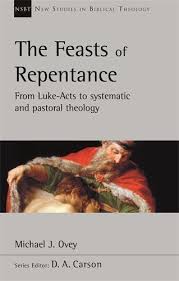
The Feasts of Repentance (NSBT) by Michael Ovey

book feasts nsbt

This latest release in the New Studies in Biblical Theology (NSBT) series, edited by D. A. Carson, is an interesting read. Sometimes trying to tackle all that the author, Michael J. Ovey, did in this volume can be a disaster. He’s ultimately trying to talk about the doctrine of repentance, he’s wanting to limit his evidence to Luke-Acts, focus on the feasts found in those two books, and tie the whole thing to systematic and pastoral theology. Though I don’t imagine that many writers would formulate that design, he did seem to pull it off.

In case you’re wondering, of all those things he wove together, repentance was his main subject. There’s another volume on repentance in this series, but they truly do not cover the same ground. His first chapter digs into what I find to be the most common question about repentance: is it necessary to salvation? He makes a good case for it being present in all actual conversions, and he is pretty good at marshaling Scriptures to prove his point. The second chapter got more into the Luke-Acts specialty as he looked at the feasts in these books and how repentance was handled in them. There was some interesting information there that I could say frankly that I’d never thought of. In later chapters, he looks at repentance in terms of Jews and Gentiles, how identity and idolatry are key to understanding repentance (one of the better chapters), and entering repentance into the discussion of faith and salvation. For the record, he does hold to a reformed view in this chapter. His final chapter looked at repentance in terms of forgiveness and the church. Along the way, there were some telling comments about our day.

Unfortunately, Mr. Ovey passed away before this book was released. It’s clear he had put a lot of work into it. By this point, you should probably have a great idea of how a NSBT volume works. This is another good representation of the unique contribution this special series makes.

I received this book free from the publisher. I was not required to write a positive review. The opinions I have expressed are my own. I am disclosing this in accordance with the Federal Trade Commission’s 16 CFR, Part 255.


Introducing Cultural Anthropology (Second Edition) by Howell and Paris

book into cul antro

Brian M. Howell and Janell Paris joined forces to produce this second edition that looks at cultural anthropology from a Christian perspective. This textbook is of manageable length and is up-to-date on the issues that are considered by many to be in flux in our turbulent days. Though it is in a textbook format, it is quite easy to read no matter your reason for approaching the subject of anthropology. More than many textbooks I’ve seen, the authors share personal asides when appropriate, so it doesn’t come across as some dry textbook-by-committee approach.

The first chapter on the discipline of anthropology serves as an overall introduction to the subject. The next chapter tackles culture and a variety of issues that fall under that umbrella. The next several chapters explore main influencing subjects like language, social structure, gender, economics, authority, marriage, religion, and medical anthropology. As you can guess, chapters 4 and 5 enter the realm of the most hot-button issues of our day. I personally felt they did a better job looking at social structure and inequality in race, ethnicity, and class than they did surveying gender and sexuality. To be fair, they were only defining terms as they are now used though they made more allowances than I could. The last two chapters serve as a conclusion and even went as far as looking at anthropology in ministry.

The textbook is attractive though I would’ve probably preferred a hardback for this type of book. The chapters are laid out nicely. There’s a list of things you need to be able to do after you finish a chapter, clear introductions and explanation of key concepts with occasional graphs and insets that are enlightening. Each chapter nicely ends with a list of key terms, discussion questions, and what might be used as an assignment looking at real-life situations in a section entitled “Anthropology and Scripture”. All in all, this is a well put together textbook.

I received this book free from the publisher. I was not required to write a positive review. The opinions I have expressed are my own. I am disclosing this in accordance with the Federal Trade Commission’s 16 CFR, Part 255.
Original Sin (NSBT) by Henri Blocher

book orig sin

The New Studies in Biblical Theology (NSBT) series covers such a wide array of fascinating theological subjects. Of those I’ve read so far, I would see them as indispensable on the theological subject they address. This volume considering Original Sin by Henry Blocher is no exception. Blocher has turned out several penetrating works by this point and always strikes me as an original thinker. I don’t always agree with his ideas about Creation, but he really knows how to jazz up your thinking and make you see other sides of issues. While I wouldn’t call this title exhaustive in its coverage, what it does address is as insightful as any I’ve read recently while doing an extended study of the doctrine of sin.

Chapter 1 lays out the parameters of the extent of Original Sin. Chapter 2 steps back to the place of the arrival of sin in Adam’s day. You will not have to agree with his take on Creation to find this information intriguing. Chapter 3 tackles the most prominent New Testament passage on the subject in Romans 5. There is fine exegesis here, outstanding representation of varying viewpoints, all followed by his own suggestion. Once again, you will not have to agree with his final conclusion to be greatly enriched by this chapter. The last two chapters look more broadly at the relation of Original Sin to human experience and evil and pain in our world. As for a recommendation, since I have been deeply in the study of sin recently, I’m sure glad I found this little jewel. What better recommendation could I give it?

I received this book free from the publisher. I was not required to write a positive review. The opinions I have expressed are my own. I am disclosing this in accordance with the Federal Trade Commission’s 16 CFR, Part 255.
Fearfully and Wonderfully Made: The Marvel of Bearing God’s Image (Updated Edition) by Brand and Yancy

book fearf wond

This book is special. It could only have been written by a man deeply in love with Jesus and with medicine. If you read the preface you will discover how Philip Yancey met Dr. Paul Brand and how they came to be co-authors. It appears to me that the joint production worked this way: Dr. Brand provided the substance of medicine and spiritual insight while Mr. Yancey with his journalistic background cast it in beautiful words. Mr. Yancey seems in awe of Dr. Brand and I can see why. Don’t misunderstand me. This book doesn’t elevate any person other than the Lord. Besides your own personal edification, this book will also supply you with a host of exquisite illustrations for teaching and preaching.

Dr. Brand is one of those doctors that you would dream of having. A doctor who sees the big picture of so many things and yet can perform tasks that in our day are usually only done by specialists. That he has spent much of his career in dispensing his considerable talents to those afflicted with leprosy tells you so much about the person he is. He proves to be a reflective Christian as well and his first two chapters on being image-bearers are nothing to sneeze at. In part two, he does a commendable job in four chapters of highlighting diversity and unity. Part three brings out many observations of the spiritual nature from his areas of specialty including the skin and bones and other such things. The fourth part that he calls proof of life looks at blood and breath. His section on pain, and his work among the suffering helps you realize that we are listening to an expert, is spiritually rich. The final section on the brain is profound as well.

I don’t want to steal his thunder in this review because you will want to discover these things as you read it yourself, but there is not one chapter where he didn’t take something I didn’t know medically and illustrate a spiritual truth that I was aware of but could now see better. I never felt he stretched anything in making his spiritual points. In fact, in every chapter, I was more amazed by my God.

This new edition that is described as “updated and combined” is an attractive hardback with a beautiful dust cover. You will want this one!

I received this book free from the publisher. I was not required to write a positive review. The opinions I have expressed are my own. I am disclosing this in accordance with the Federal Trade Commission’s 16 CFR, Part 255.
The Doctrine of Humanity by Charles Sherlock

book doct humaity

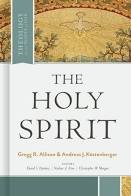
At this point, I’ve been blessed to use several volumes in this too-little-known Contours of Christian Theology series. This one on the doctrine of humanity by Charles Sherlock compares to the best volumes in the series. It dives into the doctrine yet not in such an esoteric way that you are left with little contribution to your thinking. Mr. Sherlock hits on most of the main components in the study of Christian anthropology. He even relates beautifully to the corresponding doctrine of sin in helpful ways. He occasionally relates a viewpoint that you might find subversive (he is not in my opinion as conservative, for example, as Sinclair Ferguson on the Holy Spirit in this series), but his contribution to the big picture of understanding this doctrine is greatly enriched by the arguments and detail he brings to bear.

His first focus, as he calls the divisions of the book, is our being made in the image of God. He looks at that in terms of ancient Israel, our being renewed in Christ, and in a variety of contexts in Christian thought. This section is truly foundational and well done. The next focuses on the human race. He takes a broad view, he reveals his political stance along the way, yet he still offers wonderful food for thought. The final section is on the human person. There’s a chapter on the unique person that covers things like human dignity, freedom, indignity, rights and the sanctity of life and an introduction to thinking about gender roles. He had a chapter each for being a woman and being a man that ran back and forth between fascinating and making you raise an eyebrow. His chapter on the whole person where he got into the body, soul, spirit, and heart was the best in the whole book. After the conclusion, he has two appendices that relate the doctrine of sin to humanity as well as some additional material on gender roles and issues.

Though you may have picked up on my few caveats, the book is still totally engrossing on many levels. Again, it’s one of my favorites in the series and is a must-have in your doctrine of humanity section.

I received this book free from the publisher. I was not required to write a positive review. The opinions I have expressed are my own. I am disclosing this in accordance with the Federal Trade Commission’s 16 CFR, Part 255.
Now My Eyes Have Seen You (NSBT) by Robert Fyall

book now eyes.jpg

The wide-ranging, impressive New Studies in Biblical Theology (NSBT) series here jumps into the Book of Job. Perhaps the editorship of D. A. Carson keeps this series running at a high pace, but in any event, I’ve seen this book by Robert S. Fyall often favorably mentioned. The author understands that Job has been subjected to widely differing interpretations. Fyall sees creation and evil as the key to understanding Job.

You may not agree with his total outlook, but the book’s value stands out most of all in its ability to highlight the masterful Hebrew poetry involved while also doing detailed exegesis on several passages that bring to light the key thinking behind the book of Job. What he has to say about the Behemoth and Leviathan was certainly new territory for me. I couldn’t agree with all his conclusions, but they are worth wrestling with. Make sure you take in his concluding chapter on “the vision glorious” as he ties together much of the detail he collects throughout the book.

There’s not a dud in this series and this book has caught the eye of all who write on Job. You had better check it out!

I received this book free from the publisher. I was not required to write a positive review. The opinions I have expressed are my own. I am disclosing this in accordance with the Federal Trade Commission’s 16 CFR, Part 255.
The Last Things (Contours of Christian Theology) by David Hohne

book last things.png

I have no idea why the Contours of Christian Theology series published by IVP flies so far under the radar. Each time I begin to study one of the main areas of systematic theology I always look up the book on it in this series. I’m thrilled that this volume on the Last Things by David Hohne completes the series. It’s clear that the editors have given the authors wide latitude as some of them delved deep in one specific area on that doctrine while others take a broader viewpoint. While I’ve gotten the most out of those that tried to materially illustrate some key overlooked parts of a doctrine, they all are of value. This latest release is of that last type. In fact, it takes the broadest view of any in the series that I have seen.

I have read a blurb that says this volume “offers a Trinitarian theological description of eschatology that is at once systematic, generated from the theological interpretation of Scripture, and sensitive to essential elements for Christian practice”. I must confess that sometimes this volume takes such a broad view in systematic theology that I forget we’re on the subject of eschatology. While the book says many brilliant things, I’m not sure I experienced marked growth in my eschatological understanding. Maybe this book would have served better as a way to view systematic theology at large rather than to say here’s how to think about eschatology. I don’t want to downgrade the book as perhaps the failure was on my end.

To be sure, this book is never sloppy, careless, or trite. The author has thought deeply and makes comments to you likely will not have thought before. He does well explaining the “now-but-not-yet” viewpoint that keeps the Bible in apparent tension. Perhaps you will be as shocked as I am that the Lord’s Prayer is the skeleton that this work hangs upon.

At the end of the day, I’m sure some will love this book more than others while all will acknowledge its scholarship. Without a doubt, everyone who does serious study on systematic theology should have every volume in the Contours of Christian Theology series.

I received this book free from the publisher. I was not required to write a positive review. The opinions I have expressed are my own. I am disclosing this in accordance with the Federal Trade Commission’s 16 CFR, Part 255.

Into His Presence: A Theology of Intimacy With God by Tim Anderson

book into pres

I’ve thought for some time that I needed some help on the theology of intimacy with God that was more depth and less fluff. There are so many who claim to be the golden ticket that it is refreshing to find someone who would prefer to dig out what the Scriptures truly say. When you think about it, there are not that many books that help us at this more theological level. There’s probably an experiential book on intimacy with God released every month but that usually doesn’t translate into us knowing anything more about it. Tim Anderson has clearly felt the same way and has made a grand attempt to step into the void. I’m not sure that this book fully settles the question, but it’s the best one I’ve gotten so far to get the discussion started.

Don’t skip his introduction as he makes it about what he’s trying to accomplish and the wide array of thinking that has to be sifted through to make sense of the subject of intimacy with God. The first half of the book comprising four chapters most scratched my itch. His defining intimacy with God forces us to think concretely about all the nebulous thoughts swirling around. Chapter 2 addresses the subject regarding philosophy and theology with some of that theology being the most helpful to me. Chapter 3 on linking the Fall of Man with intimacy with God was one of the best in the book and did clear up some real questions for me. The chapter on God as our Father tied in some important information as well and made sense of the role of fathers in our lives that is often written about today.

The chapter on interpreting biblical images of marriage and Christ perhaps got a little off track and in some cases, I felt split the hair too finely. Some of the pages on hermeneutics and how to interpret the Song of Solomon might have been better in another book too. There were additional chapters that addressed intimacy with the Holy Spirit and how suffering might be involved. A final chapter on songs of intimacy did not materially add to my understanding because I did not know every song discussed. I can see how that would have been a helpful exercise in his class, but I thought it was, perhaps, less effective in the book. Though he was cautious not to go the How-To route, a real theological discussion for how to apply the more pertinent things his book told us might have been in order.

Though I still say we need more, this book is an outstanding start. I appreciate what was shared here and the work that went into it. It’s nice to know that he read so across the spectrum to make sure he got a thorough idea of what’s believed in Christianity. It added something nice to when he discussed the theological directives of Scripture itself. I’ve scribbled several helpful notes from this fine book. Now I just need to figure out myself how to put it all in practice.

I received this book free from the publisher. I was not required to write a positive review. The opinions I have expressed are my own. I am disclosing this in accordance with the Federal Trade Commission’s 16 CFR, Part 255.