Transforming Grace by Jerry Bridges

book grace

Jerry Bridges has a way of writing that requires you to deeply search your heart. While this volume might not be as famous as a few others he has written, it’s still a bestseller with good reason. He strives to make sure we don’t miss the amazing in grace. I preferred reading it one chapter at a time and then dwelling on what he had to say.

His first chapter on the performance treadmill pulls you in. So much of Christianity has degenerated to this unscriptural performance Christianity. He reminds us that we are so bankrupt, so spiritually bankrupt, that no amount of performance could ever get us anywhere anyway. He explains how we are legalistic by nature and how that warps our thinking. He also begins a discussion of what grace is that carries into the next chapter. There he explains who needs it. If you don’t already know, he makes it clear that you and I do. Chapter 3 discusses how amazing Grace is and chapter 4 uses a well-known parable of Jesus that Mr. Bridges entitles “the generous landowner” to further illustrate grace. That discussion continues in chapter 5 when he asked the question: does God have a right? He explains that we can never obligate God. This was one of my favorite chapters in the book.

Chapter 6 explains how we are compelled by love, not a list of “oughts”. Chapter 7 well explains how the proof of love is obeying Christ’s commandments. Chapter 8 is where Mr. Bridges connects one of the subjects he is most famous for writing on, holiness, with grace. Note the chart on page 121 too. Chapter 9 explains what true freedom is and that it springs from grace. Chapter 10 beautifully describes the sufficiency of grace while chapter 11 proceeds to remind us of the humility we should take on that subject.

Chapter 12 turns even more practical as he describes how to appropriate God’s grace. In that chapter, he describes how we must “die” to produce fruit. There’s more discussion of submitting to God in humility as well. He concludes with a chapter on the garments of grace.

There’s a nice, lengthy discussion guide added to this edition. You will want to check it out.

Reading this book just helped me decide that I need to read everything that Jerry Bridges has written. These newest editions are rather attractive, quality paperback volumes. I began this book wondering if he was even going to go too far, but he beautifully described grace and guided us between legalism and licentiousness. I don’t see how a Christian couldn’t be helped by reading this wonderful book. In fact, we would all be better off if we did.

I received this book free from the publisher. I was not required to write a positive review. The opinions I have expressed are my own. I am disclosing this in accordance with the Federal Trade Commission’s 16 CFR, Part 255.
The Expositor’s Bible Commentary (Rev. Ed.)-Volume 7: Jeremiah-Ezekiel

book ebc 7

Volume 7 of the Expositor’s Bible Commentary (EBC), Revised Edition, covers from Jeremiah through Ezekiel, and is another successful updating in the beloved series. This volume contains two brand-new authors with new works and one revision by an author from the original series. It uses the helpful format found in the other volumes of the series.

The Book of Jeremiah is tackled by Michael Brown, replacing the respected Charles Feinberg. He begins the Introduction by describing the world of Jeremiah’s day. Next, he describes the uniqueness of the book of Jeremiah, both in its length and in its contrast between despair and hope. He describes how he comments on the final, canonical form rather than drowning in the nebulous world of sources. After that, he discusses date and authorship, stylistic differences, and his own opinions about editorial activity and sources. I found that to be of little value. When he gets back to historical background he is much more effective. The discussion of background is followed by one of literary style where he discusses issues of structure. He ends with a section on texts and versions, followed by a bibliography and outline. The commentary itself follows the normal style of overview, translation, commentary, and notes. He gives solid exegetical help with commentary of sufficient length for the aims of this series.

Lamentations is done by Paul Farris, Jr., replacing H. L. Ellison. I’ve seen some good press on this commentary, and it appears to be well earned. He begins the Outline discussing title, authorship, date, and historical setting. From there he gets into literary setting where he describes the alphabetic acrostic poetry, the voice, the dirge meter, and city laments in the Ancient Near East. After a brief section on liturgy, he has one on theology. Even including the bibliography and outline this is rather brief. The commentary itself follows the same style mentioned above, but is very detailed and helpful.

The work on Ezekiel has been updated by Ralph Alexander. The Introduction has not been majorly updated, but has a much better appearance. It still covers background, unity and authorship, date, place of origin and destination, occasion and purpose, literary form and structure, and theological values. Some reviewers downgrade Mr. Alexander’s commentary merely because he has a pre-millennial viewpoint. Don’t listen to them. This is a commentary of value.

This is another fine volume that bolsters the status of the EBC, revised edition, and I recommend it.

I received this book free from the publisher. I was not required to write a positive review. The opinions I have expressed are my own. I am disclosing this in accordance with the Federal Trade Commission’s 16 CFR, Part 255.

Guns, Mass Killings, and an Article that Makes Sense of It


We live on the superficial edges of the debate about what conclusions we should draw for the increasingly common disasters like occurred in Las Vegas. Within  hours of the heartbreaking tragedy the discussion turned to guns. First, may God help the grieving people of that evil act!

Some of us have wondered about inconsistencies that have made their way around the web. Were there more shooters? Is information being held back? My conclusion? Who knows. I’ve heard good arguments both ways. My gut is that some things still don’t exactly add up, but I suspect we’ll never really know. I’m not in a place to get answers, and neither are any who read this. 

I’ve been thinking about this whole gun debate ( I’m for honoring the Second Ammendment, but only own old guns handed down to me–I could shoot an intruder, but couldn’t wage a small war). I am a student of history and know that all the atrocious dictatorships, especially of the Twentieth Century, took the guns away before they brutalized and slaughtered millions. I also know that a gun law could never stop someone who already intends to commit a more heinous crime. If I intended to break the law and mass kill people, would a gun law give me even a momentary pause?

On the other hand, I realize that when something terrible, and even senseless, happens, our first reaction is to do something. Unfortunately, human nature is more satisfied in doing something quickly that doing something helpful. Let’s all take a breath and remember there’s no easy answer or quick solution. Even worse, I assure you our problems are much too deep for the superficial, self-sustaining politicians of our day. 

I also know the citizens of our country are going to dismiss with a roll of their eyes my first solution: we need a major turning to God. We need Jesus Christ. Forgive my pessimism, but I suspect things will have to get worse–much worse–before it’s even considered. 

In the meanwhile, there’s some societal trends worth noting. I came across an article that’s so good I wish I had written it. It’s by a master of political writing, Peggy Noonan. I share it below. Don’t haggle over ever sentence, but interact with what she says. I hear truth in her words.

The article 
God bless!

Evangelical Theology by Michael Bird

book bird theo

Michael Bird has found a niche in the world of systematic theologies. His title explains where he’s coming from. He is striving to provide a “genuinely evangelical theology textbook”. While he doesn’t trace out every side path as some of the larger systematic theologies do, he still makes a grand presentation of what the Bible teaches about theology for those who fall in the evangelical category. Mr. Bird writes in a pleasant way that communicates deep subjects for easy understanding.

He divides this theology into eight parts. Prolegomena, the triune God, the kingdom, Jesus Christ, salvation, the Holy Spirit, the Gospel and humanity, and the community (church) are the order in which he approaches the subject of systematic theology. He begins the book with an essay entitled “why an evangelical theology?”. He presents six key factors that have defined where modern evangelicalism is today that really all centers around great debates over the last several centuries. In this essay, he, in his own words, lays his “ecclesial and theological cards on the table”. After discussing his own denominational journey, he describes himself as a follower of Jesus, an evangelical, reformed, broadly Calvinistic, yet I must praise him for his ability not to be boxed in. His confession that he has more background in biblical studies than systematic theology is clear throughout the text, but in my view, makes this a great secondary resource to go along with your favorite major systematic theology.

For purposes of this review, though I scanned the whole book, I carefully interacted what he shared about Christology. It is in this reading I did that I came to really respect this book as a great asset to have for theological study. He covered all the main points of the doctrine, he included a few extras of the unusual questions that sometimes pop up in these studies (like “did Jesus descend into hell?). Most importantly, in places where I didn’t agree with his conclusions, I still learned from him. To my mind, that makes for the ideal theological reading.

I enjoyed this work. I’m happy to have it on my shelf beside several other old standbys. The subject of systematic theology is one where one or two works are simply not enough. I suggest you add this fine work to those you consult on systematic theology.

I received this book free from the publisher. I was not required to write a positive review. The opinions I have expressed are my own. I am disclosing this in accordance with the Federal Trade Commission’s 16 CFR, Part 255.

Faith and Reason by Henri Blocher

book faith reason

Henri Blocher is a respected theologian who delivers here what he calls “a primer on apologetics”. Though I would disagree with him on a few points, he gives much wonderful fodder for the tension between faith and reason. His style reminds me in some degree of C. S. Lewis. He has a knack for making some deep concepts understandable. This is my first encounter with Mr. Blocher, but rank him as a voice worth considering in the area of practical apologetics.

Chapter 1 is something of a historical survey that describes where we’ve come from and where we are today. He makes clear how reason has become in conflict with Scripture. He even explains that many of us feel fatigue because we are required to use reason every day. In chapter 2 he exposes rationalism to the light of Scripture. That entails explaining what rationalism is and how its use can never be free of assumptions. He ends the chapter with explicit explanation of what the Bible teaches on the subject.

Chapter 3 is outstanding as he tackles the rationalistic belief that the Bible is a nebulous book twisted to say whatever the current user wants it to say. That leads to a discussion of the biblical text itself and its trustworthiness. The middle of this chapter is extraordinary in its explanation of the rationalist’s presuppositions that are brought into their conclusions. They see redaction and other things that undermine the trustworthiness of the text because of their own presupposition to reject it. In other words, they present a self-fulfilling prophecy.

Chapter 4 discusses what modern science is, and how a misunderstanding of what it is partly explains why it is so antagonistic to faith. In chapter 5 he disallows the conclusion that scientific research has positively concluded the Bible to be in error. I can’t follow him in what appears to be his belief in theistic evolution, or in his explanation of the reality of miracles in how he still downplays a few of them himself, but still there is much food for thought even in that discussion. I can agree, though, with him and his conclusion that the believer is not to press for miracles because the Lord only uses them on occasion to confirm his message.

At only a little over 100 pages, I imagine this is just right for what many people may want to ponder the dilemma that divides faith and reason. I think everyone would be helped by interacting with what is said here, so I recommend this volume warmly.

I received this book free from the publisher. I was not required to write a positive review. The opinions I have expressed are my own. I am disclosing this in accordance with the Federal Trade Commission’s 16 CFR, Part 255.
Satellite Bible Atlas by Schlegel

book sat b atlas

This Bible Atlas is extraordinary. I’m a Bible Atlas nut, and own most all Bible atlases in print today. Somehow, I had missed this one until now. I’m so impressed with this volume, that if I were forced to have only two Bible atlases in my library I would pick The Carta Bible Atlas for its scholarship and coverage of many Bible events, and this volume by William Schlegel for its conservative viewpoint and typography as well is its coverage.

I’ve seen some other satellite maps of Bible lands, but they are much inferior to this volume. The author here has a much better grasp of what you really need in a Bible Atlas map. The satellite imagery allows you to see at a glance the typography that plays such a part in many Bible episodes. A majority of the maps take up a full-page, which makes them the perfect size. Color, information overlays like direction of movement, and good labeling make these maps ideal.

The text follows the Bible in chronological order and gives all kinds of wonderful information. There is information about the Bible story itself in some cases, plus other topographical information, as well as some discussion of where the Bible site is located and can be found today. Because the author “takes a conservative view of biblical chronology, accepting chronological numbers given in the Bible at face value”, I’d label this volume refreshing.

In addition to the maps and text, several photographs are interspersed throughout the text. Most of the photos are by Todd Bolen, who is one of the best photographers of Bible sites today. There are so many fine maps in this book, and several of them stand out. I especially enjoyed the maps of Jerusalem overlaid upon a topographical map. Don’t miss the regional map on page 148, nor the index to major sites that will be really helpful for more in-depth study.

This Atlas succeeds on all levels! It will make for pleasurable hours and effective study. I give it the highest recommendation!

I received this book free from the publisher. I was not required to write a positive review. The opinions I have expressed are my own. I am disclosing this in accordance with the Federal Trade Commission’s 16 CFR, Part 255.
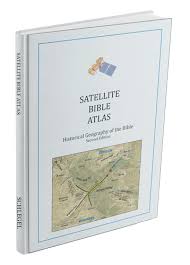
Photo Companion to the Bible: The Gospels–A Great Resource!

cd gospels

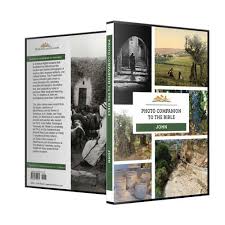
Wow! I hardly know what to say about this phenomenal collection of photographs on the Gospels. Over the years, I’ve seen attractive photos in books I have and noticed the name Todd Bolen in the photo credits. I had even heard others reference a website called BiblePlaces.com and talk about wonderful photo collections that could be purchased there. Now that I have Photo Companion to the Bible: The Gospels in my hands I know what all the hype was about. For the record, the hype was fully justified.

All 89 chapters of the four Gospels are covered by more than 10,000 pictures. I suppose the most common usage for this resource would be for those who want to create sharp PowerPoint presentations. For that use, there’s nothing free on the Internet that even comes close to what we have here. Putting up a slide for a sermon on some passage in the Gospels will now be greatly upgraded for those who possess this resource.

I see another use for this product that may not be as often discussed. There could hardly be a better resource for those who enjoy some visual learning mixed in. To me, there’s something incredible about seeing a picture of a Bible site for some spectacular story in Scripture. It gets my imagination fired up even more. Further, you will find photos here of cultural elements and even photos of artifacts from museums. There are some things that are simply not common in our day and culture that we need help visualizing. As an added bonus, I saw several historic photographs for those doing deep study.

I’m not as software savvy as some, but I found this resource easy to navigate. I have the disk, but saw where you can download a digital version as well if that fits your needs better. If you purchase this resource, you will be allowed to use it in teaching, preaching, and even church newsletters. If you want to use it in books, or other commercial products or websites, you can contact Mr. Bolen to set that up. Each photo has a brief note to explain what you’re looking at. Your purchase comes with free lifetime updates. Apparently, Mr. Bolen wants us to be pleased, and promises to work with anyone not completely satisfied.

One thing that really sets this resource apart is the pictures of places that are difficult to get to for the modern tourist. In other words, there are pictures here of places you will never see on the average Bible tour. I so appreciate this resource that I hope Mr. Bolen will put together future photo collections for some hard-to-find Old Testament locations (he has some of these pictures on his website). In fact, he ought to make one of those big beautiful coffee table books for Bible sites. The photos here are truly of that quality.

This is a special resource and I highly recommend it.

I received this resource free from the publisher. I was not required to write a positive review. The opinions I have expressed are my own. I am disclosing this in accordance with the Federal Trade Commission’s 16 CFR, Part 255.
Embodied Hope by Kelly Kapic

book e hope

Kelly Kapic dives deep into the theology of suffering in this fine volume. There’s nothing of glib, overly-generalized platitudes, or fluff to be found in its pages. There’s no attempt to dissect suffering in a dry academic way either. No, this book probes what the Bible actually teaches on the subject of suffering that interacts with all our lives in some way.

Though there is starting to be a sizable body of work on suffering in print today, this work can qualify as a theological work. That is not to say, however, that it lacks heart at all. In fact, the author was probably the perfect candidate to pen this book. On the one hand, he is a trained theologian, while on the other hand, his wife has faced incredible suffering. Having already survived cancer, she has also lived with connective tissue disease as well as Erythromelalgia, or “man on fire” syndrome. As you can imagine, the author struck the right balance between heart and head as he wrote here.

The book itself is divided into three main parts. In part one, he examines the struggle itself. He admits that we can have hard thoughts about God in times of profound suffering. Along the way, he explains how important lament is to suffering despite people’s preference for the stiff upper lip. In describing our questions that come with pain, he exposed our tendency to jump back and forth between self-praise and self-condemnation. Of course, neither are the sole answer. He also explained how we should be mindful of our mortality and how that might be tied up in the things we learn in suffering.

In part two, he tackles what he calls “the strangeness of God”. With skill, he takes us to Jesus Christ and His cross. In the final section, he makes worthwhile practical conclusions. I was enlightened as I read.

This book has already been recommended by several people who have our ear on the subject of suffering. For example, Joni Eareckson Tada, who herself has written much on pain, says she loves this book.

Whether to put on your theological shelves, or to help you wrestle in life’s dark moments, I recommend this book as a winning effort.

I received this book free from the publisher. I was not required to write a positive review. The opinions I have expressed are my own. I am disclosing this in accordance with the Federal Trade Commission’s 16 CFR, Part 255.
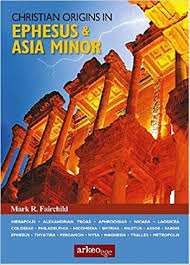
Christian Origins in Ephesus & Asia Minor by Fairchild

book ephesus

This is the book that I will be taking with me if I am ever privileged to tour Turkey and all the Bible sites there involving Paul or the Seven Churches of the Revelation. Since I have done some solo touring in Israel, I know what I’m looking for in a book that I would want to carry with me every day of the trip, and this is that kind of book. This second edition is an attractive hardback that would still easily fit in a backpack for travels. In the meanwhile, this book will also serve as an outstanding Bible study resource.

The book begins with some vivid maps of First Century Asia Minor, followed by maps of Paul’s First and Second Missionary Journeys. In fact, the maps were created by Tutku Tours. After a brief introduction, chapter 1 introduces us to Ephesus. After background information and Bible history are shared, we get wonderful pictures and a tour guide to the archaeological site. In fact, the map on pages 10 and 11 are the same sort of map you would get if you were touring the site. If you use the map, and then the text, pictures, and descriptions given, you could easily plan your trip. The armchair traveler would feel as if he or she were there too. The paper and visual quality are similar to the small books you often find at tourist sites, though much more true to Bible history.

Chapters 2 and 3 spread out from Ephesus to places like Miletus, Priene, Colossae, Hierapolois, Troas, and Assos. The quality of text, pictures, and tour guide information maintains its high level. Chapter 4 looks at Peter and John’s ministry in Asia Minor while chapter 5 turns its attention to the Seven Churches of Revelation. Finally, chapter 6 continues this history for the years after the New Testament period.

After a brief conclusion, the book ends with a helpful glossary as there are many terms the reader might not be familiar with, timelines for archaeological periods, and historical ones as well. The author even attaches a lengthy bibliography for important commentaries on the New Testament as well as historical and archaeological resources on all the sites studied in the volume.

I’m really impressed with this book and recommended for either Bible touring or Bible study. You’ll be a winner either way!

I received this book free from the publisher. I was not required to write a positive review. The opinions I have expressed are my own. I am disclosing this in accordance with the Federal Trade Commission’s 16 CFR, Part 255.