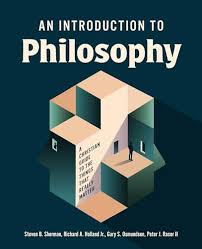
An Introduction to Philosophy: A Christian Guide to Things That Really Matter

Here’s a fantastic introduction to philosophy from a distinctly Christian perspective. While it is set up as a textbook, it has several advantages over typical textbooks. First, there’s understandability. The four authors must have made that priority number one or they have a phenomenal editor. It seemed to me that they determined we readers could walk away from this book comprehending its contents. That clarity is so distinct that I believe homeschool families could use this for their children in high school as well. It connected many dots for me too.

Second, there is its Christian perspective that was so valuable, yet delivered without sacrificing depth. As you read each chapter, I challenge you to notice the quantity of things you’re learning without any loss of quality. I felt that way in every single chapter. The last two chapters on the meaning of life ended the book on a powerful climax. Dare I use the word “moving” in a textbook?

Finally, without losing its Christian charm, the authors clearly represented diverging philosophies honestly. Proponents of these opposing viewpoints would likely dismiss conclusions in this book, but I don’t think they’d say the authors failed to state their views correctly.

This is a great book. Only on the chapter on sexual ethics did the authors write scared. Otherwise there was a pleasant confidence across the pages of this book. I’ll keep this one handy.

I received this book free from the publisher. I was not required to write a positive review. The opinions I have expressed are my own. I am disclosing this in accordance with the Federal Trade Commission’s 16 CFR, Part 255.
God’s Presence With Us and In Us (ESBT) by Miguel Echevarria

Here’s another fine entry in the excellent ESBT series. I’m shocked this series isn’t even more widely known. It has so many things in its favor. Its theology is rich, it always holds its page count under 200, and it sticks to the pattern of tracing its subject across biblical theology from Genesis to Revelation. I’ve read all the titles so far, and I have not found one that failed to keep to these constraints. Apparently, this series has some good editors. This latest entry on the Holy Spirit well holds the standard, so you are getting something of value.

The best way I can describe where this author lands is to tell you that Beale’s The Temple and the Church’s Mission: A Biblical Theology of the Dwelling Place of God is by far his most quoted work in it. I didn’t actually count, but I saw it repeatedly. He would follow Beale in the big picture as most authors in this series would, but he particularly seized on the centrality of the idea of Eden as a cosmic Temple and that the Lord is taking us to a new cosmic Temple to enjoy with Him.

I’m not suggesting this isn’t an original work, but only explaining what it builds upon. Mr. Echevarria is an excellent writer and reading this book is not a difficult task even if its subject is weighty. Having read a lot on this subject, I can’t say that anything was totally new to me, but the presentation of helpful material was top-notch. Still, I underlined several little nuggets that I appreciated.

There’s not much to criticize here. I think, perhaps, he bogged down a bit about the spiritual gift of preaching in the context of gender. I’m not sure that was the hill to die on even temporarily for what this book was aimed at. It’s still not a serious enough flaw to detract from a great book.

I recommend this book just as I do the whole series. 

I received this book free from the publisher. I was not required to write a positive review. The opinions I have expressed are my own. I am disclosing this in accordance with the Federal Trade Commission’s 16 CFR, Part 255.
Classical Theology for the Modern Man by Carl Truman

Carl Trueman is one of the most influential Christian writers of our day. He has been able to impact his generation by taking the timeless truths of Scripture with a keen philosophical understanding and assess our culture with profound results. Just notice which podcasts want him as a guest and you will see what a far reaching phenomenon he really is. On a personal level, I’m moved when reading him or listening to him.

Having said all that, this book is a more modest offering. These 70 pages are more of an elaborate essay. It almost assumes you’ve taken in his more blockbuster writings. He mines one of his ideas developed before writing this book that western culture has a therapeutic mindset. To my mind, he spends some time tracing how we must look to earlier times of Christianity for consistency and then spends the most time tracing a very specific line of creedal literature as the natural result of that look to earlier times. I don’t have any problem with his favorites, but some are going to argue at how narrow his look backwards finally becomes. Could that defeat his premise? At the end of the day, he is a Presbyterian and when he sizes up where we should finally land, he doesn’t have much but Presbyterian writings left.

If you follow his church, you will love this book. If not, you might not like it quite as much. This book does not change my thinking that he is one of the most outstanding writers of our time, but I just could not hold this up beside his more famous works. I think my only little criticism is that he doesn’t develop the theme, that could’ve been quite interesting, as much as getting in the weeds of where he wanted our journey to end. Still, this is Trueman and so it’s still a four out of five stars. 

I received this book free from the publisher. I was not required to write a positive review. The opinions I have expressed are my own. I am disclosing this in accordance with the Federal Trade Commission’s 16 CFR, Part 255.

Romans (IBC) by Susan Eastman

Romans is a bit more of a challenge for more critical commentators with its decisive doctrine. If such commentators disagree with that statement, then at least we can all admit it’s more challenging for more conservative readers to use. I often read such works to see how it’s approached from the other side and for theology that can really get you some new angles to consider. So far I’ve enjoyed these latest revisions in this series over its predecessors.

Let me make a few observations about this specific volume. 1. It is not as critical as several volumes in similar series though it is reliably critical at the key passages you’d expect. 2. In some episodes of going after the critical line it is more conciliatory preferring to make a case rather than an attack. 3. It speaks positively on the Gospel and doesn’t completely disregard sin. 4. Some of its reflections for preaching don’t seem really on point though Romans is a book that less lends itself to that kind of direction anyway. 5. The exegesis is more interesting as several word studies, background information, and analysis would strike you as thoughtful.

The author is a clear, expressive writer. Whether you are a critically-minded or conservative reader you know what to expect coming to this series. In either case, you’ll find it in good quality here.

I received this book free from the publisher. I was not required to write a positive review. The opinions I have expressed are my own. I am disclosing this in accordance with the Federal Trade Commission’s 16 CFR, Part 255.