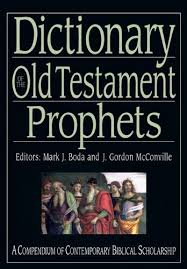
Dictionary of the Old Testament Prophets

book ot pro

The Dictionary of the Old Testament Prophets is another of IVP’s successful “black” dictionaries. It’s edited by two respected scholars: Mark Boda and J. Gordon McConville. It is, perhaps, one of the most helpful of these black dictionaries because the prophets are clearly one of the trickiest genres. Though some of the entries are clearly aimed at those in major scholarly study, any Bible student could find much to glean from in this volume.

For first-time users there’s a guide at the beginning explaining how to use this dictionary as well as a list of abbreviations. If you scan the list of contributors, you will see several highly respected scholarly names.

The dictionary approaches an incredible array of subjects in alphabetical order. You will be hard-pressed to think of a term, even an obscure scholarly term, that affects prophetic study, and not find it in this volume. Additionally, you will have the equivalent of a scholarly introduction such as you would find in a major commentary on every prophetic book of the Old Testament. Most of the main issues will be covered such as structure, composition, and theology.

For example, look at the article on marriage and divorce. You will have a discussion of the practice of each in Israel, what it could be used as a metaphor for, and how it was used in various prophetic books. It’s really fascinating!

Some of the contributors will reach more critical conclusions that I’m comfortable with, but the scope of this volume makes it a winner. I’m not aware of any real competitor to it, and I highly recommend it.

I received this book free from the publisher. I was not required to write a positive review. The opinions I have expressed are my own. I am disclosing this in accordance with the Federal Trade Commission’s 16 CFR, Part 255.

The Expositor’s Bible Commentary (Rev. Ed.)-Volume 12, Ephesians-Philemon

book ebc 12

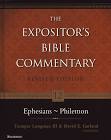
Volume 12 of the Expositor’s Bible Commentary (EBC) is a major revision of volume 11 of the old series that also covered Ephesians through Philemon. Only two authors revised their earlier works and every other commentary is a new treatment by a different scholar. What we have here will be a real blessing to pastors and Bible students.

The Book of Ephesians is now handled by William Klein. Considering the importance of Ephesians, some will label it a very concise volume. Still, don’t see the brevity as superficiality. This volume is well done. In the Introduction he discusses authorship, structure, setting, date of composition, purpose, the relation to Colossians, theology, and textual issues. There’s also a fine bibliography and outline. If you see a negative review of this one, you may find that it’s not for any lack of quality work, but his corporate view of election and the fact that he’s a complementarian may be the real reason. I appreciate this work.

The Book of Philippians now has highly-respected scholar David Garland as its commentator. That’s a coup for this series. The writer of massive, major commentaries has proven himself adept here with a briefer entry. In the Introduction, he discusses background, date and place of origin, integrity of the letter, purpose and occasion, literary form, followed by a bibliography and outline. The commentary itself is outstanding.

Todd Still does Colossians. In his introduction he begins by discussing the overarching Christological theme. He surveys all the other typical introductory issues, also providing a bibliography and outline. The commentaries in the same fine style as the rest of these in the series.

Robert Thomas revises his earlier work on Thessalonians. Some criticize him for his dispensational viewpoint, but I’ve always enjoyed reading it. It appears to me that he took care in doing the revision and it’s even a far better work than before.

Andreas Kostenberger replaced two authors from the old series in his handling of the Pastoral Epistles. He has since written other commentaries on those epistles and this is a fine improvement over the older series (though I like them as well). He tackles each of those three epistles separately. Again, this is a quality commentary for pastors to have.

Philemon sees a revision by the previous author and continues to be a very usable entry.

This book is another economical, wonderful tool for pastors and teachers. Many of us have used the older set for several years, and appreciate the care that went in producing this new set that will last for years to come. I give it the highest recommendation.

I received this book free from the publisher. I was not required to write a positive review. The opinions I have expressed are my own. I am disclosing this in accordance with the Federal Trade Commission’s 16 CFR, Part 255.

The Expositor’s Bible Commentary (Rev. Ed.)-Volume 2, Numbers-Ruth

book ebc 2

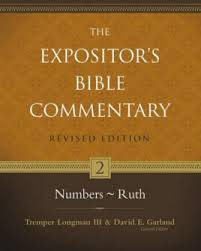
Volume 2 in this revised edition of the Expositor’s Bible Commentary (EBC) now covers from Numbers through Ruth. It’s a huge volume of over 1300 pages! You will find the same quality commentary throughout that the series is known for. It is a pastor’s favorite for many.

The Book of Numbers has been revised by Ronald Allen. He was given more space in the old set and that continues to be true in the 450 pages of quality commentary we have here. Though there has been some updating, the Introduction is still divided into the same 12 parts. Some of the most provocative are the two sections that outline the problem of the large numbers and the suggestion of a solution.  I can’t personally follow his theory there, but appreciate the overall conservative approach. The commentary itself is one of the better available today.

The commentary on Deuteronomy has been replaced with a new one by Michael Grisanti. The Introduction is short, but covers the basis. The bibliography is extensive, and some helpful maps have been added to the commentary. The commentary itself is successful because of its clarity and conservative conclusions.

The commentary on Joshua also has a new author in Helene Dallaire. Though briefer than Numbers and Deuteronomy above, it has still been well received as a mid-length commentary. The Introduction gives an overview of the book, and one of Joshua,  followed by a discussion of authorship and composition, literary form, historical background and dating, the people of the land, and theology. There’s also a bibliography and outline. Since the scholarly world is really varied in dating Joshua, the author gives a good synopsis of both conservative and liberal views. There are some helpful charts throughout the commentary too. I would label this commentary as solid and helpful.

The commentary on Judges also has a new author, this time by highly respected Mark Boda. He stays within the confines of the series, which limits page number, but still succeeds in providing a concise, yet penetrating volume. He approaches Introduction by discussing in turn, its canonical forms, its historical contexts, its sociological dynamics, it’s a literary shape, it’s rhetorical purpose, and its theological potential. He also has a nice bibliography and outline. In using it you will easily see the hand of a seasoned commentator.

George Schwab provides a new commentary on the Book of Ruth. I had a lot of trouble agreeing with his conclusions in the Introduction. The chart on page 1308, however, was outstanding. The commentary itself is helpful, but I found a few conclusions in the commentary a little over the top as well. I’m not saying it isn’t worth consulting, just that it wouldn’t be my favorite.

I don’t see how you could go wrong with this thick commentary covering five books of the Old Testament. When you think about what you’re getting, you could even call it an economical value too. This is really a nice one!

I received this book free from the publisher. I was not required to write a positive review. The opinions I have expressed are my own. I am disclosing this in accordance with the Federal Trade Commission’s 16 CFR, Part 255.


Mark: Through Old Testament Eyes by Andrew T. Le Peau

book mark ot

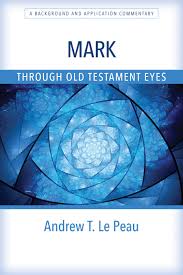
This book is the inaugural volume in the Through Old Testament Eyes commentary series. Series editor Andrew T. Le Peau contributes this volume on the Gospel of Mark. As we are starting to see such a proliferation of commentary series these days that the market is almost glutted, so a new series especially needs a unique contribution to not get lost in the multifarious market. If this first volume is any indication, I think this series is going to have something to say that’s not found in others. The Old Testament angle is only part of its success.

Be sure to read the Series Preface to see how it’s set up. In the Introduction to Mark’s Gospel, you immediately see that this series is aimed at pastors and Bible students, not academic types. He gives a long movie analogy of movies borrowing from older movies to describe Mark’s borrowing from the Old Testament. It’s in this Introduction that you find one of the highlights that will be carried through the whole commentary. Scholars often make a discussion of structure a quite nebulous exercise, but he takes it and in a few paragraphs turns it into something truly helpful. Compared to others, the Introduction is short, but I think it succeeds for what this series intends to be.

Every passage has commentary with an emphasis on its relation to the Old Testament. That does help where other commentaries sometimes lack. It’s those sections in the dark shading that I love the most. They contain all kinds of helpful information. It often involves explaining structure. Many times there’s a helpful chart that aids understanding even more.

I see this commentary as the perfect secondary commentary. It holds up well with the other serious paperback commentaries on the market. If this series can sustain what we have here, it will likely be quite successful. In any event, this first work on Mark is a winner.

I received this book free from the publisher. I was not required to write a positive review. The opinions I have expressed are my own. I am disclosing this in accordance with the Federal Trade Commission’s 16 CFR, Part 255.

Reformation Commentary on Scripture (NT XIII) on Hebrews and James

book ref heb jam

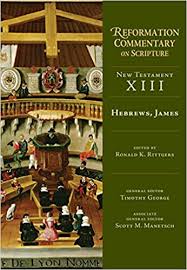
Though several titles have been released in this Reformation Commentary on Scripture series, this is my first opportunity to review or use one of its volumes. Immediately I’m impressed by the hardback volume and its attractive dust jacket. Since this series is different than most that I use, I really appreciated the guide to using the commentary that was provided at the beginning of the volume. That is followed by a general introduction to the whole series that explains what its producers are hoping to accomplish. The editors are seeking to help modern interpreters and preachers, as well as furthering historical understanding and Christian scholarship. There’s a great deal of helpful information on that history and how exegesis fared in Reformation times. It was thrilling to see a sympathetic view of Anabaptists from that time as well.

Next, we have an introduction to Hebrew and James that reviews things as they stood in the Reformation period. The commentary itself is easy to follow. The person quoted is always listed at the beginning with a more detailed bibliographic entry at the end of the periscope. Hebrews and James are tricky for totally different reasons, and that makes this step back to Reformation times even more interesting. There were some authors quoted that I’ve read Spurgeon loved that I’ve not seen anywhere else that was icing on the cake for me too.

It’s all really fascinating. It’s a terrible mistake to assume that only our generation has anything to say. Though the years aren’t equal, the Reformation seems like the midway point between New Testament times and today in my view. It’s great to see what was believed at that time. Plus, you must respect the men who returned to the Bible at such cost in their generation. What they have to say is at least worth listening to.

I think I’ll be checking out other titles in this fine series. IVP is to be commended for providing us today with such a valuable asset.

I received this book free from the publisher. I was not required to write a positive review. The opinions I have expressed are my own. I am disclosing this in accordance with the Federal Trade Commission’s 16 CFR, Part 255.

Zondervan Handbook to the Bible

book zon han

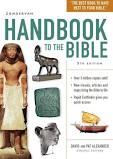
This handbook that is the favorite of many has garnered a fifth addition. I’m told that there are over 3 million copies in print in many languages for the first four editions. Even the earliest editions, edited by David and Pat Alexander, were colorful and more eye appealing than most on the market. That tradition is extended in this latest edition. It’s beautiful, colorful, full of helpful articles, and contains wonderful maps, charts, diagrams, and photographs.

Section 1 introduces the Bible with broad discussion, helps put the Bible in its proper setting, explains keys to understanding, looks at the unity of the Bible, and surveys the challenges of reading the Bible today. The next section covers the Old Testament, breaking it down by looking at the four genres found there. Each book of the Bible is given an overview and a synopsis of its contents. There’s many articles of special features found in the book as well as lavish illustrations. The New Testament is approached in the same helpful way.

You will enjoy the final section too that they call the “rapid factfinder”. I describe it as a brief Bible dictionary as well as a reference on where to find further discussion in the book itself.

The book is beautiful and well done. The paperback cover is sturdier than most and actually works well in this case. Many of the contributors are well-known scholars. I imagine any Bible student would crave this book. It’s a winner.

I received this book free from the publisher. I was not required to write a positive review. The opinions I have expressed are my own. I am disclosing this in accordance with the Federal Trade Commission’s 16 CFR, Part 255.

Second Corinthians (NIGTC) by Harris

book nigtc 2 cor

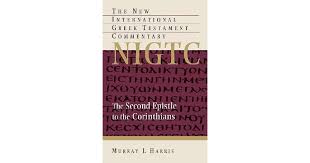
This volume by Murray Harris is one of the most respected in the well-known New International Greek Testament Commentary (NIGTC) series. Its success arises from its masterful exegesis, its scholarly clarity, and its warmth. Along the way, you will have one of the most conservative entries in the series as well. Having already written a helpful commentary II Corinthians in the EBC series aimed at pastors, Harris flexed his scholarly muscles in producing this meticulous, yet clear technical commentary.

Harris provides a massive bibliography running 100 pages. He begins the Introduction by digging into the literary issues of II Corinthians. I appreciated that on page 1 he wasted no time in saying, “one of the areas in which there is consensus among NT scholars is that Paul was the author of 2 Corinthians….” Quickly he segues into where the strongest debate concerning this book always happens – how it fits with I Corinthians. He explains what he calls “the severe letter”. He works through all the main possibilities before he begins defending the integrity of II Corinthians. There’s debate also about some of the passages and if they possibly come from a different hand than Paul. Again, these passages are covered from every possible angle and he is quite open to conservative solutions.

He also tackles the occasion, purpose, and outcome of the book. From there, he comes back at the book with a view to explain historical issues. In doing so he will review the date, Paul’s opponents, and the collection for Jerusalem. He works with care in producing a chronology before he dives into discussions about structure. There’s also some good discussion of theology in the book, which you will also find in the commentary itself.

The commentary proper is over 800 pages on the text. It is in perusing these pages that you will see that Harris lives up to the reputation that has attached to this book. As with most volumes in this series, the English translation of the Greek presented is nearby and fairly easy to follow even for non-Greek readers.

This volume is easily the best we have on the more technical side for II Corinthians today. Don’t miss it.


I received this book free from the publisher. I was not required to write a positive review. The opinions I have expressed are my own. I am disclosing this in accordance with the Federal Trade Commission’s 16 CFR, Part 255.

Haggai and Malachi (NICOT) by Jacobs

book hag mal

This latest entry in the highly- regarded New International Commentary on the Old Testament (NICOT) by Mignon Jacobs covers Haggai and Malachi. It replaces the serviceable volume by Pieter Verhoef that’s been much used for 30 years. In the last few decades this series has transitioned to academic issues from its earlier emphasis of assisting pastors, though scholarly pastors will still love it. If you appreciate the last few entries in this series, you will find this new title in that same vein and fully of their caliber.

After a substantial bibliography, the Introduction of Haggai begins with the historical background. We learn of the times of the prophet, his identity, and the date of his activity in the book. The next section tackles historical context by explaining what the author calls “chronological indicators” followed by the sociopolitical context and the conceptual framework. Next, there’s a brief discussion of the text followed by a section on inter-textual indicators. That revolves around Haggai’s comparison with Ezra, Chronicles, Jeremiah, Isaiah, and Leviticus. There’s also a short section on structure (It could have been longer). The Introduction ends with a brief overview of the message that includes a few theological values.

The book of Malachi has an Introduction with the same design as that used by Haggai and explained above. There’s a few more charts and tables in this one to help the reader. The outline provided in the section on structure was also much more detailed than that of Haggai. I thought the theological discussion of the ideal versus the real was illuminating.

The verse by verse commentary of both sections is helpful. Scholarly issues are well defined and inter-textual discussions are well done. I’m glad to have this book on my shelves. It’s a real asset!

I received this book free from the publisher. I was not required to write a positive review. The opinions I have expressed are my own. I am disclosing this in accordance with the Federal Trade Commission’s 16 CFR, Part 255.

Zondervan Handbook of Biblical Archaeology

book arc h

This Zondervan Handbook of Biblical Archaeology is a real gem. Not only is it attractive, but it assists in the very area that many Bible students struggle: archaeology. Randall Price has both taught and participated in archaeological excavations, and is the perfect candidate to produce this book. H. Wayne House, a prolific biblical writer, assists.

Whatever you do, don’t skip the introduction to biblical archaeology provided in this volume. It defines terms, helps you see were biblical archaeology is today, explains the major difference between minimalists and maximalists, explains the limitations of archaeology, its value, and its methodology. There’s a good description of what archaeology contributes to biblical studies too. That’s followed by a fascinating explanation of an archaeological site. It really brings archaeology to life. The introduction ends with an overview of archaeological periods.

The book is divided into three main sections, you have archaeology in the Old Testament, archaeology and the intertestamental period, and archaeology in the New Testament. This enables the reader to approach the Bible chronologically and apply archaeology to it.

You will love all the vivid, color photos, the helpful charts and diagrams, and the text itself. As a bonus, each of the main sections has a detailed chart of archaeological discoveries from that time. There are several helpful color maps at the end, as well as a thorough glossary.

I was pleasantly surprised by this book and highly recommended!

I received this book free from the publisher. I was not required to write a positive review. The opinions I have expressed are my own. I am disclosing this in accordance with the Federal Trade Commission’s 16 CFR, Part 255.

The New Testament in Antiquity by Burge, Cohick, and Green

book nt antiq

This book is a fine new entry on the market for New Testament introduction. This attractive, well-illustrated volume by Gary M. Burge, Lynn H. Cohick, and Gene L. Green is an up-to-date survey of the New Testament. Its special emphasis is to provide that introduction within the cultural contexts, whether Jewish, Hellenistic, or Roman cultures. That viewpoint helps bring the New Testament to life. The book is designed as a textbook, and the publisher provides both instructor and student resources for it, but any Bible student could learn much from it.

Chapter 1 begins with a broad look at the issues involved in studying the New Testament. The reader is reminded of the importance of context, geography, history, and as said before, culture. Chapter 2 discusses the historical setting of the New Testament. It begins by explaining the post-exilic times, continues through the Hellenistic period, and ends by explaining the Roman era. (Notice the chart on page 38, which is one of the most creative I’ve ever seen explaining the family of Herod). Chapter 3 narrows its focus to Israel and the time of Jesus. Chapter 4 expands the discussion to the Mediterranean world of the Apostle Paul. Chapter 5 discusses sources for the Gospels – I find that chapter off target, but it’s exactly what you’ll find in most modern New Testament introductions.

Chapters 6 – 11 cover the life of Christ and the four Gospels. It’s helpful to view the Gospels collectively as a life of Jesus and then examine the uniqueness of each gospel. Chapter 12 overviews the book of Acts while chapter 13 gives an overview of the Apostle Paul. Chapters 14 through 26 survey the rest of the books of the New Testament. A concluding chapter discusses the preservation and communication of the New Testament.

The maps and pictures are well chosen, beautiful, and quite enlightening. Some of the illustrations and reconstructions were especially eye-catching. The design of this survey is ideal. It is at once to the point and of sufficient depth to be a real asset to readers. I imagine this book will be the text of choice for New Testament survey classes for the next several years. Pastors and Bible students will find it worthwhile to check out as well. I recommend it.

I received this book free from the publisher. I was not required to write a positive review. The opinions I have expressed are my own. I am disclosing this in accordance with the Federal Trade Commission’s 16 CFR, Part 255.