A Book Every One In Ministry Needs To Run And Buy!

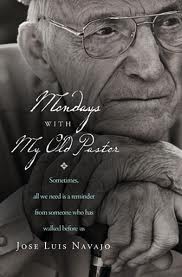
mondays with my old pastorYou think I’m exaggerating when I tell you to run and buy Jose Luis Navajo’s Mondays With My Old Pastor, but I assure you I have never more thoughtfully made such a statement. My friend, Ryan Hayden, gave me the book telling me it had such an impact on him. I looked forward to reading it, but never dreamed it would so move me. It is certainly one of the top 2 or 3 ministry books I now possess.

Don’t let its laid-back format fool you. It wraps you up in a story to deliver its gold, but it is more than a story as it touches all the places we need as Christ’s servants. Particularly if the strain of that service weighs on you.

It apparently has a few things working against it on the surface, yet those things vanish with every turn of the page. First, it is written by an unknown Spanish- speaking pastor. The translation is so good, however, that you never think of it. Plus it can help abolish the ridiculous thinking that the Lord can’t use others in another culture on the same level as us. Second, you may not know this pastor, but you will want to walk his steps and feel every throb of his heart. Third, the old pastor he learns from is unknown too. But you will have the most incredible vision of what an entry into Heaven this old man must have had. He could join Paul and Spurgeon and make quite a team. He was of their ilk.

In the book Mr. Navajo is sinking under the weight of ministry and decides to look up his old pastor for counsel. As the book goes along we learn the old pastor is dying, but he is energized to share with this protege of his. He goes every Monday for a meeting with the old pastor and the pastor speaks from accumulated wisdom, extraordinary stories, and power from a dynamic walk with God. The chapters are the discussion on each Monday.

Every chapter is a field of diamonds scattered all over the ground. If you can’t be helped by this book, take off your work boots and leave the gospel field–there’s no help left for you. But if you want to see–I mean really see–read with your senses fully engaged. You will find yourself craving the fellowship of your Lord! You will want to stay in the field, with your head now on straight and your heart running at full capacity.

The book boils down to 15 key principles. The list is amazing as is the journey to get to them. There are so many lessons, so many corrections and reproofs, and so much hope. I’m not going to mention even one of the principles in this review as I wouldn’t want to rob you of the journey. There are a thousand greats quotes in the book as well, but I will let you do your own digging too.

Thank you Mr. Navajo for taking us on your journey by writing it down for us. Thank you old pastor for your sage counsel–we will never forget it!

RELATED POSTS:

Leading on Empty

Dangerous Calling

Leading On Empty–Personal Observations and a Book Review

old gas pumpAre you out of gas? Is your tank dry? Yet the road ahead of you goes out beyond the farthest horizon? While this could happen to anyone, what about if you are in the ministry? You are slowing down while the need in God’s work is ever growing. I am now convinced that this is a common problem, perhaps inevitable for those of us who want to give our all.

I’ve read, I’ve studied, and for a season of last year, I felt it! My love of the ministry never wavered. I never stopped loving preaching passionately, yet I felt a weariness. I didn’t quite understand it. I never stopped, but the engine wasn’t running as well. My gentle Lord worked in a variety of ways to help me. He is faithful! 

Among those things He used was this book, Leading On Empty by Wayne Cordeiro. It was during a conversation with a friend  where we were each throwing out book titles that we had read or heard about, that he mentioned this book. Strangely, I didn’t even think I needed the book at the time but was intrigued when he said he had heard of some prominent pastors who were rescued to some degree by this book.

Frankly, I’m not ashamed to speak of this in my life. If far better men than me have faced it, why shouldn’t I? Life has taught me, anyway, that I am far from the strongest person. I see more clearly than ever that I am just going along, held in His hands, and living on His grace. Because of that grace, we need not live on and on with an empty tank.

So I can review this book on more than a theoretical level. Sometimes a book is worth three times more at a certain season of your life than at any other. It might not be your need at this time. On the other hand, it might be soon. I recommend every pastor, and really any leader, have this book on the shelf. For perspective,  I read over half of this book at a tough time for me, and then read the other half later when things were so much better for me. I can recommend it from both angles.

Mr. Cordeiro, a pastor of a thriving, large church, hit bottom. He simply had nothing left to give. He tells his story –warts and all. But as you read, you know he writes with a distinct measure of authority.  He shows how at times Elijah, Moses, Jeremiah, and David lived this too. “Burnout”, being overwhelmed, or out of gas–call it what you will, but it is a real danger, particularly for pastors. As easy as pastoring looks to many, the weight of souls is a load like no other.

He shows statistics for how widely pervasive this issue really is among pastors. He explains the concept of strength being perfected in weakness. He shows how the long-term stress of this leads to depression. He shows how people like Spurgeon suffered here. He sounds the alarm of early warning signs.

His biggest suggestion is solitary refinement– stopping, listening, being quiet. He suggests we divide our lives into what only we can do versus what others can do. We often work where others could while neglecting that 5% that only we can do. My personal life, my family, my Bible time–here are things that only I can do.

His chapter on “Finding the Still Waters” is on target. He also wants us to remove the stigma that is so often put on rest. Our resources of physical strength are obviously limited so we must carefully develop a strategy. Rest, he says, is not a sin, but a responsibility. We see the principle in the weekly Sabbath and in the land resting every 7 years in ancient Israel.

He focuses on being in our Bible and shares this acronym to get more:

SOAP

S = Scripture

O= Observation

A = Application (Never stop without it)

P = Prayer

He pushes taking a sabbatical. That is a little beyond most of us financially, and he finally confesses it. Still, work refreshment into your life. His idea of a Personal Retreat Day is worthwhile too. The last few chapters focus on these kinds of practical things.

This book can make a difference.

leading_on_empty

Books On The Study Of Bibliology (The Doctrine Of The Bible)

Bible picThis doctrine has lived in the battleground for years. This was, of course, always  true, but since the 1920s it has reached epic proportions in the struggle between God and Satan. Were I the Devil, I too, would focus on destroying trust in God’s Word. Without that trust, how could you ever know what God really has to say to us? Then why pursue what could never be known? You see why this study is essential to Christianity itself?

There are many great books that help with the key to this doctrine: the inspiration of Scripture. Here are some that I find to be the most helpful.

1. Theopneustia-The Plenary Inspiration of the Holy Scripture by L. Gaussen

This book had such a strong influence on later volumes that held to a full inspiration of Scripture. Heavy perhaps, but so accurate in sharing the biblical position. A real classic.

2. The Inspiration and Authority of the Bible by B. B. Warfield

Perhaps the most well-known volume of all on the subject. It has graced the shelves of most conservative pastors since written. It would be a boon to the cause of Christ if more pastors read it today. Somewhat scholarly in tone, but worth mastering.

3. Our God-Breathed Book–The Bible by John R. Rice

 I read this 20 years ago and it really helped me. It makes a very understandable case for an inerrant, infallible Bible. He really wrote with passion. He was criticized by scholars for having a position they labeled as “mechanical dictation”, but what he wrote really corresponds to what the Bible says. The last part of the volume was about translation and his position has made this book fall from favor with independent Baptists, but the bulk of the book is fine no matter where you fall on the translation issue. You might enjoy the 2 volumes he compiled on the subject, The Sword Book of Treasures and A Coffer of Jewels, as well.

4. The Savior and the Scriptures by Robert Lightner

He makes a powerful case for inerrancy in a shorter volume. Not as deep as some volumes but very helpful. Teachers and preachers will especially enjoy his contribution.

5. The Inspiration and Authority of Scripture by Rene Pache

If you need to teach this subject, you will find this volume very accessible and helpful. I recommend it.

Other volumes of note:

You might like Inspiration of Holy Scripture by Robert Haldane as it makes a strong case (look for the beautiful Klock & Klock volume now out of print). Has God Spoken? by Hank Hanegraaff is written in a popular style. Here’s some others I consulted in varying degrees: The Story of the Bible by Frederic Kenyon, Thy Word Is Truth by Edward J. Young, The Old Testament in the New by S. Lewis Johnson, Jr., All About The Bible by Sidney Collett  (Different), The Battle For the Bible by Harold Lindsell, Inspiration and Interpretation edited by John Walvoord, and God’s Inerrant Word by John Warwick Montegomery.

Canonicity


1. The Canon of Scripture by F.F. Bruce

So very helpful. I couldn’t agree with every conclusion but much insight is gained in reading this volume.

2. Inspiration and Canonicity of the Bible by R. Laird Harris

Extremely helpful and so I highly recommend this volume.

Also look for:

How We Got Our Bible by Neil Lightfoot, General Introduction to the Old Testament by William Henry Green, and How We Got Our Bible by W. H. Griffith Thomas.

English Translation

I am a Received Text man and recommend The Identity of the New Testament Text by Wilbur Pickering. I really enjoyed Burgeon’s Warnings on the Revision by D. A. Waite. I’d love to secure Dean Burgon’s writings some day. You might enjoy A Brief History of English Bible Translations by Laurence Vance.

I must say a word about some unhelpful pro-KJV writings floating around that have done the KJV and the TR (Textus Receptus) more harm than anything out there. Never use nonsense to prove a point when you actually have logical points. The racist, cruel writings of Peter Ruckman as well as the dishonest scholarship of Gail Riplinger are an embarrassment to all independent Baptists. We have much better. As I often do, I read from the other side to fully hammer out my position. The King James Only Controversy by James White and The King James Version Debate by D. A. Carson, both warm-hearted believers whose writings I have enjoyed at other times, wrote calmly, though I personally wasn’t persuaded by the minority text position they espoused. I still think that a majority of manuscripts is the best checks and balances to combat error in the text and so I follow the TR myself. Plus what God’s people have believed to be God’s Word for centuries carries much weight to my mind.

I pray you enjoy studying this great doctrine on the Book we can build our lives on! 

RELATED BLOG POST:

Books on Studying the Bible

Books That Encourage When Life Is Tough

faith

Every so often there is a certain kind of book that I simply must read. Books that encourage, inspire, and get my head back on straight. I’m not the only one who has it difficult at times. I’m not the only one who suffers obstacles in my service of Christ either.

In recent days, a good friend of our family asked me about books she might read in the coming year to encourage her in her walk of faith. Then a college friend of my wife wrote asking about books that might help someone she loved who had faced hardship while trying to serve the Lord. I’d like to recommend 5 books that have meant the very most to me in this way. They all are true stories of what happened in especially tough times, times that make my bad times look a little puny. These books help get my head back on straight and remind me of what a wonderful Savior I serve. Here in random order:

1. Evidence Not Seen by Darlene Deibler Rose

Ms. Rose was serving the Lord as a newlywed missionary in New Guinea when the Japanese invaded. Her and her husband were taken to different POW camps and finally she lost contact of what happened to him. Her sufferings were horrific, but her faith was incredible. There were moments where turning on a God you couldn’t figure out for the moment would have been so easy and tempting, but she choose the path of following God when the results weren’t too positive. The warden of the POW camp was as awful as the worst villain in any novel. Wait to you read what happened to him! Powerful!

2. When Iron Gates Yield by Geoffrey T. Bull

Mr. Bull was in China serving as a missionary when the Communists moved in. Things were going so well and then it all fell apart. He found himself incarcerated and down at times. He is real in what he felt and tells us so, yet we find His God is real. The Lord made Himself known in ways large and small. When one need would be met, another would quickly arise. Any old book by Mr. Bull will be worth your while. If you are as blessed by Mr. Bull as I am, you can also look for Tibetan Tales. That was the time before the Communists took over and he was a young man working in the fascinating area of Tibet.

3. Shadow Of Death by Lilli Schultze

A family tries to escape Europe as the Nazis took over. The Lord brought them through step by step, terror by terror. This family faced one of life’s greatest trials–seeing your family in danger and not having the power to stop it. The way they consistently turned to the Lord is extraordinary!

4. Green Leaf In Drought Time by Isobel Kuhn

 Mrs. Kuhn, a missionary herself tells the story of the Arthur Mathews family as they faced difficult missionary work and then had to flee China. The story is that it was literally one frustrating obstacle after another.  At times it seemed that the Lord had deserted them. They kept on trusting though they had feelings as we all would. The title is taken from Jeremiah 17:8. One of the best! Kuhn is a great writer. Look also for her biography By Searching which is also well worth your time reading.

5. The Autobiography of John Paton

Perhaps the best biography I’ve ever read! It is hard to fathom following the Lord with all he faced among the cannibals in the South Seas Islands. He had a thousand opportunities to quit serving the Lord and never did. When he had to guard the grave of his wife to keep the natives from digging up her body to eat it, you feel like quitting for him. He was betrayed often, his work collapsed over and over, and good results were elusive for such a long time. Finally, he perseveres to see the Lord honor him. Your faith will soar reading this book! Probably any biography of him would be good.

Look for a beautiful hardback edition published by Vision Forum (and now out of print) and re-titled Missionary Patriarch: The True Story Of John G. Paton that sold for around $20 (I saw cheaper used copies online). It would make a nice present or a family keepsake.

We need these type of books.

Obstacles are part of life. Frustrations abound in the Christian life. You and I are not alone. One thing I’ve definitely learned over the years of reading these books is that everyone who really served God in a meaningful way suffered hardship, often great hardship. Instead of thinking that God is just picking on me, I should realize that He is picking me out for something special.

Let’s read, remember, and press on to the finish line.

(Some of these books are in print, but also look on used book sites. Search Amazon, Ebay, and Christian Book Distributors. Happy hunting.)

Dangerous Calling–A Book I Needed In The Ministry!

I knew the ministry was tough. Figured that out the hard way. I still love it and want to do it the rest of my life. I thank God for it, but it’s tough. This book (Dangerous Calling by Paul David Tripp) was like the ultimate gut check for me. Funny thing was that unlike what I’ve been tempted to think so many other times, the culprit of my pain was me. The biggest source of my failures? You guessed it–me.

There is hope in this, however, because in a world of things I can’t change, with Christ’s help, I can change me.

Before I tell the themes that spoke to me in this book, I must stop and thank Mr. Tripp for his transparency. Some authors throw in a watered-down criticism of themselves that is really just to show you how wonderful they are in their realness. That is simply not the case here. He takes chapter one to tell where he was at one time in his ministry. Frankly, he was an unspiritual jerk. He held little back in the telling of the story.

Why is that so helpful? Because in some details I could see myself. He spoke of how his “inner lawyer” always came out to defend him. He acknowledged that he was more or less deceived. Am I the only one who finds his discernment runs at such a lower level when the subject is me?

He takes us to task for letting the ministry define our identity. Before I am Jimmy the pastor, or Jimmy the blog writer, I am Jimmy the man. That Christian with varying levels of spirituality, that man utterly needy of Christ, that is who I am. I need to shed the illusions of grandeur where the ministry has elevated me to think something beyond who I really am.

He said: “No one is more influential in your life than you are, because no one talks to you more than you do.” I assure you I am quite the chatterbox in this area. My mind never stops! In all that talking he says “you preach to yourself an anti-gospel of your own righteousness, power, and wisdom, or you preach to yourself the true gospel of deep spiritual need and sufficient grace.” He says we quit thinking of ourselves as a needy child of God and see ourselves as the PASTOR! As if there were some special category! Later in the book he says of we in the ministry: “We are still a mess.” He talks about the fact that we are still in the middle of our sanctification. We know this is true of Mr. Tripp and Mr. Jimmy Reagan. I’m in the middle of my sanctification and still have such a way to go. What about you my pastor friends and acquaintances?

He tackles other issues. My equating my Bible knowledge with spiritual maturity. Ouch! Or how about confusing numbers with success and then riding that roller coaster? He talks about how we think we have arrived and listen to no one. He talks about the ministry overtaking my personal devotions and worship of God, and about how I will lose my awe of my Almighty God. I can walk among the treasures of the Word of God and prepare sermons and never see the sparkle of the gold.

He explains that when I go this way I am in danger of things that I would never want to do. I start separating my private and public self. I can preach against something and turn around and do it–of course anyone could do it, but my problem might be how blind I can be to how serious it is. I can too become completely ensnared by the fear of man. I preach, I speak, I lead just to gain the praise of those who haven’t figured out how wonderful I am yet. Sadly, I no longer act for the approval of One.

All of this will lead to living for self-glory. In that all of us deal with pride, this is a real and present danger. This becomes the gasoline the Enemy throws on the fire of my life to burn up what I could do for the One Whom I love, the One Who gave His all for me.

There’s more. Don’t think I gave you a good enough rundown that you don’t need this book. I need this book. I suspect all of us in the ministry desperately need this book. I’ll recommend it too for pastor’s wives to understand their husbands, and, in that your husband’s call has become yours, you ladies too could fall victim to your own hearts as well. Church members, learn here how to pray for your pastor, learn how to love him, but bring him back down to earth. You might want to give him this book as a gift saying you just heard other pastors saying it helped and blessed them. (That’s true, you heard it from this pastor).

I thank the Lord for this book, for what it means to me, and pray I allow the Holy Spirit to use it on me in the days ahead.

Books On How To Study The Bible

Since I just finished teaching a class on “How To Study The Bible” that I found personally rewarding, I’d like to share about the books I consulted on this important topic. Collectively, Christians seem to be ever sliding backward on personal Bible study. We are starting to reap a disaster in Christianity as Christians know little of what the Bible says. Whether the preacher in the pulpit, the teacher in the classroom, or the Christian at home, we need help.

Here are the books that I found most helpful:

1. Interpreting The Bible by A. Berkeley Mickelsen

The best all-round volume that covers all the bases well. It’s scholarly, yet the reasoning can be easily followed. It’s especially helpful on specialized topics like parables and figures of speech. Begins with a good section on the history of interpretation. If I could only have one volume on the subject, this would be it.

2. Basic Bible Interpretation by Roy Zuck

More focused and to the point than many, yet it contains sufficient depth. Dr. Tim Jayne, who has taught the Bible for many years, actually gave this book when he was telling me that it was most effective for students to his mind. Mr. Zuck is a solid teacher from Dallas Theological Seminary. Although he finds dispensationalism in every shadow, I highly recommend this title for the real help it gives. (Logos is now offering this title here)

3. Principles of Expository Preaching by Merrill Unger

The title is misleading in that this book is not about preaching, but Bible interpretation. In that good preaching springs from right interpretation, this book will help any Bible student. A worthy addition to your library.

4. Understanding and Applying The Bible by Robert McQuilkin

A popular, helpful tool for the Bible student trying to gain principles to study the Bible. A different approach from Mickelsen, Zuck, and Unger, but he sheds real light.

5. Biblical Interpretation by W. Randolph Tate

A volume well respected in the scholarly world and helpful to we Bible students. A little deeper than the aforementioned titles, but I’d grab a copy if I could.

6. Bible Explorers Guide by John Phillips

This well-beloved Bible teacher has really given us a worthwhile volume. Pitched at the S.S. teacher/layman level, it really brings concepts alive that some of the more scholarly volumes just can’t give us–at least not as passionately. Not the last word on the subject, but I would hate to be without it!

7. Not Like Any Other Book by Peter Masters

Not as well known as other volumes on the subject, but a timely expose on ridiculous ideas that have infested Biblical scholarship and renders them unable to grasp the riches of God’s Word. I love this book!

Other Volumes

You might grab: Biblical Hermeneutics by Terry (old, large, and mined by later writers), Hermeneutics by Virkler (old, but shorter), Protestant Biblical Interpretation (influential, but not as helpful as some to a Bible student), and Toward An Exegetical Theology by Walter Kaiser (Popular and helpful).

Books to encourage doing Bible study: How To Master The English Bible by James Gray, Methods of Bible Study by W. H. Griffith-Thomas, and How To Study The Bible by R. A Torrey. J. Vernon McGee, I.M. Haldeman, and Arthur Pink have written on this as well.

Books more geared toward personal Bible study: Independent Bible Study by Irving Jensen (Inductive Method), How To Study The Bible by Braga, Dynamic Personal Bible Study by Cyril Barber, How To Read The Bible For All Its Worth by Fee and Stuart, How To Study The Bible For Yourself by Lahaye, Creative Bible Study by Richards, How To Understand Your Bible by Alan Stibbs, The Joy of Discovery by Oletta Wald, How To Enjoy Studying The Bible by Joseph Gettys, Principles of Bible Hermeneutics by Haritt (fine, but lacks perspective), Methodical Bible Study by Traina, Knowing the Scriptures by A.T. Pierson (unique), Enjoy  Your Bible and Simply Understanding The Bible both by Irving Jensen, Understanding the Bible by John Stott, Interpreting God’s Word Today by Kistemaker, and How To Get the Most From God’s Word by John MacArthur all might prove helpful.

Happy studying!

Here’s something similar on Bible Atlas books. Just click:

Bible Atlas

Reflections On 9 Years As Pastor Of First Baptist Church

It seems like yesterday that we came in that moving truck from Tennessee to West Union, Ohio. 9 years! I can’t fathom it really. We beat the statistics at least in that the average pastorate is around 18 months at the last count I heard.

I laugh when I think of the naivety I brought with me. Leaving the banking world really brought little help in the new life the Lord called me into. When our church surprised me with a celebration today, it really got me thinking.

Pastoring is tougher than I imagined for sure. I’ve got the bumps and bruises to prove it. I’ve seen the days when everyone thought I was the greatest pastor around and the days where I was the most incompetent pastor that ever walked behind the pulpit. I’ve lived through the harder days when the choices I felt required of God to make cost me much to the days now where I am just Jimmy and my people love me while knowing I have feet of clay.

As I type, I’m weighing it all out. Yes, it’s difficult, but if I could go back 9 years, would I do anything differently? Not on your life! I don’t care that some plans flopped, or some planned big days were small potatoes at best. I still consider the call of God on my life the greatest life of all.

To get to shepherd, with God’s help, other believers, to get to stand and preach, and to get spend my days in God’s Word, still washes away the worst debris of the ministry as if it never happened.

So thank you dear folks of First Baptist Church for the privilege of being your pastor. And thank you Lord for condescending to call one as unworthy as me to the greatest work I could ever imagine. All I want for the rest of my life is to continue this honor of serving my Lord.

Guest Blogger–Pastor Mike Montegomery

mike and susie montgomery

I’m glad to have my friend Pastor Mike Montegomery guest blogging on Reagan Review. I’ve learned over the last few years that he is a dedicated Pastor who loves his people, is dedicated to preaching God’s Word, and has a passion for souls. He is as true a friend as could one could be. He was the one who moved in our home while we were in Tennessee a week soon after my wife became paralyzed and tore a closet out of our bedroom replacing it with an accessible bathroom. He even raised the funds for the project. Needless to say, his Christianity is of the real variety. We love his entire family. He is also a reader and I love to hear his take on books he has read. 

He has his own blog at

http://philippians216.blogspot.com/

Brothers We Are Not Professionals

Boardman Holman Publisher

By: John Piper

First Published in 2002

286 pages

Overview

This book is a thought provoking look at the ministry and the personal walk of the pastor. Mr. Piper writes with passion and beauty. He does a great job of keeping your interest and always makes you think.

The purpose of the book is clear in the preface. Pg. xi “The aim of this book is to spread a radical, pastoral passion for the supremacy of and centrality of the crucified and risen God-Man, Jesus Christ, in every sphere of life and ministry and culture.” As far as this reader is concerned he hits what he aims at.

High notes

Mr. Piper repeatedly encourages the study of the pastor. He challenges you to be well read and well prepared. His writing reminds me often of A.W. Tozer in that it is often passionately spiritual and deeply rooted in the Word of God. He exalts the Scripture and calls for the Scripture to speak through the preacher in the pulpit. He leaves the reader with the understanding that the source of a sermon is Scripture, not the mind of the preacher. This book is never boring and will stir your soul as well as your mind. He willingly and boldly confronts misconceptions within the local church polity and theology.  He also emphatically stands on the Scripture for men only in the pastoral ministry. Mr. Piper closes the book with a strong plea for pastors to strengthen their own marriage, and in light of times, this cannot be echoed too often.

Low Points

Mr. Piper is a staunch Calvinist and it does come through in the book. Most of his emphasis is for the sovereignty of God and of course we can agree that God is sovereign. Chapter Fifteen I felt he had waded into a realm of doctrine that I believe is quicksand. In Chapter Eighteen he covers the importance of baptism. Though we agree on the time and method I feel he gives too much wiggle room to paedobaptism.

Summary

All in all, the entire book is a great read and any pastor will walk away from each chapter with at least one convicting and stirring truth. I would put this book at the top your stack!


The Backflow Of The Schaap Tsunami

When the wave of the tsunami flows back to sea you are left with destruction. If you walk through the muck and look closely you can start to understand the ruinous conditions wrecked upon the landscape. I’ve looked. Two days ago I wrote   The Tsunami of Jack Schaap and I can’t believe what I see. This post has nothing to do with Mr. Schaap per se, but what is going on in Independent Baptist churches.

Two hideous things jump out. First, people who love the Lord and desperately want to do right are at a complete loss with how to handle an abusive pastor. I have received calls and emails  asking, “what can we do?” The answers aren’t easy. As a pastor, I know you don’t want to make petty criticism fashionable. You know the type–that’s the wrong color of paint, that’s a stupid song to sing, that’s an inferior way to illustrate that point, or even it’s criminal to have a service at 6 p.m. instead of 7 p.m. We pastors can take a little abuse too!

But pastors becoming enraged, engaging in verbal battles, and threatening their church members is epidemic. Of course there are many wonderful pastors serving selflessly. I know some of them. On the other hand, we’ve heard stories of chest bumping, yelling, and threatening to have you shunned.  I am well aware of troublemakers, but I am referring to people who are torn because they fear hurting the church and hurting others while knowing that type of pastoral behavior is unreasonable and unchristian. It should be dealt with, but how?

I’m still thinking it through, how to balance pettiness and real issues. I imagine the answer lies in the Biblical qualifications of a pastor (1 Timothy 3). Things like “brawling” are sufficient to opening the discussion of a man being disqualified to pastor. As it is now, it seems “husband of one wife” is the only one that counts. The Bible, however, makes no such distinction. If a real qualification is breached, it must be dealt with. If it’s something less than a stated Biblical qualification, let it go. Lord, give us wisdom.

Even if you, as I, think highly of the office of the pastor, we must honor it further. We must not sully its call, nor corrupt its beauty. We must hold it accountable to protect its great honor. And may God help us.

A Theology Of Luke And Acts

Respected scholar Darrell Bock delivers in this volume on his topic of the theology of Luke and Acts in the BTNT series. Mr. Bock, already hailed as having given us the best modern exegetical commentary on Luke, writes on a subject here he has given many years of his life to study.

You will find all the usual suspects on the study of Luke and Acts–the connection of Luke and Acts, salvation, Christ, the Holy Spirit, women, and the poor. But there’s more. Things I hadn’t thought much of in regards to Luke and Acts, all laid out in a cogent, clear, persuasive form. As you would expect, he interacts much with other scholars and their opinions as he travels along his subject. As a pastor I can’t help but see some of that as the straitjacket the scholarly world has wrapped around itself. Still, he is concise enough that his text holds interest. If you are like me, you so think of Luke as one of the Gospels that you at times forget its special connection to Acts.

Zondervan asked we reviewers to pick one chapter and particularly review it. I chose the one that I felt I had the least knowledge of–“The Law in Luke-Acts” (Chapter 18). It really didn’t seem to me Luke or Acts had a lot to say on that subject.

Mr. Bock shows us that the scholarly world has had occasion to analyze the subject recently. He laid out the basics clearly in 3 paragraphs. I appreciate Mr. Bock fairly representing other viewpoints while telling his conclusion.  In doing so he dodges the problem of becoming so immersed in details, as many do, that they forget a conclusion was why we went digging in the first place. I don’t have to agree to enjoy the evidence being weighed and a conclusion being drawn.

He concludes that “… in the end law-abiding for Luke is only a consideration for Jewish believers, while Gentiles must be sensitive to certain practices tied to the law.” His idea seems to be “law-sensitive” is the orientation of Luke and Acts, and that it carries “realized promise” but no “salvation benefit.” Of course it has no salvation benefit, and I doubt Luke is really “conservative” in regards to the Law. More likely, to my mind, it’s Jewish person-sensitive since Christ has uprooted what has been deeply ingrained  into the very fiber of their people. I’d say it’s more a sensitivity to the complications of a progressive revelation.

He also masterfully discusses the issues of whether or not the Law failed, or at least how should what Jesus did be accounted for with the Law. He lays out all the possibilities available to form an opinion. I left it thinking that the Law failed in doing what people imagined it would while it fully succeeded in all the Lord planned for it to do.

He traced things like Sabbath incidents and gave us the data that is needed to form our opinions. Mr. Bock succeeds because he gave me what I needed to decide for myself. And he did it well. The whole book delivers in this way. I suspect this book will be popular among scholars, students, and pastors. As for me, it will hold a prominent place on my shelves and will be the first volume I reach for on questions of Luke-Acts theology. What better recommendation could a pastor possibly give?

I received this book free from the publisher. I was not required to write a positive review. The opinions I have expressed are my own. I am disclosing this in accordance with the Federal Trade Commission’s 16 CFR, Part 255 .