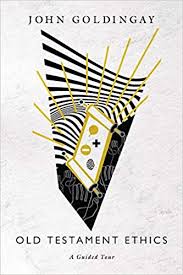
Old Testament Ethics by John Goldingay

book ot eth

Mark this down is an interesting addition on a subject that runs as wide a gamut as almost any in biblical studies: Old Testament ethics. Enter John Goldingay who has written both major exegetical commentaries and substantial works on Old Testament theology into the Old Testament ethical debates. To be honest, sometimes he’s just a little too far left for me. On the other hand, if we were to tabulate the top scholars on the Old Testament today, he would make most people’s list. I actually enjoyed this volume more than some others of his that I have reviewed.

He divides the book into five parts with the first 3 being subject oriented. He categorizes those subjects as qualities, aspects of life, and relationships. Part four looks at eight of the most important texts in the Old Testament, or at least texts where ethics would be most discussed. Part five contains seven chapters on various people in the Old Testament who had pronounced ethical dilemmas. In my view, this was an excellent framework to approach ethics in the Old Testament.

I found some of the subjects enlightening while others were provocative. If you’ve read him before, that comes as no surprise. In a few cases, he shocked me by taking a more conservative viewpoint than I anticipated. In a few other cases, I found him a little hesitant. In other words, I sensed he might be afraid he would offend someone a little left of him. That’s just my impression. Impressions are a dime a dozen so you can analyze that for yourself.

In any event, there is some good material here to help you wrestle with these highly-debated subjects. In a book of this nature, it’s not if a writer agrees with you on every point, but if he or she is able to stretch you to think about more sides of the issue than you otherwise would have. On that score, Mr. Goldingay has wonderfully succeeded.

I received this book free from the publisher. I was not required to write a positive review. The opinions I have expressed are my own. I am disclosing this in accordance with the Federal Trade Commission’s 16 CFR, Part 255.

Zondervan Illustrated Bible Backgrounds Commentary: Volume 2A, John

book 2a zond.jpg

This commentary on the Gospel of John is my first foray into the Zondervan Illustrated Bible Backgrounds Commentary. Often sold as a set, individual volumes like this one can be picked up. This commentary on John is new within the series and is written by Craig Keener. The amount of writing that this world-class scholar has done is almost beyond belief. I’ve personally used his massive two-volume commentary on the Gospel of John to advantage, but this new commentary is a completely different resource.

You will find the background and commentary in this book to the point. Unlike others of this style that I have seen, however, things most likely to need illumination are exactly what received comment. You might not agree with every comment made, but you won’t find any of the pointless fluff that is often passed off as a viable resource for students. In addition to Keener’s writing, some fine designers exquisitely integrated visuals throughout the book. Sometimes they included a helpful chart, a sidebar on a specific item, a map, a picture, or an illustration. Again, the value of the book is in its wise selections both in comment and visuals. What you end up with is a resource that is as attractive as it is helpful.

Pastors might enjoy this commentary on the fly but would need other more-detailed resources to go with it. Still, this commentary could be an incredible asset to Sunday school teachers, Bible study group leaders, or people attempting to do serious Bible study at home. It’s not common for books aimed at these users to be so well underpinned with quality scholarship. For that reason, this book is a clear winner.

I received this book free from the publisher. I was not required to write a positive review. The opinions I have expressed are my own. I am disclosing this in accordance with the Federal Trade Commission’s 16 CFR, Part 255.

Reformation Commentary on Scripture (NT VII) on Romans 1-8

book rcs rom.jpg

Before I even cracked open this book, I figured it might be the most important in the Reformation Commentary on Scripture (RCS) simply because it covers Romans 1-8. I further imagined that its editor would likely find what to leave out more difficult than what to put in with such a wealth of Reformation writings on these chapters available. When I finally perused this volume, I found that editor Gwenfair Walters Adams had done as well as job as could be done though arbitrary choices had to be made.

I enjoyed Adam’s introduction to the commentary on Romans 1-8. She fully described the challenges you would anticipate with this volume and yet gave a wonderful overview in around 25 large pages. She explained which groups wrote widely on Romans and which did not and yet was equitable to all. I felt she was exceptionally fair to the Anabaptists and accurately stated their position. Without doubt, this volume favors a Calvinistic viewpoint, but what else would you expect from a Reformation commentary?

If you are familiar with this series, you will be pleased to know that this latest release is wonderfully consistent in following the series format and making interesting selections from Reformation writings. General editor Timothy George has succeeded in having this series make a congruous presentation.

Picky readers can always argue selections made for each passage, yet it would be impossible to debate the distinct contribution this volume makes. There is nowhere else you could gain all these Reformation insights between two covers. And as we said before, these chapters were the favorite of the Reformers. There simply had to be great pressure in covering Romans 1-8 in the RCS series and that pressure has brought us a pearl.

I received this book free from the publisher. I was not required to write a positive review. The opinions I have expressed are my own. I am disclosing this in accordance with the Federal Trade Commission’s 16 CFR, Part 255.
“In Christ” in Paul edited by Thate, Vanhoozer, and Campbell

book in christ in paul.jpg

This book is a substantial resource on the important doctrinal concepts of union and participation. As the title suggests, the expression “in Christ” is key in the Pauline writings and, perhaps, an important peg to hang New Testament studies on. When I saw the names Michael J. Thate, Kevin J. Vanhoozer, and Constantine R. Campbell listed as editors, I knew this would be a book of significant theological depth. Probably more important for the parts than its whole, this is a book that can be referred to for almost any issue imaginable touching on union and participation.

Vanhoozer himself provides a lengthy introductory article that serves as a grand overview of the subject. The rest of the articles are divided into three parts: Pauline theology and exegesis, some highlights from reception history, and theological reflection. I found the articles in parts one and three more interesting, but that probably has more to do with my tastes rather than any deficiency in part two. Most of the articles are narrow in scope. In other words, they slice off a small part of the overall discussion and examine it thoroughly. I imagine this book will be used more for reference than for being the textbook on the subject. On the other hand, I wouldn’t be shocked to see this work referenced repeatedly in future scholarly articles.

The first five articles by Douglas Campbell, Constantine Campbell, grant McCaskill, Susan Eastman, and Matthew Croasmun were most helpful overall. After that, you received help on baptism in relation to the subject, and the digging into 2 Corinthians, Galatians, Ephesians, and Philippians on participation. Part two sifts history to see what some of the theological giants thought about the subject before it received its more recent extensive coverage in the scholarly world. Irenaeus, Clement of Alexandria, Augustine, Martin Luther, Calvin, John Owen, and Karl Barth all received attention over these six chapters. Part three contained three articles that showed you how much this important theological concept can require new reflection in a variety of other parts of Scripture. Here we looked at going from the Trinity to Christian virtue, participating in the body and blood of Christ, and unity.

There’s no way that any scholar doing detailed work on union and participation will not have this work near at hand for decades to come. In addition, the rest of us can glean from its pages to draw out profound theological reflections.

I received this book free from the publisher. I was not required to write a positive review. The opinions I have expressed are my own. I am disclosing this in accordance with the Federal Trade Commission’s 16 CFR, Part 255.
Maturity by Sinclair Ferguson

book maturity

Over the past few years, I’ve made it a point to read new works by Sinclair Ferguson that come along. I’ve been blessed immensely and have greatly expanded my doctrinal understanding of many points. I don’t always agree with him, but he can’t be dismissed carelessly as he thinks deeply before pen ever touches paper. As it turns out, this work on maturity or growing up and going on in the Christian life is a revised volume of the work he wrote in his earlier days. It’s not as overtly doctrinal as other works of his that I’ve read, but the doctrinal underpinnings are obvious throughout. As the title suggests, it has a devotional flavor and is really geared to propel us forward in our Christian lives.

The book is simply set up. There are five subjects of growing up, standing firm, facing difficulties, pressing on, and maturity that gets anywhere from 1 to 4 chapters each. Some sections were more valuable to me than others, but that probably has more to do with needs in my life rather than a wavering quality of writing.

His first chapter throws down the gauntlet for why maturity is so critically important to Christians. A few paragraphs in and Ferguson refuses to allow us to think that there’s some magic formula to rush the process of maturity. As he says, it takes time and patient progress. There are several hindrances, which he outlines carefully, but the Bible also presents a process that will lead to maturity – a process that we should cooperate with. Later, he’ll talk about the key of abiding in Christ and what he calls full assurance. He tackles what guidance is as well.

In the next section, just as you would expect if you’re familiar with Ferguson’s writings, he outlines the problem of sin. From there he’s going to talk about handling temptation and fighting the enemy. In one of the best sections of the book, he talks about coping with suffering. In the section called “pressing on”, he explained serving faithfully and running patiently. He concludes with one chapter on maturity itself.

The book is well written. He marshals much Scripture, disperses much doctrine, and gives practical, balanced help. There’s none of the cheesiness of so many current titles on the market today. If you want realistic help, a help that understands that sanctification is a lifelong affair as is the maturity that springs from it, then this is the book for you.

I received this book free from the publisher. I was not required to write a positive review. The opinions I have expressed are my own. I am disclosing this in accordance with the Federal Trade Commission’s 16 CFR, Part 255.
Exalted Above the Heavens (NSBT) by Peter Orr

book exalted

The New Studies in Biblical Theology (NSBT) has had several outstanding releases over the last year or so, but this new volume by Peter C. Orr on the risen and ascended Christ is one of the best I’ve seen in some time. Its main strength is its ability to step inside nebulous, often-misunderstood subjects and really illuminate them for the reader. This book really helped me sew up some tears in my own thinking. The scholars will love it because he has an ability to give succinct overviews of where scholarly interaction on the subject has gone. On the other hand, those of us who are just jumping in to gather all the theology and biblical understanding we can receive will get it in spades!

After a brief introduction that explains what this book is all about, he jumps into the identity of the exalted Christ. He sensibly surveys what’s the same and what’s not the same between the exalted Christ and the earthly Jesus. Chapters 3, 4, and 6 were worth the price of the book alone for their expert guidance. The author really expanded my thinking about the relationship of the exalted Christ and the Holy Spirit. For that matter, his explanation of the church as a corporate identity of Christ was outstanding.

He looked at the location of Christ from several angles over several chapters. That discussion helps bridge the gap between biblical passages that talk about Christ at the Father’s right hand with those that speak of Him as with us here and now. Later, he went beyond location to talk about the activity of Christ both on earth and in heaven. There was a short, clear concluding chapter of reflections as well as a full bibliography and indices.

I see some things now that were muddy to me before. This is a fine book!

I received this book free from the publisher. I was not required to write a positive review. The opinions I have expressed are my own. I am disclosing this in accordance with the Federal Trade Commission’s 16 CFR, Part 255.
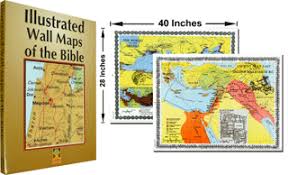
Illustrated Wall Maps of the Bible–A Great Resource!

book ill maps set.jpg

This beautiful resource is the perfect choice for Sunday School, college classes, or any sort of Bible class. The size of these wall maps (28 X 40 inches) is ideal. The maps themselves are attractive and loaded with the best information. Carta maps are my favorite and the ones chosen for this package are the most important for a teaching setting.

When you open the container that holds these maps you will first see an 18-page Bible atlas that will aid your use of the larger maps and help you prepare to teach. All 12 maps are included in this atlas along with 5 additional maps. The bonus maps in this atlas include: The Land of Canaan with an inset of the walls of Jericho, The World of the Greeks with a small insert of the empire of Alexander the Great, The Roman Empire with a small inset of the city of Rome, Jesus in Galilee (an exceedingly helpful map), and the Growth of Christianity. Don’t miss the chronological table on the back cover either. All of these will give you a leg up as you use the large wall maps in the classroom.

The first wall map, Culture and Commerce in the Ancient Near East, provides a helpful overview of the ANE and why population centers gravitated to where they did. The second map, ANE in the Second Millennium B.C., helps you see that Israel falls between the dominant areas of Egypt and the peoples near the Tigris and Euphrates Rivers. In that millennium Egypt was the more dominant. The map that covers the next millennium shows the ascendency of the Arameans and Babylonians.

A map on the Coming of the Israelites narrows the focus to Israel and includes an inset of the Exodus. The next two maps cover respectively the Kingdoms of David and Solomon and the Kingdoms of Judah and Israel after the Kingdom split. The insets include a map of Megiddo and Jerusalem in the 6th Century B.C.

Next, the maps turn to the New Testament with the first one showing Palestine in Greco-Roman Times with an inset of Jerusalem in the Hasmonean period. The next map, Jesus In His Land, shows some of the broad sweeps of Christ’s life and the inset brings Jerusalem to Christ’s time as well. A map called The Journeys of the Apostles shows from Israel to Tarsus and covers Philip and Paul’s work there. The inset shows Caesarea Maritima. The next map, the Spread of the Early Church, views Christianity from Babylon to Rome and to Egypt to the south with an inset of Paul’s Missionary Journeys. I might have swapped the map and the inset there, but both are good. The final two maps show physical maps of Israel with wonderful detail and many place names for each Testament respectively.

I’d easily label this the best set of wall maps I’ve ever encountered. This collection a winner!

I received this book free from the publisher. I was not required to write a positive review. The opinions I have expressed are my own. I am disclosing this in accordance with the Federal Trade Commission’s 16 CFR, Part 255.
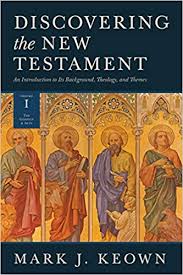
Discovering the New Testament: Volume 1–The Gospels and Acts

book nt inrto.jpg

I love this book! I’ve had the privilege to use and review many books on New Testament Introduction, but this volume has one of the best combinations of design, layout, information, and approach that I’ve encountered. Though it only covers the Gospels and Acts until volumes 2 and 3 are published, it may easily become the first grab off the shelves when questions of New Testament Introduction arise for me.

This volume is my second foray into the writings of Mark Keown. His two-volume work on Philippians in the EEC series was, in my opinion, a very successful exegetical commentary. This work is of a completely different sort. He exhibits the gifts of a teacher though out, so it’s no surprise to me to learn that he has taught this material for many years.  This book is ideal for students, but I also notated page numbers at the beginning of places I want to review later for further study. There’s much to be said for writing that can communicate clearly as found in this book.

There’s nothing missing that I would want in New Testament Introduction (through Acts) in Keown’s approach. Both the Jewish and Greco-Roman contexts were exquisitely presented. For those who care, there’s a clear overview of critical methodologies. Though it seems a fool’s errand to me, there’s a chapter on the speculative Synoptic theories. Keown excels in the five chapters that cover each of the four Gospels and Acts in turn. You will leave each chapter with a better understanding of the purpose of each book. Next, he mines the paramount theme of the Kingdom in a chapter that captures the heart of these writings. The final two chapters look at miracles and parables in a way that answers criticisms and sees through them to their purpose.

You may quibble over some point (he speaks of “Q” as fact), but overall this book can stand up to any conservative Introduction. On the teaching level, this work could easily serve this generation as Merrill Tenney did for past ones. In fact, it’s far better than that oft-used textbook for my money. You will do yourself a favor to look this one up.

I received this book free from the publisher. I was not required to write a positive review. The opinions I have expressed are my own. I am disclosing this in accordance with the Federal Trade Commission’s 16 CFR, Part 255.
Job (NIVAC) by Walton

book job nivac.jpg

When I think of John Walton, I tend to think of Genesis as it seems those titles have received more press. He is a widely-published, influential author, and I felt it would be interesting to check out this work on Job in the NIV Application Commentary (NIVAC) series. What I found upon opening this work was exceptional writing, clear statement of scholarly options, and no fear to reach his own conclusions. On the other hand, I found as I often have before with him, that he reaches many conclusions that I couldn’t agree with. I’m not suggesting that agreement with me is a benchmark you need to consider in evaluating a book, but I wonder if many pastors will find his conclusions too far afield even if he is technically a “conservative” scholar.

In the Introduction, he states that Job is not on trial in the book. I’ve never thought that was the purpose of Job. Perhaps Walton is too hard on Job and God. Job won’t stand as a role model in his mind even if many of us have drawn great inspiration from him. He lets his conclusions on genre determine his thoughts of the trustworthiness of Job’s history and finds it lacking. He doesn’t see Satan as the Devil. Several of these conclusions will make it impossible to traverse the territory we normally do in Job.

The book gives much better help in individual passages. Perhaps he will serve as a foil to help you not carelessly reach old conclusions, or at least force you to think them out more carefully. The personal insights of “Kelly’s Story”, a student of his whose disability entails much suffering, do remind us how challenging the story of Job is. Walton has written extensively on OT theology and that shows up in some helpful ways as well.

This volume isn’t my favorite NIVAC one, but the set including this one is worth obtaining.

I received this book free from the publisher. I was not required to write a positive review. The opinions I have expressed are my own. I am disclosing this in accordance with the Federal Trade Commission’s 16 CFR, Part 255.

Sermons on 2 Timothy by Calvin

book 2 tim

The trifecta is complete! With this edition of sermons on 2 Timothy, Banner of Truth carries the day by now having in print all of Calvin’s sermons on the Pastoral Epistles. Their coup stands more pronounced by the masterful translation Robert White accomplished in these volumes. There has been a volume of select sermons in an older translation, but all these sermons on the Pastorals in a quality English translation were unobtainable until now. The triumph concludes with these volumes being printed in lovely, quality editions that will last for generations.

The quality and set up mirror the previous two releases. Mr. White provides sermons titles and, mercifully, uses modern punctuation. (A comparison of other Calvin sermons translated by others proves how vital translation is to older sermons).  There’s a brief introduction that places these sermons in Calvin’s career. Calvin’s own difficulty in ministry, as Mr. White well explains, makes these sermons passionate. He provides a few more paragraphs to explain how Calvin approaches this epistle. As before, the book ends with “prayers before and after the sermon” giving more insight into Calvin’s practice in preaching.

Also as before, you need not think this volume is only for someone who subscribes to the theological system that bears Calvin’s name. Calvin is a master preacher who handles the text in a way that instructs on how to preach as well as it informs on the passage the sermon addresses. In that sense, it’s a double success that demands a place on every pastor’s shelves. Whether you agree with every line or not, these sermons are pure gold!

I received this book free from the publisher. I was not required to write a positive review. The opinions I have expressed are my own. I am disclosing this in accordance with the Federal Trade Commission’s 16 CFR, Part 255.