Hearers & Doers by Kevin Vanhoozer

book hear do.png

Kevin Vanhoozer is one of our sharpest theological minds today. He so often breaks into territory that no one else tackles. He may wrestle with a multitude of heavy theological works, but he is the guy to bring it to the rest of us. Since his latest subject here is that of making disciples, particularly from a pastor’s point of view, and since there’s a glut in the market on discipleship, he shows the league apart that he works in amongst a world of works that all say the same thing. Make room among all the dime-a-dozen discipleship titles on your shelves for this provocative volume to have a prominent place. This book is one for a pastor to lay as a foundation for our work. The subtitle accurately lets you know what you are getting yourself into: A pastor’s guide to making disciples through Scripture and doctrine.

After a clear introduction, Part One that is made up of four chapters explains why discipleship matters. He champions the importance of theology in making disciples. Chapter 2 is so profound that it could be pulled out of this book and presented as commentary on our age, at least involving fitness and body image which has taken on its own religious pretensions. I shared that chapter with some in my family as making clear things that I was ashamed I had never thought of. The next chapters explain the importance of taking disciples from hearing to doing and in building up the body of Christ.

Part Two in four more chapters digs into working out discipleship. Pastors should be challenged by his analogy of our being the eye doctor and general practitioner of the church. Next, he looks at the disciple as a member of the church, which is sadly so de-emphasized in our day. I found myself not fully agreeing with all he said in the chapter on the communion of saints, but there are some fair correctives there that may keep us from running off into the other ditch. The final chapter, wisely, looks at us as children of God who are disciples as “fitting image of Jesus Christ”.

You can often judge how much I find value in a book by how much I underline and notate throughout. My volume of this book is marked all over with usually something on every page. This book is for those who want to think, so pick it up and read slowly and you will be in for a treat.

I received this book free from the publisher. I was not required to write a positive review. The opinions I have expressed are my own. I am disclosing this in accordance with the Federal Trade Commission’s 16 CFR, Part 255.
Romans 9-16 (RCS), edited by Philip and Peter Krey

book rcs rom 9.jpg

Romans 9 is one of the key chapters of Reformation thinking, so this volume covering chapters 9-16 is pivotal in the Reformation Commentary on Scripture (RCS) series. Since this volume has been released, an additional volume covering Romans 1-8 has also come out giving us an extraordinary resource in Reformation views on this key book of the New Testament. In this volume (9-16), two Lutheran professors, who happen to be brothers, Philip D. W. Krey and Peter D. S. Krey, culled all of Reformation commentaries to create this fine resource. These two were even raised by a Lutheran pastor, so they have lived in Reformation thinking their entire lives. They certainly have the credentials to assemble this volume of the best that Reformation commentators have to offer. To my mind, they have succeeded.

Their introduction to Romans 9-16 shows their understanding of the issues that were at the heart of Reformation thinking. In our day, many of us would label those views as Calvinist views, though they give the most kudos to Augustine and Luther. They do, however, quote Calvin in several places throughout the commentary itself. It’s clear these editors agree with those they quote in many cases. In that introduction, they will speak of predestination, double predestination, single predestination and offer an excursus on Erasmus and the freedom of the will as well as opposing views that they label as conditional predestination. Still, they get into other key issues that they label the call of the nations, the ministry of the word, and Christian ethics. All in all, it was well done.

The commentary itself is of the quality that I have so far found in every volume in this series that I have reviewed. There is likely an overabundance of primary material to sift through with corresponding choices to be made for what best represents Reformation thinking to share in this volume, but they appear to me to have done an excellent job. I feel one could easily get a full grasp of what the reformers thought about most passages in Romans 9-16 in this compilation. If you grab the one that’s now released on Romans 1-8, you will have a resource well worth having and consulting for this mountain peak of Scripture called Romans.

I received this book free from the publisher. I was not required to write a positive review. The opinions I have expressed are my own. I am disclosing this in accordance with the Federal Trade Commission’s 16 CFR, Part 255.
Leviticus, Numbers (NIVAC) by Roy Gane

book lev num nivac.jpg

This volume on Leviticus and Numbers by Roy Gane is easily one of the best in the NIVAC series. While the value of Leviticus in this book might surpass that of Numbers in my estimation, you will receive real help on both. The writing is so engaging, the passion so evident, and rather than apologize for the Bible Mr. Gane wisely counsels us to put our own modern culture on trial. On more than one occasion, he finds that we ultimately struggle with the same problems they once did. If the goal of the NIVAC series is to provide a scholarly explanation of the text and then take it on to modern application, then this volume has succeeded in spades. I can’t recall what is admonished in Leviticus ever having been more profitably related to our day than what you will find here.

I was thoroughly impressed with all that was nicely explained in the 13 pages of the introduction to Leviticus. The big picture, the relationship to the New Testament, and a careful case made for Leviticus being something more than legalism was made clear. There’s a brief pass at authorship (God, then mostly Moses) before an exceptional section on structure and themes. I’ve read many thick exegetical commentaries that were far less helpful on structure than what you find here. I felt the introduction to Numbers was not as well-done as that of Leviticus, but what you read there is all helpful.

The best value of all will be found in his explanation of the details of Leviticus. Without doubt, many struggle here. Again, it appears that the normal design of a NIVAC commentary (original meaning, bridging context, and contemporary significance) fit Mr. Gane like a glove. Some commentaries in this series will often either shortchange bridging context or contemporary significance, but I was pleasantly surprised to find something truly helpful in every one of those sections. The volume was more conservative than I expected while the engaging style exceeded any expectations I would’ve had for a volume on Leviticus! If you would like to see if I am reviewing accurately, find some obscure subject in Leviticus and go read what Mr. Gane has to say about it. If you will do that, you will agree with me.

I received this book free from the publisher. I was not required to write a positive review. The opinions I have expressed are my own. I am disclosing this in accordance with the Federal Trade Commission’s 16 CFR, Part 255.
Ephesians (TNTC) by Bock

book eph tntc

This latest release in the Tyndale New Testament Commentary (TNTC) series has snagged yet another top-flight scholar. Darrell Bock tackles Ephesians here after his major works on Luke, Acts, and the historical Jesus. In case you weren’t aware, his two-volume commentary on Luke in the BECNT series is often rated as the best exegetical work we have on that book. Though he branches away from his normal work in this effort to grapple with a Pauline epistle, his credentials are clearly up to the mark. TNTC targets an audience below those major exegetical works though its scholarship is always top-notch. It seems to me that Mr. Bock understood the aims of the TNTC series and brought us an excellent work within those parameters.

After a select bibliography of a few pages, Bock jumps into his introduction. He begins with explaining the importance of Ephesians which many find to be a mountain peak within Pauline writings. He goes on to explain destinations of the letter with plenty of background on the city of Ephesus before he gets into several issues involving authorship. When he enters a more formal discussion of authorship and date, he explains vocabulary and style and theological issues within Ephesians. He doesn’t find enough evidence to deny Paul authorship.

After a brief outline, Bock enters the commentary section that makes up the bulk of the book. For each passage, he gives context, before entering into commentary itself for each verse. There’s also a paragraph or so on the theology of the passage. In my estimation, he makes the reader fully aware of the issues and what the passage is trying to say to us. For example, I thought he handled the Household Code with skill and grace. He stayed true to the text concluding a conservative position yet wrote in a way that would not be overly antagonistic to someone of a different persuasion. The quality of commentary remained throughout.

Pastors, teachers, and Bible students will appreciate the fine help this commentary provides. I recommend it.

I received this book free from the publisher. I was not required to write a positive review. The opinions I have expressed are my own. I am disclosing this in accordance with the Federal Trade Commission’s 16 CFR, Part 255.
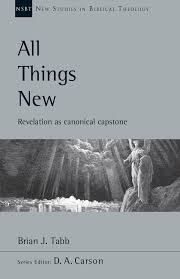
All Things New (NSBT) by Brian J. Tabb

book all th new.jpg

If you are like me, you know what to expect when you pick up the latest entry in the New Studies in Biblical Theology (NSBT): perceptive theology, careful scholarship, in-depth coverage that even exceeds many commentary introductions, and a work that goes beyond anything you already have on your shelves. That consistency is as steady as the unchanging gray covers that adorn every volume. On the one hand, some credit must go to D. A. Carson for his editorial work. On the other hand, somebody must have done their homework in choosing authors as well.

This latest release by Brian J. A Tabb looks at the book of Revelation “as canonical capstone”. As heady as that sounds, the author knew how to make a strong case for his thesis. As I read, I thought this author is great at digging. He brought out so many things that are easily missed and made so many connections between Scriptures that we rarely see. Mr. Tabb takes an “eclectic” approach to Revelation. In fact, he much reminds me of Gregory Beale. (He cited 19 of Beale’s works in his bibliography!) Still, it’s clear he did his own work and made his own conclusions. Further, as one who is a futurist rather than following his eclectic approach, I felt he was gracious throughout. Even better, the type of information he mined for us can be taken and shone back into Revelation no matter which approach to prophecy you take.

His introduction was outstanding and contained all kinds of wonderful information. I did much underlining there. From there he divides his book into four parts: the triune God, worship and witness, judgment, salvation and restoration, and the word of God. Part one contained, you guessed it, three chapters on the Sovereign on the throne, Jesus as the Lion and the Lamb, and the Spirit of prophecy. These were some of my favorite chapters in the book with particular success in the chapter on the Holy Spirit. Part two looked at followers of the Lamb and discussed things like a priestly kingdom and a new Israel while another chapter talked about the battle for universal worship. I felt that viewpoint was well worth digging into. Part three considered the wrath of the Lamb and made several insights on things like the seven seals, the seven trumpets, and the seven bowls of wrath, as well as a new Exodus. There was a chapter on Babylon the harlot and Jerusalem the bride as well as another on all things new. Part four only had one chapter on the Word of God but it was well done and followed by a conclusion for the book. There’s a lengthy bibliography for those wanting further study.

This book even contains some charts that summarize important information for the reader and that I was blessed by. This book is fully up to the high standards set by the NSBT series and I recommend it.

I received this book free from the publisher. I was not required to write a positive review. The opinions I have expressed are my own. I am disclosing this in accordance with the Federal Trade Commission’s 16 CFR, Part 255.
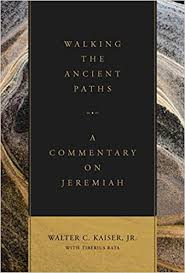
Walking the Ancient Paths: A Commentary on Jeremiah by Kaiser and Rata

book walk ancient.jpg

I’ve been using the works of Walter Kaiser for several years, so when I saw that he was coming out with a new work on Jeremiah I was instantly intrigued. Now that I’ve had a chance to get into this commentary, I can confess that it did live up to my high expectations. As something of a commentary junkie, I’ve had the privilege to review all types of commentaries all the way up to the massive tomes that cover every conceivable issue. As much as I enjoy using all of them, if I were forced to choose, this type of commentary prepared by Kaiser and his colleague Tiberius Rata is the most ideal for pastors. It has more depth than the TOTC series and is pretty close to the NAC in its scope. If you can imagine that style of commentary, then you will know how to gauge this work that is a model volume of its class. Further, in these days of prolific commentary production, I would argue that Jeremiah would be one of the books most in need of a new commentary of this type.

The introduction is not massive, but it gets to the heart of what most Bible students and pastors are looking for. There is background on Jeremiah and his times. There’s a brief mention of compositional issues because the scholarly world is so enamored with them. You will find conservative conclusions here. There is a discussion of Jeremiah’s relation to Deuteronomy as well as the text of Jeremiah. The section on theological emphases could probably have been expanded but was accurate as far as it went. The authors give us an extensive outline of Jeremiah along with a brief bibliography at the end of the introduction. (There’s a lengthy bibliography at the end of the book).

As for me, I enjoyed the commentary itself even more than the introduction. What you received in every passage was clear guidance on understanding the text. If scholarly side issues were mentioned, they never dominated the discussion. I don’t see how this book could not help someone wrestling with the challenging book of Jeremiah. Let’s label this book a necessity!

I received this book free from the publisher. I was not required to write a positive review. The opinions I have expressed are my own. I am disclosing this in accordance with the Federal Trade Commission’s 16 CFR, Part 255.
The Old Testament in 7 Sentences by Christopher Wright

book ot 7 sen

When Christopher J.H. Wright produces a book, it will be worth checking out. Every book of his that I’ve read, whether it be a commentary or theological work, is simply above average. I think the reason he so often succeeds is that his scholarship on any issue involving the Old Testament can stand up against any other scholar’s work, yet his works possess a spirituality that few of them can match. Every time I read one of his works, I’m reminded of how much he possesses the flavor of his mentor, John Stott. Not that he just repackages Stott’s work, but he has that special gift to blend scholarship and spirituality that is too often lacking these days.

This work is a little different. Not in quality, but in what he usually writes. IVP has started publishing these books (I enjoyed the one on philosophy) and I assume a series may follow. As you can imagine, these books are more of a survey. In this case, we are getting our overview from seven key texts of the Old Testament. Both the number seven and the choice of texts are arbitrary, or at least debatable, but Mr. Wright has chosen as well as anyone could. What he did accomplish, though, is using these texts to cover more ground. For example, when he chose, “the Lord is my shepherd”, he covered what all the Psalms and wisdom writings are attempting to accomplish in the Old Testament. In other words, he pulled off this difficult writing assignment.

His choices were creation with Genesis 1:1, Abraham with Genesis 12:3, Exodus with Exodus 20:2, David with I Samuel 13:14, the prophets with Micah 6:8, gospel with Isaiah 52:7, and Psalms and wisdom with Psalm 23:1. As I said above, he covers much more ground than those texts suggest. To my mind, he chose these texts to unlock the larger narrative of each section of Scripture.

This book would be ideal for a Bible student’s first pass at surveying the Old Testament. Pastors might not need this book as much as others he has written but would probably be happy to put it in the hands of their people. Still, even the most seasoned Christian will find nuggets along the way in this winning volume.

I received this book free from the publisher. I was not required to write a positive review. The opinions I have expressed are my own. I am disclosing this in accordance with the Federal Trade Commission’s 16 CFR, Part 255.
The Message of Discipleship (BST) by Peter Morden

book mess disc.jpg

This latest release in the Bible Speaks Today (BST) series explains the topic of discipleship by careful exposition of key texts. If you are familiar with this series, you know that that is how these volumes on Bible themes work. Peter Morden appears quite comfortable in this format. Personally, I wondered what would be the best texts to consider, and I found that I pretty much agreed with what Mr. Morton has chosen. Partially because of the subject matter, I found this volume to be one of the most devotional that I have read in the series. Mr. Morton comes across as equally adept at handling the devotional aspect. The only tiny criticism that I could find in the volume is that he, perhaps, quoted others a bit much. To be fair, I didn’t actually verify that with the other volumes, but that was my impression as I read. At least, he chose wonderful works to quote, and some you don’t normally see quoted in one of these types of works too.

The 17 chapters, or expositions, are divided into three parts: the foundations of discipleship with four chapters, the resources for discipleship with four chapters, and the practice of discipleship with nine chapters. The chapters on the foundations of discipleship look closely at the ministry of Christ and the call he put on us. The chapter on Isaiah 6 was an excellent addition here as well. In part two there were fine chapters on prayer and the church regarding discipleship, but my personal favorite was a gem of a chapter on discipleship and the Holy Spirit. Part three dug deep into our personal walk with Christ and included the resurrection, holiness, a needy world, daily work, finance, living in dark times, the key of love, making disciples in our world, and a concluding exposition on finishing the course.

Though this book has quality scholarship, I would deem it to be helpful to any Christian reader. The writing is accessible and the message is warm. Mr. Morton is a pastor in addition to being a scholar and it shows throughout.

I received this book free from the publisher. I was not required to write a positive review. The opinions I have expressed are my own. I am disclosing this in accordance with the Federal Trade Commission’s 16 CFR, Part 255.
Paul and Union with Christ by Constantine Campbell

book paul union christ.jpg

Wow! I knew this book was highly regarded on the influential subject of union with Christ. I’ve seen Constantine Campbell’s name show up all over this issue as well. What surprised me, though, is this book’s laudable design. I cannot think of a more ideal way to examine Paul’s relationship to the theological subject of union with Christ than to simply exegete every passage in the epistles of Paul that touch on the subject. Along the way, Campbell tackles “in Christ”, “through Christ”, “into Christ”, as well as every other conceivable expression on the subject. In addition to exegeting each passage, he outlines the possible uses of the word and categorizes each passage as to its likely usage.

Before all those passages are exegeted, there are two chapters that cover introductory matters and a history of the issue seen through the eyes of the major theological players that have most contributed to how the debate has gone. There’s a lot to evaluate there as Campbell does a fine job explaining the strengths and weaknesses of each theologian. After chapters 3 through 7 exegete all those passages, there are several chapters of theological study. More terms are defined and exegeted as well as major concepts of participation like the body of Christ, Temple and building, marriage, dying and rising with Christ, and the new Adam being explained. There’s one chapter that well explains Trinitarian issues and another that tackles the often-debated relationship of union with Christ and justification. The twelveth chapter defines union with Christ with all the information we gained throughout the book and there’s one final chapter on implications and future directions that will really appeal to scholars. Fortunately, there’s a scriptural index that will make this volume as wonderful a reference as it is a theological read.

To my mind, this volume is without peer for the needs of Bible students and pastors on union with Christ. Without a doubt, it will be my go-to volume.

I received this book free from the publisher. I was not required to write a positive review. The opinions I have expressed are my own. I am disclosing this in accordance with the Federal Trade Commission’s 16 CFR, Part 255.

Old Testament Ethics by John Goldingay

book ot eth

Mark this down is an interesting addition on a subject that runs as wide a gamut as almost any in biblical studies: Old Testament ethics. Enter John Goldingay who has written both major exegetical commentaries and substantial works on Old Testament theology into the Old Testament ethical debates. To be honest, sometimes he’s just a little too far left for me. On the other hand, if we were to tabulate the top scholars on the Old Testament today, he would make most people’s list. I actually enjoyed this volume more than some others of his that I have reviewed.

He divides the book into five parts with the first 3 being subject oriented. He categorizes those subjects as qualities, aspects of life, and relationships. Part four looks at eight of the most important texts in the Old Testament, or at least texts where ethics would be most discussed. Part five contains seven chapters on various people in the Old Testament who had pronounced ethical dilemmas. In my view, this was an excellent framework to approach ethics in the Old Testament.

I found some of the subjects enlightening while others were provocative. If you’ve read him before, that comes as no surprise. In a few cases, he shocked me by taking a more conservative viewpoint than I anticipated. In a few other cases, I found him a little hesitant. In other words, I sensed he might be afraid he would offend someone a little left of him. That’s just my impression. Impressions are a dime a dozen so you can analyze that for yourself.

In any event, there is some good material here to help you wrestle with these highly-debated subjects. In a book of this nature, it’s not if a writer agrees with you on every point, but if he or she is able to stretch you to think about more sides of the issue than you otherwise would have. On that score, Mr. Goldingay has wonderfully succeeded.

I received this book free from the publisher. I was not required to write a positive review. The opinions I have expressed are my own. I am disclosing this in accordance with the Federal Trade Commission’s 16 CFR, Part 255.