New Book Reviews
Healing Your Church Hurt –Book Review
Guest Blogger-Kyle Shearin-“The Life of St. Paul” by James Stalker
Forgiveness by Harold Vaughan and T.P. Johnston
Book Review–The Resignation of Eve
The Resignation of Eve by Jim Henderson is presented as tackling the “sad resignation…developing among dedicated Christian women who feel overworked and undervalued in the church.” I thought it might be the perfect counterpart to another book I recently read: Why Men Hate Going To Church. I felt the victim of bait and switch as I read this book.The real goal of this book is to promote women in the ministry. I must confess up front that women in the ministry is not a position that I find scripturally sound. He contends that many women are leaving church over this issue. Of course some women have left church if they could not have a key leadership/pastoral role in the church, but are we to believe that this is even in the top 5 reasons for women leaving church? What, then, is the reason men are leaving the church? Because leadership is open to them? He paints a dark picture of many more women leaving if they are not allowed to take any role they like.He makes his case with case studies of individual stories of women he interviewed. Each chapter is well written and you leave the chapter feeling you really know something about the woman be describes. Still, to prove a point, he uses only anecdotal evidence. Despite trying to say he used a good variety of women to present his case, the majority of Christian ladies I know could not be described by any example he used.
The few conservative women he wrote about were not the best examples he could have used (I mean these ladies no disrespect). Even with them I felt thay were presented as naive, just not sophisticated enough to see the obvious truth that everything the Bible says about women not being pastors was culturally charged and without present bearing. Many thoughtful Bible students would disagree and to just state it as fact is weak.
As the book went along, you got the feeling that he was promoting the idea that we must structure church to give people what they want to get them to stay. There was never a discussion of what the Bible actually said about how church should be done.
He did mention a few inconsistencies among some churches that refuse women the office of a pastor. But that alone couldn’t carry his premise.
The book should be advertised to the target audience of denominations that say they believe women are allowed to pastor but the numbers are out of kilter. Then the book could use arguments, as it did, that are used in the workplace. All in all, I cannot recommend this book.
I received this book free from the publisher. I was not required to write a positive review. The opinions I have expressed are my own.
Feed My Sheep
Albert Mohler first discusses the primacy of preaching citing history and Scripture (e.g. Col 1: 25-29) to build his case. He shows us that preaching is not one of a pastor’s important duties, but , in fact, it is the key one. We do live in an age where pastors are expected to do everything and some pastors prefer almost any administrative duty to the hard work of sermon preparation. Perhaps over time we become rather slick, but too superficial to do our people any good. I loved his analysis about “product envy” for preachers. Other professions can look at how many items sold or made but results in the task of preaching are not so easy to calculate. The lack of quantifiable results may derail us from expounding the Word of God which carries the help those we minister to really needs.James Boice tackles the “foolishness of preaching”. He argues that preaching is God’s wise way to show that the world’s wisdom is foolishness. He also speaks of how many Bible characters preached, and how preaching leads to conversions and church growth. Ultimately, this works because the Lord works through His Word.Derek Thomas writes on “Expository Preaching.” Really this is the type of preaching referred to in the whole book. Using the history of several great preachers, defining the terms of preaching carefully, he writes as an academician. His description of failed preaching types is really good.
Joel Beeke writes on experimental preaching, or getting beyond explanation to application as all good preaching should. R.C. Sproul discusses teaching in preaching. Since we live in a generation that prefers light preaching this is a challenge to help our people learn the Word of God. R.C. Sproul Jr. has a brilliant chapter on “Preaching To The Mind”‘.
Sinclear Ferguson writes with good effect on “Preaching To The Heart.” His chapter is practical. Don Kistler gives us “Preaching With Authority”. He discusses how Jesus spoke with authority, an authority so obvious all noticed. He relates how Paul wrote about it, for example, Titus 2:15. He reminds us of what an awesome call we have in our call to preach. Eric Alexander writes on “Evangelistic Preaching”. Some might find it lacking.
John Piper speaks on “Preaching To Suffering People.” Perhaps this is an example of how productive a use this call to dedicated preaching can provide. John MacArthur writes the closing chapter as a plea to take the contents of this book and go and do what a shepherd should do.
The book is an encouragement. It runs against the tide of modern-day preaching and is what we need. You may have noticed that every writer tightly holds to reformed theology, and though I definitely do not, we must graciously admit that reformed writers are simply giving us the best writings on preaching today. This book is a clear example of that fact. I want to be the preacher the Lord wants me to be. Don’t you?
I received this book free from the publisher. I was not required to write a positive review. The opinions I have expressed are my own.
Tyndale by David Teems
You always assumed, I’m sure, that William Tyndale was an important man in Christian history. This book shows just how amazingly important he was. You knew about his first English translation of the New Testament, perhaps you even knew he died as a martyr. Did you know, though, that he had a great effect on our English language? He is credited with many words in our language coming from his pen. If you are a lover of the KJV as I am, you will be shocked as I was to learn that many of the most memorable lines of the KJV came over unchanged from Tyndale. Consider:
Let not your hearts be troubled..
The Lord bless thee and keep thee.
The Lord make his face to shine upon thee and be merciful unto thee.
…for whither thou goest, I will go, and where thou dwellest, there I will dwell.
There are many others that Mr. Teems shares with us. You leave this book convinced that Tyndale has had the greatest influence of all on the Word of God in English. There really is no close second.
You are impressed too as you read of Tyndale’s simple faith and dogged determination to translate the Bible into English. It was his driving passion from which he never wavered. Mr. Teems quotes Tyndale in regards to his translation work:
…that I never altered one syllable of God’s word against my conscience, nor would do this day, if all that is in the earth, whether it be honour, pleasure, or riches, might be given me.
Though Mr. Teems didn’t exactly word it this way, it is obvious that Tyndale was especially gifted by God for his great work. It was his life’s work, one that cost him greatly, living and running as a fugitive with loneliness and danger always staring him in the face.
Mr. Teems has done us great service in this volume. He is handy with a pen. His own literary skill makes him able to demonstrate how deep Tyndale’s talents really go. He holds Tyndale up beside the great literary figures and even mentions where Shakespeare used Tyndale. I finished this book thinking that more than a heroic man, Tyndale was one of the really great ones. Perhaps he hasn’t had his due, but Mr. Teems while fairly showing his faults, accurately presents us with “Tyndale: The Man Who Gave God an English Voice.”
I received this book free from the publisher. I was not required to write a positive review. The opinions I have expressed are my own. I am disclosing this in accordance with the Federal Trade Commission’s 16 CFR, Part 255.
Why Men Hate Going To Church by David Murrow
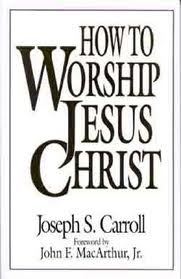
Why Men Hate Going To Church—the title says it all. It’s the question we have all had, on a subject we have all noticed, without ever asking. Perhaps you imagined that there was no answer. It is just one of the mysteries of life. Read this book by David Murrow and you will have answers that will make you wonder that you never noticed them before. He gives answers that stem from the fundamental differences of men and women. We see some of these ideas in marriage books to our advantage. I will confess to being skeptical as I began, but this book is compelling. As a pastor I found his marketing/media perspective unique and thought provoking.How To Worship Jesus Christ by Joseph Carroll
Recently Ryan Brown, Jamin Boyer, and I had the privilege to visit Dr. Tim Jayne’s new office. It’s beautiful, roomy, and as ideal as any preacher could imagine. We talked, had a great visit, and as Dr. Jayne is known to do, he gave us each a book. In addition to teaching college students the Bible, he is well known as one who encourages preachers to read fine books. I appreciate that emphasis in his ministry. There is an obvious passion in him that I share on that subject.While there he recommended a book that he wishes every pastor would read–“How To Worship Jesus Christ”. He has given scores of this book away over the years. Strangely, I already had the book and it was laying in a pile of books that I intended to read soon. Somehow, it was never the book I selected. I think I got it in a box of books I picked up at a library sale.Since he told us that many pastors he has introduced the book to read it every year, I read it right away. The book fully lived up to its reputation. He was a missionary for many years and the contents of this book were worked out in those days of service. His influences command respect. He called Hudson Taylor “the father of modern faith missions” (emphasis mine). A. W. Tozer, who never fails to challenge me, was clearly his greatest influence.
He effectively made the case for what our private time is all about. He says, “My quiet time then became something for Him, not something for me.” The great need, he says, is to worship Christ until He becomes real to you. That grows into it being about Him, not even the people to whom you minister. Perhaps preachers talking of that concept today learned it here. In any case, I have never heard it better said.
He quotes Phil 3:8 “…that I may win Christ” and spoke of intimate fellowship with Christ being the key. He explains that people who must always be pushed to do things like witnessing or supporting missions have a serious problem. Then he continues: “What was Paul always doing? He is consistently bringing you to Christ and leaving you with Christ.” To my mind, that is profound. Nuggets that really challenge you continue to the end of the book.
The book is still in print by Moody (My copy is older). Amazon.com and others have inexpensive used copies while a new copy can be gotten from CBD for $8.19 (Christianbook.com)
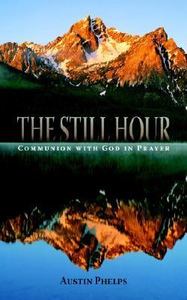
The Still Hour by Austin Phelps
“The Still Hour” is a book, though, I wonder how I missed all these years. Read it at your own risk. I was greatly convicted and concluded I didn’t pray at all.
Listen to these chapter titles to get an idea of what you will encounter in this volume:
Absence of God in Prayer
Unhallowed Prayer
Romance in Prayer
Idolatry in Prayer
and many more. It’s only 136 pages, but a phenomenal read.